
Overview of the Concept of Youth Worker Support Subsidies and Current Status of Support Projects by Local Government
To help young people who are early in their careers and those working in small and medium-sized enterprises achieve economic independence and encourage long-term employment, the central government and various local governments operate various youth worker support subsidy programs. Major local governments such as Seoul, Gyeonggi, Incheon, Busan, and Daegu have multi-dimensionally designed effective benefits such as regional housing costs, living stability funds, and asset-building support to prevent the outflow of the youth population and help them settle down.
Let’s systematically examine the basic concept of youth worker support subsidies and the current status and differences of support projects by major local government.
- Definition and Main Purpose of Youth Worker Support Subsidies
Concept: It is a public support system that aims to alleviate income gaps and promote living stability by supporting youth who continue working life after employment with cash-like allowances, welfare points, housing costs, and asset-building savings matching.
Core purpose: It resolves the recruitment and job-seeking difficulties caused by wage and welfare gaps between large corporations and small and medium-sized enterprises, and establishes a foundation where young workers can stably settle in local communities and continue economic activities.
- Current Status of Youth Worker Support Projects by Major Local Government
Many local governments in South Korea are deploying independent support projects tailored to the characteristics and financial conditions of young people residing in their regions.
Seoul Metropolitan Government: It focuses on the living stability of working and job-seeking youth centered around youth allowances and housing support, and in particular, monthly rent support projects to ease the burden of housing costs are active.
Gyeonggi Province: Through the ‘Youth Worker Support Fund’ series (such as working youth support), it provides quarterly welfare points or asset-building matching support funds to young people working in small and medium-sized enterprises, resulting in very high satisfaction.
Metropolitan cities such as Incheon, Busan, and Daegu: They competitively introduce specialized projects by local government, such as transportation cost support, work encouragement allowances, and settlement support funds, to induce long-term employment of young people working in local small and medium-sized enterprises.
- Key Differences and Verification Points of Support Projects by Local Government
Diversity of support methods: Depending on the local government, support methods vary, such as direct cash payments (account deposits), Onnuri gift certificates, local currency, welfare mall points, or asset-building forms (linking with Youth Dohap Accounts, etc.).
Income and work criteria: Standard median income ratios (e.g., 120% or less, 150% or less, etc.), the size of the employing company (small and medium-sized enterprises, medium-sized enterprises, small business workplaces, etc.), and four major public insurances subscription status and working hours criteria vary by local government.
Strictness of residence requirements: Most support projects prioritize the requirement of having a resident registration address in the corresponding local government and actually residing there as of the application date, so you must carefully cross-check the transfer report date and residence period conditions.
Seoul Metropolitan Government Youth Allowance and Worker Support Benefits and Residence Requirements
Seoul Metropolitan Government, the Seoul Welfare Foundation, and others are carrying out various welfare projects to promote job-seeking activities, support social entry, and stabilize the livelihoods of working youth residing in the region. In particular, Seoul has pioneered youth support policies differentiated from other local governments, and to receive subsidy funds, strict residence requirements and income criteria must be met simultaneously.
We have detailed Seoul’s representative youth support benefits and specific residence qualification requirements.
- Main Content and Benefits of Seoul Youth Allowance (Job-Seeking and Livelihood Support)
Target and purpose of support: This is a cash-like support project aimed at promoting job-seeking activities and livelihood stability for youth who are unemployed or working short-term.
Support content: A certain amount per month (e.g., around 500,000 KRW per month) is paid for several months as cash-like points linked to a check card (clean card), helping them freely use it for purposes necessary for job-seeking and living, such as food expenses, transportation expenses, education expenses, and book purchase costs.
Connection with self-reliance support programs: Going beyond simple cash payments, it induces practical entry into society by jointly supporting career counseling, employment capacity-building programs, and community activities for youth.
- Seoul Youth Worker and Housing Support Benefits
Housing cost and monthly rent support: It eases the soaring burden of housing costs by supporting monthly rent subsidies (e.g., youth monthly rent support) targeting homeless youth workers and single-person households residing in Seoul.
Welfare points for youth working in small and medium-sized enterprises: Targeting young workers who work in small and medium-sized enterprises located in Seoul and fall below the standard median income, it provides annual welfare points that can be used in welfare malls, reducing the welfare gap between large corporations and small and medium-sized enterprises and inducing long-term employment.
- Strict ‘Seoul Residence Requirements’ and Selection Criteria
To receive the benefits of Seoul’s youth support projects, above all, the address criteria must be accurately met.
Resident registration address requirement: As of the application date, the residence must be registered as Seoul Metropolitan Government on the resident registration, and it must match the actual residency facts.
Residence period requirement: Depending on the project type (youth allowance, housing support, etc.), not only simple transfer status but also ‘the period of residing with resident registration in Seoul’ or ‘minimum residence period’ are often required, so you must definitely check the announcement.
Income and work criteria: Since the standard median income (e.g., 150% or less, etc.) condition and employment status (employment insurance subscription history, working hours, etc.) are combined and evaluated, you must carefully cross-check the income judgment criteria based on the health insurance premium payment amount.

Key Characteristics and Comparison of Support Amounts for Gyeonggi Province Youth Worker Subsidies (Working Youth Support)
Gyeonggi Province actively operates the ‘Gyeonggi Province Youth Worker Support Subsidy (such as Working Youth Support)’ system, which is a representative asset-building and welfare support project, to induce long-term employment and improve the treatment of youth workers experiencing economic difficulties while working in small and medium-sized enterprises within the province.
We compare the core characteristics of Gyeonggi Province’s support projects, which differentiate them from other local governments, as well as specific support amounts and details.
- Core Characteristics of Gyeonggi Province Youth Worker Support Projects
Improvement of treatment centered on small and medium-sized enterprise workers: By concentrating practical benefits on youth workers working in small and medium-sized enterprises, small business workplaces, and social welfare facilities, which have relatively vulnerable welfare and wage levels compared to large corporations, it lowers the turnover rate and induces long-term employment.
Divergence of cash-like support and welfare points: Gyeonggi Province’s youth worker support projects are composed of various tracks (such as welfare points and Meister bankbooks) with very high satisfaction levels experienced by youth, such as paying monthly cash-like points, local currency, or matching support funds upon saving for a certain period.
Strict income and working hour criteria: Unlike support targeting unemployed job seekers, applicants must simultaneously satisfy the conditions of being currently employed in a small or medium-sized enterprise within Gyeonggi Province, standard median income (e.g., standard median income of 100% or 120% or less, etc.), and weekly working hours (e.g., 36 hours or more per week, etc.).
- Comparison of Support Amounts and Benefits by Major Detailed Project
Gyeonggi Province’s representative youth worker support programs are largely divided into welfare point support projects and asset-building (bankbook) support projects.
Gyeonggi Province Youth Welfare Point Support Project
Target: Youth who work 36 hours or more per week in small and medium-sized enterprises, medium-sized enterprises, small business companies, and social welfare facilities within Gyeonggi Province and satisfy monthly salary (income) conditions (e.g., standard median income of 150% or less, etc.)
Support amount: Welfare points equivalent to approximately 1.2 million KRW per year paid divided by quarters (paid in 4 installments per year)
Usage: Freely usable for various items such as health management, self-development, culture and leisure, and furniture/appliance purchases in the exclusive online welfare mall
Gyeonggi Province Youth Worker Support Bankbook (Asset-building support such as the former Working Youth Bankbook)
Target: A project to help asset building for low-income working youth (youth currently working even if work forms vary, such as working in small and medium-sized enterprises or part-time/daily workers)
Support amount and structure: If the youth themselves save a certain amount every month (e.g., 100,000 KRW, etc.), Gyeonggi Province’s budget and deposit support funds are matched so that upon maturity in 2 to 3 years, support funds are added to the youth’s own savings, helping them prepare a lump sum of several million KRW (e.g., 5 million KRW or more plus interest)
Purpose of use: Utilized for future planning and establishment of a foundation for self-reliance for youth, such as housing purchase, jeonse or monthly rent deposit, education expenses, and startup/marriage funds
- Core Points to Watch Out for When Applying
Priority fulfillment of residence requirements: All support projects within Gyeonggi Province require that the resident registration address as of the application date is registered as ‘Gyeonggi Province’ and that you actually reside there.
Restriction on overlapping benefits with other projects: Since overlapping participation with asset-building support projects of similar nature from the central government or other local governments (e.g., Youth Dohap Accounts, Youth Tomorrow Chaeum Gongje, and some other projects) may be restricted, you must check the overlap benefit criteria in the announcement in advance.
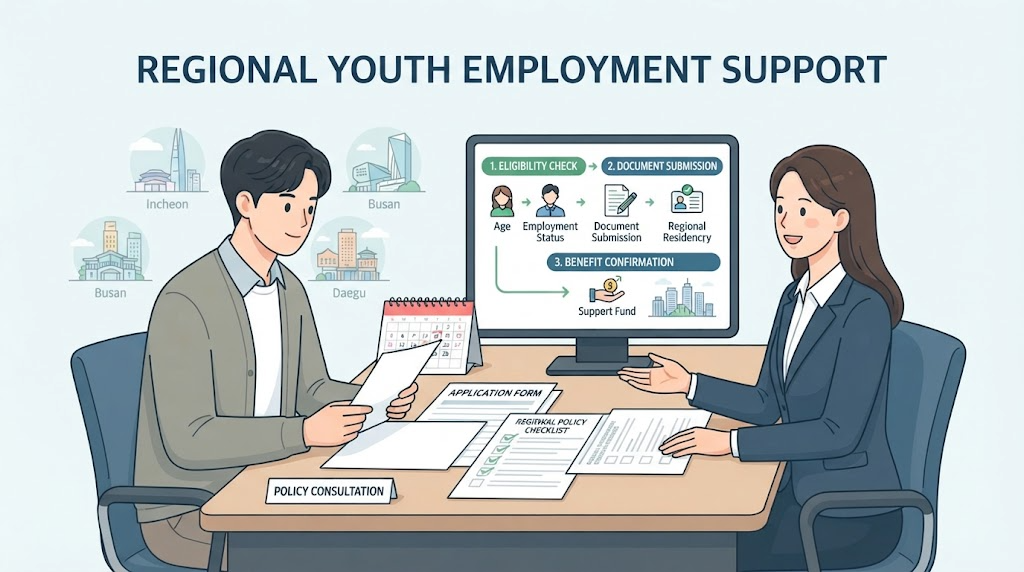
Differences in Support Subsidies by Major Metropolitan Cities and Local Governments Such as Incheon, Busan, and Daegu
In addition to the metropolitan area (Seoul and Gyeonggi), regional metropolitan cities and major local governments are also deploying various youth worker and employee support projects to prevent the outflow of local youth to other regions and promote economic stability. Depending on the financial conditions, industrial structure, and youth population ratio of each local government, distinct differences are shown in support amounts, payment methods, and detailed qualification requirements.
We compare the representative subsidy statuses and regional differences of major metropolitan cities such as Incheon, Busan, and Daegu.
- Incheon Metropolitan City: ‘Incheon Dream for Youth Bankbook’ and Labor Support
Main project content: It operates projects (such as the Dream for Youth Bankbook) that induce asset building and long-term employment targeting youth workers residing in Incheon and working in small, medium, and medium-high enterprises.
Support method and amount: It is designed so that youth can receive a lump sum upon maintaining employment and residency for a certain period (e.g., 2 to 3 years) by matching the youth’s own savings with city and national funds.
Characteristics: Reflecting the characteristics of manufacturing and small-and-medium enterprise dense regions, it tends to link complex benefits such as cash-like asset building support and transportation cost support.
- Busan Metropolitan City: ‘Busan Youth Working Joy Card’ and Long-Term Employment Support
Main project content: Busan City, the largest metropolis in the southeastern region, provides support in the form of welfare points and work encouragement allowances to promote the culture and welfare of youth workers working in small and medium-sized enterprises and prevent job turnover.
Support method and amount: A certain amount per year (e.g., equivalent to 1 million KRW per year) is paid in installments in the form of welfare points or dedicated card points so that they can be freely used for culture, health, self-development, etc.
Characteristics: It focuses on increasing the welfare satisfaction of youth workers working in local small and medium-sized enterprises with relatively low wage levels.
- Daegu Metropolitan City: ‘Daegu Youth Worker Nursing and Welfare Support’ and Youth Allowance
Main project content: Daegu City operates projects through periodic announcements that support quarterly or annual welfare benefits and settlement support funds for the living stability and cultural welfare of youth workers.
Support method and amount: It multi-dimensionally provides benefits closely related to real life, such as welfare mall point payments, health screening cost support, and cultural leisure activity cost support, targeting young workers working in local small and medium-sized enterprises.
Characteristics: It often includes customized support requirements for manufacturing and technical youth workers working in local industrial complexes (Daegu National Industrial Complex, Seongseo Industrial Complex, etc.).
- Comparison of Core Differences in Support Projects by Major Metropolitan City and Local Government
Cash-like asset building vs. welfare points: While ‘bankbook (matching savings)’ forms that help build lump sums are active in Incheon and some local governments, places like Busan and Daegu frequently parallel ‘welfare point and joy card’ forms where immediate consumption and welfare satisfaction are possible.
Income criteria and industry requirements of employing companies: Standard median income criteria (e.g., 100% or less, 120% or less, 150% or less, etc.) and the scope of supported companies (manufacturing preference, inclusion of small business owners, etc.) differ by local government.
Strictness of residency and employment duration: Common to all metropolitan cities, resident registration maintenance within the corresponding local government as of the application date and actual residency period (e.g., resident registration for 3 months or more, etc.) are strictly evaluated, so you must keep in mind that eligibility for benefits can be immediately revoked if you move out to another region.

Methods to Check Residence Criteria Fulfillment and Precautions for Overlapping Benefits by Local Government
When applying for youth worker support subsidies, the items that are evaluated most strictly and where applicants frequently fail are the ‘residence requirements’ and ‘overlapping benefit status’. Since subsidy budgets are limited and the criteria of each local government and the central government are closely intertwined, you must accurately diagnose your condition and prepare before applying.
We have summarized easy methods to check whether residence criteria are met and key points to watch out for regarding overlapping benefits by local government.
- Methods to Pre-Check and Prove Residence Criteria Fulfillment
Checking resident registration address match: Most local government support projects require that the resident registration address as of the application date is registered as the corresponding local government (e.g., Seoul, Gyeonggi, Incheon, etc.). Since it is not recognized simply because your workplace is in that region or your living sphere is there, you must clearly verify your actual address through ‘Gov24’ or a ‘Resident Registration Copy’.
Checking residence period requirements: Some projects go beyond simple transfer status and require ‘the period of residing with resident registration in the corresponding region’ (e.g., continuous residence for the last 6 months or more, or cumulative residence period, etc.). In this case, if you have a history of moving, you must issue a ‘Resident Registration Extract (including transfer history)’ and directly calculate the detailed residence period.
Proof of actual residence: If your resident registration address and actual residence do not match or the name on the lease agreement is not under your name, you may be requested to explain during the future actual residence verification stage, so it is safe to check lease agreements or utility bill payment details in advance.
- Precautions for Overlapping Benefits Between Local Government and Central Government Projects
Restrictions on overlapping participation in similar projects: Overlapping participation within the same period is often prohibited with youth support funds supported by the government (such as the Ministry of Employment and Labor) (e.g., Youth Tomorrow Chaeum Gongje, etc.) or similar asset-building and cash-like support projects of other local governments (e.g., Youth Dohap Accounts, other regional youth allowances, etc.).
Disadvantages upon detection of overlapping benefits: If the fact of overlapping benefits is confirmed through computerized systems and agency screening, even after selection later on, the support decision can be canceled or the already paid subsidy funds can be recovered in full, so you must thoroughly read the ‘Excluded Targets for Overlapping Support’ section of the announcement.
- Final Checklist for Successful Application
- Detailed confirmation of announcements: Since budget situations and guidelines by local government change slightly every year, you must first check the residence and income criteria of the latest year’s announcement.
- Utilizing advance inquiries: If qualification requirements are ambiguous due to residence transfer dates or job changes, making a phone inquiry in advance to the regional branch or youth support call center to receive an official interpretation is the surest coping method.
Korean version: 한국어로 읽기