
Why National Technical Certifications Are Absolutely Advantageous When Changing Careers (Introduction)
When you dream of a new career and knock on the door of the job market, the first concern you face is, “What should I add to my resume to gain a competitive edge?” Nowadays, with rolling recruitment for experienced hires becoming the mainstream, showing your own definitive weapon in the document screening stage is the core key that determines whether you pass.
Among numerous credentials, why do national technical certifications still hold an absolute dominance in the job market? Let’s examine the compelling reasons.
- The Surest ‘Officially Verified Mark’ That Objectively Proves Skills
While numerous experiences and careers written on a resume leave room for subjective packaging, a national technical certification means that your professional knowledge and skills in that job field have been officially verified by a state-certified institution (such as the Human Resources Development Service of Korea).
From the perspective of a recruiter, a certification serves as the fastest and most objective evidence that makes them believe, “This applicant possesses the basic knowledge and problem-solving abilities required for practical work.”
- Document Screening Bonus Points and Essential Preferential Requirements for Public and Large Corporations
Many companies explicitly state “preference given to holders of relevant engineer/industrial engineer certifications” in the preferred qualifications section of their job postings.
Public corporations and institutions: In addition to granting recruitment bonus points, certain job series even require a certification as an application qualification itself.
Manufacturing and engineering industries: Because legally mandated appointment certifications (such as electrical safety managers and fire safety managers) are essential under the Occupational Safety and Health Act or related laws, job changers holding certifications are evaluated by companies as “valuable talent” who can be deployed into practical work immediately.
- A Cheat Key That Fills the Weaknesses of Non-Majors or Career Changers (Job Transitions)
When you want to transition to a completely new job or change your career path to a field unrelated to your major, what holds you back the most is a “lack of experience.”
If you acquire a relevant national technical certification in advance, you can offset the handicap of being a non-major and leave a strong impression as “a talent who has studied deeply and prepared for this field,” thereby noticeably boosting your document screening pass rate.
💡 Tip: A certification in the job market goes beyond simply being a record that you “studied”—it is the most powerful self-verification tool showing that you do not fear new challenges and have built job expertise.
In the next chapter, we will take a detailed look at the 3 best high-value national technical certifications that most reliably increase document screening pass rates in the 2026 job market.
BEST 3 “High-Value National Technical Certifications” Drawing the Most Attention in the 2026 Job Market
When preparing for a career change, you worry most about, “Which certification should I get to actually increase my document screening pass rate?” As recruitment trends rapidly change in 2026, companies prefer talent who satisfy both practical skills and legal safety standards, bringing high-value certifications with clear merits into the spotlight.
Here are the BEST 3 national technical certifications that serve as the most powerful weapons in the job market.
- Electrical Engineer / Industrial Engineer Electrical (The Ultimate All-Purpose Cheat Key for Facility Management and Manufacturing)
Electrical-related certifications are steady sellers that have been consistently loved for decades, but even as of 2026, their value is rising higher.
Why are they receiving attention?: There is no place where electricity is not used, including manufacturing companies, building facility management, and engineering firms. In particular, under laws such as the ‘Electric Utility Act’, buildings or factories of a certain size or larger are legally mandated to appoint an electrical safety manager. Therefore, certification holders can always enjoy a position of ‘power’ rather than a ‘super-subordinate’ role in the employment and job change market.
Target audience for career change: Those who want to transition to facility management roles, or prepare for career changes into manufacturing production/technical positions or public enterprise technical positions (electrical series).
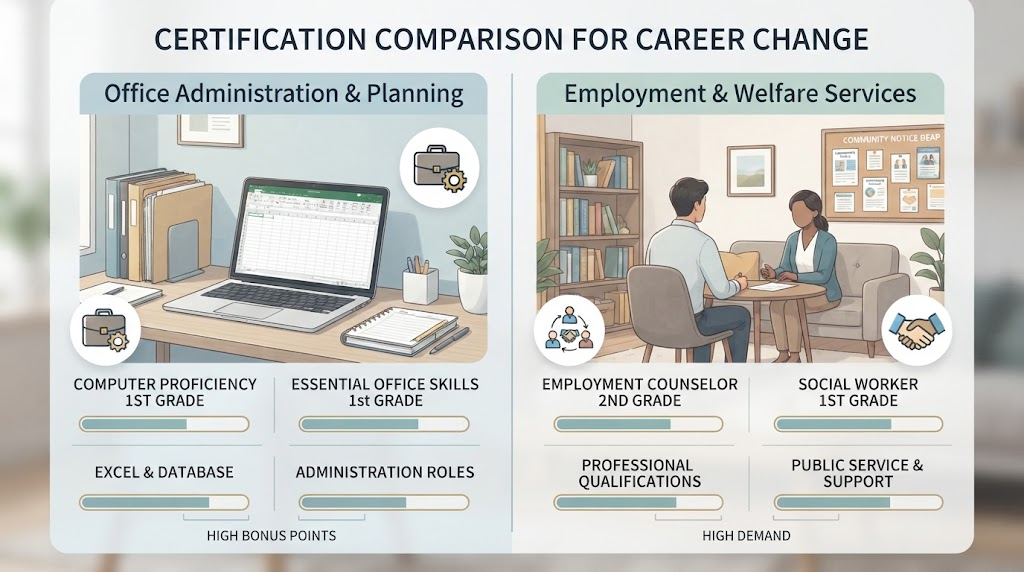
- Computer Specialist in Spreadsheet & Database Level 1 (Essential Basic Skill for Office and Administrative Job Changes)
If technical jobs have the Electrical Engineer, the office, administrative, and planning job market undoubtedly has ‘Computer Specialist Level 1’.
Why is it receiving attention?: As a national technical qualification proving practical skills in Excel and databases (Access), it is a core specification that secures document screening bonus points (usually 0.5% to 3%) across a wide range, from general office jobs in large corporations to public institutions and mid-sized company administrative roles. In particular, it instills the most basic yet powerful reliability for job changers from non-major or humanities backgrounds whose certification sections look empty.
Target audience for career change: Job seekers aiming for general office positions such as management support, general affairs, human resources, and financial assistance, as well as public institution open recruitment.
- Vocational Counselor Level 2 / Social Worker Level 1 (Specialized Specifications for Employment and Welfare Public Institutions and Career Pivots)
As employment and welfare policies of the government and local authorities expand, demand for professional personnel is steadily increasing in public institutions, centers affiliated with local governments, and private employment agencies.
Why is it receiving attention?: It gives the most reliable bonus points when changing careers to public-natured institutions such as employment centers under the Ministry of Employment and Labor, women’s human resources development centers, and middle-aged tomorrow centers, or making a career pivot into administrative job groups. Because you study vocational counseling studies and labor-related laws and regulations that are directly used in practice, it is a representative ‘liberal arts and non-major friendly certification’ that even non-majors can pass if they challenge it with persistence.
Target audience for career change: Those who wish to transition to administrative and counseling roles, or prepare for open recruitment for contract or regular positions in employment and welfare-related public institutions and local governments.
💡 Tip: Rather than blindly following what others say is good when choosing a certification, it is wisest to first analyze 3 to 4 job postings to see “whether your ultimate target company or job requires it as a legally mandated appointment qualification or definitely grants document bonus points” before making a decision.
In the next chapter, we will take a more detailed look at customized recommended items by job category, such as technical jobs, office/management jobs, and IT fields.

Customized Recommended Items by Job Category (Technical vs. Office & Management)
When you decide to change careers, rather than vaguely chasing “certifications that people say are good,” it is important to figure out which category your target detailed job belongs to and establish a customized strategy.
From technical engineering to IT and business/accounting, we have organized the most impactful recommended certifications in the job market by job category.
- Technical & Safety Engineering Category: Industrial Safety Engineer / Fire Facility Engineer (Mechanical/Electrical)
In the technical job change market dealing with fields such as manufacturing, construction, plants, and logistics centers, the hottest topics lately are undoubtedly ‘safety’ and ‘fire protection’.
Industrial Safety Engineer: With the reinforcement of the Serious Accidents Punishment Act and the establishment of safety and health management systems becoming mandatory, hiring demand for safety managers has exploded across manufacturing and construction in all industries. Regardless of your major, as long as you meet the application qualifications (related department or experience), it is a cheat code that can maximize your market value in the job change market.
Fire Facility Engineer (Mechanical/Electrical): This is an essential legally mandated appointment certification when moving into building disaster prevention, fire facility design and supervision, and building management. If you acquire dual engineer certifications (‘ssangkisa’—holding both certifications simultaneously) along with the Electrical Engineer certification, you can receive free-pass-level treatment in the technical job change market.
- IT & Digital Development and Planning Category: Engineer Information Processing
This remains a powerful officially recognized specification when changing careers not only as a software developer but also into IT service planning, data analysis, and system operation (SM/SI) roles.
Engineer Information Processing: It proves that you possess overall knowledge forming the backbone of practical IT work, such as computer architecture, operating systems, databases, and software engineering.
Looking at IT system recruitment postings for mid-sized/large corporations and IT public enterprises, Engineer Information Processing is still frequently specified as an ‘application qualification’ or ‘document screening bonus point item,’ making it considered an essential course for developers and IT planners from non-major backgrounds.
- Business, Accounting, and Financial Management Category: Computerized Accounting and Tax Level 1 & 2 / Computerized Accounting Level 1
If you are preparing to switch to finance, accounting, tax, or general affairs departments that deal with numbers, certifications proving practical software utilization skills are much more advantageous than theoretical education.
Computerized Accounting and Tax (Hosted by the Korea Association of Certified Public Tax Accountants): This shows that you can skillfully operate accounting programs (such as KcLep) most widely used in domestic small and medium-sized enterprises and tax accounting firms.
In particular, if you acquire Computerized Accounting and Tax Level 2 or higher, you can be recognized as an immediate contributor without a separate program test during the practical interview of a general company’s finance/accounting team, significantly increasing your document and interview pass rates.
💡 Job-Specific Selection Guide Summary
Want to go to factory/construction sites and facility management?
→ Industrial Safety Engineer, Fire Facility Engineer
Want to go to IT/software and system planning?
→ Engineer Information Processing
Want to go to finance/management support/general affairs in a general company?
→ Computerized Accounting and Tax Level 2, Computer Specialist in Spreadsheet & Database Level 1
💡 Tip: Before starting your certification study, open recent job postings from 5 companies you want to work for and see with your own eyes which certifications are listed most frequently in the preferred qualifications section. The certification with the highest frequency is your ‘top priority recommended item’.
In the next chapter, we will look into realistic study strategies and time management methods that allow office workers and non-majors to acquire certifications without burning out.

Certification Acquisition Study Strategies for Non-Majors and Office Workers
“I’m completely exhausted when I come home from work, can I really study for that difficult engineer exam?”, “Can I really pass as a non-major with no baseline?”
Anyone challenging national technical certifications as an office worker and non-major inevitably has these fears. In a situation where absolute study time is lacking, it is difficult to pass by doing the exact same thing as others. We share 3 smart study strategies that make 200% use of limited time.
- Office Worker-Tailored ‘Slicing Spare Time’ and Designing a Daily Timeline
Sitting at a desk after getting off work and focusing for 3 to 4 hours is nearly impossible for office workers. Physical energy hits rock bottom and it usually ends up lasting only three days. Instead, you must use daily spare time as a weapon.
Commuting public transit time (a total of 1 to 2 hours a day): Never bring heavy, thick theoretical books. Use a smartphone or tablet to view theory summaries or incorrect answer notes, or listen repeatedly to past exam explanation lectures with earphones plugged in.
Utilizing lunch time (30 minutes): Finish lunch quickly and focus exclusively on memorizing 5 core formulas or legal keywords that must be memorized that day in the company break room or a quiet cafe.
Pure study space concentration after work (exactly an hour and a half): Instead of lying down on the bed as soon as you come home, sit at your desk and solve 1 to 2 sets of past exams based on what you saw during your commute today to build practical sense.
- Drastically Reduce Theory Reading and Win Through ‘Repeated Review of Past Exams’
The question patterns of national technical certification exams (Engineer, Industrial Engineer, Computer Specialist, etc.) are standardized to a certain extent. Especially for exams where question bank methods or similar types are repeated, reading theory from start to finish is a waste of time.
Step 1 (Grabbing the Conceptual Framework): Listen to online lectures quickly at an accelerated speed (1.5x) and skim only the overall flow and terminology concepts. (It is important to push forward with progress without striving for absolute perfect understanding.)
Step 2 (Infinite Review of Past Exams): Even if you only understand 50% of the concepts, immediately dive into past exams from the last 5 to 7 years. When you encounter parts you don’t know while solving problems, tracing concepts backward through explanations to learn them (aka the ‘viewing 100 times strategy’) is much more effective for non-majors.
Step 3 (Organizing Incorrect Answer Notes): Create incorrect answer notes for why you got wrong answers wrong, and for the week right before the exam, repeatedly review only the incorrect answer notes.
- Lowering Tuition Burden Through Government Support Systems Such as the Tomorrow Learning Card
National technical certification online lectures or academy costs are also a considerable burden for office workers. In this case, you must actively utilize the ‘National Tomorrow Learning Card’ examined earlier.
If you apply for the worker government support (employed worker tomorrow learning card) course through the Employment24 website, you can receive a significant portion of tuition support from the government for popular certification online lectures or academies.
Not only does it alleviate the tuition burden, but because you must fulfill a certain attendance rate and progress rate, it serves as an excellent motivational device that imposes compulsiveness (study routine) so you do not become lazy.
💡 Tip: The more you are a non-major, the first 2 to 3 weeks can be painful enough to make you want to close the book because terms are unfamiliar. Once you cross this hurdle, question patterns start coming into view. Sticking it out with grit with the mindset that “everything is difficult at first” is the only shortcut to passing.
In the next chapter, we will organize final utilization tips and FAQs that maximize your career change success rate after acquiring a certification.

Practical Tips (FAQs) to Increase Career Change Success Rate After Acquiring a Certification
Even after holding a national technical certification through blood, sweat, and tears, many people worry, “How should I weave this certification into my resume and cover letter so it catches the recruiter’s eye?” We have organized practical utilization tips and Frequently Asked Questions (FAQs) that maximize the synergy of acquiring a certification and boost your career change success rate.
Q1. When writing multiple certifications in the resume certification section, in what order should they be placed?
A: To increase the visibility of your resume, you must place the ‘core legally mandated appointment certification or engineer certification directly related to the job you are applying for’ at the very top.
For example, when transitioning to facility management or a technical job, rather than putting general certifications like the Computer Specialist in Spreadsheet & Database or the Korean History Proficiency Test at the top, you should place the Electrical Engineer or Industrial Safety Engineer at the highest priority where it stands out the most, allowing recruiters to intuitively grasp within 1 second that “this applicant is ready to be deployed into this job immediately.”
Q2. I lack practical experience and only have a certification. How should I weave it into my cover letter?
A: You must storytelling the certification acquisition process not as a simple ‘result of memorization power,’ but as ‘passion for the job and a problem-solving process.’
Writing Example: “Feeling the limitations of practical knowledge as a non-major and to overcome this, I studied for 2 hours every day after getting off work and acquired the OO Engineer certification in 6 months. Based on the systematic engineering analytical skills and understanding of laws and regulations learned through this process, I will become an engineer who proactively prevents risks that may occur in the field.”
By appealing to the effort and persistence put into earning the certification like this, you can prove diligence and learning capability that more than make up for any gaps in practical experience.
Q3. The final pass announcement for the certification exam is not out yet, can I write ‘expected to acquire’ on my resume?
A: If you are in the state of passing the written exam or taking the practical exam and waiting for results, it is permissible to specify [Certification Name] (Expected to Acquire) or (Awaiting Results) in the resume certification section.
However, if the final pass announcement date is too late compared to the interview schedule, or if the certification number does not come out by the time employment is confirmed, it could rather have an adverse effect. It is safest to submit your resume in alignment with the timing when passing the practical exam is certain or official certification numbers are issued.
Q4. Does simply having a certification make you advantageous in salary negotiations during an experienced hire career change?
A: Especially in technical jobs and safety/facility management fields, the presence of a legally mandated appointment certification determines the base camp of your salary.
If you hold a certification that a company is legally required to appoint (such as an electrical safety manager, fire safety manager, industrial safety and health manager, etc.), from the company’s perspective, you are a valuable resource that resolves legal risks in talent recruitment, which can act as a much stronger card during salary negotiations or requests for treatment improvement.
💡 Final Closing Checklist
- Resume Optimization: Re-verify whether the main certification directly connected to the target job is placed at the very top
- Cover Letter Branding: Seamlessly connect the certification acquisition process as the basis for diligence and job competency
With your thoroughly prepared and hard-earned national technical certification as your wings, we sincerely cheer for your successful career change to your desired target company and an even higher career leap!
Korean version: 한국어로 읽기