
Introduction: Why is the ‘resident registration address’ standard absolute when reporting bulky waste?
When you finish moving or cleaning out your house and need to throw away a large wardrobe or mattress, the first thing you do is search for “online bulky waste reporting” on a portal site. Nowadays, it has become really convenient because you can apply with just a few clicks on a PC or smartphone without having to visit a community center directly.
However, people often make the mistake of accessing and applying at a random, noticeable site because they are confused about which one to choose among the various local government sites or civil complaint portals that appear in the search results.
“My friend in the next neighborhood said they applied online quickly, can’t I just go into any district office site and report it?”
“If my address on my resident registration and where I currently live are slightly different, which one should be the standard?”
To tell you the conclusion first, the ‘resident registration address’ is an absolute standard that does not allow even a slight error when reporting bulky waste online. This is because the collection and disposal of bulky waste is not collectively managed by the national government, but is an autonomous affair independently operated by each local government (city, county, district) according to its own cleaning ordinances.
If you pay the fee and report through the system of a district (gu) or city (si) that is not your actual resident registration address, the information is not transmitted at all to the jurisdiction’s collection company responsible for the actual site. As a result, even after paying precious costs, you may experience absurd situations where your trash is left unattended for days or mistaken for illegal dumping.
To prevent unnecessary collection refusals and administrative confusion and to clear out your waste most quickly and safely, let’s take a detailed look at why online reporting based on the resident registration address is an absolute rule.
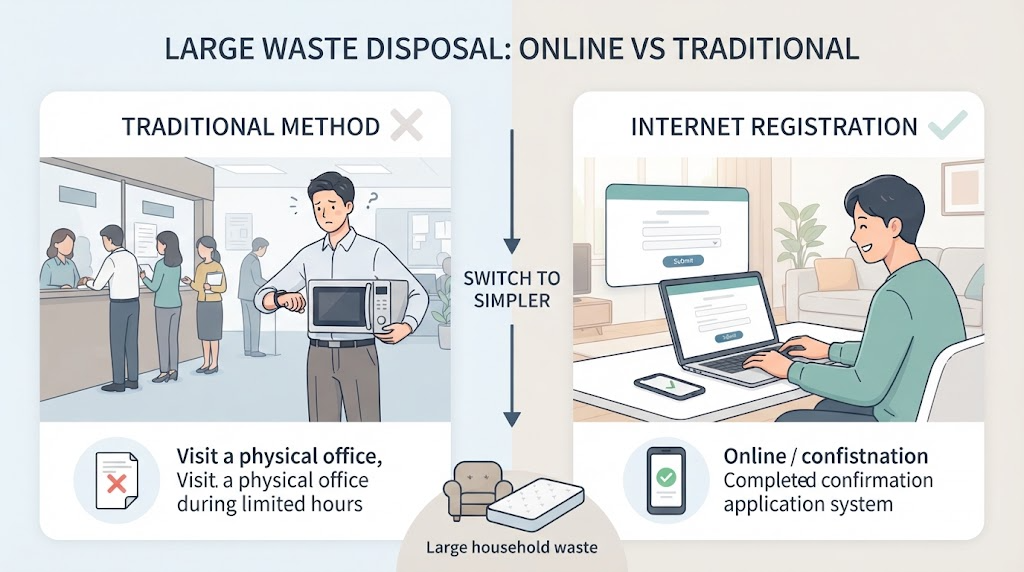
Basic Concept: Ordinance Operation Structure by Local Government and Advantages of Online Reporting
When searching the internet to discard bulky waste, you often feel confused because the homepage layouts and application methods vary subtly by local government. Why is South Korea’s bulky waste disposal system not common nationwide, but divided so much by district? And if you understand the background of why online reporting has become a powerful alternative compared to the past, administrative procedures feel much closer.
- Understanding the ordinance operation structure by local government
According to domestic waste management laws, affairs regarding the collection, transportation, and disposal of bulky waste are not collectively controlled by the national government, but are delegated to be autonomously operated according to the cleaning ordinances of each local government (city, county, district).
Reflection of regional conditions: Since population density, collection infrastructure, contract types of dedicated collection companies, and locations of landfills and incinerators differ by local government, differences occur in fees or disposal rules by item.
Structure of responsible administration: Because the local government to which your address belongs directly determines the internal waste disposal costs and manages private collection companies, you must use the system of the “district office having jurisdiction over your resident registration address” for collection data to be linked normally.
- Powerful advantages of ‘online reporting’ completed via PC and mobile without visiting a community center
In the past, you had to use annual or half-day leave on weekdays or split your lunch break to directly visit the community center (dong office) counter to purchase bulky waste stickers. However, with the introduction of the online reporting system, a huge change has come to our daily lives.
24-hour reception without time and space constraints: Even late at night, on weekends, or holidays, as long as you have a smartphone or PC, you can access at any time to report and pay fees.
Transparent and simple fee confirmation: Since detailed specifications and amounts for each item are transparently presented on the screen, there is no need to argue while explaining items to staff on-site.
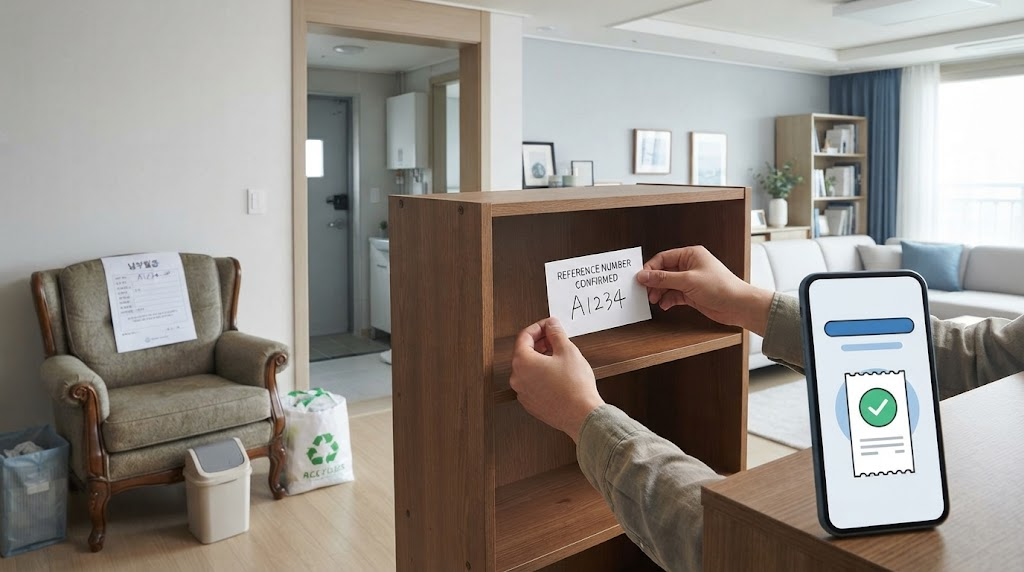
Convenient payment and alternative certificate issuance: Various non-face-to-face payments such as credit cards and account transfers are possible, and even if you do not have a printer, you can replace the payment certificate by writing down the receipt number and disposal details directly on a blank sheet of paper and attaching it, making it very practical.
💡 Core summary: If you understand the ordinance structure by local government and utilize the convenience of online reporting, you can clear out bulky waste most legally and smartly without wasting time and footwork going back and forth to administrative agencies.

Application Procedure: 4 Steps from Accessing the Jurisdiction Local Government Homepage to Selecting Items and Paying Fees
Once you have checked your resident registration resident address, it is now time to turn on your PC or smartphone and proceed with the online reporting in earnest. Even those doing it for the first time can easily complete the application in just a few minutes by following the 4 steps below along with the guidance of the local government official homepage.
Step 1: Accessing the official homepage of the local government (district office / city hall) with jurisdiction over your address
First of all, search for “[resident region name] + district office (or city hall)” on a portal site to access the official homepage. You must enter the ‘Civil Complaints by Field > Bulky Waste Disposal Reporting’ menu within the official website operated by the relevant local government, rather than an integrated civil complaint portal.
If you search for ‘bulky waste’ in the integrated search bar on the homepage main screen, you can easily find a link that directly connects to the dedicated reporting page.
Step 2: Member registration or non-member login and entering disposal information
Bulky waste reporting requires logging in for identity verification and checking application details. Log in as a non-member through simple authentication or mobile phone identity verification, or proceed with a simple member registration.
After logging in, enter basic personal information such as the exact address of the disposal location (based on the resident registration address), applicant’s contact number, and name.
Step 3: Selecting disposal items, entering specifications, and checking fees
Search and select the type of item to discard from the item categories registered in the system.
Detailed specification and quantity entry: For wardrobes, dressers, mattresses, etc., select the item that exactly matches the dimensions or specifications (single/double, etc.) measured earlier with a tape measure and enter the quantity.
Automatic fee aggregation: The fee for each selected item is automatically calculated and displayed as the total payment amount, so check carefully to see if the details are correct.
Step 4: Online payment of fees and issuance of payment certificate (receipt number)
Securely pay the fee through payment methods supported by the local government, such as credit card payment or real-time account transfer.
Securing the payment certificate: Once the payment is successfully completed, a ‘payment certificate (receipt number)’ is issued. If you have a printer at home, print out the payment certificate screen and attach it to the waste. If you do not have a printer, you can write the local government name, receipt number, item, and fee amount largely and directly on a clean blank paper or paper with an oil-based pen and attach it to finish the disposal preparation perfectly.
💡 Practical tip: Capture the receipt number and scheduled disposal date granted after completing payment on your smartphone screen or make a memo of them. This serves as reliable evidence to prevent loss or misplacement of waste until collection.
Precautions: Frequent Mistakes and Countermeasure Tips, Such as Incorrect Address Input and Wrong District (Gu) Application Errors
Online bulky waste reporting, which can be easily handled via PC or smartphone based on the resident registration address, is very convenient, but collection is sometimes refused or people face trouble due to small carelessness unconsciously committed in the online environment.
To prevent unnecessary waste of time and collection delays, we point out 4 representative mistakes that occur most frequently when reporting bulky waste online and their corresponding countermeasure tips.
- Incorrect address input and omission of detailed address (dong and ho)
Mistake: A case where you recently moved so your resident registration address has not yet been completely transferred, or you accidentally omit the detailed address (dong and ho) or lot number while typing quickly on the keyboard.
Countermeasure tip: Before applying, you must recheck your current exact resident registration address through Gov24, etc., and closely look over once more right before final payment to see if there are any typos in the disposal location input field.
- Mistakenly applying to a ‘different district (gu)’ or another local government system by trusting search results alone
Mistake: A case where you carelessly search on a portal site and then access the bulky waste reporting page of another region exposed at the top (e.g., a nearby other district office) and pay the fee. In this case, even though you paid the money, data is not transmitted to the actual on-site collection person in charge, leaving the trash neglected for days.
Countermeasure tip: You must develop a habit of checking whether “the exact name of the local government where you reside (e.g., ○○-gu, Seoul)” is explicitly stated at the top of the accessed website or in the URL.
- Mismatch between actual item specifications and applied items
Mistake: A case where you roughly estimate the size of a wardrobe or dresser by eye and apply for it as a small item at a lower rate, or incorrectly select a single mattress as a double mattress.
Countermeasure tip: Based on the specification description and guidance dimensions for each item appearing on the online reporting screen, you must accurately compare the actual size of the item measured with a tape measure in advance and select the appropriate item to prevent collection refusal.
- Failure to attach or loss of ‘payment certificate (receipt number)’ after completing payment
Mistake: A case where, out of relief that the fee payment was successfully completed online, you omit printing or fail to write down the receipt number on a blank piece of paper, causing the collection team to mistake it for illegal dumping.
Countermeasure tip: If you do not have a printer, you must write the local government name, receipt number, item, and payment amount largely on a clean blank paper with an oil-based pen and firmly attach it with tape to a place where the waste is clearly visible. Wrapping it once with clear plastic so it does not get wet in the rain is also a good method.
“Even if you pay careful attention to just one small detail, you can clean it up neatly all at once without collection refusal or omission. We hope you will complete your online reporting perfectly using these precautions as a compass!”

Conclusion: Emptying Bulky Waste Smartly and Without Hassle Through Online Reporting Based on Accurate Address
Stepping away from the hassle of having to directly visit the community center, the smart non-face-to-face online reporting era where you can process bulky waste anytime and anywhere with just a PC or smartphone has now settled.
Even if the system or specification measurement for each local government felt a little unfamiliar at first, if you prepare step by step following the core guidelines we looked at together today, anyone can cleanly clear out waste without collection refusal or mistakes.
Shall we summarize the key points for successful and smart bulky waste disposal once again?
Compliance with the resident registration address standard: Prevent collection omission by using the official homepage of the exact jurisdiction local government (district office / city hall) to which your residence belongs
Thorough preliminary specification check and 4-step application: Pre-measure the size of the item to be discarded with a tape measure, select the exact item, and complete online fee payment
Certain attachment of payment certificate (receipt number): Print out or write the receipt number on a blank paper with an oil-based pen, attach it firmly so it does not get wet in the rain, and block misunderstanding as illegal dumping
Bulky waste disposal is not simple trash disposal, but a step of a new beginning that transforms your home into a fresher and more comfortable space.
Put down the cumbersome footwork and experience smart organization that saves both time and cost by using the online reporting guide based on the accurate address standard introduced today as your compass. We sincerely cheer for your fresh daily life and departure in a new space!
Korean version: 한국어로 읽기