
Introduction: The Core of Government-Funded Education, Why Payment and Attendance Management Are Important
Once you have been issued the National Tomorrow Learning Card and set your mind for a new career challenge, it is time to dive into the training course in earnest. It is easy for many people to only care up to the process of issuing the card, but in order to truly make the government-funded benefits your own and successfully complete the course, there is a separate gate that is most important yet tricky.
It is precisely accurate tuition payment and thorough attendance management. We examine the key reasons why these two determine the success or failure of completing the education.
Smooth course registration and out-of-pocket contribution processing: Even if course application is approved, if you do not pay the exact out-of-pocket contribution within the set deadline, course registration may be canceled or experience setbacks. Figuring out the account balance and payment structure of the card-affiliated bank in advance is the first step.
Strict attendance criteria determining completion: Unlike general private academies, since government-funded courses involve national budgets, attendance management is very thorough. If you fail to meet the set criteria (usually an attendance rate of 80% or more), you are processed as failing completion, which can result in card limit deductions or disadvantages in future support.
Conditions for receiving precious training incentives: Diligent attendance goes beyond simply acquiring a completion certificate; it is an essential condition to fully claim training incentives paid when conditions are met.
Only by accurately knowing and handling the entire process from tuition payment to daily attendance management can you fully enjoy government funding benefits without giving up midway.
From now on, let’s take a look one by one at specific tuition payment tips and confusion-free attendance check know-how that you must know for a successful training completion.
Mastering National Tomorrow Learning Card Tuition Payment Tips and Out-of-Pocket Contributions
Once you have selected a training course and finished course application, it is now the tuition payment stage for official registration. Unlike general card payments, government-funded education involves administrative procedures and verification items that must be checked, requiring careful preparation.
Check out the 3 key payment tips to complete your registration neatly without mistakes.
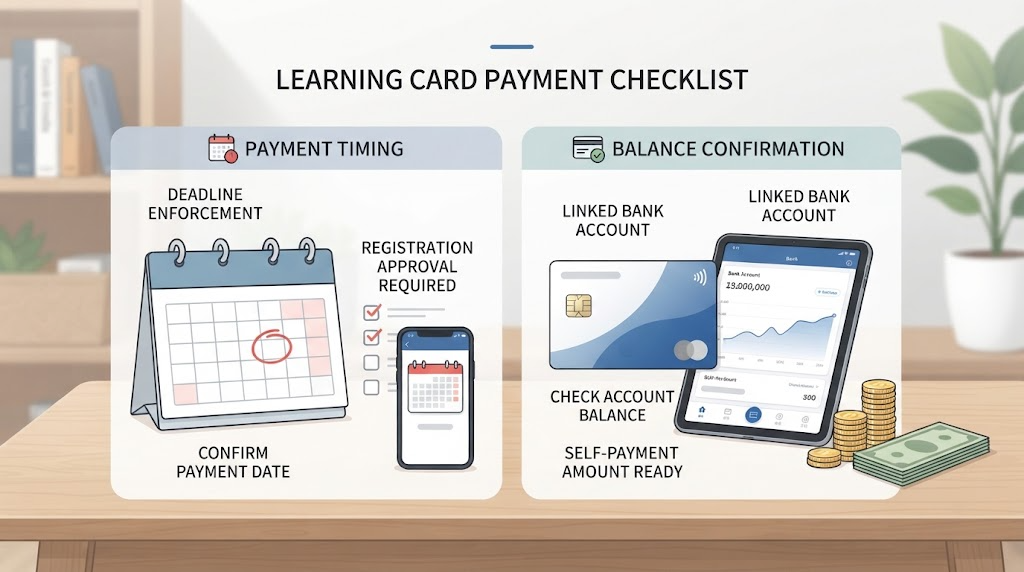
① Tuition payment timing and essential preparation items
Strict adherence to payment deadlines: Even if your course application is approved, registration is not automatically completed. You must complete payment with your own card within the designated payment deadline guided through the employment center or HRD-Net to be finalized as a final student. Be careful, as missing the deadline can automatically cancel your application.
Checking card and account balances in advance: The National Tomorrow Learning Card processes payments through the designated account of the affiliated bank (Shinhan Card, Nonghyup Card, etc.) linked at issuance. Right before payment, you must make sure there is a sufficient balance in the linked account to cover the out-of-pocket contribution to prevent withdrawal errors.
② Understanding the out-of-pocket contribution calculation structure and support rates
Government funding does not mean it is always 100% free; out-of-pocket contributions (personal burden) are applied differently depending on an individual’s employment status or income level.
Differences in support rates by type: Government support rates are applied differently depending on general workers/job seekers, low-income groups, National Employment Support System (K-Work Experience/K-ETT) participants, etc. Out-of-pocket contributions are exempted or significantly reduced for Type I K-ETT participants or low-income groups, but general types must directly pay a certain percentage of out-of-pocket contributions.
Deductions by training course: You should accurately check in advance on the course application screen how much is deducted from the government support limit out of the total tuition fee and how much your out-of-pocket contribution that you must pay directly with your card is, making it easier to plan your budget.
③ Preventing payment errors and practical payment tips
Checking online vs. on-site payment methods: Depending on the course, you may pay directly online through the Vocational Training Portal (HRD-Net) or the Employment24 web/app, or you may need to visit the training institution directly before the course opens to process card payment. Proceed with payment in the exact manner according to the institution’s guidance guidelines.
Over-limit and card status check: If you have not used the card for a long time after issuance or if your lump-sum limit is insufficient, payment errors may occur. Before paying a large amount of tuition, it is safe to contact the card company in advance to check the usage limit and whether the card is normally activated.

Easy-to-Confuse National Tomorrow Learning Card Attendance Check Methods and Management Tips
Once you have safely completed your tuition payment, the next core gateway you must pay the most attention to is daily attendance checking. Unlike general private academies, government-funded courses operate their systems very strictly because attendance management is directly linked to the execution of national budgets.
To avoid being disadvantaged by minor carelessness, carefully check the easy-to-confuse attendance check methods and practical management know-how.
① Basic method and importance of attendance checking
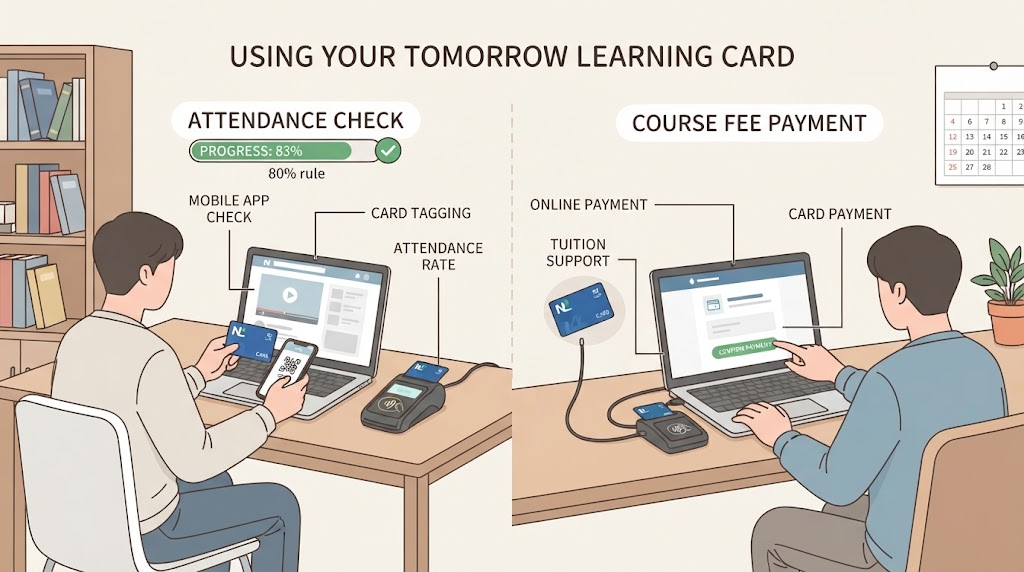
Two-way check for check-in and check-out: In government-funded courses, both the ‘check-in’ at the start of class and the ‘check-out’ at the end must be completed to be recognized as normal attendance. Caution is required because missing either side can be processed as an absence.
Familiarizing yourself with the check method: Usually, you directly tag your National Tomorrow Learning Card on the dedicated terminal provided at the training institution, or use GPS/QR authentication methods utilizing the smartphone’s Employment24 app (or designated attendance management app) in parallel. You must accurately familiarize yourself with the attendance method guided by the academy on the first day of class.
② Absolute standard for completion, the ‘80% attendance rate rule’
Maintaining a minimum attendance rate of 80%: Most government-funded training courses require attendance of 80% or more of the total training hours for final completion to be recognized.
Penalties occurring upon failure to complete: If you fail to meet the 80% attendance rate and are processed as failing completion, not only will national subsidies be deducted, but your National Tomorrow Learning Card account limit may be reduced (typically a 200,000 KRW reduction up to maximum reduction) or you may face restrictions on taking training courses in the future. Unless it is a natural disaster or an unavoidable accident, you must unconditionally defend the 80% or higher rate.
③ Criteria for handling tardiness, early leave, and outings and how to cope
Cumulative time management: If the number of times you are late, leave early, or go out accumulates beyond a certain standard, they can be added together and processed as 1 absence.
Submission of officially recognized documentary evidence: If you inevitably become late or absent due to reasons such as hospital treatment, reserve forces training, or work-related duties, you must notify the training institution in advance and submit objectively recognized evidentiary documents such as a medical certificate, opinion letter, or confirmation certificate to open the path to be recognized as attendance.
Precautions You Must Know When Unexpected Situations Occur, Such as Dropping Out or Absence
Even if you enthusiastically start government-funded training, your plans may face setbacks due to unexpected sudden situations such as changes in work duties, sudden deterioration of health, or personal circumstances. Since government-funded courses are tied to the national budget, regulations on dropping out or absence are strict, so it is safe to accurately know the related penalties and coping methods.
① Disadvantages occurring upon dropping out of training (expulsion/dropout)
Account limit reduction penalty: If you fail to finish the training to the end due to a simple personal change of heart or carelessness and drop out (expulsion or dropout), a certain amount (typically 200,000 KRW or more) is deducted from the overall support limit of the National Tomorrow Learning Card.
Risk of support restriction: If dropout counts accumulate, you may be restricted from taking new government-funded training courses for a certain period in the future, so you must exercise caution in course selection and participation.
② Coping tips when unavoidable absences occur
Unexcused absence is strictly prohibited: If you miss classes without notice when circumstances arise, it is processed as an absence as-is, and if accumulated, it can lead to an attendance rate below 80% and result in a failure-to-complete processing.
Mandatory submission of officially recognized evidentiary documents: If unavoidable reasons occur, such as hospital treatment (hospitalization and treatment), reserve forces training, or major schedules at work, you must notify the training institution in advance and submit objective evidentiary documents such as a medical certificate, opinion letter, or attendance confirmation certificate to open the path to be recognized as attendance according to regulations.
③ Prompt communication with the employment center when problems occur
When it is difficult to coordinate with instructors or institutions during training, or when problems occur with attendance checking due to system errors, do not worry alone.
You must immediately notify the person in charge at the jurisdiction’s employment center or the HRD-Net customer center of the situation and receive official guidance to prevent unfair failure-to-complete or subsidy disadvantages and smoothly resolve the problem.

Conclusion: Enjoying 100% of Government-Supported Benefits through Thorough Attendance and Smart Payment
Using the National Tomorrow Learning Card to build new job competencies and start career challenges is the most valuable investment for the future. However, just as important as issuing subsidies and registering for classes, accurate tuition payment and diligent attendance management are the true core keys to completing the course successfully.
Smart payment within the exact deadline: Cleanly processing out-of-pocket expenses without missing the designated payment deadline to smoothly confirm course eligibility
Defending an 80% attendance rate and thorough attendance management: Never missing daily check-in and check-out tags, and quickly submitting supporting documents when unavoidable reasons occur to prevent non-completion penalties
Active response in unexpected situations: When problems such as payment errors or missing attendance occur, communicating with the training institution and the jurisdiction employment center instead of keeping it to yourself to protect your rights
Each seemingly minor payment and attendance check gathers to become a sturdy shield protecting your precious government-supported benefits and card limit.
Based on the practical payment tips and attendance management tips guided today, we hope you safely complete the training course without dropping out. We sincerely cheer for your successful self-development and dazzling career growth! 🚀
Korean version: 한국어로 읽기