Why Should You Check Pre-Conditions Before Starting a Government Support Application?
If you have decided to learn a new certification or skill utilizing government support systems, it is wise to carefully check the preliminary qualification conditions before immediately clicking the course application button.
Many people plunge right into applications thinking, “Everyone must be able to receive this benefit,” only to suffer setbacks due to unexpected disqualifications or falling into support exclusion categories. Let us examine the realistic reasons why you must check pre-conditions before applying.
- To Prevent Wasted Time and Find the Support System That Fits You
Various government support projects, including the National Employment Learning Card which is the core of government-supported training, have slightly different support scopes and conditions depending on an individual’s employment status (job seeker, office worker, freelancer, self-employed, etc.) and income level.
If you do not accurately figure out in advance whether your conditions match, the hassle arises where even after choosing a training course you like, card issuance is rejected or desired benefits cannot be applied, forcing you to prepare from scratch.
You must check support types in advance that perfectly match your current status and situation to reduce unnecessary administrative time waste and secure the most advantageous benefits.
- Screening in Advance Whether You Fall Under Support Exclusion Targets (Exception Regulations)
Unfortunately, just because someone is a South Korean citizen does not mean everyone can unconditionally receive government support benefits. Depending on the purpose and intent of the system, certain individuals are excluded from support.
Current public officials, private school staff
High-income self-employed individuals with annual sales above a certain amount
High school and university students whose remaining years until graduation exceed a certain standard (excluding exceptions such as some correspondence or night universities)
Cases subject to duplicate restrictions in other government support projects, etc.
If you proceed with application procedures without knowing that you fall under these exclusion targets, approval may not be granted or problems such as subsequent retrieval of funds may occur, making accurate verification from the starting line essential.
- For Smooth Course Completion and Planned Curriculum Design
Checking pre-conditions goes beyond simple qualification checks; it is the first step in planning the time and money you will invest moving forward.
You must understand the basic validity period of the Learning Card (5 years from issuance date) and individual support limits (3 million to 5 million won) in advance to draw a long-term certification acquisition roadmap.
You must gauge how the self-payment rate is determined in advance to prevent unexpected economic burdens during the learning process and increase completion rates.
💡 Preview of the Next Chapter
If you have confirmed through preliminary searches that you fall under the government support application targets, it is now time to dive into the core qualifications for issuing the National Employment Learning Card.
In the following section, we will clearly organize specific criteria by employment status and the support limit structure.
Comprehensive Summary of Basic Qualification Conditions for Issuing the National Employment Learning Card
The National Employment Learning Card, which is the foundation and core of the government support system, is a reliable system that helps any South Korean citizen participate in vocational skills development training. However, detailed issuance criteria and support conditions may vary depending on each individual’s employment status or situation.
We will clearly organize the basic qualification conditions and support benefit structures that you must know to obtain the National Employment Learning Card.
- Anyone Who Is a South Korean Citizen Can Basically Apply (Broad Support Scope)
Unlike in the past, the current National Employment Learning Card has dramatically expanded its targets to encompass not only the unemployed or job seekers but also working modern individuals.
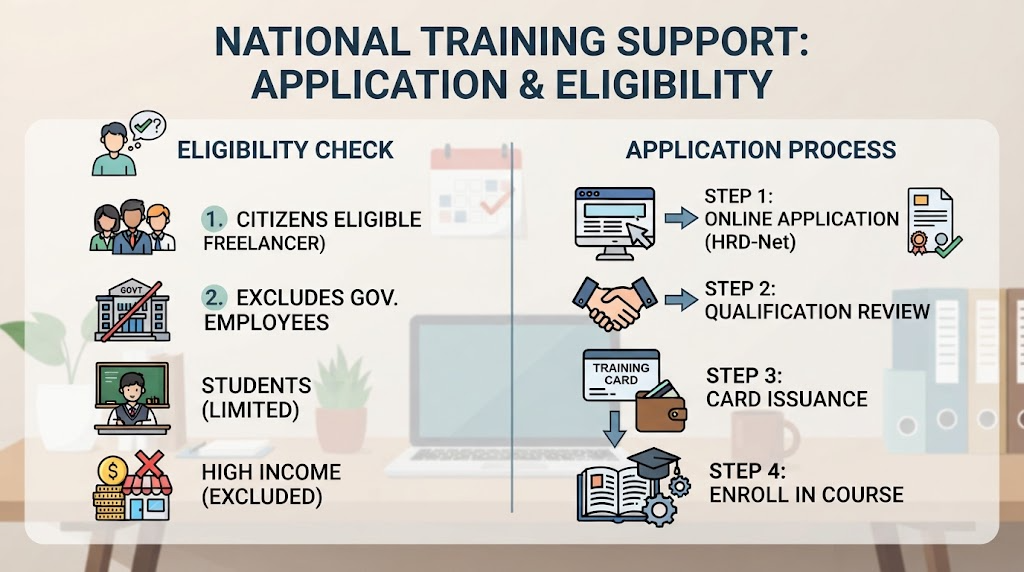
Applicable targets: Job seekers, office workers (general employees), special-type contract workers (special employment workers), freelancers, small-scale self-employed individuals, etc., can apply regardless of their employment status.
Office workers preparing for certifications for job changes or job competency enhancement while maintaining a job, and those trying to challenge new fields while living as freelancers, all possess the qualifications for issuance.
- Checking Exception Regulations for “Support Exclusion Targets” Whose Issuance Is Restricted
Issuance is possible for most, but due to the purpose of the system, certain individuals below are restricted or excluded from National Employment Learning Card issuance.
Current public officials and private school staff
High-income self-employed individuals whose annual sales exceed a certain standard (usually 150 million won, etc., varying by industry)
High school and university students whose remaining years until graduation exceed a certain standard (however, issuance is possible if they fall under certain exception regulations such as prospective graduates or students in correspondence or night universities)
Persons deemed inappropriate for government training support according to other laws and regulations
- Individual Support Limits (3 to 5 Million Won) and Self-Payment Rate Determination Structure
Once the card is issued, a training cost account of a certain amount is granted to the individual, through which tuition fees can be frugally supported.
Basic support limit: A basic account of 3 million won is supported per individual, and the limit can be raised up to 5 million won depending on the individual’s income level or employment status. (Example: low-income families, specific employment support targets, etc.)
Differential application of self-payment rates: Depending on the employment rate and job category characteristics of the training course, the government supports 45% to 85% of the training cost, and the remaining amount (self-payment portion) is paid by the individual. In the case of low-income employment support targets such as National Employment Support System Type 1, the self-payment rate can be significantly lowered or exempted.
💡 Preview of the Next Chapter
If you have carefully checked the qualifications for issuing the Learning Card, you are probably wondering what steps you must go through to actually get the card in your hands.
In the following section, we will easily guide you through the specific 5-step procedure for applying for and receiving government support through Goyong24 and HRD-Net.

5-Step Procedure for Government Support Application and Issuance at a Glance
If you have checked the qualification conditions for issuing the National Employment Learning Card, it is now time to go through the practical administrative procedures of applying for and receiving the card. To ensure that even first-time applicants can follow along smoothly, we clearly organize the 5-step process from government support application to final course registration.
Step 1: Goyong24 or HRD-Net (Vocational Training Portal) Membership Registration and Login
First, you must access the official online platform and go through identity verification.
Access channel: Access the website of Goyong24 or HRD-Net (Vocational Training Portal), which are government vocational training integrated portals.
Identity verification: Complete membership registration and login through joint certificates (official certificates), financial certificates, simple authentication (PASS, etc.). (It can also be conveniently used via mobile apps.)
Step 2: Filling Out the National Employment Learning Card Issuance Application Form and Submitting Required Documents
Once login is complete, navigate to the card issuance application menu and fill out the form.
Application menu: Select “National Employment Learning Card Issuance Application” within My Page or the government subsidy application menu.
Information input and document attachment: Enter personal information, training purpose, receiving method, etc., and upload required certification documents (such as employment certificates, business closure fact certificates, if necessary) depending on your job seeker or office worker status.
Step 3: Qualification Review and Employment Center Approval Process
Once the application is submitted, a review stage is conducted where the jurisdiction employment center examines qualification requirements.
Eligibility for support is reviewed based on the submitted documents and individual employment status.
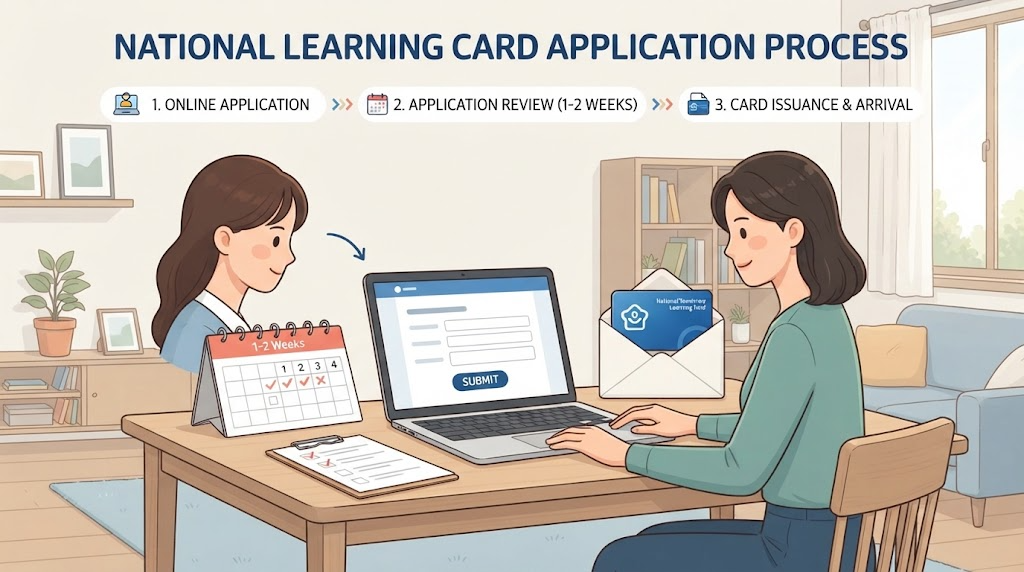
If there are no special issues, the review is usually completed within 1 to 2 weeks on a business day basis, and a notification text message (SMS) is sent upon completion of approval.
Step 4: Card Issuance Completion (Receiving Mobile and Physical Cards)
Once approval is granted, the Learning Card is finally issued through affiliated card companies (Shinhan, Nonghyup, etc.).
Issuance format: You can first be issued in the form of a mobile simple payment card that can be used immediately on your smartphone, or receive a physical card delivered by mail.
The issued card is linked with check card or credit card functions, and it does not operate in a way where government subsidies are pre-charged, but rather as an account concept where when you pay training costs when needed, they are deducted and applied by the support ratio.
Step 5: Exploring Desired Training Courses and Paying for Course Registration
Once you have the card in your hands, you can now search for the certification course you want to learn and start taking it in earnest.
Search for the government-supported certification course you want to take on HRD-Net or Goyong24.
Once you pay the self-payment portion and complete course registration, you can begin government-supported learning in earnest while fulfilling attendance rate conditions.
💡 Preview of the Next Chapter
Now that you have learned up to the application method, you are probably wondering how long it actually takes to get the card in your hands and what points you should watch out for so that approval is not delayed.
In the following section, we will closely examine the average required period and core tips for passing the approval review.
How Long Does It Take From Application to Final Approval? (Tips to Shorten the Period)
Once you have finished applying for the issuance of the National Employment Learning Card, one of the things you will be most curious about is, “So exactly how long will it take until the card comes out?” You are bound to feel impatient wondering if approvals will be delayed and cause you to miss your desired course opening date.
We will accurately point out the average required period and organize practical tips to prevent approval delays and shorten the period as much as possible.
- Average Required Period: Usually Takes 1 to 2 Weeks on a Business Day Basis
From the application for issuance of the National Employment Learning Card to final approval and card receipt, it generally takes about 1 to 2 weeks (7 to 14 days) on a business day basis.
Review period: Approximately 3 to 7 business days are required for the employment center officer’s qualification check and review process.
Production and delivery period: After card company approval, it takes an additional 3 to 5 days for the physical card to be produced and delivered by mail or for the mobile card to be issued.
However, during year-end and New Year seasons, new semester seasons, or job seeker countermeasure periods when application cases flock, the review queue may become longer and take a few days longer than usual.
- Main Causes of Approval Review Delays (Major Mistake Checkpoints)
If a review that you thought would finish quickly without issue has remained “in progress” for several days, you need to check whether it falls under the causes below.
Omission or error in required documents: Cases where document files are unclear or incorrect forms are attached during employment status or job change preparation processes.
Delayed verification of status and employment insurance insured person qualifications: Cases where job change or resignation processing is not completely finished, causing the status on the employment insurance system to be mismatched.
Incorrect contact information entry: Cases where the employment center officer called for verification but you were away or the number was wrong, causing the review to be placed on hold.
- Administrative Procedure Tips to Maximize the Reduction of Issuance Periods
To start taking classes without disruption on your desired government-supported certification course opening date, keep the following shortening know-how in mind.
Applying at least 3 weeks before the opening date: If you apply hastily right before classes start, card issuance delays can lead to situations where you miss the first week of classes or fail to pay your self-payment portion on time. Applying with leeway 3 weeks in advance is the safest.
Preparing required documents in advance: If there are certification documents required according to your employment status, have them ready in advance so you can attach them immediately right after applying.
Actively utilizing mobile issuance: Rather than just waiting for the physical card to be delivered by mail, if you are issued first as a mobile simple payment card through the smartphone app immediately upon approval completion, you can rapidly proceed with online lecture payments or course registration even before receiving the physical card.
💡 Preview of the Next Chapter
If you have safely completed card issuance and approval, now the final stage of successful government support application remains.
In the following section, we will guide you through the card validity period, precautions when using it, and attendance rates and completion criteria that must be checked before taking classes.

Practical Finishing Advice for Successful Government Support Applications
If you have smoothly completed all processes from National Employment Learning Card issuance to course registration, it is now time to run toward certification acquisition in earnest. We organize practical finishing advice that you must remember to 100% utilize the hard-earned government support opportunity and complete the course to the end.
- Frugally Managing the Card Validity Period (5 Years) and Support Limits
The issued National Employment Learning Card is not a disposable item to be used once and thrown away.
5-year validity period: Since it can be used effectively for 5 years from the issuance date, aside from the certification you are acquiring this time, you can leisurely prepare for other job-related training or additional certification courses that will help your career moving forward.
Checking balances and support scopes: Since it is a method of deduction within individual support limits (3 million to 5 million won), it is recommended to periodically check remaining support amounts and remaining limits through HRD-Net My Page to establish long-term self-development plans.
- Attendance Rates and Completion Criteria That Must Be Defended Before Taking Classes
The success or failure of government-supported training ultimately depends on “consistent attendance and completion.” You must be careful not to have your benefits canceled due to minor carelessness.
Maintaining a minimum 80% attendance rate: Although it varies by course, you usually must attend 80% or more of the total training time to be recognized as a normal course completion and fully receive training allowances.
Caution regarding penalties: If you fail to meet the attendance rate without justified reasons or drop out midway, you may suffer disadvantages not only in not receiving training allowances but also in future card re-issuance or support fund limits, so you must thoroughly manage mobile attendance checks (such as QR codes).
- Parallel Self-Directed Learning Without Relying Solely on Government Support
Government-supported academies or online lectures are merely reliable guides that build the framework; opening the door to final passing is your own effort.
Rather than hurrying just to keep up with class progress, utilize weekends or spare time to concurrently do repeated past exam question solving and incorrect answer note organization.
As much as you have put on the wings of the government’s reliable financial support, if you add your own will and thorough review habits, you can proudly achieve the goal of certification acquisition without financial burdens.
💡 Wrapping Up: The First Step of Self-Development Without Cost Worries!
So far, we have examined the entire process from government support application to qualification check verification, issuance procedures and period shortening tips, and successful course finishing advice.
If you follow the government support system step-by-step, which may have felt complicated, you can dramatically lower economic burdens and anyone can challenge desired certifications. Based on the contents confirmed today, try proudly starting a new challenge that you have postponed!
Do you happen to need English SEO metadata or blog thumbnail image AI prompts related to this post? Please feel free to tell us!
Korean version: 한국어로 읽기