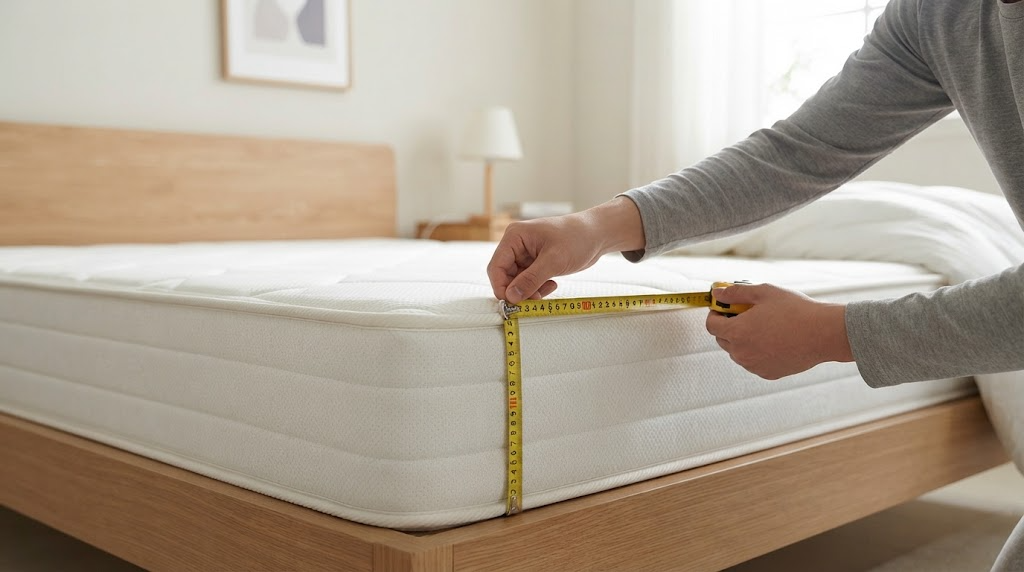
How to Dispose of a Mattress: Why Checking the Size Specs Comes First
A mattress is one of the most troublesome bulky wastes to handle during a move or furniture replacement. This is because it is bulky and quite heavy, and unlike regular waste or small appliances, it cannot be simply discarded anywhere.
When reporting to the community center or issuing a disposal certificate online, the most crucial and accurate piece of information you must enter first is the ‘mattress size.’ Here are two realistic reasons why you must thoroughly check the dimensions before discarding a mattress.
- Bulky Waste Fees That Vary Widely by Size (The Basis for Cost Calculation)
According to local government ordinances, bulky waste processing fees are determined differently depending on the type and size (specification) of the item.
While Single (S) or Super Single (SS) sizes typically incur a fee of around 10,000 to 15,000 KRW, fees for Queen (Q), King (K), Large King (LK), or large products combined with hot water or electric mats can rise from 20,000 up to over 30,000 KRW.
If you report roughly by eye without knowing the exact size and report a lower amount than the actual specification, the collection company may refuse pickup or subject you to fines, forcing you to do the work twice.
- Essential Information for Arranging Collection Vehicle Loading Space and Manpower
Due to the internal springs and filling materials, a mattress is quite heavy and bulky, requiring space to be efficiently loaded onto a truck like Tetris.
When collection companies or local government sanitation workers plan collection schedules and vehicle (such as a 1-ton truck) routes, they must understand the specified size and number of mattresses in advance to assign two workers or gauge whether equipment like a ladder truck is needed.
If a gigantic mattress that does not fit the specifications is left sitting at the site, it may not fit on the collection vehicle, leading to delayed collection or unfortunate incidents where additional labor costs are billed.
Tip. Before discarding a mattress, it is even more perfect if you briefly check your local government’s criteria on whether the frame and mattress must be separated and reported individually (most cases report the mattress size alone).
[AI Image Generation Prompt Guide for Insertion (16:9)]
Style: Clean, bright, and modern lifestyle photography, soft indoor daylight, professional service concept, text-free.
Scene Description: A close-up view of a measuring tape being used to check the dimensions of a clean modern mattress in a bright bedroom, preparing for disposal or moving. The composition is wide 16:9, highly professional, realistic textures, absolutely no text, no watermark, no logos.
Negative Prompt: Hangul text, messy room, dark shadows, low quality, cluttered background, cartoon style.
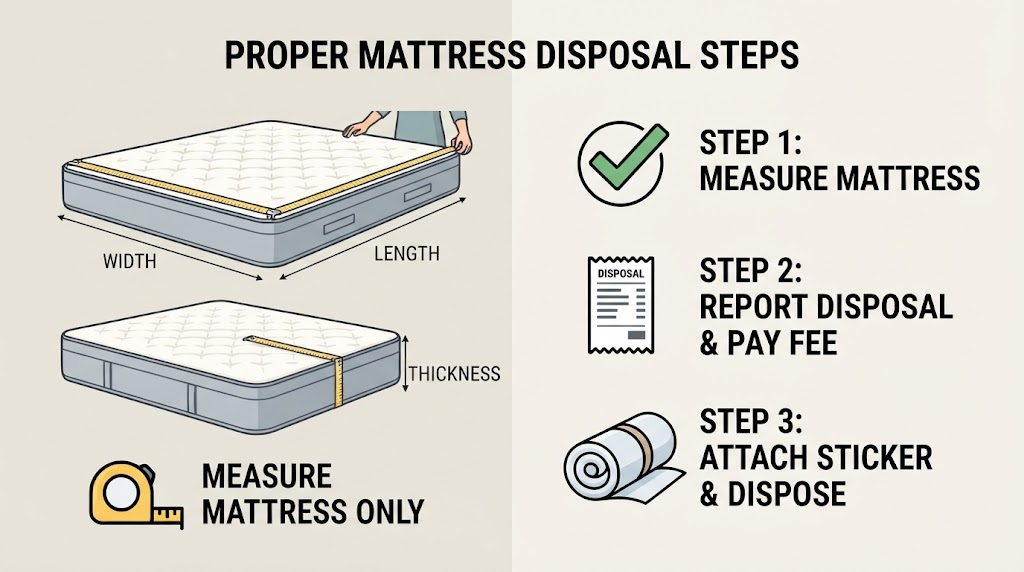
How to Accurately Measure Your Home Mattress Specifications
Even though you made up your mind to report bulky waste to discard your mattress, it is often confusing when you actually wonder, “Is our home mattress exactly a Super Single or a Queen size?” If specifications vary slightly by brand or labels have worn off from age, you are likely to run into trouble.
Here are three ways to accurately check and measure your home mattress specifications without getting rejected during local government reporting or facing pickup refusal.
- Compare with the Domestic Standard Mattress Size Chart
It is best to first check the approximate width and length to see where the mattress you used falls among domestic standard specifications. (※ Unit: cm)
Single (S): Width 1000 × Length 2000 (or 1900)
Super Single (SS): Width 1100 × Length 2000
Double (D): Width 1350 × Length 2000
Queen (Q): Width 1500 × Length 2000
King (K): Width 1600~1650 × Length 2000
Large King / Cal King (LK / CK): Width 1700~1800 or more
💡 Checkpoint: The most commonly used sizes domestically are Super Single (SS) and Queen (Q). Specification determination is over 90% complete just by roughly checking the width with a tape measure.
- Measure Width, Length, and Height Directly with a Tape Measure (The Most Reliable Method)
If it is old furniture or a product from an imported brand (Simmons US, Sealy, IKEA, etc.), there may be minor differences from domestic standard specifications. In such cases, you must pick up a tape measure and measure directly.
Measurement tips:
Measure the longest cross-section of the mattress’s width (left-to-right breadth) and length (top-to-bottom length) in a straight line.
In cases of premium mattresses that are sometimes excessively thick (such as pocket spring plus memory foam combinations), they may be classified as large or extra-large depending on the local government, so it is safer to also check the thickness (height) with a tape measure.
Measurement tip: With all mattress covers and blankets removed, you must measure based on the edge of the mattress body itself to avoid errors.
- Focus on the ‘Actual Mattress Measurement’ Rather Than the Bed Frame Specifications
Sometimes people make the mistake of measuring and reporting the size of the entire bed frame (including wood panels or headboard) instead of the mattress.
Because of the design or headboard, the bed frame is larger than the mattress by 10 to 20 cm or more on all sides.
Since the core item we need to discard when reporting bulky waste fees is the ‘mattress’ rather than the frame, you must select specifications based on the floor area of the mattress itself, not the frame size, to prevent pickup refusals at the site.
Tip. Precautions When Reporting to Local Governments
If the specifications are ambiguous when reporting online (via local government websites or smartphone apps), it is safest to report it as one size larger (e.g., if it is ambiguous for a Super Single, check if it qualifies for a Queen) or call the responsible department at the local community center. You can proactively prevent situations where reporting a lower specification results in additional fees or delayed collection.
[AI Image Generation Prompt Guide for Insertion (16:9)]
Style: Clean, professional lifestyle photography, bright indoor daylight, modern and orderly bedroom interior, text-free.
Scene Description: A person’s hands holding a yellow measuring tape across the width of a clean, neat mattress in a bright modern bedroom, taking exact measurements for waste disposal. Wide 16:9 aspect ratio, high resolution, realistic textures, absolutely no text, no watermark, no logos.
Negative Prompt: Hangul text, cluttered background, dark shadows, low resolution, messy room, cartoon style.
Differences When Disposing of Spring Mattresses vs. Memory Foam/Latex Mattresses
Although mattress exteriors may look similar, their weight, volume, and disposal precautions vary completely depending on the materials filling the interior. In particular, traditional spring mattresses and the widely used memory foam and latex mattresses of today differ in collection methods and key points to consider when reporting to local governments.
Here are the characteristics of both materials and the differences to keep in mind for proper disposal.
- ‘Spring Mattresses’ with High Weight and Disassembly Difficulty
Having been the most popular choice for decades, spring mattresses are densely woven with steel springs and wire structures inside, making them extremely heavy and bulky.
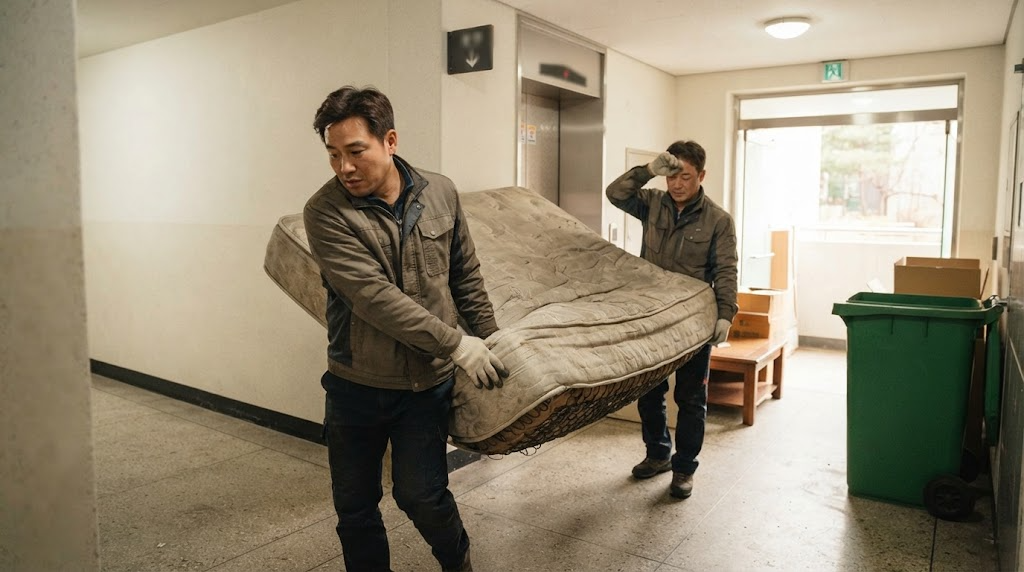
Disposal characteristics: Because of the steel springs, they are so heavy that even two workers struggle to carry them, and if springs are worn out and protruding, there is a risk of safety accidents or injuries during disposal.
Points to note: When reporting to local governments, you don’t just look at the size; the weight varies depending on whether it’s a continuous coil spring or an independent pocket spring. When discarding, it is safe to firmly tie it down with rope or tape so that the springs do not protrude before moving it to the designated location.
- ‘Memory Foam and Latex Mattresses’ That Are Easy to Roll or Fold but Require Caution
Composed of high-density foam or natural rubber materials, memory foam and latex mattresses may appear relatively lighter or more flexible than spring products, but there are precautions based on material characteristics during disposal.
Disposal characteristics: Some products have good elasticity and a degree of flexibility, allowing you to reduce volume by rolling or folding them. (However, thick, high-density memory foam can still be heavy.)
Core difference (Natural latex warning):
Natural latex mattresses can easily crumble or generate hazardous substances when exposed to sunlight (ultraviolet rays), so depending on the local government, special waste classification criteria may apply in addition to attaching regular bulky waste stickers.
Additionally, latex can produce toxic gases in the event of a fire and is processed differently from general incinerable waste, so it is safest to check whether your local government ordinance or bulky waste item list has a separate ‘latex’ category.
Tip. Summary of disposal by material
Spring mattress: Watch out for heavy weight and steel wire safety accidents (punctures), report accurately based on size, and discard after tightly binding.
Memory foam/latex: Volume may be relatively flexible, but for latex materials, report after checking if there are special regulations by local government.
[AI Image Generation Prompt Guide for Insertion (16:9)]
Style: Clean, professional interior lifestyle photography, bright daylight, modern bedroom setting, text-free.
Scene Description: A comparison concept showing a neatly cut cross-section of a mattress revealing inner pocket springs and high-density memory foam layers inside, placed on a clean wooden floor. Wide 16:9 aspect ratio, high resolution, realistic textures, absolutely no text, no watermark, no logos.
Negative Prompt: Hangul text, dark shadows, low resolution, messy dust, cartoon style, unrealistic graphics.
Online and Offline Mattress Disposal Fee Reporting and Discharge Procedures
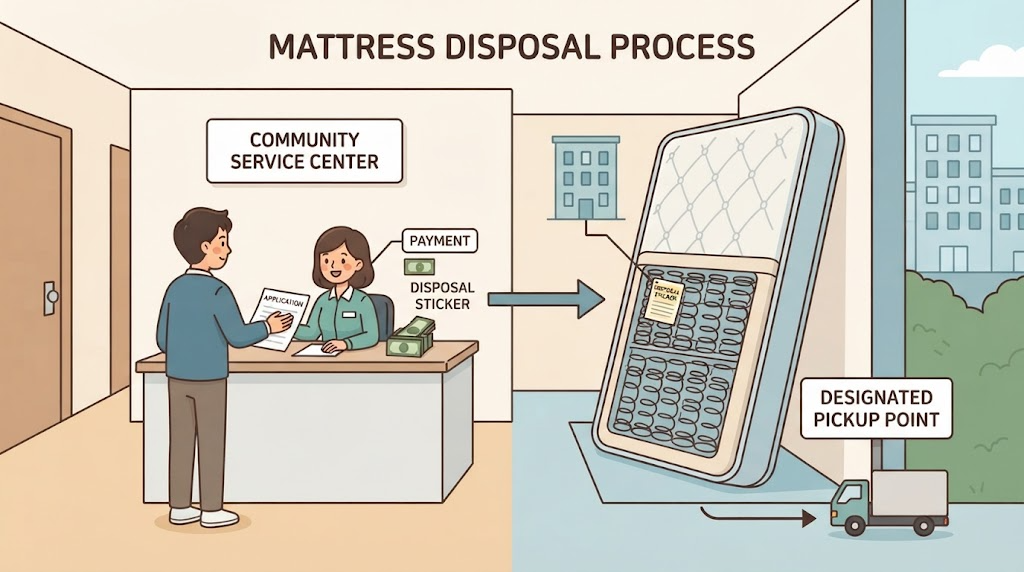
Once you have checked the mattress specifications and material, you must now report the bulky waste disposal fee to the competent authority and obtain a payment certificate (sticker). In the past, you had to visit the community center in person, but nowadays you can easily handle it using a smartphone or PC.
We provide a step-by-step guide to the offline and online procedures for reporting mattress disposal fees and discarding it correctly.
- Offline Reporting Method: Visiting the Administrative Welfare Center (Community Center)
This is the most reliable traditional method when you are not used to using the internet or find smartphone verification cumbersome.
Procedure:
Visit the civil petition office of the administrative welfare center (community center) with jurisdiction over your residence. (Bring your ID)
Fill out the bulky waste disposal report form with the mattress specifications (Single, Queen, etc.) and disposal location.
Proceed with cash or card payment for the bulky waste fee matching the specifications at the counter.
Receive the issued ‘payment certificate (sticker)’ and attach it to the surface of the mattress.
- Online Reporting Method: Local Government Website or Mobile App (Recommended)
This is the most preferred method as you can apply 24 hours a day, anywhere without having to fit a puzzle of time.
Procedure:
Access the ‘official website’ of your place of residence’s city/county/district office or run a regional-exclusive bulky waste disposal app (e.g., affiliated services like ‘Ppaegi’).
After signing up or completing identity verification, enter the ‘bulky waste disposal report’ menu.
Select ‘mattress’ from the item selection, and enter the accurate specifications (Single, Super Single, Queen, etc.) checked earlier along with the scheduled disposal date and location.
Pay the fee using a credit card or simple payment.
Write down the ‘payment certificate number’ displayed on the screen meticulously on a blank piece of paper, or print it out if printing is available and attach it to the mattress. (※ Recently, many local governments collect it even if you just write the number in large letters with a permanent marker.)
Tip. Points to Note When Reporting Online
When entering the disposal location, you must accurately write down your home’s detailed address and apartment building/unit number, or the collection base location in front of the villa so that collection drivers do not make a wasted trip. In addition, you must write down the ‘report certificate number’ assigned after reporting completion so that it is clearly visible using a permanent marker or oil-based pen instead of a water-based pen, ensuring it does not erase even if it rains or the wind blows and the paper gets wet.
[AI Image Generation Prompt Guide for Insertion (16:9)]
Style: Clean and modern minimalist lifestyle photography, soft indoor daylight, digital convenience concept, text-free.
Scene Description: A clean modern smartphone resting on a bright wooden table showing a digital waste disposal fee payment confirmation screen, with a sleek minimalist laptop nearby. Wide 16:9 aspect ratio, high resolution, realistic textures, absolutely no text, no watermark, no logos.
Negative Prompt: Hangul text, cluttered desk, dark shadows, low quality, cartoon style.
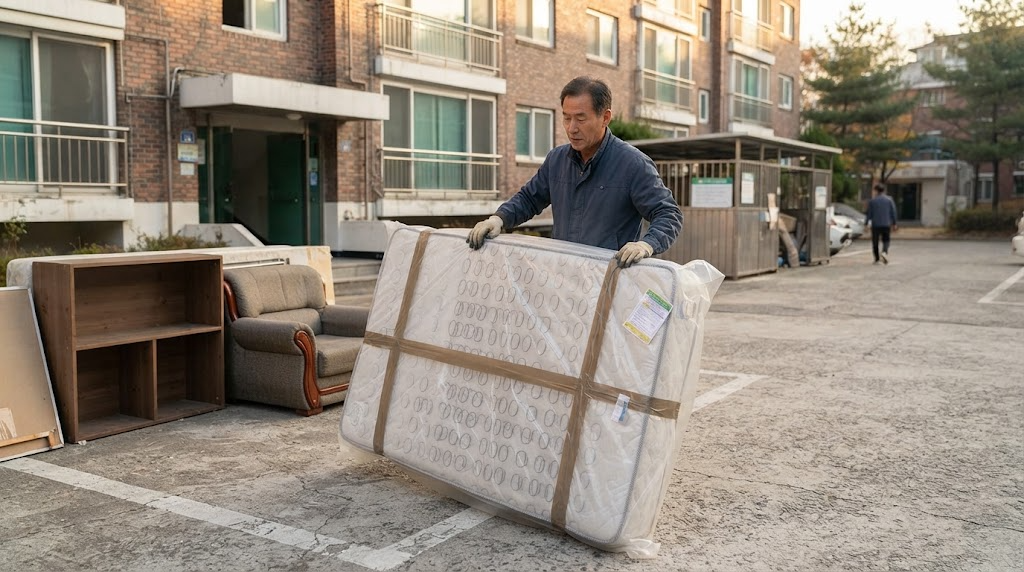
Summary of Collection Days, Disposal Locations, and Same-Day Collection Tips
Once you have finished reporting the bulky waste fee and attaching the payment certificate, only the final step remains: discarding it at the correct location on the designated date and waiting for collection. Because mattresses are bulky, casually selecting the collection day or location can result in missed pickups or inconvenience to neighbors.
We clean up and summarize everything from how to check collection days for successful disposal, selecting the right disposal location, to tips for dealing with rainy weather.
- Checking Local ‘Collection Days’ and Strictly Observing Disposal Times
In most cases, bulky waste is not collected every day like regular general waste.
Understanding collection cycles: Collection days by neighborhood (e.g., twice a week, specific designated days, etc.) are set by each local government or jurisdiction-affiliated outsourcing company. The ‘scheduled disposal date’ specified during online reporting must typically match the date when the collection company performs pickups.
Observing disposal times: Most regulations require disposing of items on the night before collection or early in the morning on the day of collection (usually before 6:00 AM to 8:00 AM). If you discard items late after the collection vehicle has already passed, they may be left unattended for nearly a week, so you must strictly observe the time.
- Selecting a ‘Designated Disposal Location’ Where Collection Drivers Can Easily Find It
Because mattresses are large and heavy, they must be placed where collection drivers can spot them at a glance for smooth collection to take place.
Single-family houses and villas: Place them upright in front of the front gate, in a corner of the building’s parking lot, or in front of the neighborhood-designated clean house (waste disposal base) without obstructing traffic.
Apartments: Discharge them at the bulky waste exclusive storage area within the apartment complex (usually near the recycling area). (※ For apartments, it is safest to inquire in advance as prior reporting or designated area confirmation through the management office is often required.)
Precautions: Placing them on alley corners, fire lanes, or spots that obstruct vehicle traffic can cause complaints, so make sure to lean them securely and closely against a wall as much as possible.
- Tips for Handling Mattresses During Rainy Weather
Spring mattresses and memory foam have properties that absorb water like a sponge, making them tremendously heavy if it rains on the day you plan to discard them.
Problems: A water-logged mattress increases in weight by two to threefold, making it difficult for collection drivers to lift, and depending on the local government, it may become a reason for weight excess or pickup refusal.
Solution tip: If rain is forecasted for the day before or the day of disposal, wrapping the mattress with a large vinyl sheet or waterproof cover (or large kimchi vinyl bags cut and taped together with tape) to prevent rain from soaking in before discarding is a smart approach.
Tip. When Local Government Collection Is Difficult (Utilizing Private Collection Services)
If you live in a high-rise villa without an elevator and the staircase width is too narrow for direct disposal, or if you need immediate same-day processing, using a private bulky waste collection and demolition specialist company is much safer and more convenient than reporting bulky waste to the local government.
[AI Image Generation Prompt Guide for Insertion (16:9)]
Style: Clean, bright, and modern minimalist lifestyle photography, soft morning sunlight, orderly urban residential neighborhood, text-free.
Scene Description: A clean, modern residential apartment building exterior with a designated neat waste disposal area under bright morning daylight, wide 16:9 aspect ratio, high resolution, realistic textures, absolutely no text, no watermark, no logos.
Negative Prompt: Hangul text, cluttered trash, dark shadows, rainy storm, low resolution, messy dust, cartoon style.
Do you need help organizing the overall HTML code or English SEO metadata (title, keyword, description) for this mattress posting?
Yes
Korean version: 한국어로 읽기