Introduction: The Charm of ‘Local Government Youth Monthly Rent Support,’ Distinct from Central Government Support
For young adults who have started living on their own, the monthly rent bill that comes out fixed every month is probably the biggest burden. Many of you have likely heard of or already applied for the ‘Youth Monthly Rent Special Support’ provided by the government.
However, did you know that “besides the central government subsidy, there are separate monthly rent subsidies doled out by your city, county, or district’s own budget”?
Many young adults miss out thinking that a single government project is everything, or give up when they narrowly fail due to slightly strict conditions. But if you look at the local governments where we reside (each city, city hall, and district office such as Seoul, Busan, Gyeonggi, etc.), there are independent monthly rent support projects hidden away that have much lower thresholds than central government policies or focus benefits exclusively on young adults residing in our neighborhoods.
“Wait, I regretfully failed the government subsidy due to income criteria, but could I pass my local government’s subsidy?”
“Yes, that’s right!”
Just by carefully examining whether double benefits are possible with the central government support project or which conditions are more advantageous to you, the destination of the subsidy stamped in your bank account every month can change.
In particular, the local government monthly rent support we will cover this time is often directly received through the jurisdiction’s city hall or district office, so only those who properly understand the system can take away the valuable benefits.
Then, how is it different from central government support, and how should we find our neighborhood’s local government subsidy? Let’s dig into it step by step starting now!

Differences from Government Support (Youth Monthly Rent Special Support) and Whether Double Benefits Are Available
“What on earth is the difference between the youth monthly rent support given by the nation and the local government monthly rent support run by each city and district office? Can I receive both at the same time?”
When you look into systems to save on studio apartment monthly rent, the part that becomes most confusing and curious is the difference between central government support projects and local government self-support projects. We will clearly organize the core differences between the two easily confusing systems and whether double benefits, which many people are curious about, are possible.
- Differences Between Government Support (Youth Monthly Rent Special Support) vs. Local Government Self-Support Monthly Rent Support
Sponsoring Ministry and Budget Source
Youth Monthly Rent Special Support (Government Support): This is a nationally certified representative welfare project hosted by the Ministry of Land, Infrastructure and Transport, carried out by injecting national funds and identical criteria for all young adults nationwide.
Local Government Youth Monthly Rent Support: This is a neighborhood-customized independent project operated with each city/province or city/county/district’s (e.g., Seoul Youth Monthly Rent Support, etc.) own ordinances and local government budgets.
Differences in Support Targets and Income/Asset Criteria
Government Support: Nationwide common criteria are applied very tightly, and you must satisfy all income and asset criteria of not only the youth’s own household but also the ‘original household’ including parents, which can sometimes make the threshold feel high.
Local Government Support: Criteria are flexibly adjusted according to circumstances by each local government. For example, instead of looking at original household income, they often look only at the youth independent household’s income criteria or relax the median income criteria compared to government support so that more young adults can benefit.
- The Most Important Question! Can You Receive Both Subsidies Simultaneously (Duplicate Benefits)?
To tell you the conclusion first, in principle, ‘duplicate benefits’ are mostly impossible between the central government’s ‘Youth Monthly Rent Special Support’ and each local government’s self-support monthly rent support project.
Reason: This is to prevent overlapping and excessive payment of cash-like welfare allowances for the same purpose (youth monthly rent support) even if national and local budgets are injected. If you are selected for both projects, you usually have to choose one according to the duplicate benefit prohibition rule, or support for other projects besides the one first applied for and disbursed is restricted.
Then Which One Should You Choose?
Comparison of Support Amount and Period: You must carefully compare government support (up to 200,000 won per month for 12 months, total 2,400,000 won) and your residing local government’s subsidy (monthly subsidy amount and period vary by local government).
Prioritizing Passing Possibility: If you think you will fail because government support criteria (original household income, etc.) are too strict, concentrating on local government self-support monthly rent support projects with relatively relaxed criteria is a much wiser strategy.
💡 Core Summary
Since duplicate benefits for the same purpose are restricted between government support projects and local government support projects, it is best to compare your income/asset conditions (whether parents’ incomes are combined, etc.) and the amount of each subsidy to select and target one system that is more advantageous and certain for you.
Then what exact eligibility requirements must you meet to apply where you and your residence belong? In the next chapter, we will take a detailed look at the specific eligibility requirements for local government youth monthly rent support.
Who Can Apply? Key Eligibility Requirements for Local Government Youth Monthly Rent Support
“They say the threshold is lower than central government support, but what conditions do I still need to meet to receive local government support?”
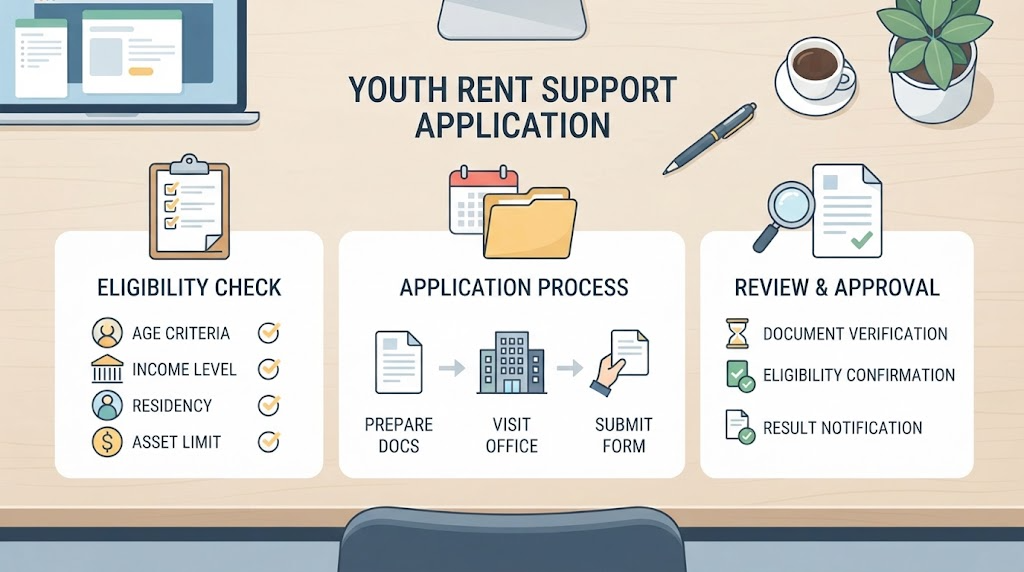
Even if you want to apply vaguely, you are confused whether you meet the qualifications, right? Although there are slight differences in detailed criteria among local governments such as Seoul, Gyeonggi, and Busan, we will easily organize the 3 core eligibility requirements commonly evaluated (age, residence and lease conditions, income criteria).
- Age Criteria: What Age Am I in International Age Years?
The first gateway that serves as the most basic foundation of local government monthly rent support is ‘age’.
Basic age range: The majority of local governments designate youth aged 19 or older to 34 or older, or 39 or older as targets.
Differences by local government: For example, Seoul sets the standard at ages 19 to 39, thus widening the age range slightly compared to the central government (ages 19 to 34) to often encompass new job seekers or office workers in their late 30s. You must definitely check the upper age limit on the announcement of the region where you reside.
- Residence and Lease Conditions: What Kind of House Should You Be Living In?
To receive subsidies, the form of your residence and the scale of the deposit and monthly rent must meet local government criteria.
Transfer of residence on resident registration: As of the application date, your resident registration address must be registered in the relevant local government (city, county, district). (Beware, as tricks by non-residents just moving their addresses can be caught during actual residence verification processes!)
Lease deposit and monthly rent limits: We cannot help youth living in infinitely expensive homes, right? They generally target homeless youth residing in housing with a deposit of 50 million won or less and monthly rent of 70 million won or less. (However, even if monthly rent exceeds 70 million won, some places meet criteria by combining deposit conversion amounts, so be sure to check detailed announcements.)
Home ownership status: Naturally, the youth themselves must be homeless, and if they own apartments or housing subscription rights, they are excluded from targets.
- Income and Asset Criteria: What Should My Income Level Be?
The reason why local government support projects are loved the most lies precisely in these income criteria.
Original Household vs. Youth Independent Household: While central government support often results in disqualifications by combining parents’ income (based on original households), many local government self-support projects evaluate based solely on ‘youth independent households (only my own income with household separation from parents).’
Meeting Standard Median Income: They apply relatively relaxed income criteria such as “150% or less of standard median income” or “120% or less.” Even if you have a little income from part-time jobs or internships, most young adults often comfortably fall within the baseline.
💡 Core Checklist for Eligibility Requirements
① Age: Are you between ages 19 and 39?
② Residence: Is your resident registration in the relevant city/district and are your deposit and monthly rent within the criteria?
③ Income: Is your independent household income within the median income criteria (e.g., 150% or less)?
If you nodded to these three conditions, you now have sufficient qualifications to knock on the door of the local government! Then, let’s check the specific procedures in the next chapter on how to actually apply at the jurisdiction’s city or district office and what documents to pull.

Methods for Visiting and Applying at Jurisdiction City/District Offices and Essential Preparation Documents
“I checked the eligibility conditions and decided to apply, but where on earth should I go and how should I apply? What other documents do I need to prepare?”
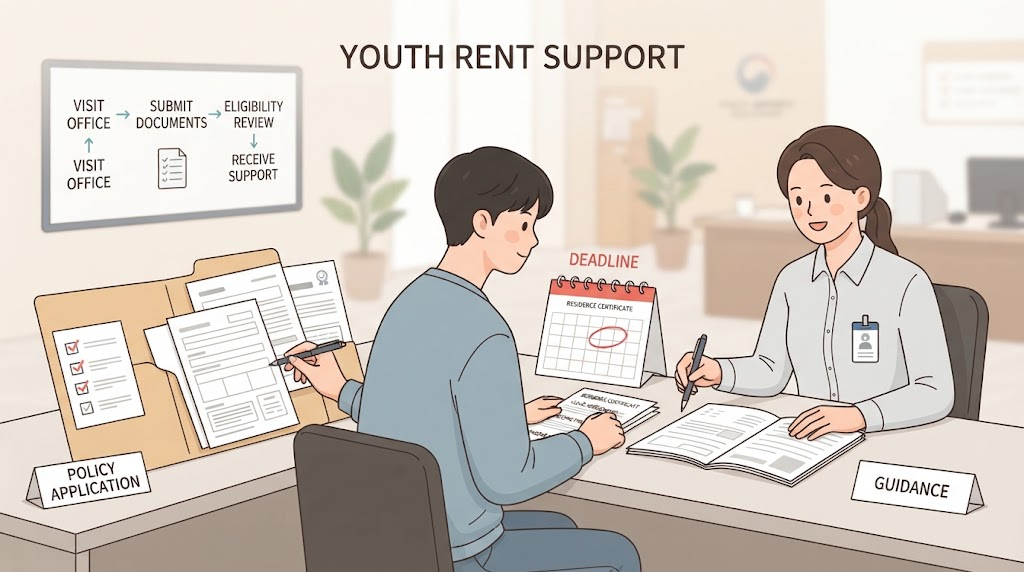
Even for young adults accustomed to online applications, a significant portion of local government projects proceed through visits to the jurisdiction’s city/county/district office (or community center) or local government-exclusive online integrated portals (e.g., Seoul Housing Portal, etc.).
We have carefully organized the application methods and essential required document checklist to help you finish your application successfully in one go without wandering around.
- Application Method: Online vs. Visiting Application, Where Should You Head?
Utilizing Local Government-Exclusive Online Portals:
In the case of Seoul, the ‘Seoul Housing Portal’, and in Gyeonggi, related youth platforms and other welfare/housing-exclusive homepages operated independently by each local government exist. The most popular method is to log in with a joint certificate according to the announcement period, fill out an online application form, and upload documents as image files.
Visiting Application at Jurisdiction City/City Hall/District Office or Eup/Myeon/Dong Administrative Welfare Center:
If using the online system is difficult, or if on-site application is mandatorily required under local government guidelines, you must directly visit the city hall, district office, or dong community center with jurisdiction over your residence. Be sure to accurately check the reception desk on the current year’s local government youth monthly rent support announcement before visiting!
- Essential Required Document Checklist That You Must Not Miss
What determines the success or failure of subsidy review is accurate document submission. Based on documents issued after the announcement date, check the list below without omission.
① Resident Registration Transcript and Abstract:
Essential to prove your resident registration address history and relationship with the head of the household. (Be careful when issuing, as abstracts including address change histories are often requested.)
② Lease Agreement (Including Confirmation Date):
This is a copy of the lease agreement for the housing you currently reside in, and the deposit amount, monthly rent amount, and contract period must be clearly stated. Check in advance whether the move-in report and confirmation date have been completed normally.
③ Monthly Rent Payment Supporting Documents (Bank Transfer Details, Etc.):
This is a bank transfer confirmation slip or non-bank deposit slip proving that you have normally paid monthly rent to the lessor (landlord) for the past few months.
④ Family Relations Certificate (Detailed):
This may be requested depending on independent household requirement reviews, relationship verification with parents, or local government detailed guidelines.
⑤ Copy of Applicant’s Bankbook:
This is a copy of the account in your name where subsidies will be deposited when finally approved.
💡 Practical Tips for Document Preparation
It is safe to prepare all documents as recently issued ones (within the last 1-2 weeks) after the announcement is dropped by the organization with jurisdiction over your resident registration address. You can issue them easily and quickly by using Government24 (gov.kr) or unmanned issuance machines.
Can you rest assured if you prepared the documents perfectly and finished applying? Wait a moment! There are critical precautions that you must never miss during the application process. Let’s check them out in the next chapter.
Practical Tips & Disqualification Prevention Tricks You Must Know When Applying
“If you checked all eligibility conditions, prepared your documents perfectly, and applied, but ended up disqualified in the final review or failed to receive the subsidy because of a single trivial mistake, there would be nothing more unfair than this.”
Because local government youth monthly rent support projects often close on a first-come, first-served basis or have limited budgets, small carelessness can lead to disqualification. We share practical anti-disqualification tips to help you grab the necklace of passing in one go without throwing away your hard-prepared opportunity!
- Beware of the Application Period and ‘First-Come, First-Served Deadline’ Trap
Early closure if you take it easy: Local government monthly rent supports usually accept applications only for a brief period during the year (e.g., first and second halves). Since it is very common for applications to close much earlier than the announced deadline once budgets are exhausted, it is safest to apply quickly within 1 to 2 days as soon as the announcement drops.
Setting alarms is a must: Apply for advance notifications on the homepage of the city, county, or district office where you reside or youth-exclusive portals (e.g., Seoul Housing Portal, etc.), or check local government blog and SNS announcement schedules on your calendar in advance.
- Matching Perfect Consistency Between Lease Agreement and Move-in Report Date
Move-in report is mandatory as of application date: Your resident registration address must 100% match the address on the lease agreement of the housing where you actually reside. Sometimes unfortunate cases occur where moving was done first, but the move-in report was processed a few days late, causing issues on the screening criteria date.
Beware of unauthorized and illegal buildings: Neighborhood living facilities (gosiwon, commercial stores, etc.) or illegal buildings where moving-in reports are entirely impossible can be fundamentally excluded from local government support targets even if a lease agreement exists, so you must check before signing.
- Meticulously Preparing Monthly Rent Payment Proofs
Cash transactions are forbidden: If you paid monthly rent directly in cash to the landlord or via a method leaving no proof, you will hit a major roadblock during subsidy screening. Records of monthly transfers from an account in your name to the landlord’s account (transfer confirmation slip, transaction statement) must clearly remain. If there are omissions in transfer records, organize your bankbook transaction history in advance.
- Checking Local Government Duplicate Support Restriction Regulations
If you have a history of receiving similar housing subsidies previously from the central government’s ‘Youth Monthly Rent Special Support’ examined earlier or from other local governments in the past, it will not be recognized as duplicate, leading to recovery measures or exclusion from selection. Wisdom is needed to carefully cross-reference any welfare benefits you are currently receiving.
💡 Summary of Final Passing Tips
Apply at the speed of light as soon as the announcement drops (within 1-2 days)
Triple check whether your resident registration address, actual residence, and lease agreement match
Perfectly equip supporting documents such as monthly rent transfer records
If you remember all these precautions and prepare thoroughly, you will be able to proudly seize the reliable monthly rent support benefits provided by our neighborhood local government! Now, shall we check the warm concluding remark decorating the grand finale of the post?

Conclusion: Don’t Miss Out on Our Neighborhood’s Hidden Benefits and Cleverly Secure Them
So far, we have looked together at everything about the local government youth monthly rent support project received through jurisdiction city halls and district offices.
Monthly rent that sweeps past and leaves bank accounts every month is always the heaviest and most burdensome fixed expenditure for young adults living on their own. For those who had to turn back with regret because the central government’s support conditions were too strict, today’s introduced local government self-support monthly rent support project in our neighborhood will serve as a precious opportunity like rain in a drought.
Shall we briefly retrace today’s content once more?
First, understand the differences between central government support projects and local government support projects, and choose the system more advantageous to your conditions.
Second, meticulously check core eligibility requirements such as age, independent household income criteria, residence and lease deposit/monthly rent limits.
Third, submit documents at the speed of light as soon as the announcement drops through jurisdiction city/district office visiting receptions or exclusive online portals.
Welfare systems do not reach out a hand first to those who wait idly. Even if it feels a bit cumbersome and requires footwork, only young adults who properly understand the system and move smartly can make hidden, high-value benefits entirely their own.
I sincerely hope this post served as a reliable compass to coolly relieve your light wallet and heavy monthly rent worries. If you have any questions during the preparation process, please feel free to leave a comment anytime, and I cheer for everyone to cleverly secure our neighborhood’s hidden subsidy benefits and complete a comfortable nest without worries about housing costs!
Korean version: 한국어로 읽기