
Overview and Basic Purpose of the Government-Funded Support (National Tomorrow Learning Card) System
Amid a rapidly changing employment environment and pace of technological advancement, the importance of lifelong vocational skill development is growing day by day. Accordingly, the government operates a representative vocational training support system so that citizens can develop their vocational skills on their own and flexibly respond to the changing labor market.
Let’s examine the overview and introduction purpose of the government-funded support system centered on the National Tomorrow Learning Card.
- Definition and Core Outline of the National Tomorrow Learning Card System
System Definition: A vocational training-exclusive card system in which the state supports part or all of the training costs to adapt to rapid technological changes and support lifelong vocational skill development.
History of Integrated Operation: In the past, cards for job seekers and employees were bifurcated, making issuance and management cumbersome. However, with the system unified into a single ‘National Tomorrow Learning Card’, any Republic of Korea citizen can receive vocational training benefits when needed.
- Introduction Purpose and Objectives of the System
Self-directed Career Development: Moving away from state-led unilateral training support, it helps individuals proactively select and design training courses that suit their aptitude and career path.
Establishment of a Lifelong Vocational Competency Framework: It provides a lifelong learning safety net “from cradle to grave” that encompasses resolving youth unemployment, strengthening re-employment capabilities for prospective retirees and middle-aged/elderly individuals, and improving the job skills of incumbent workers.
Strengthening Labor Market Connectivity: By supporting the development of practical competencies required in actual industrial fields beyond simple theoretical education, it provides job seekers with smooth entry into the labor market and offers employees employment stability and career advancement.
State-of-the-art vocational training support is essential for building a resilient workforce. If you would like to proceed with the next section or adjust the tone of the draft, please let me know!
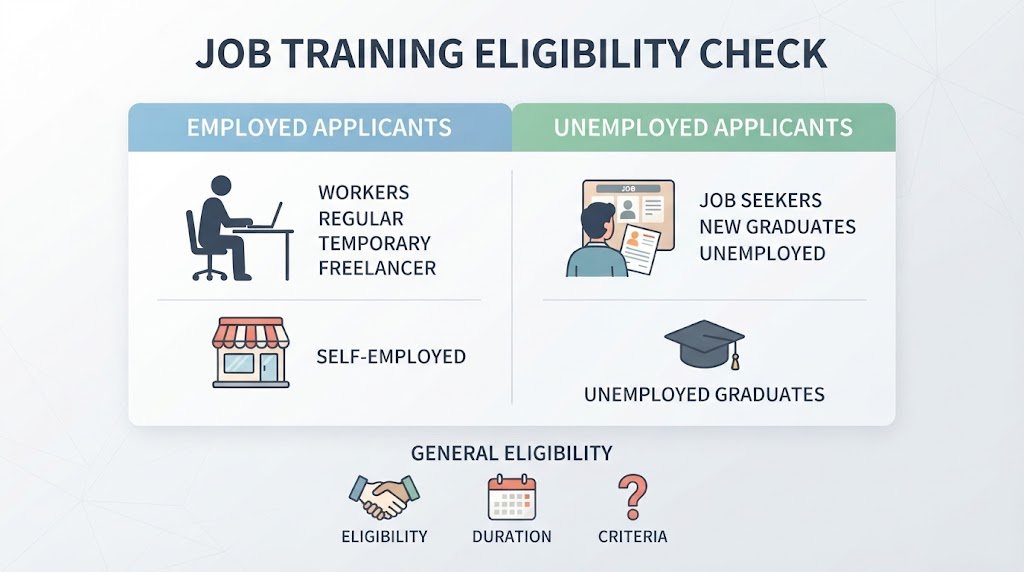
Eligibility and Target Audience (Who Can Apply?)
One of the greatest charms of the National Tomorrow Learning Card is that its target audience is very broad. In the past, cards for the unemployed and employees were separated and the eligibility requirements were strict, but now the doors are widely opened so that any citizen of the Republic of Korea can develop their vocational skills.
Let’s take a detailed look at the eligibility requirements to see specifically who can apply.
- Basic Principle of Target Audience (Any Citizen of the Republic of Korea)
In principle, anyone who is a citizen of the Republic of Korea can apply for and use the National Tomorrow Learning Card.
Regardless of whether you are a job seeker or an employee, basic eligibility for issuance is granted to citizens who wish to receive vocational training, and you can enjoy wide-ranging benefits regardless of changes in employment status or preparations for changing jobs or careers.
- Detailed Types by Major Support Target
Job seekers: Unemployed job seekers looking for a job and prospective new job seekers
Employees (Workers): Small and medium-sized/large enterprise employees, non-regular workers, special employment type (special employment) workers, freelancers, etc.
Self-employed individuals: Sole proprietors and self-employed small business owners meeting certain income requirements
Other targets: Prospective graduates and graduates of universities (graduate schools) who are unemployed
- Exclusion Targets (Cases Where Application Is Restricted)
Although it is a system that anyone can apply for, issuance is restricted for some individuals for public purposes or to prevent duplicate support with other systems.
Public officials and private school faculty members
High-income self-employed individuals whose annual sales exceed a certain standard
Elderly persons aged 75 or older (however, exceptions may apply depending on certain courses and local government standards)
Those subject to compulsory education under laws or certain individuals meeting special conditions among livelihood benefit recipients, etc.
If you meet the eligibility requirements, anyone can apply for a card through the Vocational Training Portal. Next, we will clearly compare the differences in support conditions and benefits between employees and the unemployed.

Comparison of Support Conditions and Benefits: Employee vs. Unemployed
The National Tomorrow Learning Card is issued to both job seekers (the unemployed) and employees (workers), but there are several differences in the support conditions, self-pay rates, and additional benefits applied when receiving training.
We will clearly compare item by item what conditions and benefits apply according to your current employment status.
- Comparison of Application and Training Participation Eligibility
Unemployed (Job Seekers):
The targets are job seekers who currently do not have a job or are not enrolled in employment insurance, and those who have completed job seeker registration with the Ministry of Employment and Labor.
Since they are in an unemployed state, they have relatively flexible time and can participate without restrictions in full-time (group) training courses conducted during the day or practical-centered intensive courses.
Employees (Workers):
This includes regular and non-regular workers in large and small-to-medium enterprises, fixed-term workers, as well as special employment type (special employment) workers, freelancers, and sole proprietors.
Since they must balance work and study, they have a high proportion of choosing night classes, weekend classes, or non-face-to-face (online) training courses that can be taken mainly after get-off work.
- Differences in Training Cost Support Rates and Self-Pay Amounts
Basic Support Limit: Both job seekers and employees are basically granted an account limit of 3 million KRW up to a maximum of 5 million KRW per person equally.
Differences in Self-Pay Amounts:
The basic support rate for training costs is applied differently depending on the employment rate (or completion rate) by job category.
In the past, there was a large gap in the self-pay rates between employees and the unemployed, but nowadays, for the same training course, the self-pay rate is often determined by the employment rate and standards of the relevant job category rather than the employment status (employed/unemployed). However, for employees, some differences in support rates may occur depending on the size of their employing company (whether it is a large enterprise, etc.) or employment insurance insured status.
- Comparison of Additional Support Benefits (Training Allowances, etc.)
Preferential Benefits for the Unemployed (Job Seekers):
Job seekers who take long-term training courses of 140 hours or more and meet the attendance rate requirement (an attendance rate of 80% or higher) are paid a training allowance (up to a certain amount per month) to help stabilize their livelihood. (However, duplicate payment may be restricted during certain periods while receiving unemployment benefits or having income)
Key Points for Employees (Workers):
Rather than training allowances of a livelihood support nature, employees focus on employment retention and career development, such as support for reduction of working hours or connection to employer-commissioned training when taking vocational training to strengthen work competencies.
💡 Tip: Choosing the Course That Is Advantageous to Me
The range of training courses you can take does not change depending on whether your employment status is employed or unemployed. However, since whether you can receive government livelihood support (training allowance) while taking training or whether you can coordinate with your working hours is key, it is most accurate to enter your status on HRD-Net (Employment 24) in advance to check the expected self-pay amount and training allowance payment status for each course.

Understanding the Structure of Training Cost Support Rates and Self-Pay Amounts
One of the things people are most curious about when receiving vocational training using the National Tomorrow Learning Card is, “How much is supported by government funds, and how much is the money I have to pay myself (self-pay amount)?”
To ease the economic burden on trainees and encourage voluntary participation, the government operates a systematic support limit and a differentiated self-pay system. We will organize this structure in an easy-to-understand way.
- Basic Account Limit: 3 Million KRW to a Maximum of 5 Million KRW per Person
Account Issuance and Validity Period: When you are issued a National Tomorrow Learning Card, a basic training cost support limit of 3 million KRW is granted. The validity period of the account is 5 years from the date of issuance.
Additional Support Limits (Up to 5 Million KRW): For vulnerable groups in employment such as low-income individuals, fixed-term, dispatched, and part-time workers, and workers in employment crisis areas, or those who meet specific requirements, an additional amount of 1 million KRW to 2 million KRW is supported through screening, increasing the limit up to a maximum of 5 million KRW.
- Method of Determining Training Cost Support Rates (Self-Pay Structure)
Although there are cases where government-funded support is completely free, most courses apply a self-pay system where you pay a certain percentage of the training cost yourself.
Employment Rate-Linked Method: The self-pay rate for training costs is determined by the employment rate and standards of the job category to which the training course belongs, rather than whether the individual is an employee or unemployed. (The higher the employment rate of a promising job category, the higher the government support rate, lowering the self-pay amount.)
General Self-Pay Rate: Typically, a personal burden occurs at the level of 15% to 55% of the training cost, and you can check the exact amount in advance on the detail page of the course you wish to take.
- Major Exception Requirements to Reduce or Be Exempted from Self-Pay Amounts
For some individuals, the self-pay amount can be significantly lowered or completely exempted to complete training entirely with government funds.
Participants in the Employment Success Package (or National Employment Support System): Benefits where the self-pay amount is exempted or reduced according to the type are applied.
Low-Income and Vulnerable Groups: For job seekers or workers below a certain standard of median income, the self-pay amount is significantly relaxed.
National Key and Strategic Industry Job Training: Training courses in national core industrial fields where human resource development is urgent are often operated with full exemption of training costs (0 KRW self-pay amount), allowing you to learn professional skills without economic burden.
💡 Tip: How to Check Your Expected Self-Pay Amount
Since the self-pay amount varies for each training course, rather than applying blindly, it is most accurate to search for the course you wish to take on the HRD-Net (Employment 24) website and utilize the [Government Support Fund and Self-Pay Calculator]. You can simulate the actual payment amount in advance according to your card type and whether you are eligible for reductions.

Application Method and Essential Preparation Procedures (Utilizing Employment 24 and HRD-Net)
If you have grasped the eligibility requirements and benefit structure of the National Tomorrow Learning Card, it is now time to learn the specific procedures for actually receiving the card and applying for training courses.
We will guide you step by step through how anyone can easily apply through the online integrated platform and the essential preparations required.
- Preliminary Preparation Stage: Membership Registration and Job Seeker Registration
Preparation of Joint Certificate (or Financial Certificate): A certificate in your own name is essential for logging into the government support portal service.
WorkNet Job Seeker Registration (for Job Seekers):
If you are currently unemployed or have the status of a job seeker, you must first register your resume on WorkNet and complete the job application so that the National Tomorrow Learning Card issuance screening proceeds smoothly. (For employees, this step may be omitted or simplified.)
- Online Application Method (Utilizing Employment 24 and HRD-Net)
In the past, there was the inconvenience of having to visit an employment center in person, but now 24-hour non-face-to-face application is possible through the ‘Employment 24’ or ‘HRD-Net (Vocational Training Portal)’ website.
- Site Access and Login: Access the official website of Employment 24 or HRD-Net, authenticate your identity, and log in.
- Move to National Tomorrow Learning Card Application Menu: Click on the ‘National Tomorrow Learning Card Issuance Application’ corner.
- Fill out the Application Form and Attach Documents: Enter required items such as personal information, employment status, and whether you are employed, and attach supporting documents (certificate of employment, appointment documents, etc.) if necessary.
- Issuance Screening and Approval: After the competent employment center screens the eligibility requirements and approval is completed, the card is issued. (Since it usually takes about 1 to 2 weeks from application to issuance, it is recommended to apply with plenty of time before the training start date.)
- Precautions When Applying Offline (Visiting Employment Welfare Plus Center)
If online application is difficult, or if review of additional supporting documents is necessary due to your special employment type (freelancer, special employment worker, etc.), you can apply by visiting the competent employment welfare Plus center in person.
When visiting, you must bring your ID card, a bankbook in your name, and employment or job seeker proof documents so that you do not make a wasted trip.
- How to Apply for Training Enrollment After Receiving the Card
After receiving the card (or receiving a mobile card), access HRD-Net again to search for the desired training course.
After selecting the course you wish to take, click the [Enrollment] button, and pay the self-pay amount matching your card type to complete final registration.
💡 Tip: Most Important Precautions When Issuing a Card
The National Tomorrow Learning Card is not issued immediately upon application, as a qualification review period is required. If you apply close to the opening date of the training course you want to take, the card may not come out and you might miss enrollment, so you must complete your application at least 2 to 3 weeks before the opening date to safely participate in the desired class.
Korean version: 한국어로 읽기