
What is Beotimmok Jeonse Loan Refinancing (Conversion)?
The heaviest burden that comes with maintaining a Jeonse lease contract is undoubtedly the monthly interest expense. In particular, tenants suffering from the burden of interest due to high-interest periods or high Jeonse loan rates from general commercial banks are paying close attention to the Beotimmok Jeonse Loan refinancing (conversion).
By refinancing your existing loan with the Beotimmok Jeonse Loan—a representative housing stability product for ordinary citizens supported by the Housing and Urban Fund—we clearly and easily summarize the concept and core structure of how much you can alleviate your interest burden.
- Concept of Jeonse Loan ‘Refinancing (Conversion)’
In a word, refinancing means “getting a new loan with a lower interest rate to pay off your existing expensive loan.”
Existing situation: When paying interest at a high rate of around 5-7% per annum using a secondary financial sector Jeonse loan or a general commercial bank product
After refinancing: Transitioning to a structure where you receive approval for the government-supported Beotimmok Jeonse Loan (low interest rate around the 2% range per annum), repay the existing loan in full, and subsequently pay interest at the low rate of the Beotimmok product.
- Why Beotimmok Refinancing is Gaining Attention (Expected Effects)
Compared to commercial bank products, the Beotimmok Jeonse Loan, which is a fund loan, has very high interest rate competitiveness because the government provides secondary compensation (interest support).
Dramatic reduction in monthly interest burden: As interest rates drop by several percentage points, you can significantly reduce the interest expenses regularly paid every month.
Strengthening housing stability: You can escape the risk of an interest bomb that may occur during interest rate hike periods and establish a stable repayment plan for 5 years (maximum period including extensions).
Additional preferential treatment for youth and newlyweds: Beyond general households, additional preferential interest rate benefits are applied for youth, newlyweds, and newborn-child households, making the perceived benefits even greater.
- Who Can Use It? (Brief Summary)
Not all Jeonse loan users can unconditionally switch to Beotimmok.
Existing loan usage requirements: Tenants who are already using a Housing and Urban Fund Jeonse loan (such as Beotimmok), or those using a general bank Jeonse loan while meeting the government-set Beotimmok subscription requirements (income, assets, deposit limit, etc.)
Contract renewal timing: Since applications are often made when renewing a Jeonse contract or within the allowable refinancing period, checking your contract period and loan execution timing in advance is essential.
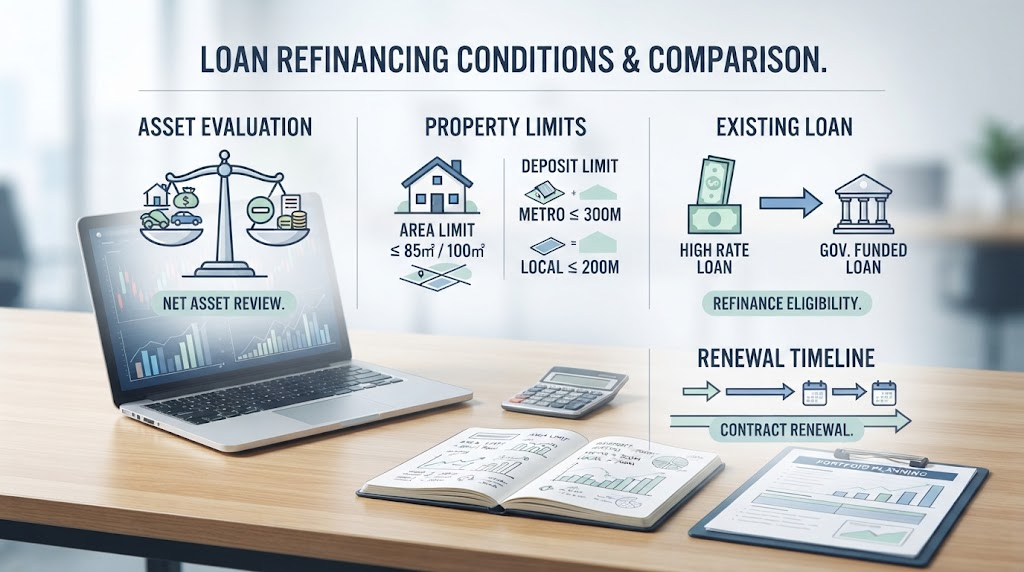
Main Conditions for Beotimmok Jeonse Loan Refinancing (Eligibility and Target)
To switch your existing loan to the Beotimmok Jeonse Loan (refinancing) and enjoy low-interest benefits, you must meet all strict eligibility requirements (income, assets, and housing criteria) set by the Housing and Urban Fund.
Let’s carefully check item by item the core criteria to see if you are indeed included in the application target.
- Basic Eligibility and Income Requirements (Combined Spouse Basis)
The Beotimmok Jeonse Loan is evaluated based on the combined income of the applicant and spouse. Income criteria differ depending on household characteristics.
General household: Combined annual income of 50 million won or less for spouses
Newlywed household: Combined annual income of 75 million won or less for spouses
Youth household (Ages 19 to 34 inclusive): Annual income of 50 million won or less based on a single head of household (single earner or unmarried basis)
Newborn-child households and public institution employees transferring to Innovation Cities, etc.: Separate upwardly adjusted income criteria applied (for newborn-child households, relaxed application up to an annual income of 100 million won or less)
- Asset Screening Requirements (Asset Criteria)
Not only your income, but your total asset value must be below the government standard for you to be selected as a refinancing target.
Asset criteria: Housing and Urban Fund asset standard amount (usually net asset value of 345 million won or less, subject to annual Housing and Urban Fund notification standards)
Evaluation target: Screened based on net assets calculated by subtracting liabilities from the total sum of real estate, automobiles, financial assets, and general assets.
- Leased Housing and Deposit Requirements
The Jeonse house subject to refinancing must also meet area and deposit limit restrictions.
Housing area restriction: Housing with a dedicated area of 85 square meters (m²) or less (however, up to 100 square meters or less is possible in eup and myeon regions)
Lease deposit limits:
Metropolitan area (Seoul, Gyeonggi, Incheon): 300 million won or less (400 million won or less for newlyweds and newborn-child households)
Provinces (non-metropolitan areas): 200 million won or less (250 million won or less for newlyweds and newborn-child households)
- Existing Loan Holding and Usage Conditions
Since this is a process of switching to Beotimmok while already receiving a Jeonse loan, conditions related to the existing loan must also be checked.
Eligible loans for refinancing: Tenants using secondary financial sector high-interest Jeonse loans or general Jeonse loans from commercial banks
Contract renewal and period requirements: It is common to apply at the time of renewing (re-signing) the lease contract or within the allowable loan execution period, and smooth screening requires no delinquency history or legal disputes on the existing loan.

Refinancing Handling Characteristics by Major Commercial Bank (Woori, Kookmin, Shinhan, Hana, Nonghyup, etc.)
Although the Beotimmok Jeonse Loan is a government-supported product whose source is the Housing and Urban Fund, actual loan screening and execution are carried out through entrusted commercial banks such as Woori, Kookmin, Shinhan, Hana, Nonghyup, Daegu, and Busan Bank.
While the common standards set by the fund are identical, there are subtle differences among banks in non-face-to-face (app) application convenience, core product linkage, and offline counter response tendencies. We compare the refinancing handling characteristics of the top 5 major commercial banks.
- Woori Bank (Representative Leader of Fund Entrusted Banks)
Characteristics: As the managing bank for the Housing and Urban Fund, it has the most abundant experience and know-how in Jeonse loan operations.
Handling Tendency: Document reviews and Q&As requested during the refinancing screening process are systematic, and you can stably receive fund loan consultations at all branches nationwide.
Utilization Tip: Since Woori Bank supports preliminary document submission and some non-face-to-face processes through its WON Banking app, it is a good idea to check availability via mobile before visiting.
- Kookmin Bank (KB) (Vast Operating Network and Intuitive Process)
Characteristics: Conducts stable refinancing screenings based on vast customer data and a thorough risk management system.
Handling Tendency: When checking loan limits and estimating interest, the interface of the KB Star Banking app is intuitive, making it convenient to run simulations in advance.
Utilization Tip: When visiting a branch counter, it is safe to carefully receive guidance on additional document requirements such as a financial transaction confirmation or liability certificate for the existing loan targeted for refinancing.
- Shinhan Bank (Strong in Digital Non-Face-to-Face Processes)
Characteristics: Well-equipped with non-face-to-face document submission and screening linkage systems through its mobile app (SOL Banking).
Handling Tendency: Highly preferred by office workers who want to minimize branch visits and conveniently check the progress of their Beotimmok refinancing screening using their smartphones.
Utilization Tip: Since scraping (automatic document collection based on official certificates) errors can sometimes occur when applying for non-face-to-face refinancing, it is advantageous to prepare employment certificates or income amount certificates as image files or PDFs in advance.
- Hana Bank (Customized Consultation and Preferential Interest Rate Linkage)
Characteristics: Tends to meticulously look after preferential interest rate conditions linked to its own flagship products, such as salary check cards and youth-preferential savings accounts.
Handling Tendency: Rather than stopping at just a fund loan, it details auxiliary transaction conditions that may arise during the refinancing process (such as automatic transfers and credit card usage), making it suitable for customers who want to lower their interest rate by even an additional 0.1 percentage point.
Utilization Tip: You can reduce waiting times by checking refinancing availability and expected limits in advance through the Hana OneQ app, and then booking a visit to a nearby branch that fits your conditions.
- Nonghyup Bank (NH) (Favorable Accessibility in Regional and Local Hubs)
Characteristics: Secures the densest offline operating network among commercial banks, reaching rural and provincial small-to-medium cities.
Handling Tendency: It is easiest for tenants living in regional areas as well as the metropolitan area to receive refinancing consultations, and it has extensive practical experience in applying deposit and housing requirements by region.
Utilization Tip: Since local agricultural cooperatives (unit agricultural cooperatives) and NH Nonghyup Bank are legally separate institutions, when proceeding with the Beotimmok Jeonse Loan refinancing, you must verify that it is an ‘NH Nonghyup Bank’ counter before visiting. (Unit agricultural cooperatives are often unable to handle fund loans.)
💡 Tip: Things to Consider When Choosing a Bank
The base interest rate and limit of the Beotimmok loan are identical regardless of which bank you go to, according to the Housing and Urban Fund rules. Therefore, when choosing a bank to receive your loan, the wisest choice is to select based on ① a place you regularly use as your main bank for convenient document linkage, ② a place easy to visit because it is near your workplace or home, or ③ a place with a well-functioning non-face-to-face refinancing support system in its app.
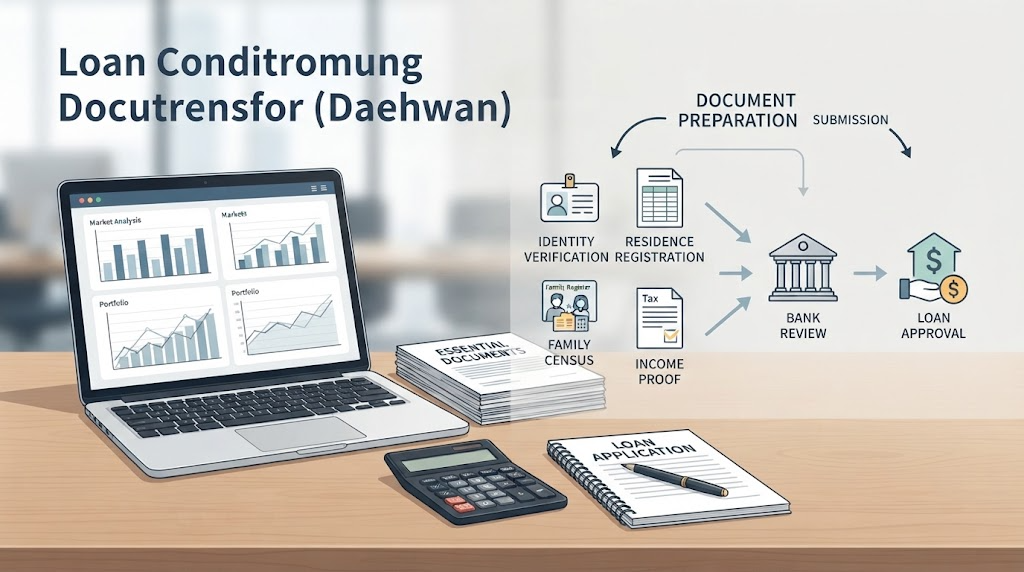
Complete Summary of Essential Required Documents When Applying for Refinancing
When visiting a commercial bank branch or proceeding with a non-face-to-face application for Beotimmok Jeonse Loan refinancing, the most demanding yet crucial process is preparing evidentiary documents.
We have comprehensively organized the 4 essential required document categories commonly requested by Housing and Urban Fund entrusted banks without omission. Prepare them meticulously in advance so that you don’t have to make a second trip.
- Personal Identification and Qualification Proof Documents (Common Basic Documents)
These are documents to verify the applicant’s identity, household composition, and basic requirements. (All documents must be issued so that the full resident registration number is displayed.)
ID: One of your resident registration card, driver’s license, or passport
Resident registration copy (deungbon): The latest copy including address change history for the past 5 years or specifying household member change details (detailed issuance may be requested if necessary)
Resident registration abstract (chobon): For checking military service fulfillment or address history (if necessary)
Certificate of family relations: Issued as a detailed certificate (for checking unmarried, married, or newlywed status and separate spouse household status)
- Income and Employment Proof Documents (Distinguishing Workers vs. Business Owners)
As core documents for screening the combined spouse income requirement, you prepare them differently according to your occupation type.
If you are an employee:
Certificate of employment (or health insurance qualification loss/acquisition confirmation)
Certificate of income amount (issued by the National Tax Service) or withholding receipt for earned income (company official seal mandatory)
If you are a business owner (self-employed):
Certificate of business registration
Certificate of income amount (for comprehensive income tax reporting) or withholding receipt for business income
If you are a no-income person or full-time homemaker:
Fact certificate (for confirming no issuance history of withholding receipts, etc.) or alternative evidentiary documents such as health insurance premium payment confirmation
- Housing and Lease Contract Related Documents
These are documents proving the deposit, area, and normal contract status of the Jeonse house subject to refinancing.
Lease contract with a fixed-date stamp affixed (original Jeonse loan contract): Original Jeonse contract currently resided in or renewed (fixed date mandatory)
Jeonse deposit receipt (or down payment/balance receipt): Financial transaction details or receipt proving that the deposit was normally paid to the lessor (landlord)
Real estate register all-inclusive certificate (registry copy): For checking the rights relationship of the leased house and the existence of senior claims
- Existing Loan Related Documents (Essential for Refinancing Screening)
These are financial-related documents that must be attached to switch your currently used expensive loan to the Beotimmok loan.
Existing Jeonse loan liability certificate (or financial transaction confirmation): Issued by the currently used bank or secondary financial sector, and must clearly state the ‘refinancing (repayment) account number’ and ‘exact remaining loan principal and interest amount’.
Existing loan agreement (or documents related to loan claim assignment, etc.): May be requested to check the repayment conditions of the existing loan according to bank operational practices.
💡 Tip: Precautions When Issuing Documents
All documents must be originals issued within the recent 1 month based on the loan application date.
Resident registration copies/abstracts and certificates of family relations can be conveniently issued free of charge on ‘Gov24’ or the ‘Supreme Court Electronic Family Relations Registration System’.
When visiting a bank 영업점 (branch) counter, additional documents (e.g., a copy of the employer’s business registration certificate, etc.) are occasionally requested, so we recommend checking the final document list once more by phone with the relevant bank manager before visiting.

Practical Tips and Precautions for Successful Beotimmok Refinancing
‘Refinancing’—switching from existing high-interest Jeonse loans to the Beotimmok Jeonse Loan, a low-interest government-supported product—is an excellent asset-management method that dramatically reduces monthly interest.
However, due to the meticulous screening process and procedural requirements unique to fund loans, you might miss the timing or make mistakes. We have summarized 3 practical tips and precautions you must remember for successful refinancing.
- Timing is Everything! Complying with Refinancing Availability Timing and Periods
Beotimmok refinancing cannot be applied for anytime you want; you must precisely hit the designated timing.
Utilizing contract renewal timing: It is most common to apply around the timing of renewing (re-signing) the lease contract. (Usually, it is necessary to meet the application requirement within a certain period from the renewal contract conclusion date or within 3 months after contract renewal)
Checking existing loan early repayment fees: If your currently used loan still has a long remaining contracted period, early repayment fees may occur. You must compare the interest saved through the rate cut with the early repayment fee to catch the timing where the net benefit is greatest.
- Thoroughly Planning Funds for Limit Restrictions and ‘Moving Expenses/Additional Amounts’
Since the Beotimmok Jeonse Loan is a government-supported product, the upper limit of the loan amount is strictly set per individual and per housing unit.
Checking refinancing amount limits: If the existing loan balance exceeds the maximum Beotimmok loan limit (e.g., 120 million won for general households in the metropolitan area, 300 million won for newlywed couples, etc.), refinancing for the excess amount is impossible, so you must personally repay the difference (equity capital) in cash.
Checking whether the Jeonse deposit has increased: If you are proceeding with refinancing while the Jeonse deposit has increased, you must definitely run a simulation in advance at a commercial bank counter regarding whether additional loans are possible for the increased deposit and what the limit is.
- Affording Ample Time for Preliminary Application Considering Screening Periods (At Least 4-6 Weeks)
Fund loans have more complex screening stages and stricter document verification than commercial bank in-house products, taking longer than expected.
Ample application schedule: It is safe to visit a bank branch or submit documents at least 4 to 6 weeks before the loan execution date (balance payment date or existing loan repayment date).
Mandatory cooperation from the lessor (landlord): When the refinancing loan is executed, cooperation related to account verification, pledge setup, or claim assignment of the lessor (landlord) may be required during the process of repaying the existing loan, so notifying the lessor of the refinancing progress in advance can be useful for smooth progression.
💡 Tip: Final Advice for Ultimate Success
Beotimmok Jeonse Loan refinancing is a powerful system that significantly saves housing costs, but if rejected due to a single omitted document or failure to meet eligibility criteria, considerable time may be required to re-apply.
If you brief your income, assets, and existing loan conditions by phone in advance to the entrusted bank (Woori, Kookmin, Shinhan, Hana, Nonghyup, etc.) you intend to join before visiting, and go through a virtual simulation, you can lower the failure probability to zero (0).
Korean version: 한국어로 읽기