Although you have passed through the door of employment amidst fierce competition and proudly taken your first steps into society as a working adult, the self-portrait of young people these days is that their shoulders are as heavy as their payslips due to the burden of soaring prices, housing costs, and living expenses. To ease these economic difficulties and support asset formation, the government and various local governments are pouring out a variety of youth worker subsidies.
However, when you actually look into receiving a subsidy, there are so many diverse types and complex names that it is easy to get confused about “which system truly applies to me” and “which subsidy is most advantageous.” Quite a few people experience setbacks due to failing requirements after applying for the wrong system based on incorrect information.
Then, what kinds of numerous youth worker subsidies are there, and what benefits are a perfect match for your employment type and income level? From now on, let’s take a look at the representative types of subsidies from the central government and local governments at a glance, and step by step find out how to wisely discover the system optimized for you.

Major Youth Worker Subsidy Types by Central Government and Local Governments at a Glance
Youth worker subsidies vary greatly in character depending on the sponsoring entity (central government or local government) and purpose. To help you find the most advantageous and suitable benefits for you, we have organized representative subsidy types into 3 categories at a glance.
1. Asset Formation and Savings Support Type (e.g., Youth Tomorrow Savings Account, etc.)
This is a form where when a working youth saves a certain amount each month, the government or local government additionally accumulates matching subsidies to create a lump sum at maturity. The representative example is the “Youth Tomorrow Savings Account,” which focuses on directly helping youths with income below a certain standard achieve independence and build solid initial assets.
2. Employment Retention and Long-Term Service Encouragement Type (e.g., Youth Job Leap Subsidy, etc.)
This is a subsidy that induces long-term employment of youths who got jobs in small and medium-sized enterprises and provides incentives to both companies and youths. The “Youth Job Leap Subsidy” is representative, and when employment is maintained for a certain period (e.g., 6 months, 1 year, etc.) or more after employment, subsidies are periodically paid to increase the sustainability of working life.
3. Housing/Living Stability and Welfare Point Support Type
In addition to cash support, this is a system designed to alleviate the burden of soaring housing costs and living expenses. This includes youth allowances independently operated by each local government (city/county/district), support for jeonse/monthly rent deposit loan interest, or “youth welfare points” that can be used for online/offline shopping and cultural life. Since benefit details vary depending on the place of residence or workplace location, careful verification is required.
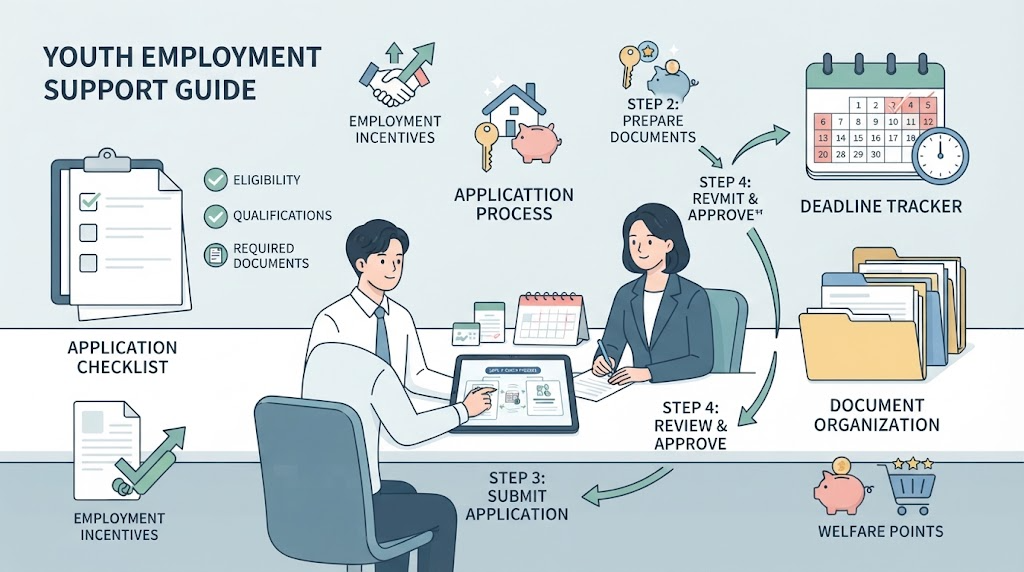
Comparison of Core Application Eligibility and Requirements by Subsidy Type
Youth worker subsidies have subtle differences in the required eligibility criteria depending on the sponsoring entity and purpose. To prevent wasted trips and choose the most suitable system for you, we have compared and organized the core application eligibility and requirements for the 3 main types examined earlier.
1. Asset Formation and Savings Support Type (e.g., Youth Tomorrow Savings Account, etc.)
* Age Criteria: Generally youths aged 19 to 34 (period extension applicable when fulfilling military service obligations)
* Income and Property Criteria: Working youths generating earned or business income who must simultaneously meet a certain percentage of the standard median income (e.g., exceeding 50% up to 100% or less, etc.) and household property criteria.
* Employment Type: Incumbent workers or business owners who can prove enrollment in the 4 major public insurances and actual work status.
2. Employment Retention and Long-Term Service Encouragement Type (e.g., Youth Job Leap Subsidy, etc.)
* Age Criteria: Ages 15 to 34 based on the employment date (for those who completed military service, age linkage is possible in proportion to the mandatory service period)
* Employment Period and Company Requirements: Must be employed as a regular worker in a small and medium-sized enterprise, maintaining employment for a certain period (e.g., 6 months or more), and eligibility is often linked according to the size or industry of the company (e.g., priority support target companies with 5 or more employees, etc.).
* Working Conditions: Regular workers whose weekly scheduled working hours meet a certain standard (e.g., 30 hours or more per week, etc.).
3. Housing/Living Stability and Welfare Point Support Type (Local Government Self-Projects)
* Residence and Workplace Location Requirements: Unlike central government projects, regional restriction requirements are essential, meaning that the place of residence on the resident registration (e.g., Seoul, Gyeonggi-do, etc.) or the workplace location must be maintained within the relevant local government for a certain period (e.g., 3 months or more, etc.).
* Income and Employment Criteria: The median income criteria (e.g., 120% to 150% or less, etc.) are often relatively flexible, or they broadly encompass small business and small merchant employees, as well as freelancers and sole proprietors.

Checking Demanding Payment Conditions and Duplicate Benefit Restriction Regulations
Although youth worker subsidies are welcome benefits that help economic independence and employment stability, screening criteria are very strict because budgets are limited and devices are closely arranged to prevent abuse of the system. You must carefully check the core payment conditions and duplicate benefit restriction regulations that you must thoroughly understand before applying.
1. Strictness of Employment Type and Employment Status Maintenance Conditions
Most subsidies do not simply look at the requirements at the time of application, but require you to faithfully maintain a specific employment type and employment status during the period before and after receiving the subsidy. For example, if employment maintenance conditions are broken, such as voluntarily resigning or changing jobs in the middle, or if working hours fall below the standard, retroactive collection measures may be taken or the payment of remaining subsidies may be immediately suspended.
2. Strict Post-Verification of Income and Property Criteria
Even if you met the requirements at the time of application, changes in income and property are periodically re-verified through National Tax Service computer data or health insurance premium payment details according to the subsidy payment cycle (monthly or semi-annually, etc.). You must be careful because if it is confirmed that your income exceeded the baseline or household property increased after approval, you may be excluded from the eligible target starting from the next round.
3. Strict Duplicate Benefit Prohibition Regulations (One Person, One Support Principle)
Among youth support projects implemented by the national or local governments, “duplicate benefit prohibition” clauses are widely applied. If you are already receiving asset formation subsidies of a similar nature or youth allowances from other local governments, or have a history of receiving benefits in the past, you may be judged as receiving duplicate benefits, resulting in your application being rejected or even being stripped of your existing benefits. Therefore, you must meticulously cross-check the details of support projects you are currently participating in or have received in the past in advance.
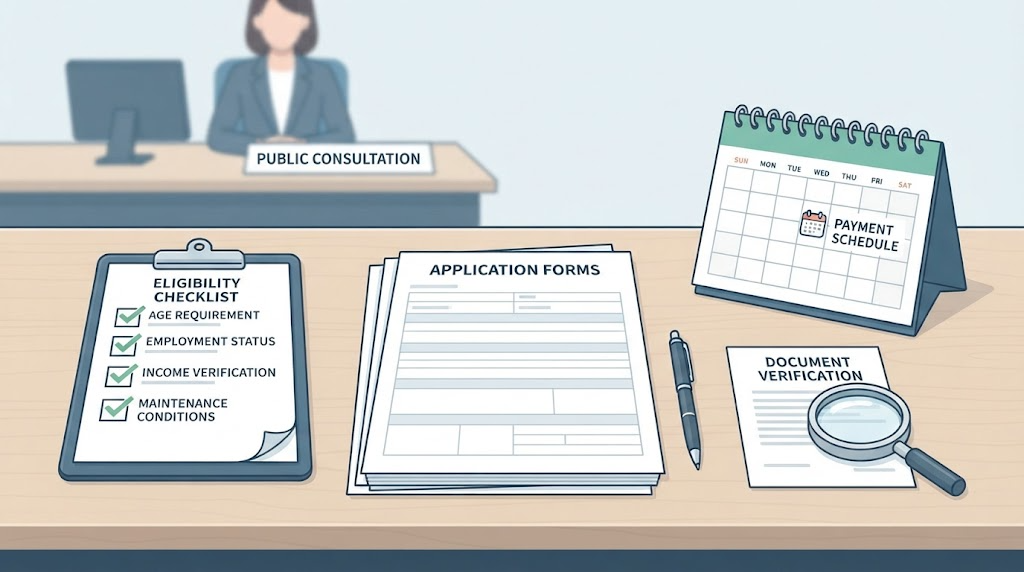
Smart Exploration and Verification Methods to Find the Subsidy That Fits You Best
In order not to miss and find the system that is most suitable and provides the greatest benefits to you among the numerous youth worker subsidies poured out by the central government and local governments, a systematic and smart exploratory approach is needed rather than searching blindly. We introduce 3 effective verification methods to reduce wasted trips and find the subsidy that perfectly fits you.
1. Utilizing Government Official Integrated Portals (Bokjiro and On-Tong Youth, etc.)
The places you should utilize first are the representative Korean welfare portal “Bokjiro (bokjiro.go.kr)” and the youth policy integrated platform “On-Tong Youth (youth.go.kr).” On these sites, if you simply enter conditions such as your age, place of residence, income level, and employment status, they custom-filter the benefits you can receive among the support projects of central ministries and local governments scattered across the country. It is the most definite first step that saves you the trouble of searching through countless notices one by one.
2. Frequently Visiting Local Government Youth Portals by Place of Residence and Workplace Location
Aside from central government projects, youth-exclusive platforms independently operated by each local government exist, such as Seoul’s “Youth Mongttang Information Portal” and Gyeonggi-do’s “Jobaba.” Local government support projects often have relatively low competition rates or exceptionally high support amounts as long as you meet the place of residence or workplace location requirements. In particular, since ad-hoc notices are frequently posted by local government, making a habit of bookmarking the youth portals of local governments you are interested in and checking them periodically is important.
3. Pre-Self-Diagnosis of Eligibility Requirements (Income, Property, and Employment Type)
If you found a subsidy you like through the portal, before applying immediately, you should carefully examine the detailed eligibility requirements in the notice. In particular, thoroughly self-diagnose in advance whether your standard median income calculation method, enrollment in the 4 major public insurances, minimum employment period, and weekly scheduled working hours accurately match the support criteria. If there are any ambiguous parts, it is wise to call the dedicated call center or the responsible department listed in the notice in advance to block unnecessary rejection risks beforehand.

Conclusion: Receiving Subsidies Without Missing Benefits Through Thorough Advance Checks
For youths struggling amidst fierce social life, youth worker subsidies are precious stepping stones that alleviate economic burdens and solidify the foundation for independence. However, because the types of systems vary and the required qualification conditions and payment standards differ for each, if you do not know the information well, you can easily miss benefits that you could have received.
The core of successful subsidy receipt ultimately lies in “thorough advance checks.” You must accurately grasp the types of support projects by central government and local governments, and carefully compare whether your age, income, and employment type meet the requirements. In addition, if you familiarize yourself with demanding employment maintenance conditions or duplicate benefit restriction regulations in advance, you can wisely prevent the risk of unnecessary rejection or recovery.
Starting today, try actively searching for and preparing benefits that perfectly fit you by utilizing Bokjiro, On-Tong Youth, and local government-exclusive portals. Only youths who carefully examine and knock ahead of others can make precious subsidies entirely their own, which will soon become a reliable economic vitalizing force in your fierce working life.
Korean version: 한국어로 읽기