
Introduction: Reading the Signals Sent by Unfamiliar Numbers on Supplement Labels
When choosing supplements at a pharmacy or online shopping mall, we encounter numerous types of vitamins and supplements. It is easy to put products into our shopping carts, drawn by flashy advertising phrases and attractive modifiers like “immune system enhancement” and “fatigue recovery,” but when we actually examine the “nutrition facts” and ingredient tables on the back, we often feel overwhelmed in front of complex terminology and unfamiliar numbers.
The real information that colorful packaging and advertisements do not tell us is contained right within those nutrition facts written in small text. In this article, we will learn the basics of ingredient table analysis that you must know in order to accurately read the signals sent by unfamiliar numbers and choose products that are just right for your body.
- The helplessness felt when encountering ingredient tables among countless supplements
The trap of flashy marketing: Numerous supplements sold on the market catch consumers’ eyes with phrases like “maximum content” and “premium ingredients.” However, there are many cases where people choose products trusting only these marketing phrases, only to suffer because the actual content needed for their bodies is severely lacking or, conversely, excessively included.
Labels that feel like alien languages: When you open a nutrition facts table, it is full of words you do not normally encounter, ranging from units like mg, mcg, and IU to % nutrient reference values and various chemical ingredient names. Because of this, many people give up on ingredient table analysis and rely solely on recommendations from others or advertisements.
- Why you must check the exact content instead of simply relying on advertising phrases
Understanding the precise dosage suited for your body: Supplements taken to protect health have no effect if taken too little, and conversely, taking too much can cause side effects or put a burden on the liver. Being able to read ingredient tables on your own allows you to objectively judge whether you are consuming an appropriate amount in light of your diet and condition.
Rational comparison of cost-effectiveness and quality: Just because a brand is expensive and famous does not mean it is unconditionally better for your body. If you carefully examine ingredient tables, you can wisely select cost-effective products that have similar contents of core main ingredients while being much more reasonable in price.
💡 Key Point
The real criterion that determines success or failure in choosing supplements is not advertisements, but ‘the objective numbers told by the ingredient table’. In the next part, we will take a specific look at what the ‘% nutrient reference value’ written on the label truly means.
Body 1: Understanding the True Meaning of Daily Nutrition Standard Values and % Ratios
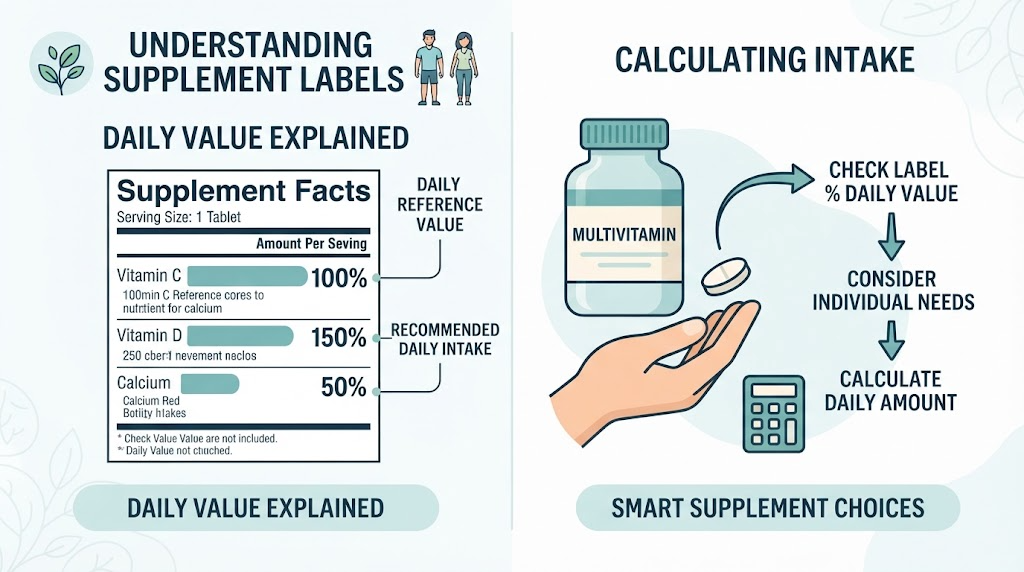
When you examine the “nutrition and functional information” section on the back of a supplement, the most noticeable thing is the “percentage (%) of the daily nutrition standard value.” Many people easily look at this number and simply think, “If I fill it up to 100%, it will be perfect,” or “The higher the number, the better it unconditionally is.”
Coming to know the scientific standards and true meaning hidden behind this percent (%) sign accurately enables wise intake tailored to your body. We learn the true meaning contained in ‘% nutrient reference values’ and how to interpret them correctly.
- Understanding what the ‘% nutrient reference value’ written on product labels implies and its standard
Ministry of Food and Drug Safety’s average standard: The standard value written in nutrition labeling is an “official comparison scale” established based on the average daily nutrient intake recommended for adult men and women in South Korea. For example, if the daily nutrient reference value for vitamin C is set to 100mg, when a product contains 100mg of vitamin C, the label is marked as ‘100%’.
Why it is not an absolute personalized recommended amount: This standard value does not individually reflect a specific individual’s age, weight, gender, activity level, or health status, but rather means the national average. Therefore, you must keep in mind that an amount sufficient for someone can be drastically lacking or excessive for someone else.
- Criteria for judging whether a supplement is lacking or excessive by comparing it with your daily diet
Complementary interaction with usual dietary habits: The three meals a day we eat regularly also contain various nutrients. If you usually eat plenty of vegetables and fruits and consume enough vitamins through your diet, taking a high-content supplement every day that fills 100% of the daily reference value can lead to excessive intake of specific components.
Utilization as a supplementary means: Supplements should play the role of “supplementation” to fill in the parts lacking from your diet after all. When looking at the % ratio on the label, you need the wisdom to figure out which nutrients are lacking in your usual dietary life and select an appropriate figure that can fill that gap (e.g., complementary products between 50% and 100%, etc.).
💡 Key Point
The ‘% nutrient reference value’ is not an absolute customized correct answer for your body, but merely a standardized yardstick to compare with other products or your own diet. In the next part, we will explore practical tips for accurately distinguishing between main ingredients and sub-ingredients and calculating pure content.

Body 2: How to Read the Ingredient Names and Content Table: Distinguishing Main Ingredients and Sub-Ingredients
If you turn over a supplement label, the place where the text is written smallest and most densely is the “ingredient names and content (full ingredients)” section. It is easy to feel dizzy because unfamiliar chemical names and numerous material names are mixed together, but simply by accurately distinguishing between ‘main ingredients’ and ‘sub-ingredients’ within this, you can transparently judge the true value of the product.
We learn practical tips for correctly reading main ingredients and sub-ingredients on health functional food labels and figuring out the hidden pure content.
- Checking the ‘main ingredients (functional ingredients)’ and their content that must be checked first in the full ingredient display
Finding functional ingredients recognized by the Ministry of Food and Drug Safety: The ingredients specified at the top of the label or in the ‘nutrition and functional information’ table are the ‘main ingredients (functional ingredients)’ that are in charge of the core purpose of the product. For example, vitamin C, lutein, red ginseng concentrate, etc., correspond to this.
Checking the order and ratio of content: The order written in the ingredient name column is usually listed in descending order of content. You must carefully check whether the main ingredients proudly occupy the front positions, or if unknown sub-ingredients are included more than the core ingredients being advertised.
- Tips for filtering out unnecessary sub-ingredients, additives, and excipients to calculate pure content
Understanding the role of sub-ingredients: Sub-ingredients are auxiliary materials added so that the main ingredients maintain their shape or bind the pills firmly, or to produce taste and aroma. Plant extracts, fruit concentrates, glucose, etc., are commonly used.
Checking chemical additives and excipients: It is necessary to examine whether synthetic excipients or sweeteners such as silicon dioxide, magnesium stearate, and HPMC (hydroxypropyl methylcellulose) are excessively included. Although they are minimal technical ingredients essential for manufacturing pills, if you have a sensitive constitution, it is advantageous to choose products with fewer such excipients.
💡 Key Point
Really good supplements do not rely on flashy sub-ingredient marketing, but are judged by how purely and in what appropriate content the ‘main ingredients’ essential for your body are contained. In the next part, we will look at the upper intake limits and overlapping intake calculation methods that must be considered when taking multiple supplements together.

Body 3: Beware of Over-Consumption! Comparing and Calculating Recommended Daily Allowances and Upper Intake Limits
Although supplements are taken for health, eating them in unconditionally large amounts does not mean their effects improve proportionally. Rather, there are not a few cases where people enthusiastically over-consume certain components and instead put a burden on their bodies or experience side effects.
In particular, the most dangerous trap for modern people who take multiple supplements simultaneously is “overlapping nutrient intake.” We learn about the difference between the “recommended daily intake” and the “upper intake limit” that you must know for safe consumption, along with overlapping calculation methods.
- The risk of overlapping intake of specific nutrients that easily occurs when taking multiple supplements together
The invisible trap of duplication: While eating a multi-vitamin as a base, people often take high-content vitamin B or C products separately for fatigue recovery, and add a vitamin D injection or extra supplement for immunity here. At this time, if you do not add up the ingredient tables of each product, you will end up consuming certain vitamins or minerals exceeding the daily recommended amount by several times or more without realizing it.
Water-soluble and fat-soluble nutrient differences: Water-soluble vitamins like vitamin B or C are excreted through urine even if they remain in the body, but fat-soluble vitamins like vitamins A, D, E, and K, or some minerals like iron and zinc, accumulate in the body and can induce over-consumption side effects (toxicity) such as headaches, nausea, and liver and kidney burdens.
- Checking and calculating ‘Upper Intake Levels (UL)’ by nutrient according to Korean nutrient intake standards
Concept distinction between recommended daily intake and upper intake limit:
Recommended Nutrient Intake: The appropriate intake standard recommended to prevent deficiencies in the majority of healthy people.
Tolerable Upper Intake Level: The maximum intake level at which harmful side effects do not appear in the human body, meaning the “red line” where the risk of harming health increases if this line is exceeded.
Practical tips for calculating your total daily intake: When choosing a new supplement or combining multiple products, you must always spread out the ingredient tables of each product and develop the habit of carefully adding and calculating to ensure that the total sum of a specific component (e.g., vitamin D, zinc, etc.) across all the supplements you take never exceeds the ‘upper intake limit’.
💡 Key Point
The iron rule of supplement intake is not “the more, the merrier,” but “moderation in all things”. Keeping the upper intake limit that your body can handle in mind and calculating the ingredient table is the beginning of true smart healthcare.

Conclusion: My Own Nutrient Analysis Routine for Smart Consumers
So far, we have carefully examined everything from the true meaning of the ‘% nutrient reference value,’ which is the core of supplement ingredient tables, to the transparent distinction between main and sub-ingredients, and the upper intake limit calculation method that must be considered when taking multiple products together. The discernment to screen out products truly needed for your body without being seduced by flashy advertisements or expensive price tags ultimately stems from the ‘power to read ingredient tables.’
To help you become a smart and wise consumer, we summarize your own nutrient analysis routine that you can practice in daily life.
- Cultivating a practical sense to judge products through ingredient tables without being dazzled by outer packaging or marketing
Looking at the back label before advertising phrases: Before letting your heart be stolen by flashy detailed pages on internet shopping malls or phrases like “maximum content” and “patented ingredients,” try developing the habit of checking the “nutrition and functional information” and “ingredient names and content” located at the very bottom or back of the product detail image first.
Filtering out the pure content of main ingredients and unnecessary additives: You must cultivate the sense to calmly compare how honestly the core functional main ingredients are contained, and whether synthetic excipients or excessive sugars and sub-ingredients that could put a burden on your constitution are mixed in.
- Habitualizing smart content calculation for safe and effective supplement intake
Calculating the total sum with your diet and existing supplements: Before putting a new supplement into your shopping cart, make a routine of carefully adding and calculating whether that nutrient is already sufficiently filled in other supplements you are currently taking or in your usual dietary habits.
Self-directed health management respecting upper intake limits: Supplements do not show better effects simply because you eat them in larger amounts; they finally exert true effects when consumed within the range your body can safely absorb and process (within the upper intake limit).
💡 Final Summary
The success of supplement shopping does not depend on luck or brand names, but on ‘your own analysis routine of reading the objective numbers of the ingredient table and applying them to your body standards.’ Starting today, do not be afraid to face unfamiliar numbers, and begin a smart ingredient analysis life that protects both your body and your wallet!
Korean version: 한국어로 읽기