
Overview and Importance of the Health Insurance Dependent System
South Korea’s health insurance system is largely divided into employee subscribers and regional subscribers. Among them, the “dependent” system refers to individuals who are primarily supported by an employee subscriber, serving as a vital social security system that ensures they can enjoy health insurance benefits without paying separate premiums. Because it plays a core role in easing the economic burden on households, it is essential to accurately understand the purpose of the system and the conditions for maintaining eligibility.
- Basic Concepts and Benefits of Health Insurance Dependents
A dependent refers to someone registered as a dependent of a family member (employee subscriber) who earns income while working, allowing them to enjoy all medical coverage benefits of the National Health Insurance equally without bearing health insurance premiums in their own name.
Exemption from premiums: It greatly contributes to increasing household disposable income by reducing fixed monthly health insurance expenses.
Guarantee of medical accessibility: It helps retirees, full-time homemakers, students, and others with little or no income receive necessary medical services in a timely manner without economic burden.
- Impact of Maintaining Dependent Eligibility on Household Economy
Nowadays, as the importance of managing fixed household expenditures grows due to aging and rising prices, maintaining dependent eligibility is a factor that cannot be ignored in terms of asset management and defense of living expenses. If eligibility is lost because requirements are not met, the individual is immediately converted into a regional subscriber.
In the case of regional subscribers, health insurance premiums are calculated by assigning points not only to income but also to owned assets (housing, land, etc.) and automobiles, which can lead to receiving unexpectedly large health insurance notices.
Since this can deal a significant financial blow to households with reduced fixed income after retirement, being familiar with eligibility standards in advance and preparing for them is the shortcut to protecting economic stability.
- Need for Regular Eligibility Checks (Income and Property Requirements)
To prevent indiscriminate free-riding and ensure fairness in the system, the National Health Insurance Service periodically (or frequently through National Tax Service taxation data linkage, etc.) reviews the income and property criteria for dependents.
Even if dependent eligibility was maintained without issue in the past, cases frequently occur where individuals suddenly receive notice of disqualification without prior warning due to exceeding the standards caused by changes in property tax bases resulting from inflation, occurrence of financial income, or temporary increases in business or pension income.
Therefore, through regular eligibility checks and monitoring, an attitude of pre-inspecting whether your or your parents’ income and property status is close to the baseline and keeping a close eye on trends of institutional changes is required.
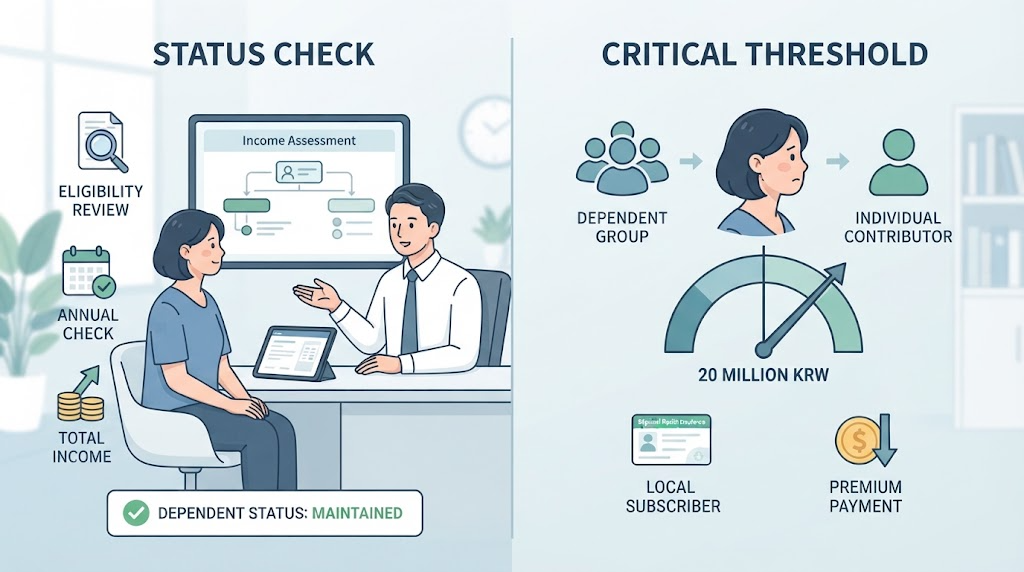
Complete Guide to Core Income Criteria for Dependent Disqualification
One of the most strictly reviewed elements to maintain health insurance dependent eligibility is the income criteria. When the income of a person trying to become a dependent of an employee subscriber exceeds certain standards, the National Health Insurance Service determines that they have independent economic capability, disqualifies them as a dependent, and converts them into a regional subscriber. Here is a detailed breakdown of the core income criteria you must know to defend against dependent disqualification.
- Annual Total Combined Income Standard Amount (Requirement of 20 Million Won or Less per Year)
To be recognized as a dependent, the sum of all income must be 20 million won or less per year. Here, “combined income” refers to income subject to comprehensive income tax taxation.
Immediate disqualification upon exceeding the standard: If the annual combined income exceeds 20 million won by even 1 won, dependent eligibility is lost, so it must be managed very conservatively.
Taxation reference year: Income amounts are calculated based on National Tax Service taxation data updated annually, and the moment the standard is exceeded, the individual is converted to a regional subscriber and pays individual health insurance premiums.
- Items Included in Income Criteria
The scope of income combined during dependent review is broader than expected. Caution is required as most income subject to National Tax Service comprehensive income tax reporting is included.
Earned income: Income generated from regular earned income, daily earned income, etc. (excluding non-taxable earned income)
Business income: Business income generated when business registration exists.
Financial income (interest and dividend income): Cases where the total sum of deposit interest, stock dividends, etc., exceeds the standard (In the past, financial income criteria were separately strict, but currently, they are managed by being included in the comprehensive income combination target.)
Pension income: Amount received from public pensions (National Pension, Public Officials Pension, Private School Teachers’ Pension, Military Pension, etc.). (※ Private pensions are excluded, but public pensions are included in the annual 20 million won criterion, so attention must be paid to fluctuations in received amounts.)
Other income: Income excluding lecture fees, prize money, and other necessary expenses, etc.
- Precautions Regarding Business Income (Registered Business vs. Unregistered Business Criteria)
Business income is one of the most common causes of dependent disqualification. In particular, special care is required because the applicable standards differ depending on whether business registration exists.
When business registration exists: If business income occurs by even 1 won (annual business income exceeding 0 won), dependent eligibility is revoked. In other words, even if sales or income are very small, if the business registration number remains active, dependent eligibility cannot be maintained. (However, cases without business registration where annual business income is 5 million won or less may be exceptionally recognized.)
When business registration does not exist (freelancers, rental businesses, etc.): For unregistered businesses without business registration, annual business income must be 5 million won or less to maintain dependent eligibility. Exceeding this results in immediate loss of eligibility.
Caution regarding housing rental income: Even small amounts of housing rental income affect the criteria depending on whether business registration exists and the amount of revenue, so thorough income management is required if operating a rental business.


Property Requirements and Other Eligibility Maintenance Conditions
To maintain health insurance dependent eligibility, you must simultaneously satisfy the property tax base criteria and support requirements in addition to the income criteria examined earlier. No matter how low your income is, if your held property exceeds certain standards, you will be disqualified as a dependent, so you must accurately understand the detailed requirements related to property.
- Property Tax Base Standard Amount (Property Tax Base of 540 Million Won or Less vs. 900 Million Won or Less Conditions)
The National Health Insurance Service reviews dependent property requirements based on the property tax base (the combined amount of land, buildings, housing, ships, aircraft, etc.) levied in accordance with the Local Tax Act.
Basic standard (Property tax base of 540 million won or less): If combined income exceeds 10 million won and is 20 million won or less per year, the property tax base must satisfy 500 million won or less (when applying the current upward adjustment reflecting amendments to the Local Tax Act and the realization of official prices, a tax base of 540 million won or less) to maintain dependent eligibility.
Exception and relaxed standards (Property tax base exceeding 540 million won to 900 million won or less): If your annual combined income is very low at 10 million won or less, you can exceptionally be recognized for dependent eligibility up to a property tax base of 900 million won or less. In other words, the lower the income, the more relaxed the property standards are applied.
When exceeding the standard: If the property tax base exceeds 900 million won, dependent eligibility is immediately lost regardless of income. (※ The property tax base mentioned here is a tax base based on official prices rather than market prices, so there may be a difference from actual transaction prices.)
- Enhanced Property and Income Requirements When Registering Siblings as Dependents
When registering siblings rather than parents or children as dependents or maintaining eligibility, much stricter and more rigorous criteria are applied. In the past, siblings could also be registered as dependents relatively easily, but as the system has been strengthened, the barrier to entry has become very high.
Strengthened property criteria: For siblings, dependent eligibility can only be maintained if the combined property tax base is 300 million won or less. This is much stricter than the general direct family criteria (540 million won to 900 million won).
Exception requirements: However, it can be maintained through rigorous review only in exceptional cases where siblings are 65 years of age or older, under 30 years of age, or correspond to persons with disabilities or persons of national merit, while satisfying annual income standards, etc.
- Criteria for Satisfying Support Requirements (Residential Co-residence and Maintenance of Livelihood Relationship)
Since the original intent of the dependent system is to protect “dependent family members sharing a livelihood,” you must prove a substantial support relationship even if you meet the income and property criteria.
Residential co-residence status: The basic principle is that the employee subscriber and the dependent reside together with their resident registration address at the same dwelling. (In the case of direct ascendants, even if they have a different household from the employee subscriber, cases where they prove they are substantially supporting their livelihood may be recognized, but co-residence requirements apply more strictly to direct descendants or siblings.)
Substantial livelihood maintenance relationship: It is continuously managed and reviewed whether the employee subscriber is economically supporting the dependent and whether the dependent’s own independent livelihood capability (income and property) does not exceed the allowable range of the system.

How to Cope with Loss of Dependent Eligibility and Guide to Transitioning to Regional Subscriber Status
Health insurance dependent eligibility
If you receive a notice of loss of dependent eligibility from the National Health Insurance Service or lose your eligibility due to unexpected income and property fluctuations, it is easy to panic. However, if you calmly understand the system and cope with it, you can minimize the economic shock. We guide you through the procedures to check when losing eligibility and wise ways to cope.
- How to Check Notice of Loss of Eligibility from the National Health Insurance Service
The National HealthInsurance Service conducts regular re-examinations annually by linking income and property taxation data from the National Tax Service and others (reflecting changes mainly based on every November), and if it is confirmed that requirements are not met, it revokes dependent eligibility ex officio.
Health insurance dependent eligibility
Notification method:
When eligibility is lost, the Service sends a “Health Insurance Eligibility Change (Loss) Notice” via mail, Kakao AlimTalk, or electronic document.
Health insurance dependent eligibility
Confirmation path:
You can search in detail for your eligibility change history and specific reasons for disqualification (excess income, excess property, etc.) through the National Health Insurance official website (NHIS), the “The Health Insurance” mobile app, or by visiting a branch office.
Health insurance dependent eligibility
+ 1
- Health Insurance Premium Calculation Method and Burden Mitigation Plan upon Conversion to Regional Subscriber Status
When dependent eligibility is lost, the individual is immediately converted into a regional subscriber without a separate grace period, and health insurance premiums in their own name are levied.
Health insurance dependent eligibility
Premium calculation method:
Since the health insurance premiums of regional subscribers are calculated by scoring and combining not only income but also owned assets (housing, land, etc.), the burden of monthly premium expenditures can be felt relatively greater compared to employee subscribers.
Health insurance dependent eligibility
Utilization of the voluntary continuation system:
If you lost dependent eligibility due to retirement or resignation of yourself or a household member and were converted to a regional subscriber, you must actively utilize the “voluntary continuation system.” If you apply to the Service before 2 months pass from the payment deadline of the premium first notified as a regional subscriber, you can maintain the level of premiums paid during your days as an employee subscriber before retirement for up to 36 months, making it a useful means to defend against a “premium bomb.”
Health insurance dependent eligibility
+ 1
- Procedure and Tips for Re-acquiring Dependent Status Following Income and Property Fluctuations
If you lost your dependent eligibility due to temporary income generation or documentary errors, or if your income and property subsequently decreased back below the criteria, you can re-acquire dependent eligibility at any time.
Health insurance dependent eligibility
Proof of income reduction and adjustment:
If your income has decreased due to business closure, suspension, resignation, or termination, you can apply for health insurance premium adjustment and income settlement by preparing objective supporting documents such as a certificate of dismissal or a certificate of business suspension/closure.
KB Think
+ 1
Subject of re-registration application: Re-registration as a dependent is not done by yourself directly, but must be processed through the HR team of the company where your family member who is an employee subscriber (spouse, child, etc.) belongs, or by visiting a branch office of the National Health Insurance Service or through its website to file a dependent eligibility acquisition report.
Retroactive application upon approval: Once approved by meeting the requirements, dependent eligibility is restored from the 1st of the month in which the application date falls, preventing unnecessary regional insurance premium expenditures. Therefore, it is important to develop a habit of re-verifying the requirements with the Service immediately when eligibility changes.
Health insurance dependent eligibility
Korean version: 한국어로 읽기