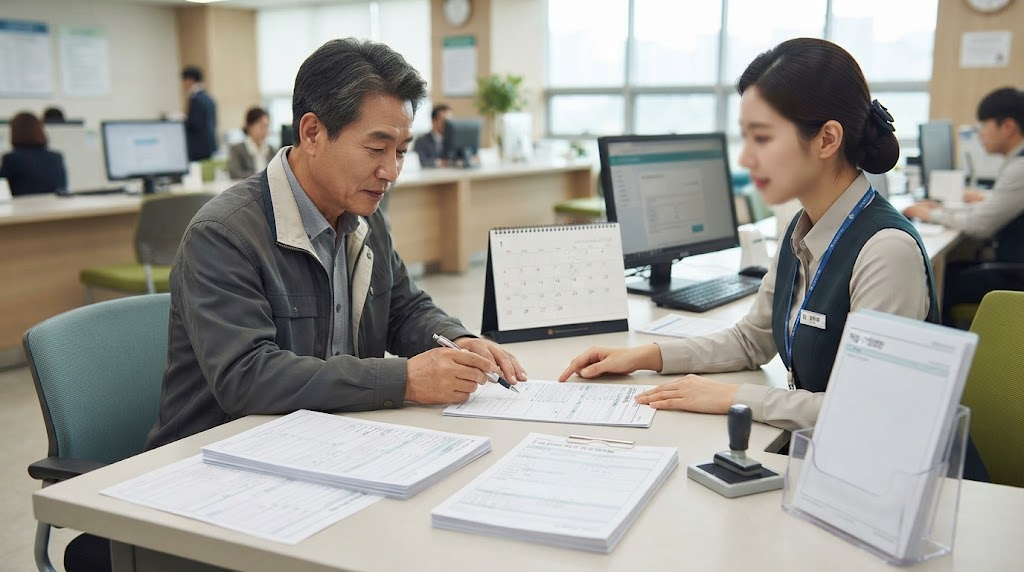
Understanding the Health Checkup System and Employee Subscriber Enrollment Types
To ensure that all citizens of the Republic of Korea can maintain a healthy life and detect diseases early, the National Health Insurance Service operates the national health checkup system. The national health checkup not only encourages voluntary health management but is also the most fundamental and reliable social security service that proactively blocks risk factors that can progress to severe diseases.
Health insurance subscribers are largely divided into ’employee subscribers’ who work affiliated with a workplace and pay insurance premiums, and ‘local subscribers’ composed of other self-employed individuals, freelancers, and so on. Among these, employee subscribers are further subdivided and managed into office workers and non-office workers according to their job characteristics and working environment. The state supports customized health management suited to the characteristics of each occupational group by applying different checkup cycles and items depending on these enrollment types.
In particular, in the case of non-office worker employee subscribers who have a lot of on-site work or require physical activity, separate management standards are applied because the risk of disease exposure or physical burden can be relatively greater compared to office workers. Therefore, accurately understanding which type (office worker or non-office worker) you fall under among employee subscribers is the first step to observing the correct checkup cycle and guaranteeing your right to health.
In the following content, we will take a detailed look at the specific checkup cycle applied to non-office worker employee subscribers and the reasons behind it.
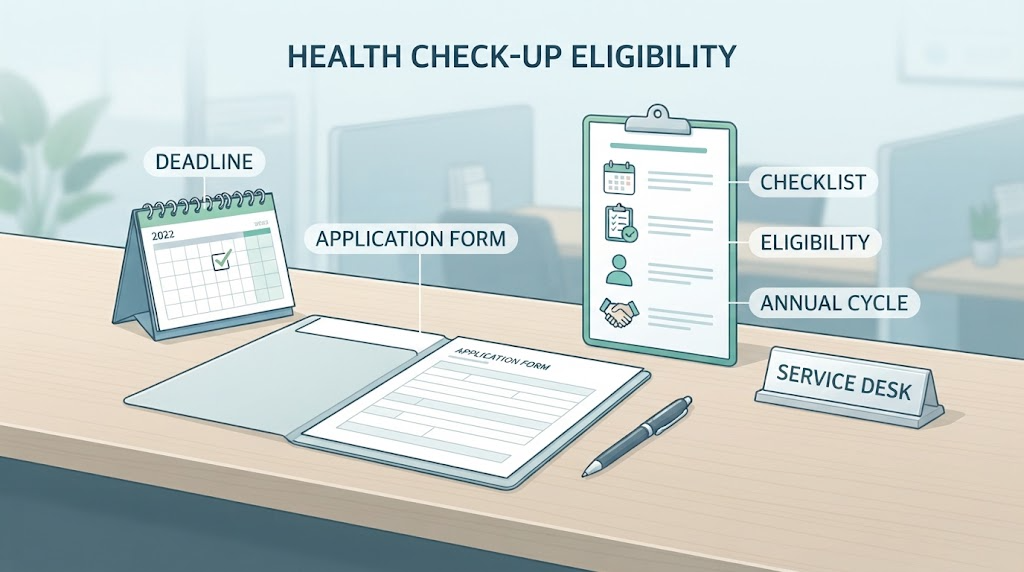
Key Features of the Checkup Cycle for Non-Office Worker Employee Subscribers
The National Health Insurance Service national health checkup differentiates checkup cycles according to the subscriber’s occupation and characteristics. For office workers among general employee subscribers, the rule is to receive a checkup once every 2 years (biennially based on even or odd birth years), but non-office worker employee subscribers with a high proportion of on-site work and physical labor are subject to a core checkup cycle different from this.
The biggest characteristic of non-office worker employee subscribers is that ‘annual implementation (once a year)’ is the rule. It is an institutional device to more frequently and closely check health status in consideration of the working environment where they are relatively more likely to be exposed to the risk of on-site accidents compared to office workers and where physical burden or fatigue easily accumulates.
The differences in checkup cycles between office workers and non-office workers are summarized as follows.
- Office worker employee subscribers: Checkup once every 2 years (implemented biennially, e.g., 2026 targets are those born in even years)
- Non-office worker employee subscribers: Regular checkup every year (once a year) (can be examined every year if eligible regardless of birth year)
As such, since non-office worker workers become checkup targets every year, even if they received a checkup in the previous year, when the next year comes, they must check their eligibility again through the National Health Insurance Service and check their health status regularly. As frequent checkup cycles make it very advantageous to detect diseases early and prevent chronic diseases, special attention is required as there are quite a few cases where they mistakenly confuse the cycle or miss the timing due to busy on-site work.
In the next section, let’s take a closer look at the major checkup items that non-office worker workers must check when receiving their checkups every year.
Guide to Major Checkup Items for Non-Office Worker Workers
As non-office worker employee subscribers receive regular health checkups every year, their checkup items are robustly configured compared to general office workers. In addition to the basic general health checkup items, various special tests are conducted together to early detect physical burdens and disease risks that may occur in on-site work or physical labor environments.
Major checkup items for non-office worker workers are as follows.
- Basic general checkup items: Height, weight, waist circumference, vision and hearing measurement, blood pressure measurement, chest X-ray (checking for pulmonary tuberculosis and chest diseases), urine test (urine protein, etc.), and blood tests (fasting blood sugar, liver function, blood lipids, etc.) are commonly conducted.
- Detailed blood and metabolic syndrome-related tests: Detailed blood tests for the early detection of chronic diseases commonly occurring in office workers, such as diabetes, hypertension, liver disease, and kidney disease, are thoroughly included.
- Age-specific and gender-specific additional tests: Oral checkups, dyslipidemia tests, and hepatitis B tests (for those aged 40) for workers reaching specific age groups are periodically provided together.
- Cardiovascular disease and on-site work-related items: Related questionnaires and diagnoses are linked to early capture respiratory diseases, musculoskeletal burdens, and abnormal signals of the cardiovascular system that may be exposed depending on the on-site working environment.
As such, the non-office worker checkup goes beyond simple formality-based confirmation and is designed to track and observe physical changes every year and practically check health risk factors originating from the job environment. It is important to actively utilize the checkup opportunity given every year to protect your health and maintain a safe working environment.
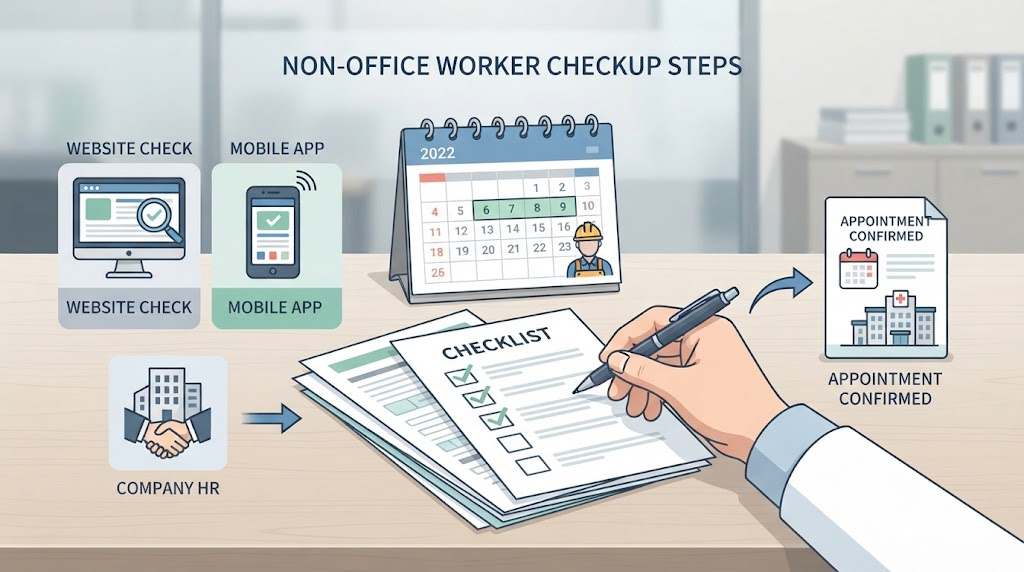
Methods to Check Non-Office Worker Checkup Eligibility and Precautions When Booking
Since non-office worker employee subscribers become checkup targets every year, it is essential to check in advance whether you are accurately included in the examination targets for this year and coordinate your schedule with leisure. We have organized the target inquiry methods and precautions when booking for non-office worker workers who might easily miss the timing due to busy on-site work.
First, it is the method to check non-office worker checkup eligibility.
- National Health Insurance Service Official Website: After logging into the service website using a joint certificate or similar, you can easily check your non-office worker checkup eligibility and items for this year through the ‘Health Checkup Target Inquiry’ section in the ‘Health Checkup’ menu.
- ‘The Health Insurance’ Mobile App: By installing ‘The Health Insurance’, the official app of the National Health Insurance Service, on your smartphone and going through simple authentication, you can check your checkup eligibility and the status of designated hospitals in real time anytime and anywhere.
- Company (Workplace) HR and General Affairs Department Verification: For employee subscribers, group checkup guides or notices sent by the service are delivered through the workplace, so you can clearly figure out your eligibility through the internal responsible department.
Second, these are the key precautions when booking a non-office worker checkup.
- Must check designated checkup institutions: National health checkups and cancer screenings cannot be received at just any hospital, so you must make a reservation and visit after checking in advance whether it is a ‘health checkup institution’ designated by the National Health Insurance Service.
- Prepare for the end-of-year rush (target the first half of the year): In the second half of the year, especially between October and December, office workers’ checkup reservations crowd at once, making waiting times very long. For a smooth examination, it is wise to secure your schedule in advance by utilizing the first half of the year (March to June) or the summer off-season if possible.
- Fasting and advance questionnaire completion: If an upper endoscopy or blood test is included, you must maintain strict fasting from 9 PM (or at least 8 to 12 hours) the night before, and to reduce hospital waiting times, it is recommended to fill out the mobile questionnaire in advance via the service notification talk or app before visiting.

Disadvantages of Missing Checkups and Essential Precautions for Office Workers
The national health insurance national health checkup is not simply a recommendation, but a system mandatory imposed on employee subscribers in accordance with relevant laws and regulations. In particular, for non-office worker workers who become checkup targets every year, special attention is required because they may suffer legal disadvantages if they postpone or fail to receive the checkup due to busy work or personal circumstances.
First, these are the fine regulations and legal disadvantages in case of missing a checkup.
- Industrial Safety and Health Act and National Health Insurance Act standards: Employers (companies) have an obligation to take measures so that workers can receive health checkups according to the set cycle. If a non-office worker worker does not receive a health checkup without justifiable reasons, a fine may be levied on the worker themselves in accordance with relevant laws and regulations. (Employers also receive fine dispositions if they fail to fulfill their obligation to conduct worker checkups, which is why companies strongly encourage examination at the corporate level.)
- Other disadvantages: In addition to legal fines, disadvantages may occur in internal personnel evaluations or own service regulations, and above all, you might miss the precious opportunity to detect diseases early, suffering a fatal blow to your health.
Second, these are essential precautions that office workers (especially non-office worker workers) must keep in mind.
- Prohibition of unjustified postponement and delaying: The thought, “I’m busy this year, so I can just take it twice next year,” does not work for non-office workers. Unlike office workers, non-office workers are targets every year, so they must complete their checkup within the designated period every year.
- Coordination of company schedules and personal schedules: If individual visits are difficult due to on-site shift work or operational schedules, it is advisable to consult with the internal health manager or HR representative to utilize checkup special leave or coordinate a relatively relaxed date in advance.
- Result verification and post-management: Rather than ending with just receiving the checkup, if warning findings such as hypertension, diabetes, or hyperlipidemia appear through the checkup result notice, you must immediately receive treatment from a specialist and start active health management such as improving usual dietary habits or quitting drinking and smoking.
The national health checkup is the most certain preventive injection and right to protect the happiness of yourself and your family. We hope you never miss the non-office worker health checkup cycle that comes every year and continue a healthy and vibrant working life through thorough advance reservation and preparation!
Korean version: 한국어로 읽기