Why Comparing Youth Housing Support Programs Matters Before Making a Move
For young adults dreaming of independence or taking their first steps into society, monthly rent, maintenance fees, or the large lump sums needed for jeonse deposits pose the greatest economic pressure. Amidst skyrocketing housing costs, governments and local municipalities pour numerous support policies and budgets every year to help stabilize housing for the youth.
However, the more diverse these systems are, the harder it is to clearly figure out “which policy is most advantageous for me,” frequently leading to missed benefits. Before embarking on securing a place to live, the reasons why you must carefully examine and compare youth housing support beforehand are clear.
1. Finding Benefits Tailored to You to Receive Maximum Practical Support
Currently in South Korea, dozens of welfare systems exist, ranging from central government-managed youth monthly rent support and jeonse loan products to independently operated monthly rent support and housing guarantee fee return guarantee projects run by individual local governments.
Because not every policy applies equally to your income or living arrangement, comparing them thoroughly in advance ensures you don’t miss out on the largest scale of benefits you are eligible to receive.
2. Preventing Mistakes Amid Complex Duplicate Restriction Rules
Most housing support projects of a similar nature have “no duplicate benefits” regulations. For instance, attempting to simultaneously receive similar support funds from a local government while already receiving monthly rent support from the central government could lead to subsequent recovery measures or disqualification.
By comparing and analyzing the eligibility requirements and restrictive clauses of each system beforehand, you can wisely select the safest and most advantageous single policy within legal boundaries.
3. Reducing Wasted Time and Effort Caused by Lack of Information
Quite a few young adults rush into signing contracts or preparing documents only to find out their conditions don’t match, leaving them in a bind. Through a thorough comparison process, you can filter out only the high-value policies that match your age, income, assets, and living arrangement, dramatically reducing unnecessary legwork and wasted time while establishing the fastest and most efficient housing plan.
The smartest first step to cutting your overwhelming housing cost burden in half and securing a reliable home begins with thorough and meticulous ‘policy comparison’.
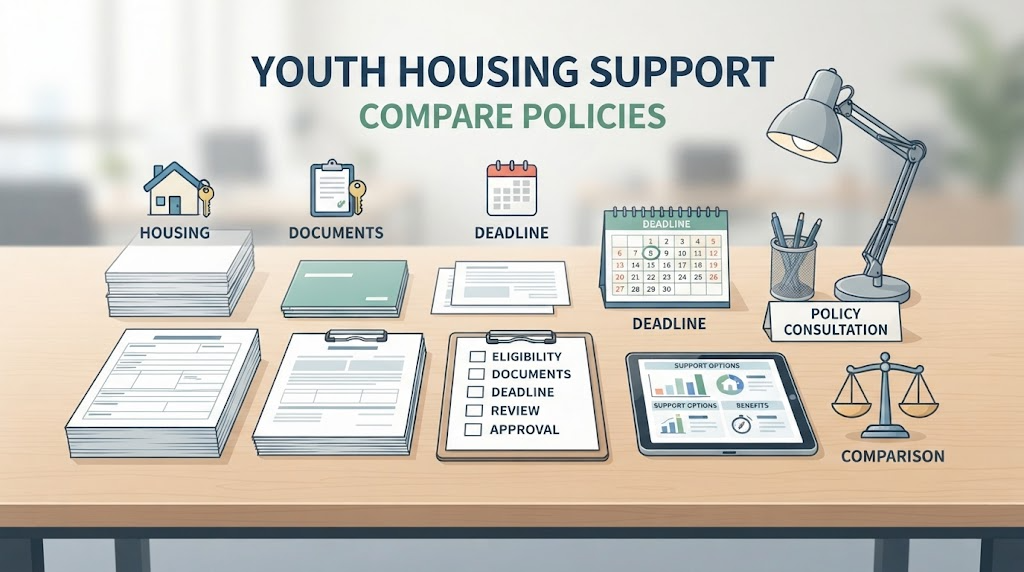
Core Comparison of Central Government vs. Local Government Youth Housing Support Policies
When starting to compare youth housing support systems, the first crossroads you encounter is the difference between ‘Central Government Support Programs’ and ‘Local Government Independent Support Programs’. The two entities differ in the source of their supporting budgets and governing organizations, and they also show distinct differences in recipient selection criteria and the nature of their benefits.
To help you choose the more advantageous package for yourself, we clearly compare the core aspects of central and local government youth housing support policies.
1. Central Government Housing Support Providing Stable Benefits Anywhere Nationwide
Programs governed by the central government, such as the Ministry of Land, Infrastructure and Transport or the Ministry of Health and Welfare, have the major advantage that any South Korean citizen can apply based on nationwide common criteria regardless of their residential area.
Representative programs include the ‘Youth Monthly Rent Temporary Special Support’ which directly provides a certain amount of monthly rent every year, the ‘Housing and Urban Fund Youth-Exclusive Beu teum-mok Jeonse Fund Loan’ which lends large lump sums at low interest rates, and the supply of public rental housing and happy housing for youth.
While you can stably receive universal and large-scale benefits on a national scale, income criteria and asset requirements tend to be applied relatively strictly under a single nationwide standard.
2. Local Government Housing Support Filling the Gaps with Customized Regional Solutions
To supplement the blind spots of central government support and prevent the outflow of local youth, various local governments such as Seoul, Gyeonggi Province, and Busan are actively rolling out independent housing welfare programs using their own budgets.
Examples include Seoul’s ‘Youth Monthly Rent Support’, each local government’s ‘Youth Lease Deposit Interest Support’, and ‘Jeonse Deposit Return Guarantee Fee Support’.
Because local government programs target only youth registered as residents and actually living in that respective area, the competition rate and support amount are flexibly adjusted according to regional conditions, and since income criteria or support limits may differ compared to central government systems, you must check based on your place of residence.
3. Understanding the Purpose Differences Between Public Rentals & Loan Products vs. Cash-like Monthly Rent Support
When comparing policies, you must also examine the purpose of the support method.
Housing Financial Products (Jeonse/Monthly Rent Loans): These focus on practical loan support to help youth who immediately lack deposits or lump sums secure funds at low interest rates.
Cash-like Support & Public Rentals: These take the form of subsidies that directly relieve the burden of monthly rent going out every month or focus on housing stability by providing residential spaces cheaper than market prices.
Therefore, depending on your current situation (whether you lack a lump sum or are struggling with recurring fixed monthly rent), you must make a strategic choice on whether to tap into central government loan products or aim for local or national monthly rent support funds.
Since the universal stability of the central government and the region-customized benefits of local governments are often not mutually exclusive, comparing both axes and finding the combination best suited for you is the core of a wise housing strategy.

3 Core Criteria for Choosing the Most Advantageous Housing Conditions for You
Once you have compared various youth housing support policies and financial products, you must now determine out of the numerous choices “what conditions are practically most advantageous for me.” We point out 3 core criteria you must examine to reduce trial and error and pull out maximum benefits.
1. Income and Asset Criteria: Understanding the Scope of Independent Youth Households vs. Original Households (Including Parents)
Many housing support policies determine success or failure depending on how far the scope of the household serving as the standard is viewed when calculating recipient eligibility.
Independent Youth Household Standard: A method of evaluating income and assets based solely on yourself and your spouse. Typically, the youth’s own earned or business income must be below the standard median income (e.g., a certain percentage based on a single-person household) or satisfy the asset value (total asset limit).
Original Household (Including Parents) Standard: A method of evaluating by combining the income and assets not only of the youth themselves but also of first-degree linear blood relatives such as parents (e.g., simultaneously satisfying 60% or less of the median income for youth households and 100% or less of the median income for original households).
However, if you meet exceptional conditions such as being 30 years of age or older or having marriage experience, parents’ income is excluded, so you must first check which screening criteria apply according to your age and independence status and weigh the pros and cons.
2. Living Arrangement and Fund Nature: Comparing Monthly Rent Support vs. Jeonse/Monthly Rent Deposit Loans
Depending on your current housing environment and the cause of your fund shortage, the nature of the product you should choose varies completely.
If you are a monthly rent resident burdened by recurring fixed monthly expenses: Cash-like support such as the youth monthly rent support project or local government voucher systems is much more advantageous. You can directly save on housing costs spent every month.
If you are a prospective lessee immediately lacking the deposit or lump sum itself to sign a contract: You must prioritize financial products like the Housing and Urban Fund’s jeonse/monthly rent fund loans (such as Beuteum-mok), which allow you to procure lump sums at much lower interest rates than commercial banks.
3. Examining Duplicate Benefit Restriction Rules and Post-Management Conditions
Just because the scale of a benefit looks large doesn’t mean you can unconditionally apply for duplicates. Regulations such as mutual exclusion clauses between local and central government support funds, or restrictions on participating in other housing welfare projects while residing in public rental housing, are intricately intertwined.
In addition, if you violate conditions that must be mandatorily maintained while receiving support funds (e.g., maintaining a homeless status, keeping transfer registration at the respective address, etc.), the support funds may be recovered later. Therefore, wisdom is needed to choose the most stable single package by considering potential changes that may occur during the benefit period.
Based on these three criteria, if you accurately cross-reference your current income level, asset status, and living arrangement, you will undoubtedly be able to find the optimal housing conditions that will serve as your strongest wings among countless policies.
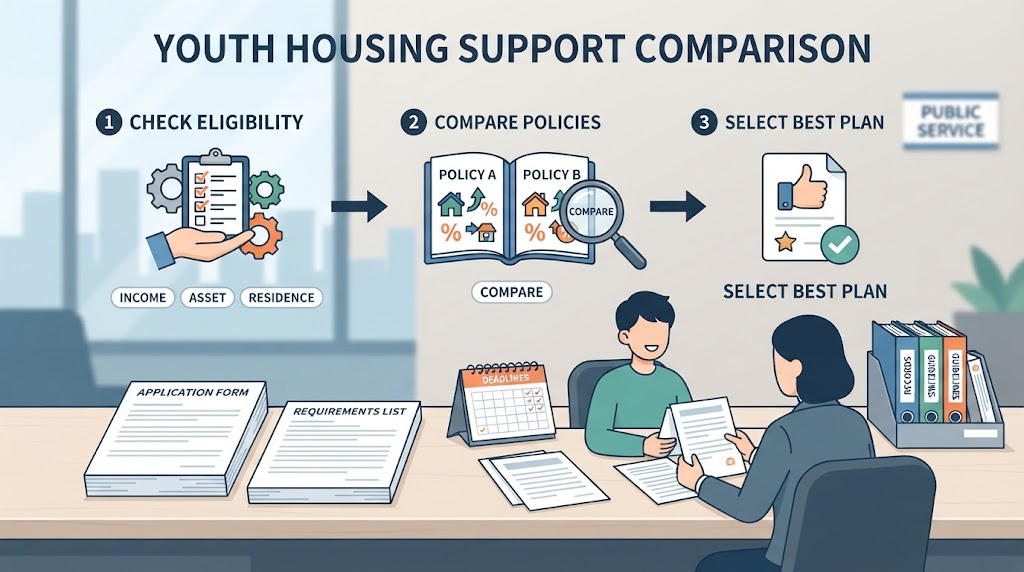
Core Tips for Youth Housing Support Comparison, Inquiry, and Application to Minimize Mistakes
Even if you compared various housing support policies and chose the most advantageous conditions for yourself, making a minor mistake during the inquiry or application process can easily lead to unfortunate disqualification or missing out on support opportunities. We have organized 3 core tips to minimize mistakes that you must know for successful benefit reception.
1. Actively Utilizing ‘Customized Eligibility Diagnosis’ on Bokjiro and Myung-Home Portals
When you are confused about whether your conditions match accurately, rather than hastily preparing documents first, it is wisest to actively utilize the ‘Preliminary Eligibility Diagnosis’ or ‘Customized Welfare Service Inquiry’ functions provided by Bokjiro (bokjiro.go.kr) or the Myung-Home Portal.
By going through simple authentication (Naver, Kakao, Toss, etc.) and entering your age, income, and asset information, you can filter out and check in advance only the items among dozens of policies where you actually possess recipient eligibility. It is a shortcut to prevent unnecessary trial and error and focus on policies with a high chance of selection.
2. Perfect Advance Preparation of Essential Evidentiary Documents (Lease Agreements, Income Proof, etc.)
If you try to issue documents right after the application period begins, issuance delays by administrative agencies or missing documents frequently cause you to miss the deadline.
Common documents frequently requested when applying for housing support, such as a lease agreement including a confirmed date, resident registration copy and abstract, family relationship certificate, income amount certificate, and health insurance premium payment confirmation, must be listed in advance and perfectly prepared as PDF files or physical copies in advance so you can quickly complete submission with one click.
3. Proactively Checking Application Periods, Open-Ended Receipt Availability, and Budget Exhaustion Deadlines
Not all housing support projects are open year-round. Especially in the case of monthly rent support or housing guarantee fee support projects operated with local government independent budgets, rather than ‘open-ended receipt’, it is very common that applications are received intensively only during specific periods or ‘closed early when the budget is exhausted’.
You must check the timing when public notices for policies of interest are posted in advance using alarms or calendars, and swiftly complete your application early in the morning on the application start date to thoroughly prevent disadvantages caused by first-come, first-served deadlines.
If thorough preliminary eligibility diagnosis, meticulous document preparation, and quick schedule checks are backed up, even complex housing support comparisons and applications can be successfully completed at once without mistakes.

Conclusion: Enjoying Solid Housing Stability Through Meticulous Comparison and Quick Application
Up to this point, we have thoroughly examined valuable content ranging from the necessity of youth housing support comparison, differences between central and local government policies, core criteria for choosing advantageous conditions for yourself, to application tips that reduce mistakes.
In front of the threshold of housing independence, which felt hopeless amidst soaring monthly rent and deposit pressure, actively utilizing various support systems prepared by the nation and local governments is a vital survival strategy for smart youth and a stepping stone for asset building.
However, no matter how groundbreaking benefits and systems exist, if you just sit back and wait, precious opportunities will not come on their own. To achieve successful housing stability, we deliver 3 final actionable pieces of advice you must remember.
1. Prioritizing ‘Fact-Checking’ That Fits Your Conditions Over Rumors from Others
Rather than being swayed by uncertain rumors around you such as “this support fund is the best” or “you’ll definitely get rejected there,” it is most certain to directly cross-reference your own income and asset criteria through authoritative platforms like Bokjiro and the Myung-Home Portal. The one who finds the policy that accurately matches your actual conditions should ultimately be yourself.
2. Thorough Advance Preparation to Prevent Missing Documents and Deadlines
Even after perfectly meeting the support eligibility, there is nothing more regrettable than missing the opportunity on the day of application because your lease agreement or income proof documents were missing or it closed early due to budget exhaustion. You must meticulously organize the list of required documents in advance and move agilely according to the schedule of the application start date.
3. Taking Housing Stability as a Stepping Stone to Leap Toward the Future
When the burden of housing costs decreases, you can break free from the pressure of monthly fixed expenses and pour more energy into your own career development, savings, and self-improvement. A reliable housing sanctuary goes beyond being just a space to sleep; it is the most powerful basecamp that supports youth so they can unfold greater dreams in society.
Solve your overwhelming housing worries through thorough comparison, meticulous inquiry, and bold, prompt application. We sincerely cheer for your stable independent standing and shining future along with robust government support!
Korean version: 한국어로 읽기