Introduction: The Truth About “Employment Rates and Post-Completion Support” That Matters Just as Much as Acquiring a Certification
A certification that you finally receive with a notification of passing after enduring hours of patient studying by digging into books. The thrill and sense of pride at that moment give job seekers an incomparable sense of accomplishment. You jump into the active job market with great expectations: “Now that I have this certification, I’ll be able to choose and get hired wherever I want.”
However, once you actually start writing a resume, you face a harsh reality. Despite holding the “title” of a certification, you feel completely lost about where and how to apply, or how to fill out a practical portfolio to showcase in a newly shifted role. This is the moment you realize the bitter truth that acquiring a certification does not directly lead to immediate employment.
At this exact point, the core criteria we must look out for when choosing a government-funded training program changes. Beyond just places that teach classes well and produce many certificate holders, “how many people actually succeed in getting employed after completion (employment rate)” and “how reliably they hold your hand until employment (post-completion support)” become the metrics that truly distinguish a genuine institution’s capability.
Going beyond the weight of a single piece of paper, let’s thoroughly uncover the truth behind the “employment rate and post-completion support” of government-funded certification education that completes your true career in the following content.

Government-Funded Employment Rates: How Are They Accurately Measured and Can They Be Trusted?
When you visit the websites of government-funded academies or training institutions, flashy banners catch your eye with phrases like “Achieved over 90% employment rate!” and “Majority of graduates succeed in early employment.” Along with the expectation of “Do really that many people get jobs?”, it is also true that doubts arise: “Could this be an exaggerated figure for marketing purposes?”
Then, on what criteria are the official “employment rates” of government-supported training courses measured, and how far can we trust them?
(1) Strict Calculation Criteria for Government-Funded Employment Rates (Subjective Estimation Not Allowed)
Unlike figures arbitrarily inflated and promoted by private academies, the employment rates of government-funded training courses officially compiled by the Ministry of Employment and Labor and HRD-Net (Employment 24) are calculated based on thorough administrative data.
Employment Insurance DB Linkage Verification: Oral testimonies or subjective surveys, such as simply “a student called to say they got a job,” are not recognized. It is strictly verified through direct linkage with nationally certified databases—such as National Health Insurance or employment insurance insured status acquisition history—whether they joined as regular full-time employees with the four major public insurances actually enrolled or under an employment form meeting certain criteria.
Tracking Survey Period: It calculates by tracking not only the temporary state immediately after completion, but also whether the employment status is stably maintained for a certain period after completion (usually within 6 months after completion, etc.), so the reliability of the statistics is very high.
(2) Points to Check Together When Looking at High Employment Rates in Advertisements
Even if based on official data, when choosing a training institution, you must look at the following two elements together to understand its true substance.
Correlation with Completion Rate: You need to check what the “completion rate” is, representing those who actually finished the course to the end compared to the total enrolled personnel. This is because if there were too many dropouts, the employment rate calculated based on a small remaining number of people may appear somewhat inflated.
Simple Employment vs Job-Linked Employment: Wisdom is required to carefully gauge through detailed reviews and courses whether it includes cases of employment in simple part-time jobs or daily labor completely unrelated to the major or the training course taken, or if they properly secured employment in the core job function you intend to learn.
In conclusion, since the official employment rate transparently disclosed through the HRD-Net (Employment 24) system is an objective indicator verified by linking the national system and employment insurance data, it serves as the most reliable and solid benchmark when choosing a training institution.
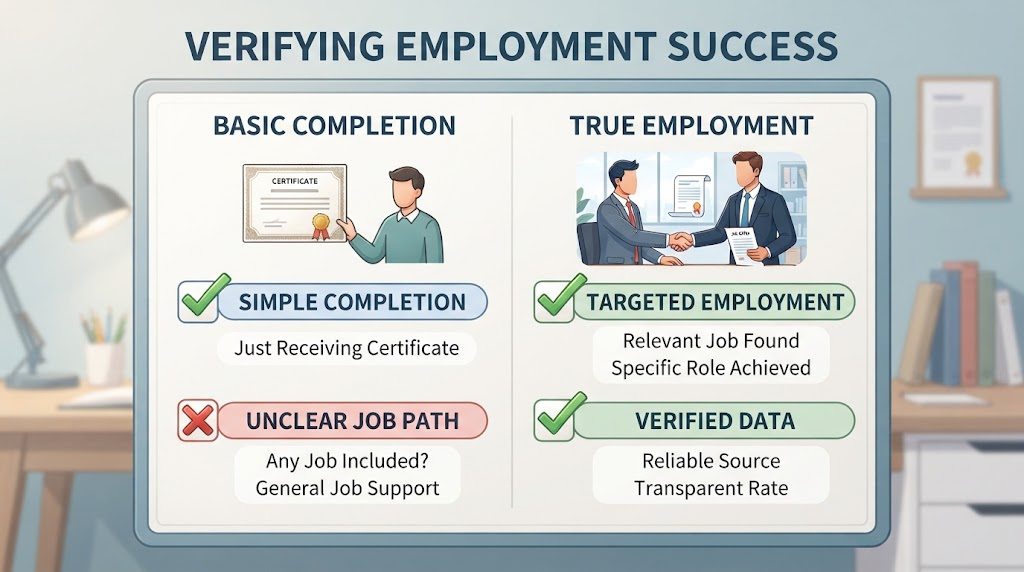
Core Elements of ‘Solid Post-Completion Support’ That Create True Employment Beyond Simple Completion
Just because you successfully completed a government-funded training course and hold a completion certificate in your hand does not mean the entire process is over. The true meaning of “completion of government-funded education” lies not in acquiring the certification itself, but in “successful employment in the desired place.” For this reason, the decisive difference dividing excellent training institutions and regular institutions appears in the “systematic nature of post-completion support.” Let’s examine the core elements of solid post-completion support that provide strong wings to a job-seeking activity that feels overwhelming on your own.
(1) Residency of a dedicated employment counselor and 1:1 customized career coaching
It is very important whether a dedicated counselor resides who closely understands the job seeker’s tendencies, desired job functions, and possessed competencies from the middle of the training course, rather than just formal counseling rushed right before the completion point, to draw a personalized employment roadmap.
(2) 1:1 resume and cover letter clinic that dramatically increases the document screening pass rate
No matter how good your specs are, a resume that fails to capture the hiring manager’s attention is useless. A system where professional instructors or the employment support department closely review and edit your practical projects and experiences accumulated during the training period so they can be attractively integrated into your resume and cover letter is essential.
(3) ‘Direct interview linkage’ utilizing an exclusive partner company network
Rather than blindly submitting resumes to public job postings on general employment portals, getting recommended directly to excellent partner institutions that have consistently maintained industry-academia cooperation with the training center to secure interview opportunities dramatically increases the probability of employment success. How solid the institution’s corporate pool is serves directly as the core competitive edge of its post-completion support.
(4) Continuous monitoring and post-support that continue even after completion
Rather than abandoning trainees just because the course is over, an attitude of taking responsibility until the end—such as continuously matching new recruitment information to students who remain unemployed even several months after completion and supporting additional interview coaching—must be in place.
Going beyond simply delivering knowledge, choosing an institution equipped with a true post-completion support system that runs alongside the job seeker until their very last step is the shortcut to employment success.

How to Fact-Check Training Institution Employment Rates and Reviews on HRD-Net (Employment 24)
No longer should anyone suffer regrets after registering by blindly trusting flashy phrases written on academy promotional flyers or websites. When choosing a government-funded training institution and course that will share your precious time, the place where you can check the most objective and accurate truth is the government’s official vocational training portal, HRD-Net and Employment 24.
We will introduce the core fact-checking methods that strip away the hype of advertising and accurately filter out only the facts.
(1) Check the ‘Official Employment Rate’ on the Training Course Detail Page
If you search for the desired course on HRD-Net (Employment 24), a detailed information page for each course appears. At the bottom of this page or in the information summary section, the official employment rate based on the Ministry of Employment and Labor’s compilation criteria, rather than numbers arbitrarily written by the institution, is transparently disclosed.
Carefully examine the flow of numbers to see whether this course has been steadily operated for the past several years and whether the cumulative employment rate is stable.
(2) Carefully Read ‘Real Course Reviews’ Left Directly by Graduates
The best way to grasp the on-site atmosphere, the instructor’s lecturing ability, and the state of practical training equipment, which cannot be known through official statistical numbers alone, is to look at the reviews of actual graduates.
Rather than reviews that are overwhelmingly full of praise, if you look for vivid reviews that specifically write down the pros and cons of the course or what they felt during the actual job linkage process after completion, you can get a sense of whether this institution is truly the right fit for you.
(3) Compare Completion Rates and Dropout Rates
Just as important as the employment rate is the completion rate (the percentage of people who finished the course to the end).
If the number of completion students compared to the enrolled number is excessively small, it means that many people give up midway because the curriculum is too overwhelming or class satisfaction is low, so you must carefully reconsider.
Just by investing 5 minutes with a smartphone or PC to fact-check data and reviews directly on HRD-Net (Employment 24), you can prevent unnecessary trial and error and find the best training institution with the highest probability of success!

Checklist for Identifying Excellent Training Institutions That Must Be Checked Before Registration
As government-funded training requires investing hundreds of hours of coursework and your precious time fully, there should be no instances of suffering regrets after registering anywhere impulsively. To identify a “truly excellent training institution” that fits you best and will produce certain results, we reveal the core checklist that you must check before pressing the registration button.
(1) Ministry of Employment and Labor Official Accreditation Evaluation Grade (Whether Certified as an Excellent Training Institution)
The objective indicator that should be checked first is the vocational training institution accreditation evaluation result conducted annually by the Ministry of Employment and Labor.
Places that have earned titles such as “Excellent Training Institution” or “Certified 3-Year/5-Year Excellent Institution” have been strictly verified by the government for their educational operation capacity, instructor expertise, financial soundness, etc., so you can choose them with peace of mind.
(2) Check HRD-Net Official Employment Rate and Completion Rate
As examined earlier, you must check the official indicators registered on HRD-Net (Employment 24), not the dazzling promotional phrases on the academy’s website.
Carefully compare whether the average employment rate over the past 1-2 years has consistently remained above the industry average, and whether there are too many dropouts (high completion rate).
(3) Practice-Oriented Curriculum and Latest Practical Training Equipment Infrastructure
You must check whether it is a place that only teaches theory with old textbooks and outdated equipment, or whether the curriculum is organized around the latest tools and practical projects actually used in the current field.
If possible, checking the classroom environment and the state of practical equipment with your own eyes through a visit consultation is the surest way.
(4) Dedicated Employment Support Department and Actual Partner Company Network
Rather than the vague expectation that “they will take care of getting me a job once I complete it,” you must check whether a dedicated employment counselor resides within the institution and constantly conducts resume clinics and interview coaching.
Also, by looking at what kinds of companies graduates actually got hired by, you can gauge how solid the institution’s partner company pool is.
(5) Professionalism of Instructors from Current Field Practitioners and 1:1 Feedback System
Whether the instructors are biased toward theory or are current field practitioners with rich practical experience in the relevant industry greatly determines the quality of education.
If you grasp in advance through course reviews how closely 1:1 feedback is provided when you ask about things you don’t understand during class, it will be very useful.
If you carefully weigh these five checklist items and make a careful choice, you will meet the best partner who can achieve definite employment results without any financial burden!

Tips for 100% Utilization of Post-Support Programs, from 1:1 Counseling to Interview Linkage
No matter how well a training institution is equipped with excellent post-support programs and professional dedicated counselors, if you just sit back and wait for opportunities to find you, the benefits are nothing more than a pie in the sky. We reveal practical tips to make the solid support infrastructure provided by the government and institutions 100% your own and seize true employment success.
(1) A passive attitude is a taboo! Approach them first and appeal your clear goals
Since a single counselor is in charge of dozens of trainees, it is difficult to receive in-depth customized management unless you approach them proactively first.
From the early to middle stages of the training course, visit your dedicated counselor and show your clear goals and determination by saying, “I specifically hope to get employed in such-and-such job functions and corporate groups.” The more firmly you make a positive impression, the sooner you can receive contact when high-quality recruitment information perfectly tailored to you comes in.
(2) Complete resume and cover letter clinics not just ‘once’ but through ‘repeated revisions’
There are many cases where people finish after receiving expert feedback just once. However, resumes and cover letters must continue to evolve according to the nature of the companies you apply to.
Whenever you make a revised version, you should frequently request reviews from dedicated instructors or the employment support department, and maximize completeness by receiving sharp feedback from the perspective of working-level staff, which can reliably increase your document screening pass rate.
(3) Approach mock interview coaching like the ‘real thing’ and internalize the feedback
Do not casually brush off mock interviews or speech coaching conducted by the institution as annoying supplementary events.
It is a golden opportunity to receive a cold evaluation of your eye contact handling, voice tone, and the logical structure of your answers from the perspective of an actual interviewer. You must take note of pointed-out weaknesses, practice repeatedly in front of a mirror, and internalize them as your own so that you can show your skills without getting nervous at the actual interview site.
(4) Actively engage in partner company recommendations and interview proposals
It is a taboo to repeatedly reject direct interview opportunities linked by the institution while stubbornly insisting only on the perfect large corporation or famous medium-sized enterprise you want.
Since partner company matching of excellent government-funded institutions has many unconventional advantages such as document screening free passes, it is a much wiser strategy to actively accumulate on-site interview experience and use it as a stepping stone to start your career.
Conclusion: Achieve Certain Employment Success Through Thorough Post-Completion Support
The moment you hold a certification in your hand always gives a thrilling and heart-filling sense of accomplishment. However, as examined earlier, the decisive difference that determines victory or defeat in the real job market is not the number of certifications, but ‘solid post-completion support and verified employment rates’.
Rather than turning your eyes to flashy promotional phrases or advertisements, wisdom is required to meticulously fact-check objective official data through HRD-Net (Employment 24), compare vivid reviews from graduates, and select the excellent training institution that suits you best. And you must not passively wait for post-support programs provided by the institution, such as dedicated counseling, 1:1 resume clinics, and partner company interview linkages, but actively delve into them and make them your own.
Equipped with the wings of thorough post-completion support on top of the solid benefits of government-funded support without financial burdens, we sincerely cheer for you to fly high with confidence toward your desired target job role. Find the best course to change your career right now on HRD-Net!
Korean version: 한국어로 읽기