Intro (Opening): The Importance of ‘Choosing the Right Institution’ for Risk-Free Government-Funded Education
[Intro] The Importance of ‘Choosing the Right Institution’ for Risk-Free Government-Funded Education
Have you issued the National Tomorrow Learning Card and decided to take your first step in learning?
Thanks to government support, you can significantly reduce the burden of tuition fees, but once you access HRD-Net, countless training institutions and similar courses pour out, making it easy to feel lost about which one to choose.
“Is a place close to home the best?”, “Is an academy with a high completion rate unconditionally a good place?”
After struggling with such worries, people often register based roughly on someone else’s reviews or eye-catching advertisements, only to end up in a mess, which can be seen quite often around us.
3 Risks Brought by Choosing the Wrong Institution
Wasting time and opportunity cost: Investing a few precious months of yours only to end up taking theory-focused classes that are completely useless in actual practice
Decrease in learning motivation (dropping out midway): A situation where, due to insufficient feedback from the instructors or inability to keep up with the pace, you end up dropping out midway and only having your Tomorrow Learning Card balance deducted
Failure in employment linkage: A case where the name sounds flashy, but actual job placement assistance or resume feedback is nonexistent
The significance of government-funded education is not simply getting a certificate or a completion diploma, but the core is ‘building practical competencies that directly connect to your actual career.’
Then, what aspects should we consider to find the optimal academy that perfectly fits me and my goals among countless institutions? Let’s go through the core comparison points for choosing a government-funded education institution that will make the probability of failure zero one by one from now on.

Body 1: Utilizing HRD-Net Objective Indicators 100%
[Body 1] Utilizing HRD-Net Objective Indicators 100%
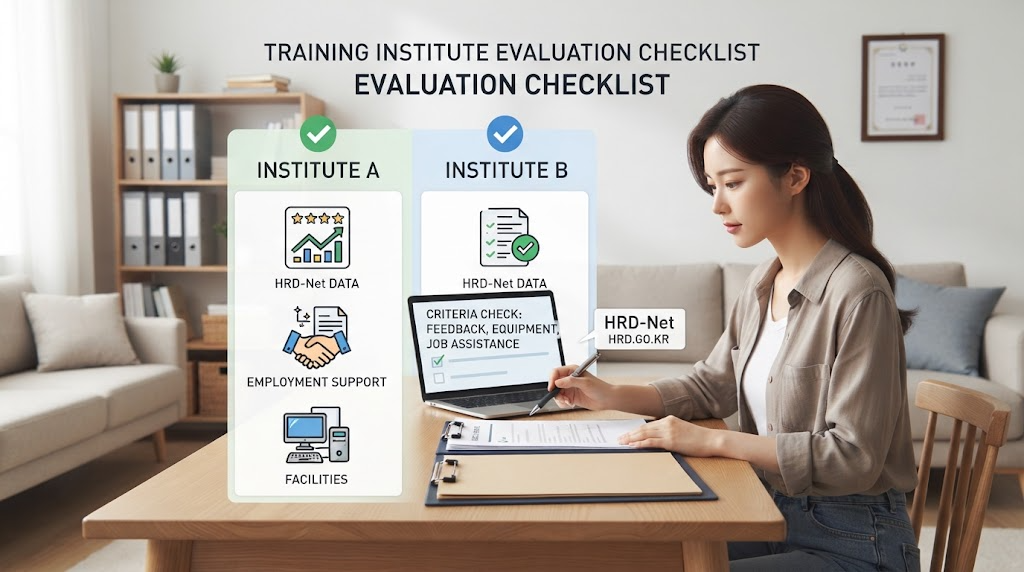
When choosing a government-funded education institution, the first and most objective place you must check is the vocational training portal HRD-Net. To avoid being swayed by flashy advertisements or word-of-mouth rumors from acquaintances, you must coldly and accurately verify the substance of the institution through official data.
We will point out 3 objective indicators that you must check on HRD-Net.
- Examining the flip side of numbers: Employment rate and completion rate
Meaning of completion rate: A high completion rate does not unconditionally mean a good course. It could be a light course that anyone can easily follow, or conversely, a figure artificially padded because dropouts were not properly managed.
Tips for interpreting the employment rate: Rather than just looking at the overall employment rate percentage (%) number, you must carefully examine ‘whether you got employed in a field that exactly matches the job you hope for’ and ‘what the scale of the number of employed people is compared to the number of enrolled students.’
- Analyzing trainee evaluations and honest reviews
Filtering out part-time or promotional reviews: Evaluations from actual graduates registered on HRD-Net are much more reliable than viral reviews on blogs or cafes.
Keywords to focus on: Don’t just look at the total star rating, but carefully examine the disadvantages commonly mentioned by graduates in the details regarding ‘instructor feedback speed’, ‘satisfaction with practical equipment’, and ‘the degree of help from actual job placement and resume editing’.
- Checking the Ministry of Employment and Labor’s institutional certification evaluation grade
The weight of the certification mark: Every year, the Ministry of Employment and Labor evaluates institutions’ financial soundness, trainee management systems, employment rates, etc., and grants certification grades (such as Excellent Training Institution, 3-year/5-year certification, etc.).
Selection guide: Places with high certification grades or selected as ‘Excellent Training Institutions’ are much more likely to operate government subsidies stably and manage curriculum courses systematically.
💡 Core Summary
HRD-Net data should not be used to find an academy you like, but rather as ‘a primary filtering net to weed out academies to avoid.’ Once you have narrowed down places verified for safety and reliability through objective indicators, it’s time to compare the next step, ‘the details of the curriculum and instructors.’
Body 2: Comparison Points for Curriculum and Instructor Expertise
[Body 2] Comparison Points for Curriculum and Instructor Expertise
If you have first narrowed down safe institutions using HRD-Net’s objective indicators, now it’s time to thoroughly examine the core essence of the education, ‘what and how you actually learn.’
No matter how high an institution’s employment rate is, if you actually take the course and find that it only repeats old textbooks and theory-centered classes, you will likely struggle when entering the field. Check out the 3 comparison points for the curriculum and instructors that will reliably boost your skills.
- Theory vs. practical ratio and reflection of latest trends
Check if education is stuck in the past: You should avoid classes that merely read textbook contents every day with woefully insufficient practice time.
Check essential industry skills: You must carefully check through the detailed syllabus how well the latest tools, programs, languages, and trends actually used by companies today are integrated into the curriculum.
- Practical portfolio and team project output process
The output is soon your resume: One of the biggest purposes of government-funded education is to complete ‘your own output (portfolio)’ and jump into the job market.
Examining the quality of projects: Be sure to check whether it stays at the level of examples where students simply follow what the instructor tells them to do, or if it’s a course where students lead everything from planning to development (or production) and even build collaboration experience through team projects.
- Instructors’ industry experience and 1:1 feedback system
Check if they are true industry experts: Whether the instructors only taught theory or have years of actual hands-on experience in the relevant industry and know the trends well determines the quality of the class.
Smoothness of questions and feedback: When you struggle to keep up with the pace or encounter an error, it is important to understand through graduate reviews how closely individual Q&A and 1:1 feedback are provided rather than being left unattended.
💡 Core Summary
The curriculum and instructors are ultimately the criteria that determine ‘whether I will be able to build the competence to earn a living on my own when I finish this course.’ Carefully compare how practice-oriented the curriculum in the syllabus is.

Body 3: Checking Tuition Fees (Self-Payment), Training Allowances, and Educational Environment
[Body 3] Checking Tuition Fees (Self-Payment), Training Allowances, and Educational Environment
No matter how wonderful the educational content is, it is difficult to complete the course unless your wallet situation and learning environment support it.
Before pressing the course registration button, let’s look at 3 cost benefits and physical environment check points that you must check with your own eyes.
Employment24
- Checking the Tomorrow Learning Card self-payment and support types
Self-payment varying greatly by course: Having the National Tomorrow Learning Card does not mean all education is 100% free.
You may have to pay a certain percentage of the regular tuition fee (15-55%, etc.) yourself.
Codeit
+ 1
National Employment Support System linkage benefits:
Depending on the participation type of the ‘National Employment Support System’ or whether you are a vulnerable class, the self-payment rate can be significantly lowered or you can receive benefits close to a full exemption, so it is recommended to check in advance which government support type you belong to.
My Wallet Policy
- Examining the payment conditions for training allowances (subsidies)
Employment24
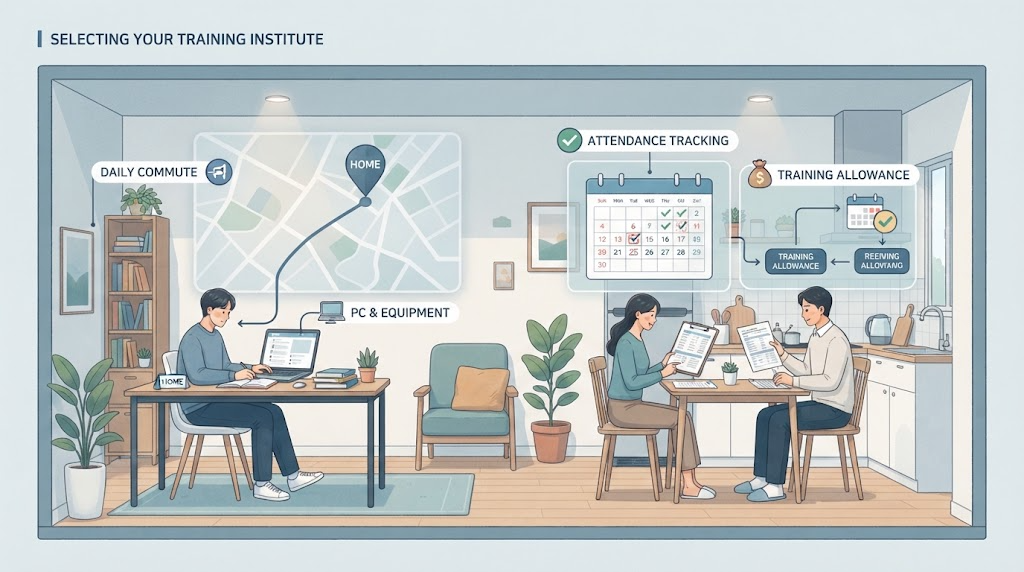
Livelihood stability support fund: If you take a long-term education course of 140 hours or more, a monthly training allowance (transportation expenses, meal expenses, etc.) is paid to job seekers or students who meet specific requirements.
Employment24
Thorough attendance management mandatory:
The allowance is normally paid only when an attendance rate of 80% or more is achieved based on the unit period, and since duplicate payments may be restricted while receiving unemployment benefits, you must coordinate your schedule in advance.
Codeit
+ 1
- Checking the physical educational environment and infrastructure
Sustainable commuting distance: Since you have to attend every day for several months, if the commuting distance from home or work is too far, you will physically tire out and the probability of dropping out midway increases.
Condition of practical equipment and facilities: If it’s a practical course like IT, design, or manufacturing, the PC specs, whether the latest programs are installed, and the presence of a private study room or lounge make a huge difference in learning efficiency. We recommend checking the classroom condition with your own eyes through an in-person visit consultation.
💡 Core Summary
Accurately calculating hidden self-payment costs and allowance conditions to set a budget, and carefully examining whether the educational environment you will visit every day is pleasant are the shortcuts to a successful completion.
Body 4: Core Question List You Must Ask During a Visit Consultation
[Body 4] Core Question List You Must Ask During a Visit Consultation
No matter how much information you gather through HRD-Net and internet reviews, there is no surer final verification method than visiting the academy in person and getting a consultation. In addition to checking the classroom condition with your own eyes, we have summarized 3 core questions you must ask when sitting down for a consultation.
Just by looking at the staff member’s attitude and specificity of answers, you can clearly judge whether this academy is a reliable place.
- Specificity of practical employment linkage programs
Figuring out whether it is a formal placement or a substantial linkage: Instead of vague questions like “Do people get jobs well?”, ask specifically, “What are the actual major employment industries and average salary levels of recent graduating cohorts?” and “How solid is the pool of partner companies?”
Checking the post-management period after completion: You must clearly check whether it ends with a brief support right after the course ends, or if post-management continues for several months after completion, such as resume editing, portfolio feedback, and interview accompaniment.
- ‘Dropout prevention’ support system when you miss the pace
Safety device for non-majors or beginners: When you can’t keep up with the pace while taking classes and get stuck with an error, you must check whether a practical system is in place where you can receive makeup classes or 1:1 Q&A.
Whether instructors provide close care: Carefully check whether it is a structure where a single instructor has to handle too many students compared to the number of attendees, making it difficult even to ask questions.
- Strictness of attendance management and penalty rules related to dropping out midway
Strict Ministry of Employment and Labor attendance criteria: Government-funded education has very strict attendance management for tardiness, leaving early, and absences. You must check in advance how the academy itself manages attendance checks and whether proof processing is smooth when unavoidable circumstances (such as hospital visits) occur.
Information on disadvantages in case of dropping out midway: If you drop out midway because the course does not suit your aptitude or due to personal circumstances, an institution that honestly guides you through potential risks such as deduction of the National Tomorrow Learning Card balance or future restrictions on government-funded training enrollment is a reliable institution.
💡 Core Summary
A visit consultation is not a place to listen to an academy’s flashy promotional comments, but rather ‘an interview place to gain final conviction on whether this is a place where I can safely invest my precious few months.’ If an institution answers transparently and specifically without hesitation to the above questions, you can choose with peace of mind.

Outro (Conclusion): Final Decision Guide for the Most Advantageous Institution for Me
[Outro] Final Decision Guide for the Most Advantageous Institution for Me
So far, we have looked at 4 criteria for wisely choosing a government-funded education institution, ranging from checking HRD-Net objective indicators to curriculum analysis, cost and environment checks, and core questions to ask during a visit consultation.
It is realistically difficult to find a ‘100-point institution with perfect conditions in every way’ among countless academies. Therefore, ahead of the final selection, establishing your own clear priorities is the most important thing.
3 Checklists for the Final Decision
Setting your own top priority value: “Is what’s most important to me practical project experience, a commuting distance close to home, or solid employment linkage performance?” Rank your own standards that you cannot compromise.
Avoiding impulsive choices: Rather than hastily registering simply because tuition is free or advertising phrases are flashy, you should make a careful decision through the step-by-step verification process examined earlier.
Mindset for completing the course: A good institution is merely a reliable helper that lowers the probability of failure, and ultimately, what creates the result is your own will and consistency.
Start Right Now (CTA)
The National Tomorrow Learning Card is a very precious opportunity to newly design and leap forward in your career. Stop feeling lost and, based on what you learned today, try executing everything step-by-step from accessing HRD-Net, listing institutions of interest, to booking a visit consultation.
We sincerely cheer for you to find the optimal institution that fits you perfectly through thorough comparison and preparation, and brilliantly be reborn as an expert in your desired field!
Korean version: 한국어로 읽기