
Prologue: The Real Reasons People Give Up on Self-Study and the Advantages of Government-Funded Programs
Whenever the New Year or job change season rolls around, almost everyone has had the experience of stopping by a bookstore and paying for a thick certification prep book. Starting with the ambitious resolution that “studying steadily for 2 hours a day will get this done in two months,” all too often only the first few pages end up blackened with fingerprints before the book is left neglected on the bookshelf.
The reason preparing for a certification exam fizzles out every time is not that your willpower is weaker than others’. It is because there were critical limitations in the fundamentally designed “learning environment and method.”
- Structural Limitations of Self-Study Ending in Giving Up After Three Days: Absence of “Compulsion” and “Direction”
Self-study, opening an exam prep book and studying alone, outwardly appears to be the most cost-effective and proactive method, but in reality, it is the method with the lowest completion rate.
The Quagmire of Errors Stalling Learning the Moment You Get Stuck
When non-majors try to understand the principles of journalizing in computerized accounting or handle complex array formulas in Computer Specialist for Spreadsheet & Database exams, they often waste half a day failing to resolve a single concept or Excel formula error. With nowhere to ask questions, they wander through web portal communities, lose their focus, and eventually close the book.
A Slack Environment Unable to Overcome Fatigue After Work
When overtime, company dinners, and exhaustion pile up, making the compromise of “Let’s rest today and do twice as much tomorrow” directly leads to giving up on the exam. Enduring for several months on one’s own willpower alone in an environment without a manager to keep the pace or peers to study alongside is something possible for less than the top 5% of people.
- The Differentiation of the K-Digital Tomorrow Learning Card (National Tomorrow Learning Card), Reducing Tuition Burden by up to 85–100%
The government-funded training (National Tomorrow Learning Card) system completely offsets these blind spots of self-study through a structured system. It goes beyond merely subsidizing academy fees; it lays down the “learning tracks that lead to the passing score.”
Government-Funded Training Fee Support up to a Limit of 3 Million to 5 Million KRW
Utilizing the National Tomorrow Learning Card issued by the Ministry of Employment and Labor enables you to receive government support covering from 45% up to as much as 85–100% of the tuition for professional certification and practical training programs that cost hundreds of thousands of won on the private market. It dramatically lowers the financial barrier to entry for textbook costs and tuition fees.
A Virtuous Cycle of the “80% Attendance Rule” Preventing Dropout at the Root
Government-funded courses require meeting the completion criteria of an 80% attendance rate to avoid training budget deductions or penalties. This minimal regulation imposes a strong, “legitimate compulsion” on an everyday routine prone to slackening, serving as a powerful driving force that makes you take your seat and make progress even on exhausting days.
Intuitive Guidance from Industry Instructors and Practice-Based Curriculum
Eliminating the inefficiency of memorizing a thick theory book from cover to cover, a systematic curriculum is provided that condenses and spoon-feeds only the most frequently tested areas and core skills essential for actual practice.
If self-study is like walking through a fog alone without a compass, government-funded classes are like boarding a bus with a guide who already knows the path to passing thoroughly to travel to your destination.
You can proceed with writing the following sections:
Writing a comparison between self-study vs. government-funded academy class methods
Writing the 4 stages of the government-funded curriculum for short-term passing
Self-Study vs. Government-Funded Academy: A Direct Comparison of Class Formats and Learning Environments
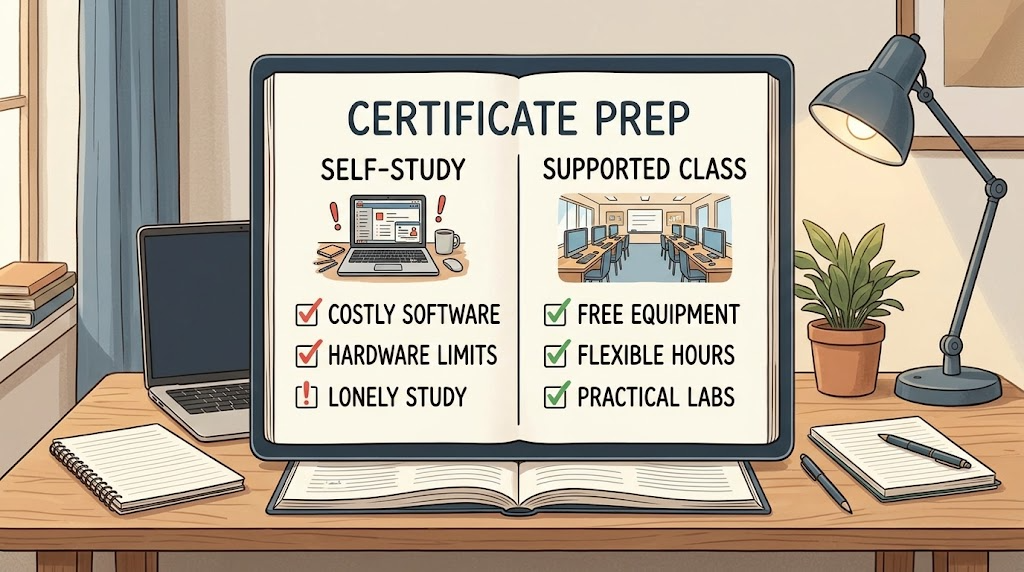
When deciding to acquire a certification, everyone wonders at least once: “Is it really necessary to spend money attending an academy? Couldn’t I just do it on my own watching YouTube or online lectures?” However, unlike simple rote-memorization exams, practical skill certifications require directly operating software and completing assigned tasks within a set timeframe. When comparing the self-study method of sitting alone at a desk wrestling with a monitor against the systematized courses of vocational training institutions, a stark contrast emerges in both study efficiency and the likelihood of completion.
Here is an examination of how these two approaches practically differ across three core pillars, ranging from progress management to practice equipment and study schedule options.
- Pacing and Feedback: Struggling Alone with Errors vs. Instant Resolution by an Instructor
- Self-Study: Time Wasted on Searching and Guesswork
When obstacles arise during study—such as code bugs, Excel macro syntax errors, or unbalanced journal entries—you must comb through internet Q&A portals or developer communities. If you cannot find the desired solution, your progress stalls for the entire day, easily draining your motivation to learn altogether.
- Government-Funded: 1-on-1 Real-Time Q&A and Troubleshooting
Professional instructors with industry experience are present on-site to address bottlenecks immediately on the spot. Going beyond simply checking the right answer, you receive immediate feedback on “why this formula triggers an error” and “how this issue is bypassed in actual work settings,” eliminating unnecessary wasted time.
- Practical Training Infrastructure: Personal Equipment Limitations vs. High-Spec Labs and Licensed Software
- Self-Study: Barriers of Software Licensing and PC Performance
Practical exams such as video editing (Premiere Pro, After Effects), 3D modeling, data analysis, and CAD require high-spec hardware and expensive software licenses. Expiring trial versions or insufficient personal laptop specifications consume significant expenses and stress just setting up a practice environment.
- Government-Funded: Dedicated Labs Identical to Exam Testing Centers
The practice computer labs of training institutions are fully equipped with officially licensed practical examination programs. In academies officially designated as actual certification test venues, you can even take the practical exam in the very seat and with the familiar keyboard you used during daily classes, significantly reducing test-day anxiety caused by adjusting to an unfamiliar environment.
- Course Formats: Struggling in Isolation vs. Situation-Tailored Multi-Tracks
- Evening Classes and Weekend Immersion Classes for Working Professionals
Short-term intensive courses are available to make full use of weekday evenings (19:00 to 22:00) after work or Saturdays and Sundays, making them ideal for maintaining a study routine alongside your regular job.
- Online Remote Courses (STEP, etc.) for Those with Tight Time Constraints
If commuting distances are long or shift work makes offline attendance difficult, you can fulfill progress rates during spare pockets of time through 100% online remote training (linked with the Smart Vocational Training Platform STEP) while receiving structured feedback on your assignments.
Core Environment Comparison: Self-Study vs. Government-Funded Training
| Comparison Item | Self-Study (Online Lectures & Books) | Government-Funded Vocational Training Program |
|---|---|---|
| Cost Burden | Entirely out-of-pocket for textbooks and private online lectures costing hundreds of thousands of won | Out-of-pocket expenses minimized through 45–85%+ government subsidies |
| Troubleshooting Questions | Dependent on searching online communities, prolonging stalled periods | Instant 1-on-1 feedback and close-up screen coaching by instructors |
| Practice Environment | Burden of personal PC hardware specs and purchasing software | Fully configured with high-spec labs and officially licensed software |
| Course Completion Rate | Around 20–30% due to reliance solely on personal willpower | 80%+ completion rate driven by attendance management (80% rule) and peer support |
Please select what to cover next:

The 4-Stage Practical Curriculum Structure of Government-Funded Programs for Achieving Short-Term Passes
The reason government-funded classes boast significantly higher pass rates than self-study is not simply because students attend lectures. It is because they follow a “4-stage standardized process for short-term completion” engineered by the Ministry of Employment and Labor and vocational training institutions based on years of passing data.
Here is an examination of the core 4-stage curriculum structure that prevents students from getting bogged down in minor details of thick textbooks and enables even non-majors to simultaneously achieve practical exam passing scores and real-world application skills in a short period.
Stage 1 (Solidifying Foundational Theory): Core Terminology and Legal Principles Understandable to Non-Majors at OnceThe secret behind the high certification acquisition rates and successful career transition rates of government-funded vocational training programs lies in a 4-stage standard roadmap thoroughly designed around passing exams and practical application. We explore the systematic curriculum stages that strip away the inefficiency of self-study—blindly memorizing thick theory books from the very first page—and bring even non-majors into the practical passing range within a short timeframe.
Stage 1: Condensed Theory and Core Terminology Groundwork Made Easy for Non-Majors
- Selective Focus on Tested Core Theory: Trimming away peripheral academic theories that rarely appear on past exams, condensed lectures are conducted focusing on the core concepts essential for multiple-choice written tests and practical interpretation.
- Tailored Explanations of Terminology: Lowering barriers to entry, instructors demystify account titles in computerized accounting journal entries, relational database (DB) schemas, and basic web programming syntax—the primary obstacles where non-majors first hit a wall—using clear industry examples and everyday analogies.
Stage 2: Intensive Hands-on Training and Mastery of Industry-Standard Software (SW)
- Repetitive Practice with Official Test Software: Conducting 1-on-1 practical training on the exact same software versions used in actual exam centers, covering Computerized Tax Accounting (KcLep, Duzon Smart A), Computer Specialist for Spreadsheet & Database (advanced Excel formulas, macros), design (Photoshop, Illustrator), and CAD (AutoCAD).
- Mastering Shortcuts and Practical Workflows: Considering that practical exams are easy to exceed time limits on if controls are unfamiliar, training focuses intensively on essential shortcut keys and standard operating workflows that can more than double task speed.
Stage 3: Reverse-Engineering Past Exam Trends and Timed CBT Mock Tests
- Reverse Analysis of Past Exam Trends from the Last 3 to 5 Years: Deconstructing and solving past exam questions reflecting the latest trends by question type, focusing corrective measures on trap questions that frequently lead to wrong answers.
- Time Attacks in an Exam-Identical Environment: Setting the exact same time limits as the real exam (e.g., 45 minutes for Computer Specialist practical, 60 minutes for Computerized Accounting, etc.) and repeating Computer-Based Testing (CBT) simulations to eliminate test-day nerves and pacing mistakes in advance.
Stage 4: Practical Portfolio Deliverable Production and Employment/Career Transition Matching
- Translating Certifications into Business Deliverables: Going beyond passing the exam to create your own portfolio—such as financial closing reports, data dashboards, design drafts, or practical project deliverables—by applying the learned software tools.
- Close-Up Support from Professional Consultants: Through dedicated on-campus career service offices, students receive tangible job placement support before and after completion, including resume and cover letter reviews, mock interviews, and recruitment connections with premier partner companies.
Summary of the 4-Stage Government-Funded Curriculum
| Stage | Core Learning Content | Target Goal |
|---|---|---|
| Stage 1: Basic Theory | Summary of high-frequency core concepts and essential job-specific terminology | Building foundational readiness for written tests and understanding core concepts |
| Stage 2: Tool Practice | Intensive operational training using official testing software | Mastering standard workflows and achieving proficiency in practical operations |
| Stage 3: Past Exam Reverse Analysis | Solving recent 3–5 year past exams and timed mock tests | Eliminating common mistakes and mastering exam time allocation |
| Stage 4: Portfolio | Creating practical deliverables, revising resumes, and job matching | Proving job-ready competencies and improving resume screening pass rates |
Please select what to cover next:
3 Selection Criteria for “Quality Government-Funded Training Institutions” to Check Before Enrolling
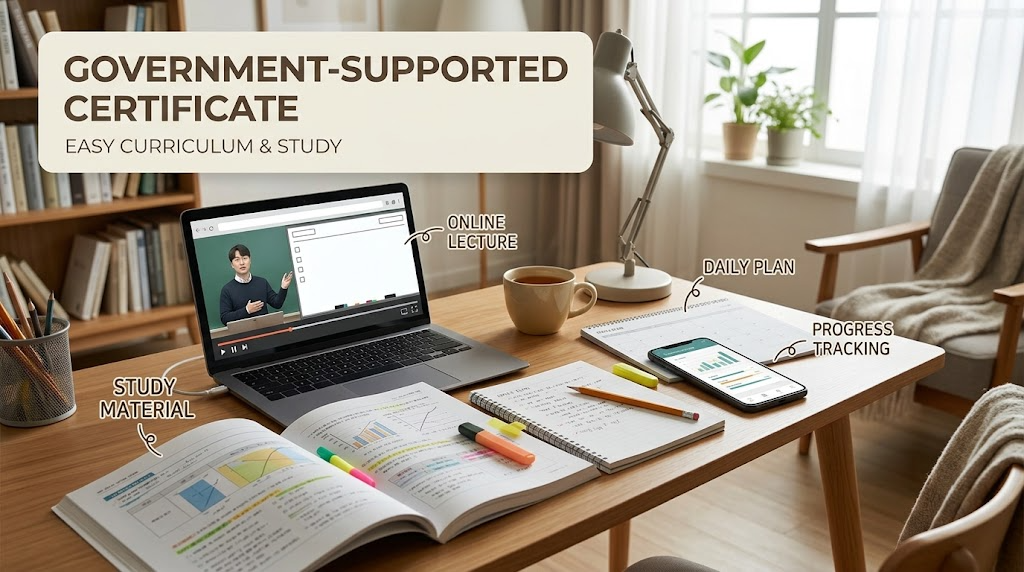
Just because you have been issued a National Tomorrow Learning Card does not mean you should hastily enroll in the academy closest to your home or rely solely on flashy promotional slogans. This is because significant differences exist across vocational training institutions regarding instructors’ practical field competencies, classroom facilities, and post-completion follow-up support.
Since government-funded training budgets have set limits and dropping out incurs penalties such as deductions from your grant balance, here are 3 criteria for selecting quality government-funded training institutions that you must check before registering.
- Verify Ministry of Employment and Labor Accreditation as a “3-Year or 5-Year Best Training Institution”
The most objective and credible indicator is the accreditation evaluation grade from the Korea Skills Quality Authority (KSQA).
- The Meaning of the Accreditation Grade
Each year, the Ministry of Employment and Labor and the Korea Skills Quality Authority comprehensively evaluate training institutions nationwide across employment rates, completion rates, trainee satisfaction scores, facilities, and instructor expertise. Only institutions receiving the highest marks in this evaluation are awarded the title of “3-Year Accredited” or “5-Year Accredited Best Training Institution.”
- Institutions to Avoid
Newly established institutions or those remaining at “1-Year Accreditation” due to deferred evaluation may be somewhat lacking in curriculum structure or administrative support. When searching on HRD-Net, make checking for the Best Training Institution certification badge next to the academy name your top priority.
- Analyze the “Completion Rate” and “Honest Reviews from Actual Students” on the HRD-Net Vocational Training Portal
Success stories featured on an academy’s official website are often selectively curated for marketing purposes. To review raw, unvarnished assessments, you should utilize the official government portal, HRD-Net (Vocational Training Portal).
- Filtering Course Reviews (Satisfaction Scores)
Check the HRD-Net course reviews, which can only be submitted by students who have actually completed the respective program. Rather than simple ratings like “It was good,” you should read specific feedback detailing points such as “whether the instructor provided solid 1-on-1 feedback instead of merely rushing through the syllabus” or “whether there were any issues with practice PC hardware specs or software versions.”
- Completion Rate and Certification Acquisition Rate Indicators
A course maintaining a final completion rate of 85% or higher relative to enrollment serves as clear proof of attentive instructor pacing and a well-established study atmosphere. Conversely, courses with high dropout rates warrant caution regarding failed curriculum difficulty calibration or substandard lecture management.
- Practice Equipment Specifications and Status as an On-Site “Authorized Testing Venue”
In practical skill-based certifications, even the monitor, keyboard, or mouse sensitivity can alter your results on the day of the practical exam.
- Lab Hardware and Software Versions
For video editing, 3D CAD, and big data analysis courses, the specifications of the academy’s practice PCs matter far more than personal laptops. It is advisable to tour the classrooms in person during consultations to verify whether the latest genuine software licenses are provided and whether the PC environment runs smoothly without lag during rendering or large-scale data extraction.
- Operation as an Authorized In-House Test Venue
Many practical certifications, such as Computerized Tax Accounting, ERP Information Manager, and ITQ, designate specific vocational colleges or private academies as authorized testing venues. Choosing an institution where you can take the national certification exam directly in the familiar computer lab where you regularly attend class reduces test-day anxiety and completely prevents mistakes caused by failing to adapt to an unfamiliar environment.
Checklist for Quality Training Institutions
| Inspection Item | Verification Path | Passing Standard |
|---|---|---|
| Accreditation Grade | HRD-Net academy search | “Best Training Institution” badge with 3-year or 5-year accreditation |
| Course Satisfaction | HRD-Net training course detail page | Satisfaction rating of 4.2 or higher with specific instructor feedback |
| Course Completion Rate | Training course public disclosure information | Maintains an 85% or higher completion rate relative to class capacity |
| Practice Infrastructure | In-person consultation and facility tour | Support for latest genuine tools and designated as an on-site authorized test venue |
Please select what to cover next:

Epilogue: Know-How on Going Beyond Certification Acquisition to Landing Practical Employment and Job Transitions
The sense of accomplishment upon receiving a passing certification notice is valuable, but it does not immediately guarantee a final job offer or salary increase. This is because the core question hiring managers ask when looking at the certification section is always: “So, based on this credential, what practical tasks can you handle immediately at our company?”
Here are 3 concluding know-how tips to completely transform the solid knowledge and hands-on experience gained through government-funded courses into weapons proving you are “job-ready immediately” on resumes and in interviews.
- Utilize the Training Institution’s Career Services Office and Job Center Post-Completion Matching to 200%
Many students end their relationship with the academy by walking out the door the moment they hold their completion certificates and credentials in hand. However, the true benefit of government-funded training lies in the “intensive employment support services provided for 6 months after completion.”
- 1-on-1 Resume and Cover Letter Revisions Based on Industry Standards
Dedicated vocational counselors at vocational training institutions understand passing data from numerous alumni and the latest hiring trends inside out. They sharply polish awkward sentences written on your own to align with hiring managers’ perspectives, focusing on job-specific keywords.
- Confidential Recruitment Recommendations and Company Matching Opportunities
Quality training institutions often maintain industry-academia cooperation agreements (MOUs) with promising local mid-sized businesses, SMEs, and startups. Recommended recruitment screenings received via academy nominations before public postings appear on general job portals feature significantly higher resume screening pass rates than open applications, making close communication with your dedicated counselor essential.
- Portfolios Speaking Through “Practical Project Deliverables” Instead of Bare Certification Titles
Even when writing a single line for a certification, you must add the “projects and deliverables (Work Products) executed in person during classes” underneath to establish competitive edge.
- Simple Listing (Before):
2026.10 | Acquired Computer Specialist for Spreadsheet & Database Grade 1 / Computerized Tax Accounting Grade 2
- Project Evidence-Based Listing (After):
[Built an Automated Monthly Sales Analysis Dashboard]
- Based on Computer Specialist Grade 1 practical skills: Automated data aggregation across 5 sales channels utilizing complex array formulas and VBA macros
[Manufacturing Enterprise Cost Closing Simulation]
- Utilizing KcLep (K-Lep): Drafted cost statements and VAT returns firsthand, independently executing the financial closing process
Do not discard the practice exercise files worked on during academy lab sessions. By layering your own data or hypothetical enterprise scenarios onto them and attaching them as a polished PDF portfolio or link (Notion, GitHub, etc.), you can establish credibility that rivals experienced professionals equipped with portfolios.
- How to Answer “Reasons for Taking Government-Funded Classes” in Interviews with a Professional Mindset
When an interviewer asks, “How did you acquire this certification?” or *”You are a non-major, but you attended a government-funded academy?”*, answering simply *”I learned it because I couldn’t find a job”* leaves a passive impression.
Recommended Response Framework:
“While working in my previous major (or previous career), I deeply felt the importance of data/accounting/practical tools in [specific job area]. Rather than studying only theory on my own, I chose a government-accredited vocational training program to properly learn industry-standard processes, and by operating the actual software for [X hours] every day, I elevated my skills to the point of being capable of independent practical execution.”
When you answer by infusing your choices with clear job-related reasons and a proactive willingness to solve problems, your government-funded training background is evaluated not merely as taking academy classes, but as ‘execution capability driven by strategic initiative toward a goal.’
Final Checklist for Connecting Certification Acquisition to Employment
| Stage | Action Guidelines | Status |
|---|---|---|
| Connecting Career Support | Submit resume draft to the training institution’s career services office and schedule a 1-on-1 consultation | [ ] |
| Building Portfolio | Compile 1–2 practical course assignments produced during classes into a PDF portfolio | [ ] |
| Differentiating Resume | Add 2 lines detailing “applicable practical tools and skills” alongside the acquired exam title in the certification section | [ ] |
| Interview Storytelling | Practice connecting application motives and reasons for acquiring certifications into a 1-minute speech | [ ] |
The experience of breaking away from the helplessness of self-study and completing a certification through the power of a structured system becomes a tremendous asset in your future career. Now, prove the perseverance shown in completing the designated curriculum from start to finish through a portfolio of your own.
Please select the next step to conclude this post:
Korean version: 한국어로 읽기