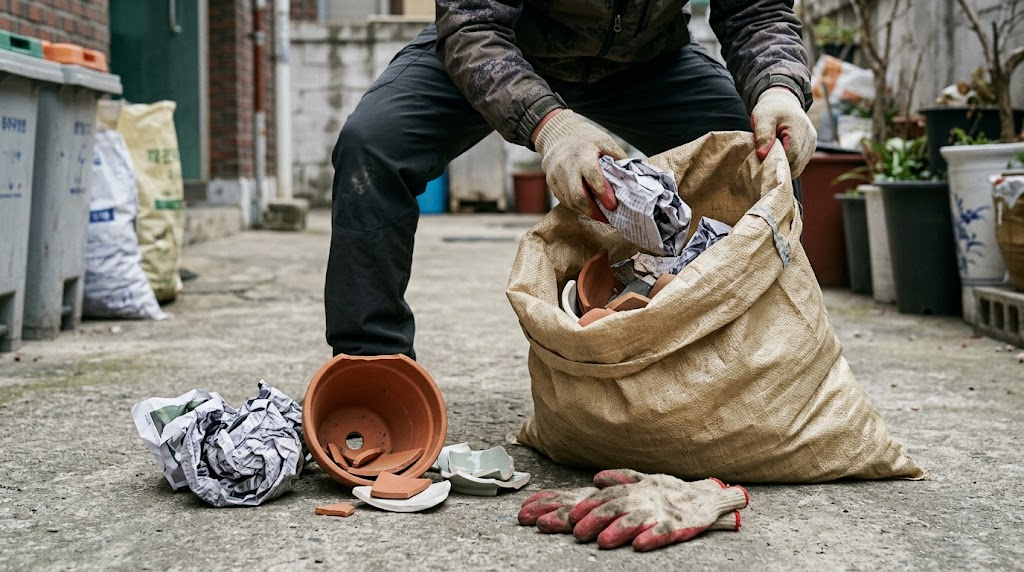
Broken Glass and Soil-Covered Flowerpots: Why Shouldn’t You Throw Them in Regular Trash Bags?
Anyone is bound to panic the moment a flowerpot falls and shatters loudly while repotting at home, or when a cherished glass cup or mirror cracks.
While cleaning up the shards, the very first dilemma that comes to mind is probably: “Should I put this in the recycling bin? Or can I just stuff it into a regular volume-rate trash bag?”
To get straight to the conclusion, broken glass and ceramic flowerpots can neither be recycled nor disposed of in regular volume-rate bags. Here are three reasons why.
- Why Recycling Sorting Plants Reject Them
They are not targets for bottle recycling: The ‘glass bottle’ collection bins at apartment recycling stations target only standardized containers that can be melted down to make bottles again from identical materials, such as beer bottles, soju bottles, and beverage bottles.
Melting temperatures are different: Broken glassware, heat-resistant glass (such as Glasslock), mirrors, light bulbs, and ceramic flowerpots have completely different raw material compositions and melting temperatures compared to ordinary glass bottles. If these materials get mixed in, they ruin the entire recycling process, so sorting plants classify all of them as waste.
- Cannot Enter Incinerators: Non-Combustible (Unburnable) Waste
Most garbage placed in regular volume-rate trash bags heads to municipal waste incinerators.
Glass fragments, ceramic bowls, ceramic pots, tiles, etc., are typical non-combustible waste that does not burn. Even if they enter incinerators, they do not burn and remain on the floor, causing incinerator breakdowns or shortening equipment lifespans.
- Major Cause of Safety Accidents for Sanitation Workers
If sharp fragments are put directly into thin plastic regular volume-rate bags, the bags tear and protrude outward during collection and compaction transport.
In this process, severe laceration accidents to the hands or legs of sanitation workers doing collection work occur frequently. Even if wrapped in newspaper, the bag easily bursts open the moment it enters a compactor truck.
One-Line Summary
Because broken glass, mirrors, and ceramic pot fragments are unburnable waste, they must be discarded not in regular volume-rate bags, but in ‘non-combustible volume-rate sacks (special designated bags)’.
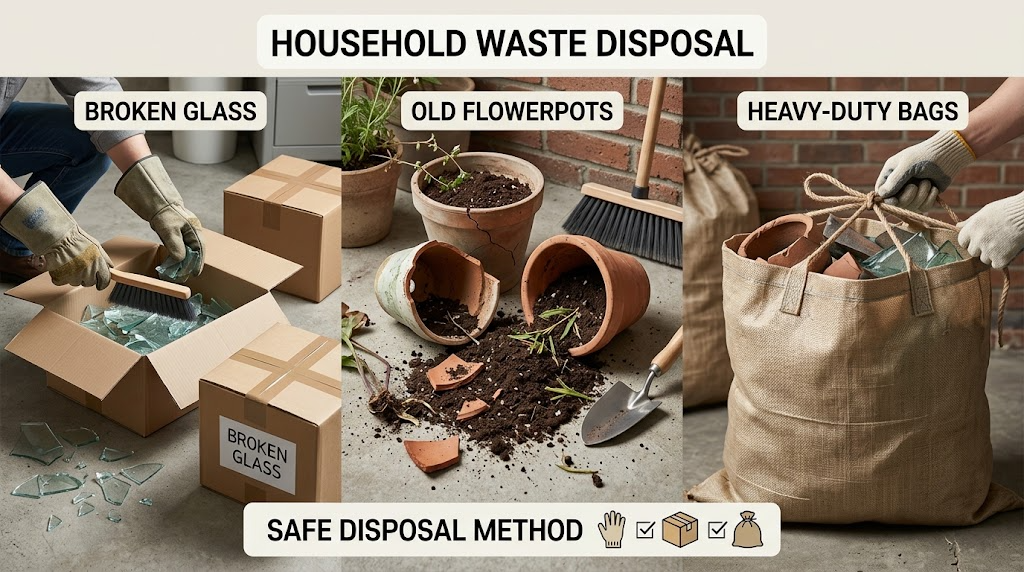
Where to Buy Special Designated Bags (Non-Combustible PP Woven Sacks) and Price Overview
To discard broken glass and ceramic flowerpots, a ‘non-combustible volume-rate sack (special designated bag/PP sack)’ rather than a regular vinyl volume-rate bag is essential.
However, because they are not readily available at any convenience store in front of your house like regular trash bags, many people end up making wasted trips wandering around the neighborhood several times. Here is a complete overview of purchase locations, dimensions, and price standards.
- Where Can You Buy Non-Combustible PP Sacks?
Non-combustible volume-rate sacks are handled only at designated local government retail outlets.
- Neighborhood Community Service Centers (Administrative Welfare Centers): This is the most reliable place to buy them. You can easily purchase them per sheet at the volume-rate bag sales counter inside the civil service center.
- Designated convenience stores and neighborhood marts: Not all convenience stores or supermarkets sell them. They are carried only at select designated outlets (such as GS25, CU, 7-Eleven, large wholesale food marts) in areas with high foot traffic or dense residential neighborhoods.
- Hardware stores: Neighborhood hardware stores registered as designated waste bag retailers frequently stock non-combustible PP sacks as well.
💡 Tip to Avoid Wasted Trips
Before heading out blindly, check the [Designated Volume-Rate Bag Retailer Status] Excel file or map in the ‘Cleaning Administration Division / Resource Circulation Division’ menu on your competent city/district office website. Whether they stock non-combustible sacks and their phone numbers are listed, so verifying inventory by phone beforehand saves time.
- Specifications (Capacity) and Price Standards
Non-combustible sacks have slight variations in handled sizes and sales prices depending on local government ordinances. (Usually, 10L, 20L, and 50L sizes are most widely distributed.)
| Size (Capacity) | Approximate Price Range (Per Sheet) | Recommended Use |
|---|---|---|
| 10L | Approx. 500 KRW ~ 1,000 KRW range | Broken mugs, 2–3 small plates, mini flowerpots |
| 20L | Approx. 1,000 KRW ~ 2,000 KRW range | 1–2 small-to-medium flowerpots, full-length mirror shards, broken dinnerware sets |
| 50L | Approx. 2,500 KRW ~ 5,000 KRW range | Large veranda flowerpots, bathroom tile replacement, bulk waste |
(※ Differences of about 100 to 500 KRW may occur depending on local government price standards.)
- Key Precautions to Know Before Purchasing
- Must verify local government jurisdiction:
Just like regular volume-rate bags, only sacks under the jurisdiction of the relevant autonomous district/city will be collected. (e.g., If you place a Seoul Gangnam-gu sack in Seocho-gu, collection will be refused and treated as illegal dumping.)
- Availability of individual sheet purchases:
Since they can usually be purchased per sheet (individually) at community service centers or marts, you do not need to buy unnecessary 10-sheet bundles; buying only 1–2 sheets of 10L–20L suited to the amount you need to discard is recommended.
- Consider weight limits:
Glass and flowerpot fragments are quite heavy relative to their volume. If you fill an oversized 50L sack to the brim, it becomes so heavy that an adult cannot lift it alone, causing the sack to tear or sanitation workers to be unable to lift it, so dividing items into 10L or 20L sacks at home is much safer.
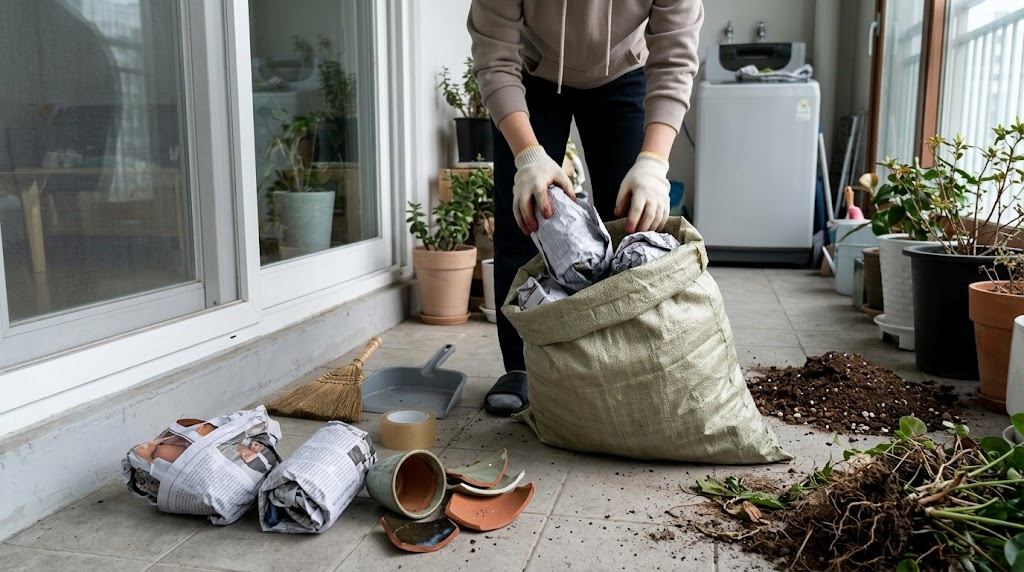
Safe and Sure Waste Packaging and Disposal Methods
Once you have prepared non-combustible woven sacks (special designated bags), it is time to safely wrap and contain the fragments without getting injured.
Even though the sack material is thick and durable woven fabric (PP), dumping sharp glass shards directly inside poses a high risk of shards puncturing through gaps during transport, causing injuries to sanitation workers or yourself. Here are the 3-step safe packaging principles to follow when handling broken glass and flowerpots.
- Complete Packaging Method for Broken Glass (Mirrors, Glass Cups, Dishes)
Step 1: Wear Gloves and Collect Large Shards
Always wear thick coated cotton work gloves or rubber gloves while working. Bare hands or thin plastic gloves are strictly prohibited.
Step 2: Double-Wrap with Newspaper or Cardboard Boxes
Roll large shards multiple times inside several layers of newspaper, package cushioning material (bubble wrap), or thin cardboard sheets.
Firmly seal the entire wrapped exterior with box tape to secure it so shards do not poke through or drop debris.
Step 3: Tips for Cleaning Fine Shards
Directly vacuuming tiny powder and glass debris that are hard to see can damage the vacuum cleaner filter or motor. Vacuum by covering the vacuum inlet with discarded pantyhose, or firmly press wide box tape or wet wipes across the surface to wipe up debris, then place that tape/wet wipe inside the wrapped newspaper bundle and seal it together.
- Tips for Separating and Disposing of Broken Flowerpots and Gardening Soil
When a flowerpot breaks, the trickiest part is the ‘soil inside the pot’ and ‘plant remnants.’
Separating Plants (Stems, Roots, Leaves):
Organic remnants like dead plants or fine roots should be placed in a regular volume-rate bag for disposal. (Too much soil or plant waste should not be mixed into non-combustible sacks.)
Pot Fragments:
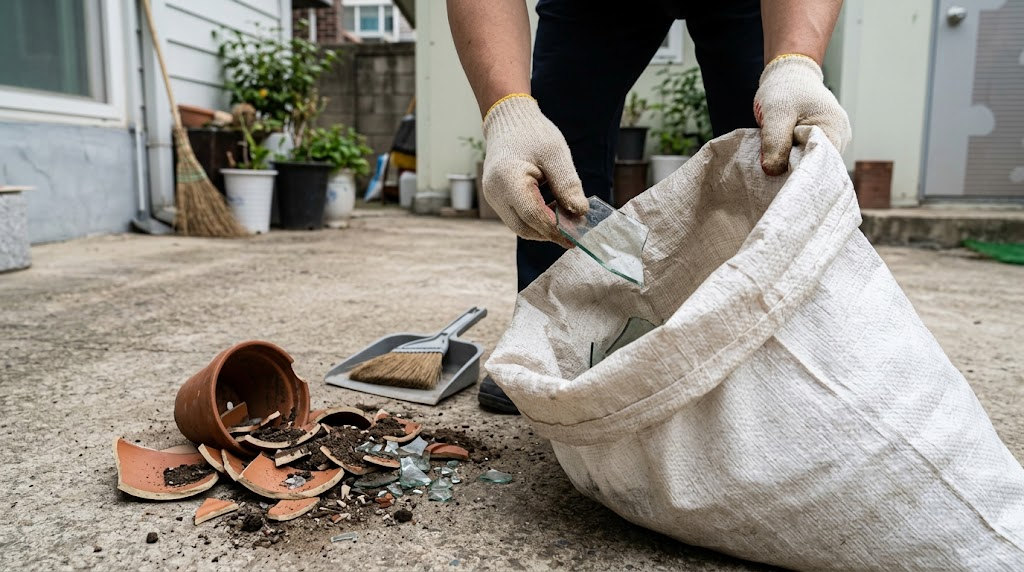
Ceramic, earthenware, and terracotta pot shards have many sharp edges. Just like glass, wrapping them once in thick paper or newspaper before putting them in the sack perfectly prevents the sack from tearing.
If it is a plastic flowerpot, it belongs in plastic recycling, not a non-combustible sack.
Disposing of Remaining Pot Soil:
Soil is a natural material, so in principle it is not regular waste, but natural disposal is difficult in urban apartments or residential areas.
A small amount of soil can be placed in small quantities inside non-combustible sacks along with pot fragments for disposal; however, if the volume is large, construction waste standards may apply depending on cleaning division guidelines by local government, so be careful not to fill a single bag entirely with soil.
- Guide for Small vs. Large Quantities
When 1 Glass Cup or 1 Small Plate Breaks (Small Quantity):
If it is a very small quantity that feels burdensome to buy a woven sack for, wrap it thickly in multiple layers of newspaper and seal firmly with box tape.
Many local governments permit placing it in the center of a regular volume-rate bag and writing “Caution: Broken Glass” in bold marker on the exterior before putting it out. (※ Since this can be subject to enforcement depending on local government ordinances, using a 10L non-combustible sack dedicated to small quantities is recommended in principle.)
When Discarding in Bulk Due to Moving, Veranda Cleanup, etc.:
You must distribute the weight. Filling a single 50L sack with heavy soil and pot shards causes the weight to exceed 30–40kg, making it impossible to lift.
Disposal etiquette is to divide items across multiple 20L sacks so the weight of each sack does not exceed 10–15kg.
- Safety Labeling on the Sack Exterior
After neatly placing the packaged bundles into the woven sack and tightly tying the opening with string, finally take a permanent marker and clearly write on the exterior of the sack.
✍️ Example of Sack Exterior Labeling
[Caution] Contains Broken Glass and Ceramic Flowerpot Shards (Watch Your Hands)
Just a few seconds of consideration serves as a decisive safety measure that prevents serious injuries to the sanitation workers collecting the waste.
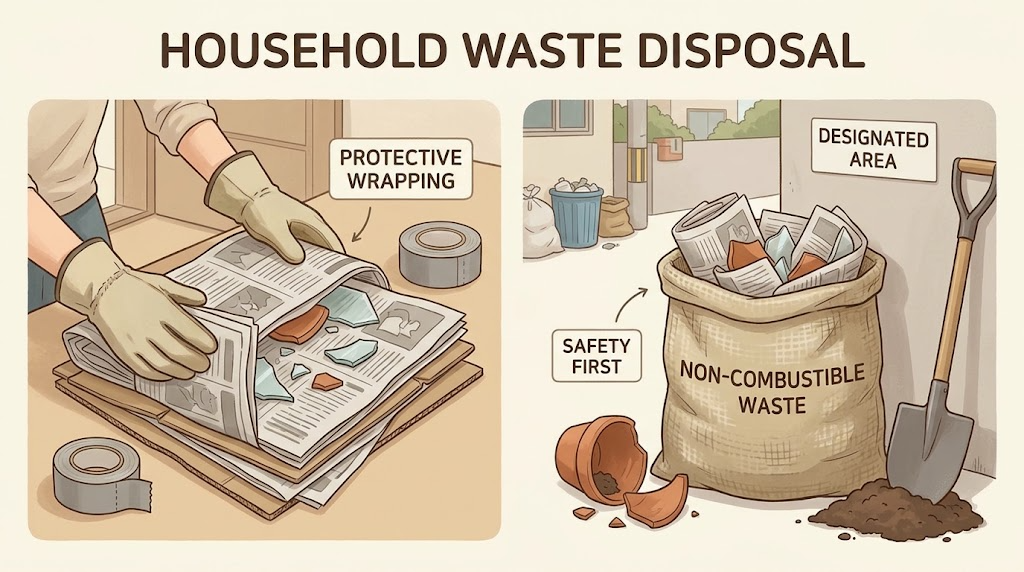
Disposal Locations for Woven Sacks and Precautions When Requesting Collection
Once you have carefully packaged and placed everything into the non-combustible woven sack, it is now time to set it outside.
However, simply dropping it in front of the door like a regular volume-rate bag does not guarantee it will be collected. This is because collection days, designated collection agencies, and pre-declaration requirements operate completely differently from general household waste depending on the local government.
To avoid the frustrating situation where a yellow ‘Uncollectible’ warning sticker gets attached to the heavy sack you carried out, here are the essential disposal checkpoints you must know.
- Accurate Disposal Locations by Housing Type
Apartments and Multi-Family Housing:
In most cases, a dedicated storage area for ‘non-combustible woven sacks/special designated bags’ is separately arranged to one side of the recycling collection area within the complex.
If the designated area is unclear, check with the security office or management office and set it out at the designated collection location so as not to obstruct passage for other residents.
Detached Houses, Villas, and Multi-Household Dwellings:
In principle, it must be placed outside the front gate of your home or in designated waste disposal areas such as the ground-floor pilotis parking lot of the building.
Arbitrarily leaving it at spots where random people discard waste, such as roadsides or under utility poles, may cause it to be mistaken for illegal dumping and delay collection.
- Checking Disposal Days and Time Windows
Collection dates frequently differ from regular garbage collection:
Non-combustible sacks are collected not by regular compactor trucks carrying burnable garbage, but on routes handled by separate special-waste collection trucks (roll-off hoist trucks or flatbed trucks).
Designated 1–2 times weekly collection:
Many local governments do not collect non-combustible sacks daily, collecting them only on specific days such as ‘every Wednesday’ or ‘Tuesdays and Thursdays.’
Observing disposal times:
The fundamental rule is to place them outside between sunset on the day before collection (usually after 7 PM–8 PM) and early the following morning. Placing them out early during daytime hours can cause complaints due to pedestrian obstruction and aesthetic degradation.
- Local Government Differences: ‘Direct Disposal’ vs. ‘Advance Collection Reservation’
This is where the most confusion occurs. Depending on local government operating methods, it is broadly divided into two systems.
Type A: Areas where items are collected automatically just by setting out the sack
Areas where waste disposal and collection costs are included directly within the price of the sack itself.
As long as you place it at the designated location on the evening of the scheduled disposal day, the district cleaning agency will collect it.
Type B: Areas where a ‘collection request (registration)’ must be made to the competent agency
In some cities, counties, and districts, on-site pickup occurs only if you register in advance by calling the [Jurisdictional Waste Collection Agency Phone Number] printed on the exterior of the sack, or by registering the disposal location and quantity via the district office website (or waste disposal mobile app).
If you set it out blindly without registering, it may be left unattended for several days, so be sure to first read the instructional notice (agency contact information and disposal guidelines) printed on the exterior of the sack.
- Criteria for Distinguishing Bulky Waste Stickers vs. Non-Combustible PP Sacks
Depending on the flowerpot size or glass format, you may wonder whether to place it in a PP sack or attach a sticker.
Items for PP sack disposal: Fragments of a size that allows the mouth of the sack to be tied completely, dismantled small and medium flowerpots, and finely shattered glass pieces.
Items for bulky waste stickers: For large ceramic flowerpots that do not fit into PP sacks (when discarded in their original intact shape) or large full-length mirrors discarded whole, do not forcefully smash them into sacks; it is much safer and simpler to obtain and attach a bulky waste sticker (payment certificate) from the district office website or community service center before disposal.
Fines for Illegal Dumping and Safety Rules Checklist
Never entertain the complacent thought: “Well, if I wrap it roughly in newspaper and slip it under a regular bag, no one will know, right?”
Secretly mixing broken glass or ceramic flowerpots into regular volume-rate bags or abandoning them on roadsides is strictly illegal under the Waste Management Act. If caught through unannounced bag-tearing inspections by local government sanitation inspection teams or via CCTV, you will face heavier administrative fines than expected.
- Administrative Fine Criteria for Illegal Dumping Under the Waste Management Act
If you discard non-combustible waste illegally without using standard bags, or get caught mixing waste, administrative fines are imposed pursuant to Article 68 of the Waste Management Act as follows:
Non-use of volume-rate bags and illegal dumping in general plastic: 200,000 KRW
Mixed disposal of non-combustible waste inside volume-rate bags (violation of separate disposal): 100,000 KRW to 300,000 KRW (accumulates depending on the number of violations)
Mass illegal dumping using vehicles, handcarts, etc.: 500,000 KRW
Illegal dumping of waste generated during business activities: Up to 1,000,000 KRW
⚠ Caution
Trying to save a few hundred to a thousand won on PP sack costs can result in fine bombs reaching hundreds of thousands of won. In particular, if a sanitation worker sustains an injury due to sharp fragments, it can even escalate to civil liability for damages.
- Must Check Before Disposal! Final Safety Rules Checklist
Before placing glass and flowerpots outside your door, check these 5 items:
[ ] Check standard bag: Did you use a ‘non-combustible PP sack (special standard bag)’ designated by the competent district/city office, rather than a regular volume-rate bag?
[ ] Double cushioning wrap: Did you wrap sharp glass and ceramic fragments with multiple layers of newspaper, bubble wrap, or cardboard and seal them with tape?
[ ] Weight appropriateness: Did you avoid packing too much into one sack and distribute the weight so an adult can lift it comfortably with one hand (within 10 to 15kg)?
[ ] Safety warning labeling: Did you clearly write the phrase “Caution: Broken Glass and Flowerpots (Watch Your Hands)” on the exterior of the sack using a bold permanent marker?
[ ] Check collection method: Did you check the exterior of the PP sack to verify whether your area requires advance collection phone/app registration, or simply placing it out on the designated day?
Epilogue (Conclusion)
When glassware or flowerpots break, it is flustering and troublesome to clean up shards, but observing proper disposal procedures is the most basic courtesy to maintain a clean local neighborhood environment and ensure the safety of sanitation workers cleaning early morning streets.
Purchase a non-combustible sack of the right size at a community service center or designated retailer, and dispose of it safely packaged following the steps outlined today!
*If today’s information was helpful, please hit Like (❤️)* and leave a comment. If you have any questions regarding where to buy sacks in your neighborhood or disposal methods, feel free to leave a comment anytime!
Additional work options for completing this blog post:
Naver SEO optimization title and tag recommendations
Prompt generation for creating the post featured image (thumbnail)
Korean version: 한국어로 읽기