Why Sorting Out ‘Items to Discard’ Is Priority #1 Before Getting a Moving Estimate
Once you decide to move, the very first thing you usually do is look into moving companies. However, in countless moving reviews, experienced movers unanimously emphasize one absolute rule: you must unconditionally sort out the items to discard before the estimator visits.
This is not merely about tidying up to make your home look neat. This single step can make a difference of hundreds of thousands of won, or as much as 500,000 won or more, in your moving costs. Here are the clear reasons why sorting out items to discard must be your top priority.
- It determines the core factors of moving costs: ‘tonnage’ and ‘staffing’
More than 80% of a full-service moving quote is determined by truck tonnage (2.5 tons, 5 tons, 6 tons, etc.) and the number of on-site crew members.
Based on one 5-ton truck: usually, 3 male movers and 1 female kitchen organizer are assigned.
If the load slightly exceeds this and requires 6 tons or an additional 5-ton + 1-ton truck: not only do additional vehicle costs apply, but labor costs (1 additional worker) are also added, jumping the estimate by 300,000 to 500,000 won easily.
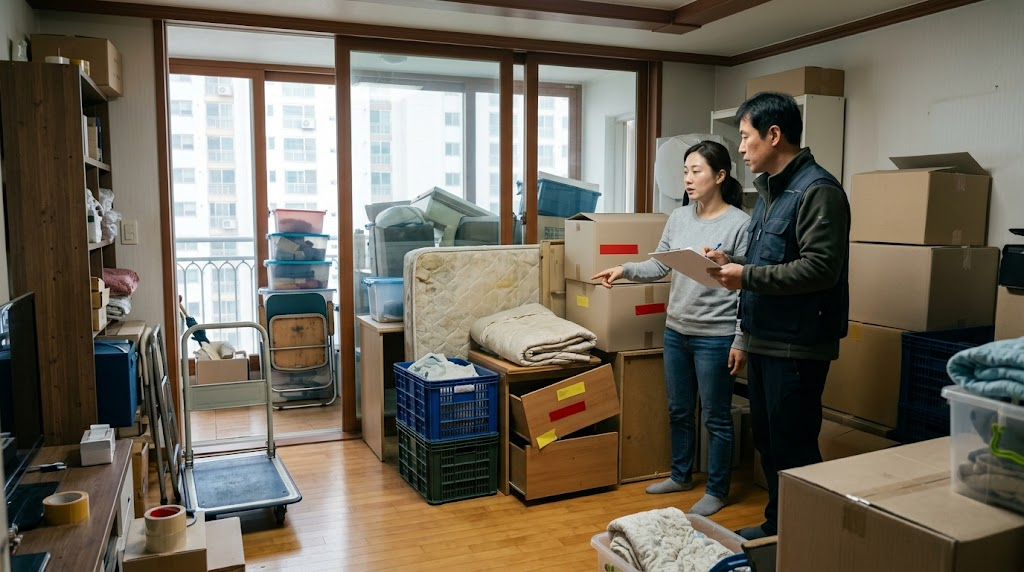
When an estimator inspects your home, they measure everything—including old wardrobes, worn-out mattresses, and unused storage boxes piled on the balcony that you plan to throw away—as ‘belongings to take.’ Even if you verbally say, “I’m going to throw this away,” the on-site estimator has no choice but to conservatively increase the tonnage to prevent a potential shortage of loading space when the physical items are right before their eyes. If you do not clear out or clearly mark the items to discard in advance, you will end up paying for trucks and labor just to haul garbage.
- It prevents the wasted effort of wrapping ‘items to discard’ in packing materials
When a full-service moving team arrives on moving day morning, they pack belongings quickly like machines.
If what to discard is not completely separated, the following mishaps will occur:
Blankets, clothes, and even pots you intended to throw away get meticulously wrapped in dedicated boxes and bubble wrap.
Only after arriving at the new house and unpacking do you realize, “Wait, why did we bring this when we were going to throw it out?”
Ultimately, double expenses occur as you have to buy waste disposal stickers again at the new home to discard them.
When packing materials and working hours are needlessly wasted, the total moving time gets longer, and as on-site workers become more fatigued, the quality of tidying and organizing at the new home drops as well.
- How to smartly separate areas for ‘items to discard’ before an in-person estimate
Then, what should you do with large furniture and bulky items already in your home before the estimator visits? Since you cannot move everything out of the house immediately, clear visual separation is key.
Mark with an ‘X’ using red/yellow masking tape
Put a prominent ‘X’ mark with highly visible tape directly on the appliances and furniture you plan to discard.
Attach disposal labels
Write [Scheduled for Disposal – Exclude from Estimate] in large letters on A4 paper and tape it on; the estimator will exclude it from the volume without mistakes when calculating the load.
Gather small waste items in one area
It is best to gather discarded knick-knacks, old dishes, books, and the like in a corner of the balcony or utility room, clearly drawing the line by saying, “Everything in this section is for disposal.”
💡 Key Point
A moving estimate is not about counting ‘belongings to keep,’ but calculating ‘belongings minus what will be discarded.’ Shedding just 1 ton of unnecessary belongings saves unnecessary labor and vehicle costs, and cuts the stress of unpacking at your new home in half.
You can proceed right away with the next subheading or related tasks:
Subheading 2: Drafting 3 Key Points for Prior Consultation
Receiving photo shooting/placement guides suitable for the body text
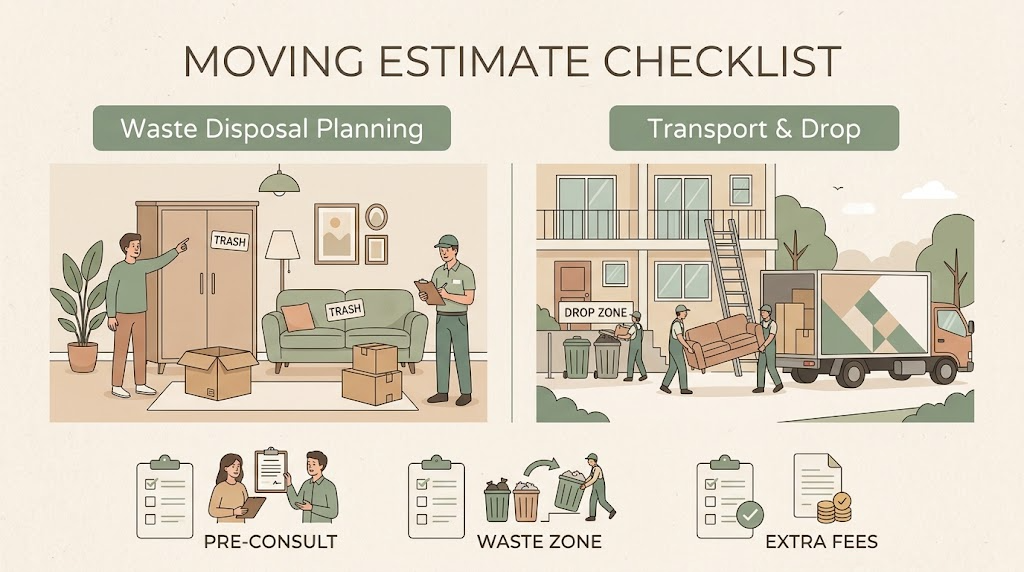
3 Key Points Where Prior Consultation with Moving Companies on Waste Separation Is Essential
Sorting out what to throw away does not mean you are done. Many people take it for granted, thinking, “Since they are lowering items with the ladder truck on moving day anyway, won’t they just bring down discarded furniture to the first floor too?” only to face serious trouble on-site.
To avoid friction with the on-site team leader or unexpected demands for additional shipping fees and tip money on moving day, you must finalize waste-related agreements in writing during the in-person estimate stage. Here are the 3 essential key points you must double-check.
- Clarifying the scope and criteria of waste ‘transport downward’
The most frequent point of dispute is “where will it be transported to.”
- Simple first-floor unloading vs. transport to the designated disposal area within the complex: Unloading at the apartment or villa first-floor entrance versus moving 50 to 100 meters to the designated recycling/disposal area (Clean House) within the complex using a handcart or dolly involves a completely different labor intensity for the crew.
- The company’s basic principle: A moving company’s basic contract is for ‘transport to the new home,’ not ‘waste discharge agency services.’ Without prior agreement, they may refuse to move items to the disposal area inside the complex—saying “we will only lower them in front of the door”—or demand an extra labor charge of 50,000 to 100,000 won.
- Practical check: During the estimate, you must verify precisely whether the condition “transporting and stacking O items of bulky waste (wardrobes, sofas, etc.) to the designated discharge location within the complex” is included in the base quote.
- ‘Work flow and time allocation’ for the ladder truck and elevator
Moving day operates on a tight schedule down to the minute. If the sequence for lowering waste gets tangled, the entire moving schedule gets delayed.
- Designing removal order: Discarded furniture must not mix with items loaded onto the truck, so work plans should be coordinated on whether ‘to lower them first via ladder truck, arrange them at the disposal site, and then begin loading the main cargo’ or ‘to lower them at the very end after finishing truck loading.’
- Elevator usage time issues during elevator moves: If the elevator reservation time is limited to 3 to 4 hours, wasting time lowering waste could incur additional usage fees or cause friction with the incoming moving household scheduled next. You must provide the list of furniture to discard to the estimator and request that the removal timing be included in the work schedule.
- Checking in advance for ‘disassembly and dismantling fees’ on bulky furniture
Small furniture can be moved in one piece, but bulky furniture cannot go out just as it is.
- Items requiring disassembly: Sliding fitted wardrobes, large 6-door wardrobes, family bed frames, and large marble dining tables must be disassembled to pass through doors or fit onto ladder trucks.
- Additional labor fee dispute points: For furniture taken to the new house and reassembled, assembly and installation fees are factored into the estimate, but many teams do not consider “labor for dismantling furniture that will be thrown away anyway” a standard service.
- Practical check: To avoid hearing “this can’t go out without disassembly, which costs an extra 50,000 won” on moving day, point out the bulky furniture requiring disassembly to the estimator and ensure in advance whether “simple disassembly work fees for discharge are included in the quote.”
| Prior Consultation Item | Easily Missed Misconception | Confirmed Details to Specify in Contract |
|---|---|---|
| Discharge Location | “If they bring it down to the 1st floor, they’ll take care of it.” | “Transport fully completed to the designated waste disposal site within the complex” |
| Work Sequence | “They’ll probably take it out whenever there’s time while lowering belongings.” | “Prioritized downward discharge of waste before starting truck loading” |
| Furniture Dismantling | “Since it’s getting thrown away, they’ll just roughly break it down and lower it.” | “Labor costs for simple disassembly and discharge of bulky furniture included” |
You can complete the article in the next step or add practical know-how:
Zero Moving-Day Disputes! How to Draft Special Contract Clauses During In-Person Estimates
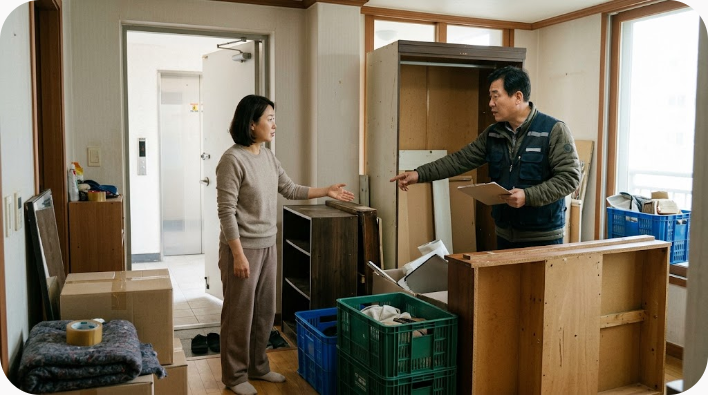
Sales representatives who visit for in-person estimates often speak as if they will do anything just to close the deal: “Oh, lowering the wardrobe and sofa? We’ll just do that completely as a complimentary service!”
However, there is something you must keep in mind: in most cases, the ‘sales team’ that provides the estimate and the ‘work crew’ deployed to the site on moving day are completely separate personnel. On the morning of moving day, saying to the on-site team leader, “The salesperson said they would just lower everything for free,” often yields the response, “We never received such word. You need to pay additional labor fees.”
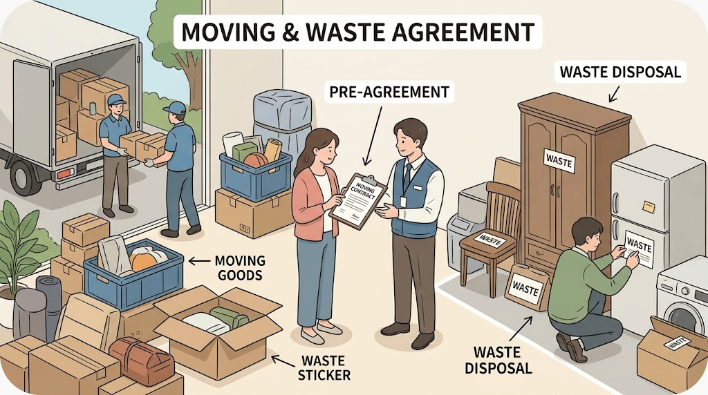
Verbal promises have no legal effect. To 100% prevent unnecessary confrontation and forced tip payments on moving day, ‘a single line of special terms’ in the remarks section of the contract (estimate sheet) decides everything.
- ‘Essential Wording for the Remarks Section’ to Write Instead of Verbal Agreements
Simply writing “waste unloading” in the remarks or special conditions section at the bottom of the contract leaves room for interpretation. You must specify and record the items and final transport location adhering closely to the 5Ws and 1H.
📝 Recommended Examples of Special Terms
- “Transport and stacking of designated bulky waste (1 section of wardrobe, 3-person sofa, queen mattress) to the designated recycling/disposal area within the complex will be completed, and no additional fees whatsoever (labor costs, equipment fees) shall occur as a result.”
- “Labor fees for simple disassembly and external discharge of built-in/sliding doors are included in the base estimate amount.”
By nailing down the number of items, transport location, and the phrase ‘no additional fees’ like this, the on-site work crew will have no grounds to dispute on moving day.
- Clarifying the Responsible Party and Timing for Affixing Waste Disposal Stickers (Declaration Certificates)
Minor disputes frequently arise regarding the attachment of waste disposal stickers as well.
- Risks of prior attachment: If you affix the stickers before furniture is even removed from the home, there is a high risk that they will tear or fall off and get lost while dismantling the furniture or moving it through narrow hallways.
- Principle of attachment after discharge: While purchasing stickers and obtaining discharge numbers is the responsibility of the homeowner (customer), it is safer to establish the standard that “stickers are checked and affixed on-site immediately after the movers complete stacking items at the disposal site.”
- Tip for drafting special terms: “Waste stickers will be directly attached by the customer after discharge is complete, and the moving crew will safely stack items on the ground of the designated discharge area.”
- 3-Step Action Plan When Unjust Additional Fees Are Demanded on Moving Day
Even if special terms are noted, should additional fees be demanded on-site under claims that “the furniture is heavier than expected” or “stair work is required,” do not confront them emotionally; handle it in the following sequence.
- Present the original contract (or photo):
Calmly show the special clauses specified in the remarks section to the on-site team leader and confirm that “the contract was finalized at the final price reflecting all corresponding items and working conditions during the in-person estimate.”
- Immediately connect a call with the estimator sales rep:
Arguing directly with on-site workers only sours the atmosphere of the move. State, “I will call the person in charge who did the estimate,” dial the sales representative, and hand over the coordination for them to speak directly with the on-site team leader.
- Verify coverage by a licensed moving business with damage compensation insurance:
Officially licensed companies (registered with the Korea Federation of Trucking Transportation Brokerage Business) face sanctions upon breaching standard contracts. If unjust demands persist, inform them that you will file an official complaint with the head office customer service center based on your copy of the licensed company contract.
| Item | Risk Arising from Verbal Agreement | Effect of Drafting Special Terms |
|---|---|---|
| Discharge Scope | “Dumping at the 1st floor entrance and leaving” | “Clean transport and stacking up to the Clean House in the complex” |
| Labor Costs | “Demanding 30,000 to 50,000 won per item for furniture dismantling and hauling” | “Completely preventing extra tips beyond the contract price” |
| Accountability | “Passing the buck (dodging responsibility) between on-site and sales teams” | “Immediate head office intervention and resolution backed by written proof” |
You can complete the article in the next step or add practical know-how:

Practical Tips for Waste Disposal to Save Costs Before Moving
When throwing away bulky furniture or broken appliances, paying for waste stickers at the community service center is not the only option. Depending on the condition and type of the item, there are clear ways to reduce costs to 0 won or even make money while decluttering.
Here are 3 realistic, practical waste disposal tips that reduce both municipal disposal fees and moving estimates during the moving preparation stage.
- Actively utilize ‘Free Home Pickup (E-Circulation Governance)’ for large and small waste home appliances
There is no need to purchase local government waste stickers for home appliances. If you use the ‘Free Home Pickup Service for Waste Electrical and Electronic Equipment (E-Circulation Governance, 1599-0903)’ jointly operated by the government and electronics manufacturers, they will enter your home and collect them free of charge without any fees.
- Single-item pickup available: For bulky home appliances such as refrigerators, washing machines, air conditioners (including outdoor units), TVs, microwaves, and air purifiers, home pickup is available even for just 1 unit.
- Bundled pickup for small appliances (standard of 5 or more): For small waste home appliances such as hair dryers, electric rice cookers, irons, fans, and blenders, individual reservations are difficult, but if bundled in quantities of 5 or more, free pickup proceeds all at once.
- Moving D-14 reservation is essential: At the end of the month or on “son-eom-neun nal” (inauspicious-spirit-free days), reservations flood in and your desired date may be fully booked. You must secure a reservation date through the website or call center at least 2 weeks before moving to safely clear them out prior to moving day.
- Utilize the golden window of Karrot Market ‘free giveaways’ and ‘bargain-price liquidations’ for furniture and sundries
Furniture or items that are in intact condition but must be discarded incur a cost of 10,000 to 20,000 won the moment you attach a disposal sticker. At this point, the most powerful solution is a local secondhand transaction platform.
- The hidden economics of ‘free giveaways’: If you list an old 3-tier chest of drawers or storage cabinet for sale at 5,000 won, inquiries are sparse, but if you list it as a ‘free giveaway on condition of self-pickup,’ people often take it right away on the same day. You save 5,000 to 10,000 won in waste sticker costs and spare yourself the labor of having to carry it down to the 1st floor yourself.
- The golden window is from 2 weeks to 3 days before moving: If you post items at bargain prices the day before moving, you cannot cope if a ‘no-show’ occurs where someone breaks an appointment. Post them with plenty of time to spare, and for items not claimed by 3 days before moving, switch immediately to the waste disposal phase without hesitation.
- Non-face-to-face convenient discharge apps (Bbaegi / Yeogiro) without visiting community service centers
Furniture that qualifies for neither free pickup nor easy giveaways (broken wardrobes, old mattresses, etc.) must be discharged as formal bulky waste. Without having to visit convenience stores or community service centers in person to buy paper stickers as in the past, you can handle it all with a single smartphone app.
- Convenient smartphone payment: Use ‘Bbaegi’, ‘Yeogiro’, or the ‘Online Bulky Waste Discharge Declaration’ on the relevant district office website.
- Automatic item measurement via photo taking: If you take and upload a photo of the furniture to be discarded, AI determines the item and specifications to calculate the appropriate fee. After paying via mobile, simply write the issued reservation number (receipt number) largely on paper with a permanent marker and tape it to the waste item, and you are done.
- Utilizing the paid ‘Bring Down for Me’ service: If you could not reach a prior agreement with the moving company or live alone and cannot physically bring heavy furniture outside, you can also safely delegate the task to the discharge location using the paid ‘Bring Down for Me (home pickup agency)’ service within the app.
| Item Subject to Disposal | Optimal Disposal Method | Cost Incurred | Precautions |
|---|---|---|---|
| Large/small home appliances | E-Circulation Governance Free Home Pickup | 0 won (Free) | Pickup not available if damaged (missing parts); advance reservation required |
| Furniture and small props in good condition | Karrot Market ‘giveaway’ on condition of direct self-pickup | 0 won (Saves sticker cost) | Close early 3–4 days before moving to prepare against no-shows |
| Damaged furniture and bulky waste | Waste discharge apps (Bbaegi, Yeogiro, etc.) | Fee officially announced by the local government | Write receipt number on A4 paper and attach after payment |
You can cleanly wrap up the entire post:
Korean version: 한국어로 읽기