Prologue: An Era Where Salary Alone Isn’t Enough, Comprehensive Guide to Government Subsidies for Young Workers
“After deducting rent, utility bills, groceries, and transportation costs from my monthly salary, there is barely any money left in my bank account.”
“Others say they build a lump sum by taking advantage of subsidies and tax benefits, but I have no idea where or how to start looking.”
The joy of landing a job is fleeting, and the reality young adults entering the workforce face is harsher than expected. While prices and housing costs are rising steeply, entry-level salary growth remains limited, making even the goal of saving a seed money amount of 30 million KRW or 50 million KRW feel distant through simple saving alone.
However, the government and local municipalities allocate a budget of trillions of KRW each year to operate various financial, income, and housing support measures for young workers with fragile foundations for independence. If you do not know about them, you will miss out, but if you know and take advantage of them, you can gain a booster effect for real income enhancement and asset building worth millions of KRW or more per year.
- Top 3 Youth Support Areas That New Professionals Often Miss
Government youth support policies are broadly divided into three pillars. You should target the area you need according to your current financial situation and employment type.
- Asset Building Support (Building a Lump Sum)
These programs help build a lump sum worth 1.5 to 3 times your principal by having the government add matching subsidies or contributions and tax-exempt benefits when you save a fixed amount each month. (Representative examples: Youth Leap Account, Youth Tomorrow Savings Account)
- Workplace and Income-Linked Support (Increasing Take-Home Pay)
These workplace-specific programs offer significant earned income tax reductions to young adults working at small and medium-sized enterprises (SMEs), or have companies and the government jointly contribute toward a maturity bonus. (Representative examples: SME Youth Income Tax Reduction, Youth Worker Tomorrow Fill Deductions Plus, Earned Income Tax Credit)
- Fixed Cost Reduction Support (Defending Living Expenses)
These practical support measures directly subsidize housing costs and commute transportation expenses, which are the largest fixed outlays leaving bank accounts each month. (Representative examples: Special Youth Monthly Rent Support, K-Pass Youth Benefits, Stepping Stone Jeonse Loan)
- At-a-Glance Comparison Checklist for Youth Worker Subsidies
Here is a summary of the criteria for key support policies that you should review first to choose the benefits that suit you.
| Support Category | Representative Program | Core Support Details | Eligibility Requirements |
|---|---|---|---|
| Asset Building | Youth Leap Account | Building a lump sum of up to 50 million KRW upon 5-year maturity (Government contribution + Tax exemption) | Ages 19–34, individual income of 75 million KRW or less & household median income of 250% or less |
| Asset Building | Youth Tomorrow Savings Account | 1:1 to 1:3 government matching against personal savings upon 3-year maturity (Up to 14.4 million KRW) | Ages 19–34 (Up to 39 for basic livelihood recipients and near-poverty group), median income of 100% or less |
| Income/Tax | SME Income Tax Reduction | 90% reduction on earned income tax for 5 years from employment date (Annual limit of 2 million KRW) | Ages 15–34, young workers employed at SMEs |
| Living/Housing | Special Youth Monthly Rent Support | Free support of up to 200,000 KRW per month for up to 12–24 months (Total 2.4 million–4.8 million KRW) | Non-homeowning young adults ages 19–34, youth household median income 60% or less & origin household 100% or less |
| Living/Transportation | K-Pass (K-Pass) | 30% refund of expenditure when using public transit 15 times or more per month | Young adults ages 19–34 (Preferential rate compared to the standard 20% for all citizens) |
While it is difficult to change the first digit of your monthly salary right away, actively utilizing the programs provided by the government allows you to defend against outgoing taxes and expenses each month and more than double your savings pace.
Starting from the next section, we will take a concrete look at subsidies tailored to you, ranging from the comparison of lump-sum savings accounts that concern most people (Youth Leap Account vs. Youth Tomorrow Savings Account) to valuable tax benefits for employees of small and medium-sized enterprises.
Would you like me to continue writing the main body for Asset Building Support for Lump Sums (Youth Leap Account vs. Youth Tomorrow Savings Account)?
Asset Building Support for Lump Sums: Youth Leap Account vs. Youth Tomorrow Savings Account
The top priority policy financial products that young adults entering the workforce should examine first when saving seed money are “Asset Building Support Programs,” where the government directly adds matching subsidies to savings amounts. This is because while ordinary savings interest rates at commercial banks hover around 3–4% annually, government-supported savings plans reach real return rates of 8–10% or more annually when combined with government contributions and tax-exempt benefits.
The two representative pillars, the ‘Youth Leap Account’ and the ‘Youth Tomorrow Savings Account’, differ distinctly in their support characteristics and income criteria. Here is a summary of key differences to help you determine which account to choose based on your earned income and household income.
- Youth Leap Account: Building a 50 Million KRW Lump Sum with a 5-Year Maturity Covering Even Middle-Class Youth
Administered by the Financial Services Commission, the Youth Leap Account is a representative mid-to-long-term asset building product designed to encompass the majority of working young adults.
- Eligibility and Age:
- Young adults aged 19 to 34 or younger (Military service period recognized up to 6 years, available up to age 40 for those who completed military service)
- Income Criteria (Must satisfy both individual income & household income simultaneously):
- Individual income: Total gross salary of 75 million KRW or less in the immediately preceding taxable period (comprehensive income of 63 million KRW or less)
However, for gross salaries exceeding 60 million KRW up to 75 million KRW, only tax-free benefits apply without the payment of government contributions
- Household income: 250% or less of the standard median income based on the number of members in the applicant’s household (a standard that most 1-person to 4-person households comfortably meet)
- Payment method and support benefits:
- Flexible monthly savings from 1,000 KRW up to 700,000 KRW (5-year maturity)
- Monthly government contribution payment of up to 21,000 KRW to 24,000 KRW depending on the individual income bracket
- Application of bank base and preferential interest rates at around 5% to 6% per annum + full tax exemption on interest income tax (15.4%)
- If you pay up to the 700,000 KRW monthly limit for 5 years, you will receive seed money around 50 million KRW at maturity, combining the 42 million KRW principal with bank interest and government contributions.
- Youth Tomorrow Savings Account: Exceptional 1:1 to 1:3 Government Matching for Low-Income and Near-Poverty Youth
Administered by the Ministry of Health and Welfare, the Youth Tomorrow Savings Account is a welfare-type savings product that focuses on supporting the economic independence of youth with vulnerable foundations for self-reliance. While the conditions are demanding, its return rate overwhelmingly surpasses that of the Youth Leap Account.
- Eligibility and age:
- General (exceeding near-poverty): Ages 19 to 34 (exceeding 50% to 100% or less of the standard median income)
- Basic livelihood recipients and near-poverty group: Ages 15 to 39 (50% or less of the standard median income)
- Income criteria:
- Earned and business income: Exceeding 500,000 KRW per month to 2.5 million KRW or less per month (Basic livelihood recipients and near-poverty group are eligible with monthly work income of 100,000 KRW or more)
- Household income: 100% or less of the standard median income (conducted concurrently with the Ministry of Health and Welfare’s asset investigation)
- Payment method and support benefits:
- You save 100,000 KRW per month (up to 500,000 KRW) for 3 years
- General youth (exceeding 50% to 100% or less of median income): Government provides 1:1 matching support of 100,000 KRW per month (At 3-year maturity: your savings of 3.6 million KRW + government support of 3.6 million KRW + bank interest = total 7.2 million KRW + interest)
- Basic livelihood recipients and near-poverty youth (50% or less of median income): Government provides 1:3 matching support of 300,000 KRW per month (At 3-year maturity: your savings of 3.6 million KRW + government support of 10.8 million KRW + bank interest = total 14.4 million KRW + interest)
- Disbursement conditions: Maintaining steady work activities for 3 years, completing 10 hours of financial education, submitting a fund usage plan
- Youth Leap Account vs. Youth Tomorrow Savings Account Core Comparison Table
Comparing the eligibility requirements and maturity payout scales of the two products in a table allows you to see the account suitable for you at a glance.
| Category | Youth Leap Account | Youth Tomorrow Savings Account |
|---|---|---|
| Governing Agency | Financial Services Commission (Korea Inclusive Finance Agency) | Ministry of Health and Welfare |
| Savings Period | 5 years (60 months) | 3 years (36 months) |
| Maximum Monthly Savings | Up to 700,000 KRW | Basic 100,000 KRW (up to 500,000 KRW) |
| Government Subsidy | Up to 21,000 to 24,000 KRW per month (differentiated by income) | 100,000 KRW per month (General) / 300,000 KRW per month (Recipients/Near-poverty) |
| Estimated Maturity Payout | Around 50 million KRW level (based on 42 million KRW principal) | 7.2 million KRW to 14.4 million KRW + interest (based on 3.6 million KRW principal) |
| Individual Income Requirement | 75 million KRW or less annually | 500,000 to 2.5 million KRW or less per month (100,000 KRW or more per month for recipients) |
| Household Income Requirement | 250% or less of standard median income | 100% or less of standard median income |
| Dual Enrollment Eligibility | Simultaneous dual enrollment with Youth Tomorrow Savings Account is possible | Simultaneous dual enrollment with Youth Leap Account is possible |
Account Selection Guide Tailored to You
- What if your monthly income is between 500,000 and 2.5 million KRW and your household is at 100% or less of the median income?
Without hesitation, you should apply for the ‘Youth Tomorrow Savings Account’, recruited around May each year, as your top priority. It offers incomparable benefits in terms of return rate (100% to 300% support).
- What if you are a regular employee exceeding 100% of the median income (annual salary in the 30 million to 60 million KRW range)?
The ‘Youth Leap Account’ is the right answer. The 5-year maintenance period may feel long, but the system has been improved so that even if terminated early after maintaining it for 3 years or longer, tax-free benefits and a portion of government contributions are preserved, significantly lowering the burden.
- Most Important Pro Tip (Overlapping Benefits):
Unlike similar asset building programs in the past, if you meet the requirements, you can enroll in both the Youth Leap Account and the Youth Tomorrow Savings Account at the same time. If you run both accounts simultaneously, the scale of seed money accumulated after 3 to 5 years will overwhelmingly surpass the savings pace of ordinary workers.
Would you like me to continue writing the subheading on specialized benefits for youth employed at small and medium-sized enterprises (income tax reduction, Tomorrow Fill Deductions, etc.)?
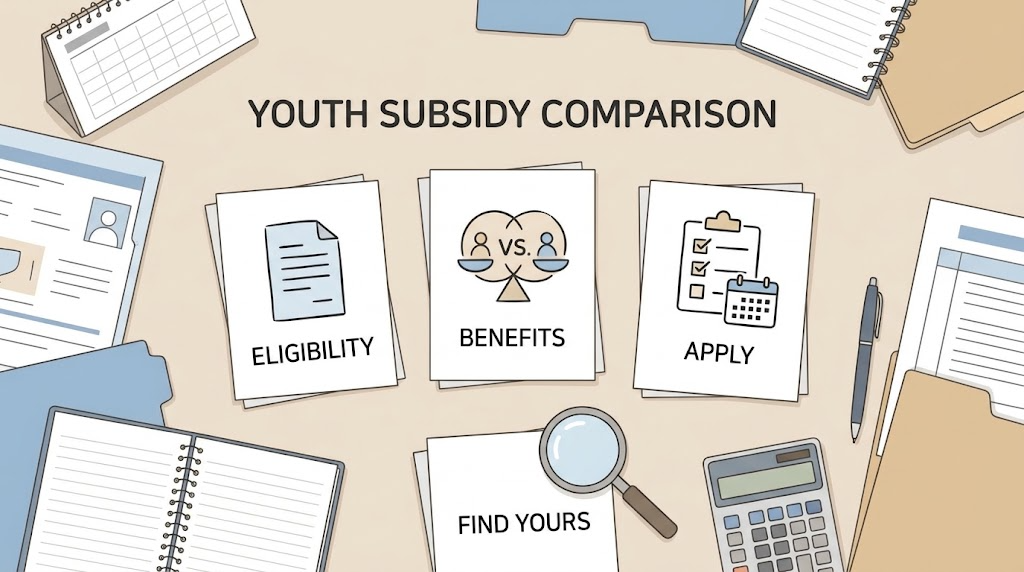
Specialized Benefits for Young SME Employees: From Tax Deductions to Long-Term Retention Incentives
There is no need to feel discouraged if your base pay or benefits package is relatively smaller compared to large enterprises or public institutions. The government intensively operates exceptional tax reductions and employer-matched lump-sum support programs to supplement the real income of young people working at small and medium-sized enterprises (SMEs) and middle-market enterprises, as well as to encourage long-term retention.
Here are three representative core benefits tailored for young SME employees that neither the company nor the tax office will look after for you unless you apply.
- SME Employee Income Tax Reduction: The Magic of Increasing the Net Take-Home Pay in Your Monthly Salary Account
The most powerful immediate benefit felt by newcomers to the workforce is the “earned income tax reduction.” This program reduces the withholding tax deducted from your monthly pay stub down to about one-tenth.
- Support Target and Requirements:
- Age: Young adults aged 15 to 34 or younger (Military service period recognized up to 6 years, extended up to age 40 for veterans)
- Company Requirements: Small and medium enterprises pursuant to Article 2 of the Framework Act on Small and Medium Enterprises (Applies to most industries including manufacturing, IT, R&D, and wholesale/retail. However, certain professional and entertainment sectors such as legal, accounting, and tax service businesses, hospitals and clinics, financial and insurance services, and drinking establishments are excluded)
- Reduction Benefits:
- A 90% reduction in earned income tax incurred for 5 years (60 months) from the SME employment date (initial date of application)
- Reduction Cap: Up to 2 million KRW per year
- Application Method and Reassessment Filing Tips:
- Download and fill out the “Application for Reduction of Earned Income Tax for SME Employees” from the National Tax Service (NTS) Hometax, then submit it to your company’s HR or general affairs department along with a certified copy of your resident registration and a certificate of military service (for veterans). The company will then register it with the competent tax office.
- Refund for Past Omissions (Claim for Reassessment): If you were already hired and working at an SME but missed applying because you were unaware of this program, you can receive up to several million KRW in taxes back at once by filing a “Claim for Reassessment of Earned Income Tax” via Hometax for income taxes paid within the past 5 years.
- Youth Employee Tomorrow Fill Deductions Plus: Building Severance-Level Seed Money Through Company-Government Matching
To encourage the long-term retention of young employees diligently working at SMEs and middle-market enterprises, this program allows the young worker, company, and government to accumulate savings through a three-party match and disburse it at maturity.
- Enrollment Requirements:
- Young adults aged 15 to 34 or younger (Up to age 39 with military service)
- Regular full-time young employees with at least 6 months of tenure at an SME or middle-market enterprise (with a trend focusing specialized operations on manufacturing and construction sectors)
- Total annual gross salary of 36 million KRW or less
- Accumulation and Support Structure (Based on 3-year maturity model):
- Young Employee Contribution: Pays a fixed amount each month (Total 6 million KRW over 3 years)
- Company Contribution: Company matches and deposits monthly (Total 6 million KRW over 3 years)
- Government Subsidy: Government deposits subsidies by tier (Total 6 million KRW over 3 years)
- Maturity Payout Amount: Upon 3 years of continuous service, you receive a lump sum of 18 million KRW—which is three times your principal contribution of 6 million KRW—plus compound interest.
- Operational Checkpoint:
- Consent and application approval from the company CEO or HR team are essential because the company must bear matching contributions. This is an optimal incentive for young workers who have no immediate plans to change jobs and wish to build a career at one workplace for at least 3 years.
- Earned Income Tax Credit (EITC): Annual One-Time Cash Support for Working Single-Person Youth Households
This is an income subsidy paid in cash by the National Tax Service every May through regular applications to support low-income young workers with tight living budgets due to low income.
- Application Criteria for Youth Single-Person Households:
- Young adults aged 18 or older who are separated from their parents on the resident register and form an independent single household
- Income Requirement: Total annual income under 22 million KRW (Aggregating not only wages, but also business and other income)
- Property Requirement: Total combined property of all household members under 240 million KRW (Sum of housing, jeonse deposit, vehicles, and bank deposits / Paid at a 50% deduction if 170 million KRW or more)
- Payment Benefit:
- Cash payment of up to 1.65 million KRW per year for a single-person household
- Application Timing:
- Regular Application: May 1 to May 31 each year (Paid at the end of August)
- Semi-annual Application: First half period (Apply in September → Paid in December), Second half period (Apply in March → Paid in June)
Summary Comparison of Benefits for SME Youth Employees
| Benefit Name | Governing Agency | Core Support Scale | Application Method |
|---|---|---|---|
| SME Income Tax Reduction | National Tax Service | 90% income tax reduction for 5 years (Up to 2 million KRW/year) | Complete application form and submit to company HR/tax department |
| Tomorrow Fill Deductions Plus | Korea SMEs and Startups Agency (KOSME) | Receive a lump sum of 18 million KRW at 3-year maturity (Own contribution: 6 million KRW) | Joint application by company and youth on KOSME website |
| Earned Income Tax Credit | National Tax Service | Up to 1.65 million KRW cash per year for single-person households | Regular application every May via NTS Hometax/Sontax |
If you work at an SME, check with your HR department first to see if the “income tax reduction” is being applied, and then explore the feasibility of the May Earned Income Tax Credit and your company’s Tomorrow Fill Deductions link in sequence based on your income criteria.
Would you like me to continue writing the subheading on Housing and Transportation Cost Relief Support (Youth Monthly Rent Support & K-Pass)?

Relief Support for Housing and Transportation Costs: Special Youth Monthly Rent Support & K-Pass
The main reason an account easily becomes empty even after receiving a paycheck is the mandatory living costs that leave steadily every month. In particular, for single-person youth households living independently, rent, maintenance fees, and commuting public transit expenses are typical fixed outgoings incurred simply by existing.
To ease the burden of these essential living costs on young people, the government operates specialized programs that provide direct cash assistance or refund a substantial portion of expenditure. Here is a breakdown of housing and transportation support benefits that can save up to hundreds of thousands of KRW in living expenses each month.
- Special Youth Monthly Rent Support: 200,000 KRW Monthly Cash Subsidy for Housing Costs
Administered by the Ministry of Land, Infrastructure and Transport, the Special Youth Monthly Rent Support is a project that directly reimburses paid rent in cash to relieve the housing cost burden of non-homeowning youth living apart from their parents.
- Target Beneficiaries and Age Requirements:
- Age: Non-homeowning youth aged 19 to 34 (single-person households living separately from parents)
- Housing conditions: Housing with a deposit of 50 million KRW or less and a monthly rent of 700,000 KRW or less (If monthly rent exceeds 700,000 KRW, applications are still allowed if the converted monthly rent deposit amount plus monthly rent total 900,000 KRW or less)
- Income and Property Criteria (Must satisfy both):
- Independent youth household: 60% or less of standard median income & property of 122 million KRW or less
- Original household (including parents): 100% or less of standard median income & property of 470 million KRW or less
(However, the income evaluation for the original household is waived if the applicant is 30 years old or older, married, or practically independent with regular income of 50% or more of the median income.)
- Support Benefits:
- Up to 200,000 KRW per month within the limit of actual rent paid, supported for up to 12 months (or up to 24 months based on the second phase of the project)
- Because cash totaling 2.4 million KRW up to 4.8 million KRW is deposited directly into your bank account each month, it can drastically reduce a year’s worth of fixed expenses for renters living alone.
- How to Apply:
- Apply online via the ‘Bokjiro (bokjiro.go.kr)’ website and mobile app, or visit the community service center (Administrative Welfare Center) with jurisdiction over your resident address
- Required Documents: Lease agreement, proof of rent transfers (last 3 months), certificate of family relations, copy of bank account
- K-Pass Youth Benefits: 30% Monthly Refund on Public Transportation Costs
For workers who use subways and city buses every day to commute, public transportation costs are a regular monthly outlay hovering around 70,000 to 100,000 KRW. By utilizing the ‘K-Pass’ from the Metropolitan Transport Commission under the Ministry of Land, Infrastructure and Transport, you can get 30% of your transportation costs back through preferential youth benefits.
- Eligibility and Youth Preferential Criteria:
- Residents of over 189 cities, counties, and districts nationwide participating in the K-Pass project
- Youth aged 19 to 34: 30% preferential accumulation rate applied, which is 10 percentage points higher than the general public (20% refund) (53.3% refund for low-income brackets)
- Refund and Accumulation Criteria:
- Applies when regularly using public transit (subway, city buses, regional buses, GTX, etc.) 15 times or more per month (up to a maximum of 60 times per month)
- Can be used across all public transit networks nationwide; transport modes requiring separate seat reservations, such as express buses or KTX, are excluded.
- Tangible Cost Reduction Effects:
- Based on a young worker spending 80,000 KRW per month on public transit: 24,000 KRW refunded monthly (saves approximately 288,000 KRW annually)
- For those spending over 120,000 KRW per month by using regional buses in Gyeonggi/Incheon, the Shinbundang Line, GTX, etc.: 36,000 KRW refunded monthly (saves over 430,000 KRW annually)
- How to Apply and Use:
- Issue a ‘K-Pass credit/debit card’ from card companies including Shinhan, Hana, Woori, Kookmin, NongHyup, Hyundai, and Samsung
- Register the 16-digit card number when signing up for an account on the K-Pass official app or website (korea-pass.kr)
- Tag and use public transportation using the physical card or mobile payment (Samsung Pay, etc.) → Card bill discount or account credit applied the following month
- Housing Financing Linkages to Check Out Together: SME Youth & Stepping Stone Jeonse Loans
If the rent burden is significant, switching from monthly rental housing to jeonse through ultra-low interest jeonse loan schemes from the government’s Korea Housing & Urban Guarantee Corporation (Housing and Urban Fund) is also well worth actively considering.
- Stepping Stone Jeonse Loan Exclusively for Youth:
- Non-homeowning single heads of household aged 19 to 34, annual income of 50 million KRW or less
- Loan support of up to 200 million KRW (within 80% of the lease deposit) at ultra-low interest rates around 1.8% to 2.7% per annum
- Jeonse/Monthly Rent Deposit Loan for Youth Employed at SMEs (SME Youth):
- Targeted at young workers at SMEs and middle-market enterprises (annual income of 35 million KRW or less, 50 million KRW or less for dual-income couples)
- Supports up to 100 million KRW at a fixed interest rate around 1.5% per annum, overwhelmingly cutting monthly interest expenses compared to commercial bank jeonse loans or high monthly rents.
Fixed Cost Reduction Benefits at a Glance
| Category | Support Program | Eligibility and Criteria | Benefit Scale |
|---|---|---|---|
| Housing Cost | Special Youth Monthly Rent Support | Non-homeowning youth aged 19–34 (60% of median income or less) | Up to 200,000 KRW/month (free support for up to 12–24 months) |
| Transportation Cost | K-Pass (K-Pass) | Youth aged 19–34 using public transit (15 times or more per month) | 30% refund on public transit expenses (up to 60 times per month) |
| Jeonse Financing | Youth Stepping Stone / SME Youth Loan | Non-homeowning young workers (when meeting income criteria) | Ultra-low interest jeonse deposit loans at 1.5%–2% range per annum (up to 100 million–200 million KRW) |
If you are an independent young adult, first check your eligibility through the ‘Youth Monthly Rent’ simulation on Bokjiro, and immediately replace and register your daily transit pass with the ‘K-Pass’ to thoroughly defend against leaking monthly fixed expenses.
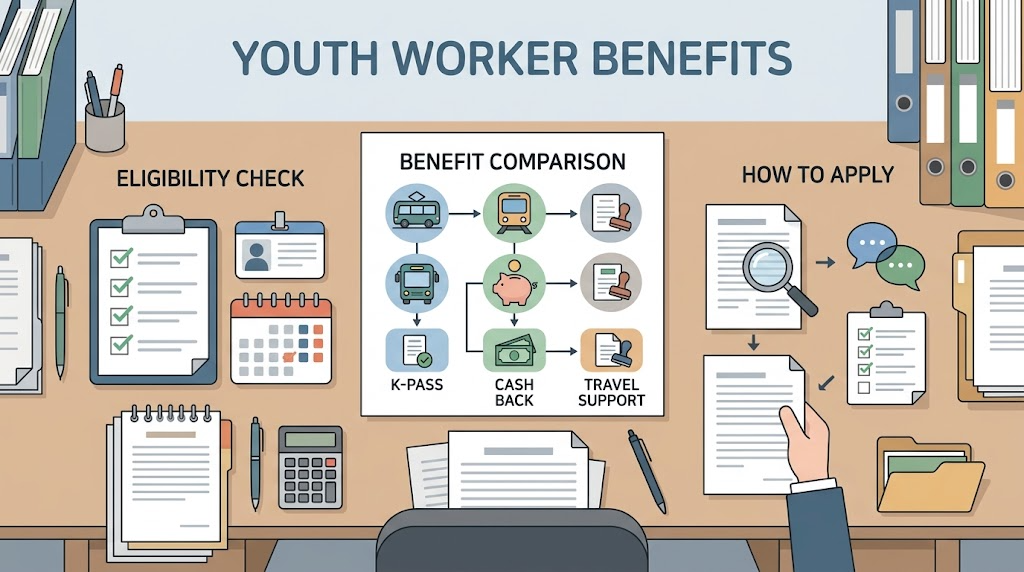
Customized Matching Guide to Find the Subsidies Right for You at a Glance
Because there is a wide variety of youth policies and income standards and age limits vary by supervising ministry, it can be difficult to figure out which benefits to look after first if you lack information.
The success or failure of applying for subsidies lies in building an optimal portfolio tailored to your current income bracket, company size (SME vs. middle-market/large enterprise), and housing type (living independently vs. living with parents). Here is a summary of customized combination formulas and online self-diagnosis know-how tailored to you.
- Optimal Subsidy Combination Roadmap by Workplace Type and Income
Targeting the roadmap that corresponds to your situation among the three types below will allow you to maximize synergy without missing out on benefits.
- TYPE A. SME Employee + Single-Person Household Living Independently (Benefit Maximization Type)
The optimal condition to enjoy the largest number of policy benefits concurrently.
- Essential Combination: SME Income Tax Reduction (90%) + Youth Leap Account + Special Youth Monthly Rent Support + K-Pass Youth
- Strategy: Save 90% of your earned income tax withheld every month to increase take-home pay, and focus the extra funds saved through rent subsidies (200,000 KRW/month) and K-Pass refunds (30% on transportation) into monthly deposits for the Youth Leap Account to build a lump sum of 50 million KRW within 5 years.
- TYPE B. Large Enterprise / Middle-Market Enterprise Employee or Living with Parents (Lump-Sum Focus Type)
A case where your income exceeds certain thresholds or you live with parents, making you ineligible for housing support.
- Essential Combination: Youth Leap Account + K-Pass Youth (+ Financial products such as the Long-Term Youth Tax-Deduction Fund)
- Strategy: Taking advantage of low housing cost burdens, maximize the monthly deposit limit (700,000 KRW) for the Youth Leap Account to fully secure tax exemption and government contributions, and collect K-Pass transit refunds on your commute.
- TYPE C. Early-Career Low-Income and Short-Term Contract Youth (Welfare Matching Type)
A case where your monthly salary is between 500,000 and 2.5 million KRW, or you are building a foundation for self-reliance while working part-time or under temporary contracts.
- Essential Combination: Youth Tomorrow Savings Account + Earned Income Tax Credit (Single-Person Household) + Special Youth Monthly Rent Support + K-Pass Youth
- Strategy: Simultaneously apply for the Youth Tomorrow Savings Account (1:1 to 1:3 government match) and the Earned Income Tax Credit (up to 1.65 million KRW cash) every May to explosively accelerate the pace of building initial seed money.
- Self-Diagnosis of Eligibility and Application Pathways via Official Government Portals
Without having to search through laws and guidelines one by one, you can accurately determine your eligibility in 3 minutes by utilizing three government-certified online portals.
- Ontong Youth (youthcenter.go.kr)
- An integrated search platform for nationwide youth policies overseen by the Office for Government Policy Coordination.
- By filtering age, region, employment status, educational background, major, and more in the [Search Youth Policy] menu, you can check not only central government projects but also local youth allowances unique to the municipality where you reside all at once.
- Bokjiro (bokjiro.go.kr)
- The welfare portal of the Ministry of Health and Welfare, which offers a ‘Welfare Service Simulation’ corner.
- When you enter information regarding income, property, and parents’ household details, the system instantly simulates whether you meet the eligibility criteria for programs such as the ‘Youth Tomorrow Savings Account’ and ‘Special Youth Monthly Rent Support’.
- Gov24 ‘Bojogeum24’ (gov.kr)
- Logging in with a joint/financial certificate or simple authentication automatically extracts and guides you through a ‘List of Government Benefits I Can Apply for Immediately Right Now’ based on your administrative information (income, resident registration, four major social insurances, etc.).
- Core Checkpoints for Concurrent Benefit Eligibility Across Similar Programs
The most important aspect to watch out for when signing up for asset-building support programs is the restriction rule regarding overlapping benefits with past or present subsidies from other ministries. You must familiarize yourself with the rules below in advance to avoid wasted efforts.
| Category | Simultaneous Overlap Allowed | Notes and Precautions |
|---|---|---|
| Youth Leap Account + Youth Tomorrow Savings Account | Simultaneous enrollment allowed (O) | Both products can be accumulated concurrently as long as you meet the income requirements |
| Youth Hope Savings + Youth Leap Account | Linkage allowed after maturity | Maturity proceeds from Youth Hope Savings can be paid as a lump sum into the Leap Account for linked benefits |
| Tomorrow Fill Deductions + Youth Leap Account | Simultaneous enrollment allowed (O) | Corporate matching deductions and policy financial products are recognized separately, allowing concurrent benefits |
| Local Government Youth Savings + Youth Tomorrow Savings Account | Duplicate enrollment not allowed (X) | Cannot overlap with local government matching accounts such as the Seoul Hope Doubling Youth Account, Gyeonggi Youth Worker Account, etc. |
| Special Youth Monthly Rent Support + Local Government Rent Support | Simultaneous receipt not allowed (X) | Local government standalone rent allowances cannot be received simultaneously during the receipt period of the Ministry of Land, Infrastructure and Transport Youth Monthly Rent (cross-application is possible after completion) |
To fully enjoy the benefits of subsidies, having the execution power not to put it off with thoughts like “I’ll look into it someday” is essential. Visit Ontong Youth or Bojogeum24 right now to check the benefits open to your age and income criteria, and mark the application deadlines on your calendar.

Epilogue: Smartly Claiming Youth Subsidies, the First Step in Financial Planning for New Workers
Financial management during the early career stage does not simply begin with seeking out high-risk investment products like stocks or cryptocurrencies. Success depends on defending against taxes and fixed expenses that unnecessarily leak from precious earned income hard-won each month, and how quickly and solidly you build your first seed money of 30 million KRW or 50 million KRW by leveraging the secure support measures provided by the state.
Faced with complex administrative terms and demanding application procedures, many young people miss out on benefits, thinking “it probably won’t amount to much” or “I’ll look into it later when I have time.” However, your outcomes will be completely different just by thoroughly claiming the programs reviewed today.
3-Step Action Plan for Young Workers to Complete Implementation
- Claim benefits from your company and the National Tax Service starting tomorrow
If you are employed at an SME, inquire immediately with your HR department about whether the ‘SME Employee Income Tax Reduction’ is being applied, and retrieve hidden refunds through a Hometax claim for reassessment if there were any past omissions.
- Establish a defense shield for fixed expenses
Replace your daily commuting transportation card with ‘K-Pass’ to get back 300,000 to 400,000 KRW in transit costs annually, and if you are an independent youth living alone, run the Youth Monthly Rent support simulation on ‘Bokjiro’ to relieve your housing cost burden.
- Hop on government-matching savings suitable for you
Open a Youth Leap Account or Youth Tomorrow Savings Account based on your income level to fully enjoy extraordinary government contributions and tax-free compound interest effects that can never be achieved through standard commercial savings accounts.
Policy financing and subsidies prepared by the state for the youth demographic are by no means handouts given for free. They are rights that diligently working and tax-paying young workers should proudly enjoy, as well as the most reliable leverage supporting economic self-reliance.
We hope you check off the benefits available to you one by one based on the subsidy portfolio summarized today. A single subsidy application started with small interest will serve as a solid starting point that multiplies your asset formation pace several times over.
Please select the additional work needed to publish and finalize the complete post:
Generate 5 candidate SEO-optimized Naver blog titles
Generate a 16:9 image prompt to insert in the middle of the body
Compile the finalized complete text from prologue to epilogue
Korean version: 한국어로 읽기