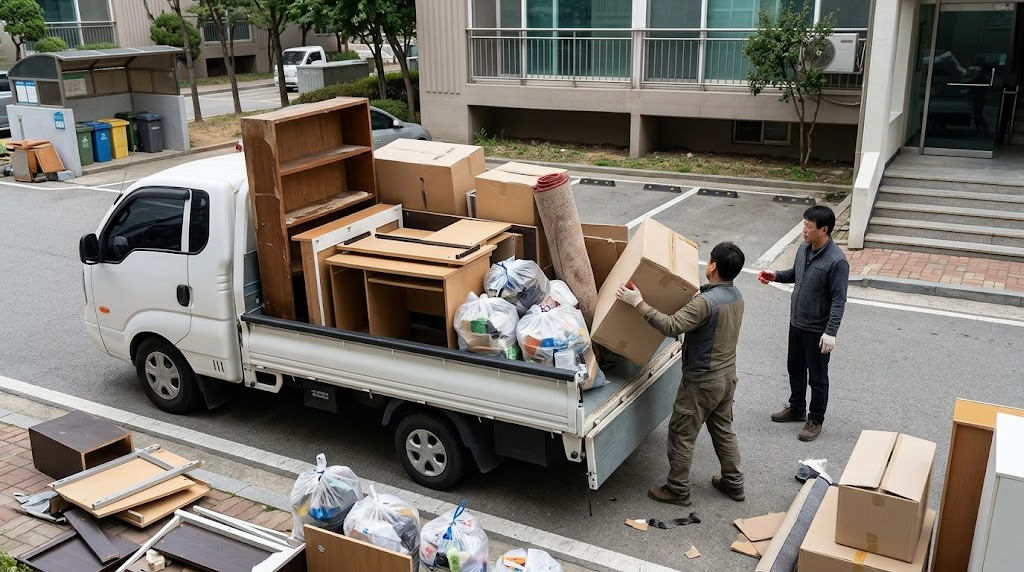
Prologue: Why Waste Disposal Costs Seem Arbitrary Depending on the Company
“For the exact same load, one company quotes 300,000 KRW, while another asks for 700,000 KRW.”
This is the very first confusion consumers face when clearing out large amounts of trash due to moving, remodeling, or estate clearing. Unlike general home appliances or parcel delivery services where fixed pricing is clear, the waste disposal market has an opaque baseline for estimates, leading to a strong perception that companies simply charge whatever they want.
In reality, even when sending the same on-site photos, the main reasons quote differences of two to even three times occur between companies are as follows.
Differences in acceptance standards at final disposal facilities
After collection, waste is transported to municipal incinerators, landfills, or private recycling facilities. The actual disposal facility expenditure varies depending on how meticulously a company sorts the properties (wood, plastic, scrap metal, waste concrete, etc.) to lower the gate fee, or whether they hand it over entirely as “mixed waste” without sorting.
Subjectivity in calculating transport vehicles and labor costs
Even for an amount that fills just one 1-ton truck, the number of workers deployed varies depending on on-site conditions (presence of an elevator, necessity of a ladder truck, work flow line, etc.). One company may base its estimate on a single driver doing the work, while another factors in two professional loading workers by default, causing differences right from the starting rate.
Variations in how on-site additional fees are induced
Some companies lure customers over the phone by first quoting the lowest price, and then significantly tack on extra fees on-site, citing reasons like “the proportion of mixed waste is high” or “stair work is required.” On the other hand, honest companies factor in potential on-site variables from the beginning and provide conservative final estimates.
Ultimately, quote discrepancies in waste disposal can be price gouging, but in many cases, they stem from differences in disposal methods and the labor invested. To prevent unnecessary spending, it is essential to accurately assess the nature of the waste and working environment at your site, and understand the basic structure of how companies calculate costs.
3 Key Criteria That Determine Waste Disposal Costs
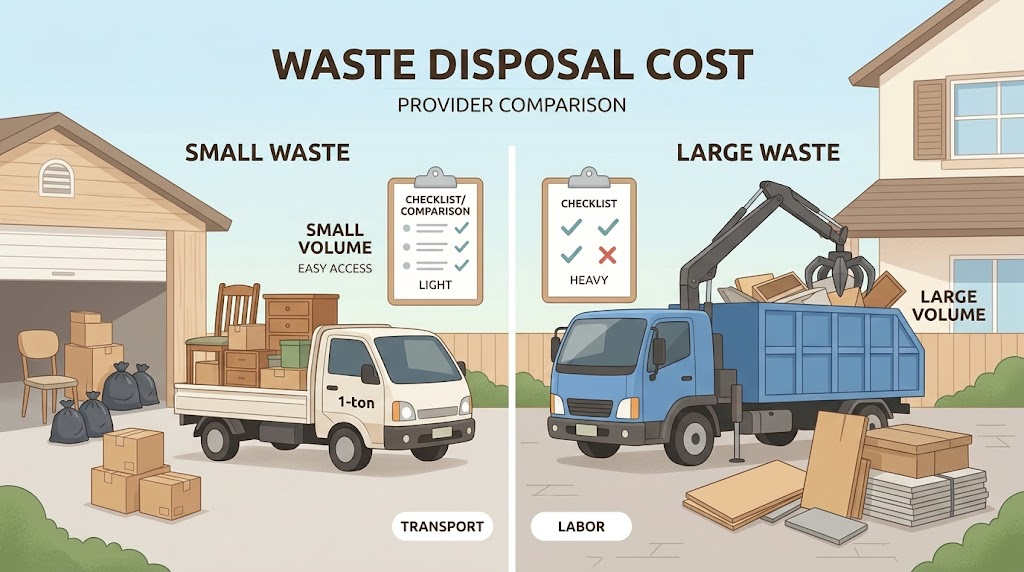
The calculation formulas used by waste collection companies when drafting estimates are roughly standardized. The reason prices vary by company also depends on how they apply these three core variables to the site.
- Type and Nature of Waste (Whether Mixed or Not)
The gate fee at waste disposal facilities (intermediate sorting yards and final incineration/landfill sites) varies significantly depending on whether materials can be recycled.
Single-material waste (wood, scrap metal, waste concrete, etc.): When only specific materials are grouped together, they carry recycling value or involve simple disposal processes, making the gate fee relatively low.
Household/commercial mixed waste: A state where furniture, plastic, vinyl, textiles, food scraps, and other items are intermingled. Because it requires manual sorting at the facility or complete incineration, the gate fee per ton is set at the highest rate.
Special/designated waste: Hazardous materials such as asbestos, slate, waste oil, and chemicals cannot be handled by regular waste vehicles; they incur surging costs because separate reporting procedures must be completed through specialized designated waste contractors.
- Volume and Vehicle Tonnage Calculation Criteria (Calculation in Cubic Meters / Roubei)
Waste is converted into a number of vehicles based on weight (kg/ton) or volume (㎥, roubei), according to each contractor’s collection criteria.
1-ton truck (cargo/box truck): Mainly deployed for small studio moving trash or disposing of a few pieces of small furniture. Quotes are typically generated based on a full 1-ton truckload (about 2 to 2.5 roubei up to the railing height of the cargo bed) as the base unit.
2.5-ton to 5-ton grapple truck: Deployed for apartment interior demolition sites or complete house clearances (clearing empty homes) where large amounts of bulky furniture and appliances pour out. Grapple trucks offer rapid loading, but securing an access route for the vehicle is essential.
Volume vs. Weight Differences: Bulky yet lightweight loads like scrap wood or Styrofoam are calculated by “volume (roubei),” whereas heavy construction waste with small volume like tiles, bricks, and plasterboard is calculated by “weight (tons)” to check for overloading and dispatch additional vehicles.
- On-Site Working Conditions and Deployed Labor Costs
Items that carry as much weight as the disposal fee itself are the labor costs and equipment rental fees required for collection and haul-out.
Haul-out path and floor level: For 3rd to 4th floors of multi-household dwellings without elevators, stair carrying surcharges (labor fees) are added because items must be carried down the stairs one by one on workers’ backs.
Use of ladder trucks: When the cargo is bulky and stair carrying is impossible, a ladder truck must be called in, directly incurring basic rental fees (around 100,000 to 200,000 KRW per hour/job).
Vehicle docking feasibility: Depending on whether the truck can pull up right in front of the building entrance or whether items must be pushed over dozens of meters on dollies (hand carts) through narrow alleyways, working hours increase and extra personnel (labor costs) are deployed.
Actual Quote Comparison: Average Market Rates and Cost Discrepancies by Type
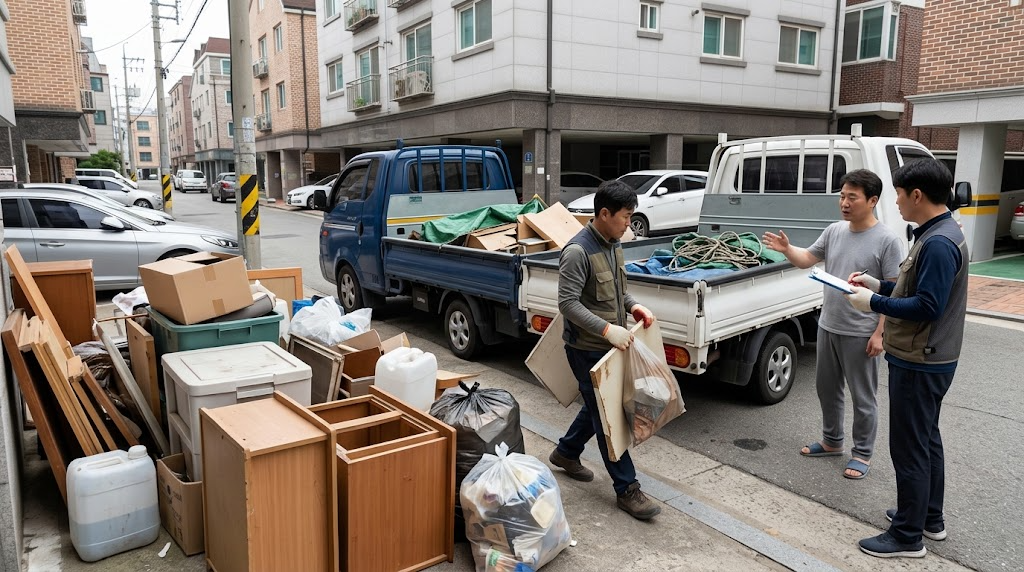
Actual waste disposal quotes exchanged on-site show significant unit price variances depending on what items, in what quantities, and through what methods they are discarded. Here is a summary of the average market rates and reasons for unit price disparities for the three most frequently requested categories.
- Household Waste and Moving Trash (Studio to Apartment Move-Out)
House clearances typically involve a mix of large household items like furniture and appliances, alongside small miscellaneous items such as clothing, dishware, and books.
- Average market rate per 1-ton truck: Approximately 350,000 KRW to 650,000 KRW
- Reasons for discrepancies:
- Haul-out method: If you bring the items down to the first-floor yard or parking lot in front of the building in advance and only request “loading (onto the vehicle)”, it can be settled within the 300,000 to 400,000 KRW range. In contrast, “on-site pick-up,” where workers handle disassembly, packing, and hauling from inside the house, requires an additional 1 to 2 workers, driving the price up to 550,000 to 650,000 KRW or more.
- Presence of recyclable appliances: If well-conditioned appliances or furniture are included, some companies offset scrap or secondhand purchase values to offer discounts, whereas other companies price purely based on landfill disposal fees at waste treatment facilities.
- Commercial Demolition and Interior Construction Waste
Waste concrete, plasterboard, tiles, and demolished partition materials resulting from remodeling or restoration work are very heavy relative to their volume.
- Average market rate per 1-ton truck: Approximately 450,000 KRW to 800,000 KRW
- Average market rate per 2.5-ton to 5-ton roll-off/grapple truck: Approximately 900,000 KRW to 1,600,000 KRW
- Reasons for discrepancies:
- Strict compliance with overload regulations: Construction waste easily exceeds the allowable weight limit (1 ton) even when filling only half of a 1-ton truck bed. Legally compliant companies that adhere to weight limits may recommend 2 vehicles, leading to higher quotes, while companies willing to risk overloading might bundle it into 1 vehicle to quote a lower price.
- Stair demolition and carrying conditions: If workers must perform manual stair-carrying (gombang: manual labor carrying materials/waste up and down stairs) on the 2nd or 3rd floor of a commercial building without an elevator, labor costs alone increase by more than 200,000 to 300,000 KRW per day.
- Unit Price Discrepancies by Material Sorting (Classified Disposal) Status
Gate fees at waste disposal facilities (final collection yards) show stark differences between “single-material waste” and “mixed waste.”
- Single materials such as wood and scrap metal: Around 250,000 KRW to 400,000 KRW per 1-ton truck
- Household and site mixed waste: 500,000 KRW to 700,000 KRW or more per 1-ton truck
- Reasons for discrepancies:
- Waste disposal facilities set lower gate fees for materials that directly enter recycling processes, such as wood or scrap metal. In contrast, mixed waste with entangled plastic, vinyl, textiles, and miscellaneous materials must head straight to incinerators or landfills, making gate fees per ton 1.5 to 2 times more expensive.
- Companies that benefit from clients presorting recyclables, or that sort materials directly on-site when loading, can save on disposal gate fees and lower their quotes; however, companies that load everything together unsorted bill disposal fees based on the highest unit rate (mixed waste standard).
💡 Average Quote Table by Type at a Glance
| Classification | Average Market Rate (Per 1-ton Basis) | Key Variance Factors |
|---|---|---|
| Simple On-Site Loading (Single Item) | 250,000 to 400,000 KRW | Recyclability of wood, scrap metal, etc. |
| Household Moving/Estate Clearance (On-Site Collection) | 450,000 to 650,000 KRW | Floor level, presence of elevator, packing service inclusion |
| Interior/Construction Waste | 500,000 to 800,000 KRW | Weight of waste concrete/plasterboard, manual stair carrying work |
| Mixed Waste (Unsorted Bulk Collection) | 550,000 to 750,000 KRW | Discrepancies in final incinerator/landfill facility gate fees |
Tips to Avoid Absurd ‘Rip-Off Rates’
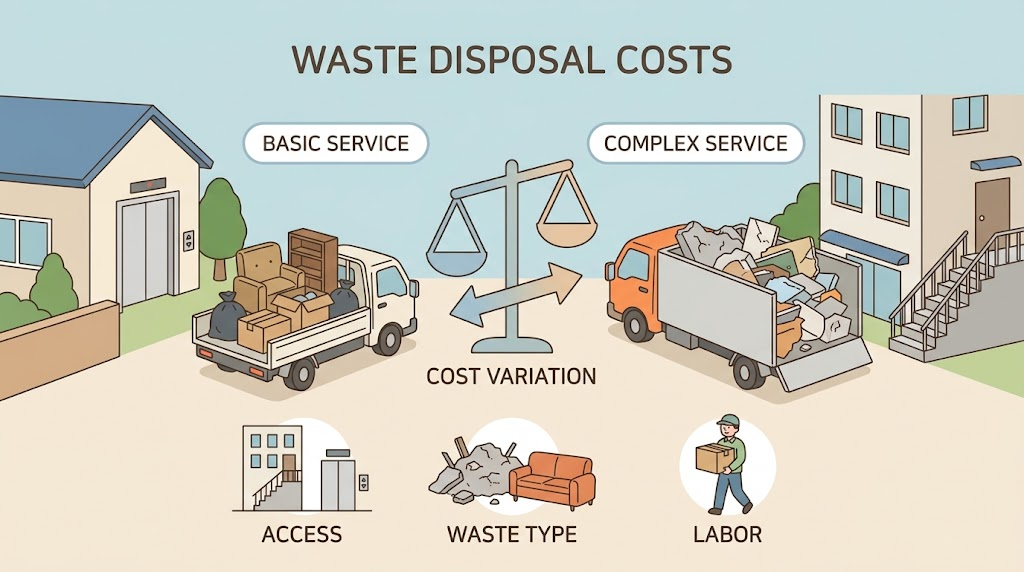
A frequent dispute in the waste collection market occurs when the quote heard over the phone differs from the final amount billed on the day of the job. To avoid being asked for hundreds of thousands of KRW in additional fees under claims such as “there is more load than expected,” “there is an elevator fee,” or “sorting work is difficult,” you need to establish clear criteria in advance.
- ‘Wide-Angle Photos’ and ‘Cataloging’ Are Essential for Phone Quotes
If you only describe the rough number of rooms or number of trucks over the phone, companies will either give the most conservative quote or, conversely, quote the lowest rate and then raise the price on-site. To eliminate room for misunderstanding, you must leave concrete visual documentation.
Shoot both overall and interior shots: Take photos with a wide angle so the overall volume of the room is revealed, and open up closets, storage cabinets, and miscellaneous items in the corners of verandas to photograph them.
Provide a large waste item list: Providing written dimensions of large items such as wardrobes (number of doors), beds (frame and mattress specifications), and refrigerator capacity prevents on-site excuses claiming “the vehicle loading limit has been exceeded.”
- Confirm the ‘No On-Site Additional Fee’ Condition via Text Message
When comparing quotes, many people choose a place solely because it offers the absolute lowest price, only to face frustration on the day of the job. Rather than stopping at verbal agreements, you must state detailed terms in writing or via text message.
Share checklist in advance: Disclose ahead of time whether an elevator is used (and who pays the management office usage fee), the necessity of a ladder truck, and the walking distance from the parking spot to the entrance (docking environment).
Get a confirmation text: Securing a response stating “Based on the photos and listed inventory sent, we confirm this is the final quote with no additional costs on the day under the specified working conditions” allows you to fend off unilateral requests for extra fees by on-site drivers.
- Check Whether the Company Is a Registered ‘Commercial Waste Collection and Transportation Permit’ Holder
There still exist unauthorized companies that run simple freight rental trucks, collect waste for dirt cheap, and illegally dump it on remote hillsides or vacant lots.
Discharger liability principle: Under the Wastes Control Act, if the identity of the discharger is verified through mail, receipts, etc., found in illegally dumped trash, not only the collection company but also the client who discharged the waste may face fines of up to 10 million KRW or criminal penalties.
Check permits: Verifying whether they hold a ‘Waste Collection and Transportation Business Permit’ formally registered with the competent district office and checking whether they are a normal business capable of issuing tax invoices or cash receipts alone can filter out shoddy and illegal operators in the first round.
- Pre-Sort What Can Be Discarded Using Municipal Bulky Waste Stickers
Leaving all items to the contractor as a whole will drive disposal unit rates to their peak. Simply discharging ahead of time a few large appliances or furniture items that are heavy or have standardized dimensions using municipal stickers (or apps like ‘Ppagi’ or ‘Yeogiro’) reduces truck loading space, saving an entire 1-ton truckload or lowering the vehicle tonnage by a tier.
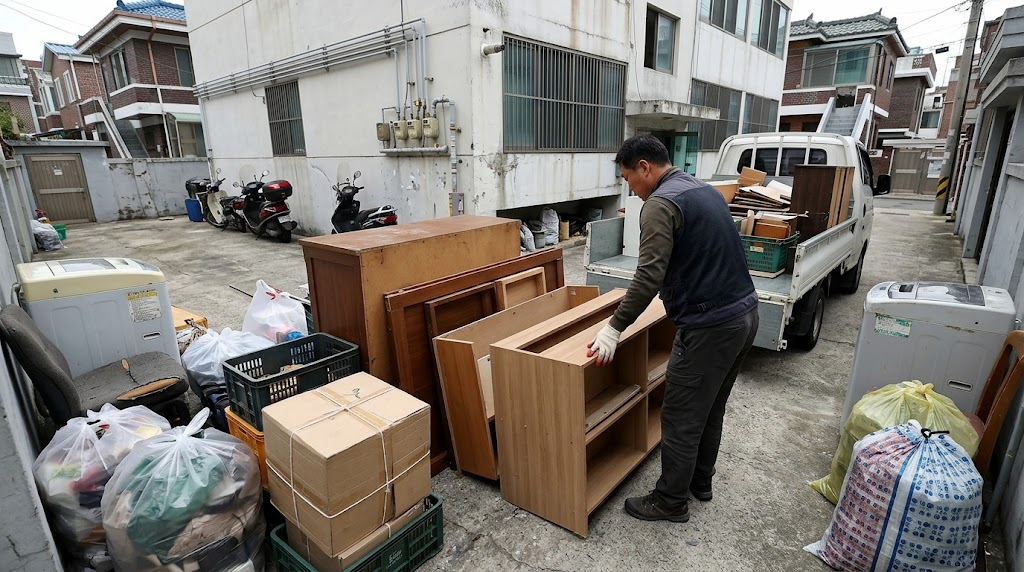
In Summary: A 3-Step Comparison Strategy to Smartly Save on Costs
When it comes to waste disposal, paying just a little attention and preparing in advance can cut unnecessary out-of-pocket expenses by hundreds of thousands of KRW or more. Here is a 3-step action strategy to substantially lower costs from requesting quotes to final pickup.
Step 1. Shed Volume and Weight with a ‘Self 1st Diet’
Before contacting a company, start by minimizing the total amount of items to be discarded as much as possible. This is because waste disposal estimates ultimately translate into “vehicle loading volume” and “labor costs.”
Utilize municipal bulky waste stickers: For standardized bulky items like furniture (chests of drawers, mattresses, desks, etc.), dispose of them in advance by attaching disposal stickers (or via the ‘Ppagi’ / ‘Yeogiro’ mobile apps) at apartment collection points or in front of your door. Leaving them to a waste collection company incurs 30,000 to 50,000 KRW or more per piece, but municipal collection resolves it for just a few thousand KRW.
Use free on-site pickup services: For discarded electronics such as refrigerators, washing machines, and TVs, apply for the Ministry of Environment’s “Free On-Site Pickup Service for Waste Home Appliances (1599-0903)” to have them collected for free right from your doorstep.
Separate recyclable sundries: For clothes, blankets, shoes, scrap metal, and waste paper, utilizing secondhand clothing collectors or neighborhood scrap yards allows you to earn some snack money while reducing the total amount of waste.
Step 2. Obtain Quotes from at Least 3 Companies Based on the ‘Same Criteria’
When looking into waste removal companies, get quotes from at least three companies to verify the average market price. The most crucial point here is to deliver the exact same information and conditions to every company.
Send identical photo packs: Take 4 to 5 wide-angle photos showing the spaces where items are located, such as the living room, rooms, and verandas, and copy and send the identical photos alongside a list of major large items to be thrown away.
Specify working conditions: Clearly indicate in advance whether there is an elevator, the distance to the parking area, and the availability of ladder truck access to secure objectivity in comparing quotes.
Filter out unusually low quotes: If the average estimate hovers around 500,000 to 600,000 KRW, a company asking for 250,000 KRW on its own is very likely an unlicensed operator with a high risk of demanding extra fees on-site or engaging in illegal dumping. Choosing a mid-range company that provides clear explanations is safe.
Step 3. Confirm ‘Additional Cost Conditions’ in Writing Before Scheduling
Once you have narrowed down a company with a satisfactory quote, put up the final defense barrier before finalizing the contract.
Check finalized inclusions: Reconfirm that the offered price fully includes “waste entry fee + loading labor + transportation fee.”
Leave a written confirmation via text: Leave a text message saying, “Based on the photos and on-site conditions sent, we confirm that there will be no additional charges on the day as long as no extra items are added.” A regular licensed company will gladly agree.
Waste disposal may seem like “they charge whatever they ask if you don’t know,” but once you reduce the volume in advance and establish objective comparison standards, it can be resolved neatly at a reasonable, standard price. Apply these three steps in order to select the safest and most economical company.
Korean version: 한국어로 읽기