Prologue: How Much Money Do You Actually Walk Away With After 5 Years?
“If I consistently deposit 700,000 KRW every month for 5 years, will I really save 50 million KRW?”
This is the most common question asked by young adults who are considering opening a Youth Leap Account or have already started making contributions. At launch, it garnered tremendous attention with the catchphrase “accumulate a lump sum of up to 50 million KRW upon completing 5 years of payments,” but once you open the account and deposit funds each month, calculating your exact expected maturity payout is not straightforward.
With standard installment savings accounts at commercial banks, the calculation is simple: multiply the principal you deposited by the agreed interest rate and deduct the 15.4% interest income tax. With the Youth Leap Account, however, you can never arrive at the actual payout by merely plugging numbers into a standard interest formula.
This is because it is designed with a three-tier structure that is entirely different from standard financial products.
Tiered Government Contributions Based on Personal Income
Even if you contribute the same 700,000 KRW each month, the amount of matching government contributions varies from 21,000 KRW to 24,000 KRW per month depending on your total earned income for the preceding year. Furthermore, if your income exceeds a certain threshold (total earned income over 60 million KRW), the government contribution becomes 0 KRW.
The Compounding Effect of 100% Tax Exemption on Interest Income Tax (15.4%)
Standard savings accounts deduct hundreds of thousands to over a million KRW in interest income tax, but this account does not take a single won. The tax exemption alone produces the same yield as a high-interest, standard taxed savings account offering 8% to 9% per annum.
Bank-Specific Preferential Rates and a Mixed Fixed/Variable Interest Rate Structure
In addition to the base interest rate, preferential interest rates must be fulfilled through conditions like salary direct deposit or credit/debit card spending. Moreover, a fixed interest rate applies for the first 3 years, while variable rates pegged to market interest rates apply for the remaining 2 years.
Ultimately, the maturity payout of the Youth Leap Account is the sum of “Principal + Bank Interest + Government Contribution + Interest Accrued on Contributions.”
Only by accurately understanding how much monthly subsidy applies to your income bracket and how much final payout will be deposited into your account without tax deductions after 5 years can you maintain the momentum to cross the 5-year finish line without giving up midway. In the sections that follow, we will break down the intricate Youth Leap Account payout structure one step at a time.

3-Step Breakdown of the Youth Leap Account Payout Structure
The maturity payout of the Youth Leap Account is significantly higher than that of standard installment savings accounts not simply because the interest rate is higher. The payout at maturity is structured across three combined tiers: ① the principal you deposited, ② the bank’s agreed interest, and ③ government contributions (along with interest accrued on those contributions). Understanding how funds accumulate at each stage makes it easy to grasp the outline of your final payout.
Step 1. Deposited Principal (Up to 700,000 KRW per month, 5-year contribution)
This represents the foundational savings forming the backbone of the payout. The Youth Leap Account is a flexible savings product allowing you to contribute any amount between 1,000 KRW and 700,000 KRW per month (up to 8.4 million KRW annually).
Maximum contribution principal: If you deposit the maximum limit of 700,000 KRW every month for 60 months (5 years) without missing a single payment, the pure accumulated principal totals 42 million KRW.
Flexible payment options: If funds are tight during a given month, you may deposit only the minimum amount or pause contributions without canceling the account, and interest and contributions will be calculated based on the accumulated principal.
Step 2. Bank Base Interest and Preferential Rates (Up to around 6.0% per annum)
The second tier consists of the contractual interest provided by participating commercial banks (KB Kookmin, Shinhan, Hana, Woori, NH Nonghyup, etc.). At launch, interest rates were set at up to around 6.0% per annum among major banks (a base rate around 4.5% per annum + preferential rates around 1.0% to 1.5% per annum).
Compounding growth effect: With each monthly principal deposit, contractual interest steadily accumulates in proportion to the remaining duration.
Tax-exempt advantage: Standard savings accounts withhold 15.4% (14% income tax + 1.4% local income tax) of total accrued interest at maturity as tax, whereas the Youth Leap Account features a complete tax exemption on interest income, allowing you to receive 100% of calculated bank interest without a single won deducted. (With maximum contributions and the highest preferential rates, approximately 5.3 million to 6.4 million KRW in interest remains entirely yours.)
Step 3. Government Contribution (Matching subsidies by personal income)
A core differentiator of the Youth Leap Account is the cash subsidy added monthly by the government based on the participating young adult’s personal income bracket (total earned income or global income) from the preceding year.
Tiered support by income bracket: Lower personal income brackets receive a higher contribution matching rate, distributed within a monthly limit of 21,000 KRW to 24,000 KRW. (However, brackets with total earned income exceeding 60 million KRW up to 75 million KRW receive tax exemption benefits only, without government contributions.)
5-year accumulated contributions: Consistently making contributions across 60 months yields pure government contributions totaling roughly 1.26 million KRW to 1.44 million KRW.
Bank interest accrued on contributions: Once deposited into the account, government contributions also earn the agreed bank interest rate, generating additional returns, which makes the ultimate benefit from the contribution tier even larger.
💡 3-Tier Payout Formula
Final Maturity Payout = Accumulated Principal (up to 42 million KRW) + Bank Interest (Tax-Exempt) + Government Contributions and Interest on Contributions
As these three components integrate seamlessly, they produce a lump sum of roughly 49 million KRW to around 50 million KRW upon reaching the 5-year maturity.
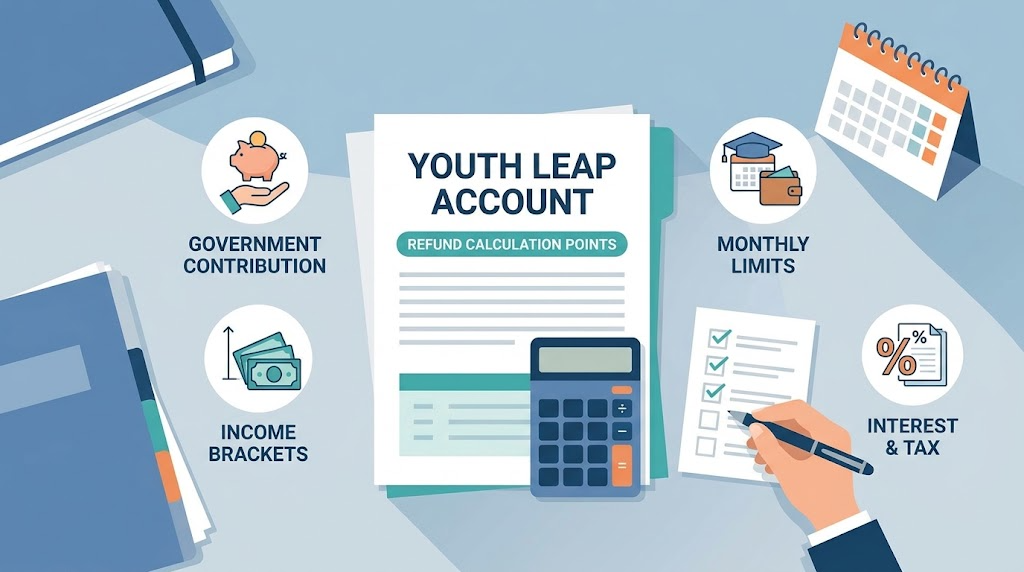
4 Key Points You Must Never Overlook When Calculating Payouts
When simulating the expected maturity amount of the Youth Leap Account, simply applying the basic formula of “monthly deposit of 700,000 KRW × 6% annual interest rate” will result in discrepancies with the actual amount credited to your bank account. You must carefully examine the 4 core variables that directly influence your final payout amount.
- Differences in the “Government Contribution Matching Limit” by Income Bracket
Even if you deposit the full monthly maximum limit of 700,000 KRW, the government contribution is not matched across the entire sum. The government contribution has a recognized monthly deposit ceiling (matching limit) determined by the subscriber’s personal income level.
Total earned income of 24 million KRW or less: Monthly matching limit of 400,000 KRW (matching rate of 6.0%, support up to 24,000 KRW per month)
Total earned income exceeding 24 million KRW to 36 million KRW: Monthly matching limit of 500,000 KRW (matching rate of 4.6%, support up to 23,000 KRW per month)
Total earned income exceeding 36 million KRW to 48 million KRW: Monthly matching limit of 600,000 KRW (matching rate of 3.7%, support up to 22,000 KRW per month)
Total earned income exceeding 48 million KRW to 60 million KRW: Monthly matching limit of 700,000 KRW (matching rate of 3.0%, support up to 21,000 KRW per month)
Total earned income exceeding 60 million KRW to 75 million KRW: No government contribution provided (tax exemption benefits apply only)
For instance, even if an employee with a total earned income of 30 million KRW saves 700,000 KRW each month, the government contribution matches only up to 500,000 KRW, accumulating 23,000 KRW per month. Because only bank interest accrues on the remaining 200,000 KRW, you need to clearly understand the matching limit for your income bracket.
- Real Yield Effect of the 15.4% Interest Income Tax Exemption
Interest earned on general financial products is subject to a 15.4% withholding tax (14% income tax + 1.4% local income tax). If 6 million KRW in interest is accrued from a standard taxable savings account, approximately 920,000 KRW is deducted as tax, leaving you with only 5.08 million KRW.
In contrast, the Youth Leap Account provides a full tax exemption on all accrued interest.
The roughly 1 million KRW that would otherwise be lost to taxes is entirely added to your payout.
Not only the bank interest, but also the interest income derived from the monthly accrued government contributions is completely tax-exempt.
Thanks to this tax-exempt effect, even if the stated interest rate is 6.0% per annum, it yields the same real return as a high-interest product offering 8% to 9% per annum on a standard taxable installment savings basis.
- Checking Fulfillment of Bank-Specific “Preferential Rate Conditions”
The maximum annual 6.0% interest rate offered by banks is fully realized only when the “base rate (approx. 4.5% per annum)” and the “preferential rate (approx. 1.0% to 1.5% per annum)” are combined completely. Missing even a single preferential rate requirement can result in a difference of hundreds of thousands of won in cumulative interest over 5 years.
Salary transfer record: Direct deposit of salary on a specified date or continuous deposits above a certain amount each month (typically allocated 0.5 to 1.0%p)
Card usage performance: Monthly payments exceeding a certain amount using credit/debit cards affiliated with the bank (typically allocated 0.2 to 0.5%p)
First transaction and marketing consent: First-time installment savings subscribers with the bank, holding a housing subscription savings account, consenting to app marketing, etc. (allocated 0.1 to 0.3%p)
Income-based preferential rate: Check whether you meet the separate preferential rate (around 0.5%p) provided to lower-income young adults with total earned income of 24 million KRW or less
Rather than neglecting the account after enrollment, you must periodically check whether you consistently satisfy the bank’s performance conditions every month for 5 years to receive the full maximum payout.
- Variables Stemming from the 3-Year Fixed + 2-Year Variable Rate Structure
The Youth Leap Account is not an entirely fixed-rate product where the same interest rate applies throughout the 5 years.
First 3 years after subscription: A fixed-rate period during which the contractual interest rate (base + preferential) set at enrollment applies without changes.
Remaining 2 years: A variable-rate period during which the interest rate is recalculated in line with market base interest rate trends.
If market interest rates drop substantially during years 4 and 5, the rate applied during the final 2 years will decrease, which may slightly reduce the total interest amount compared to initial simulation estimates. Conversely, if base interest rates rise or remain high, the payout volume will be defended accordingly. When calculating expected maturity proceeds, taking a conservative approach by factoring in potential interest rate changes during the final 2 years is prudent.

Simulation Comparison of Estimated Maturity Payouts by Income Level
Because the government contribution limit and matching ratio vary according to the subscriber’s personal income bracket, the final maturity payout of the Youth Leap Account shows meaningful differences as well.
Assuming that the monthly maximum limit of 700,000 KRW is diligently deposited for 5 years (60 months) and the bank preferential interest rate is fulfilled to apply the highest rate (assumed at 6.0% per annum), we simulated and compared the estimated payouts across major income brackets.
- Annual Income of 24 Million KRW or Less (Maximum Contribution Matching + Income-Based Preferential Rate Bracket)
This bracket includes low-income young adults such as entry-level workers, part-time employees, or new hires at small and medium-sized enterprises (SMEs). Government contribution benefits are the most substantial here, and an additional income-based preferential interest rate (0.5%p) from the bank is applied.
- Deposited principal (5 years): 42 million KRW (700,000 KRW monthly × 60 months)
- Government contribution: 24,000 KRW accumulated monthly (6.0% matching ratio applied to monthly recognized limit of 400,000 KRW), totaling 1.44 million KRW
- Bank interest (tax-free): Approximately 6.4 million to 6.5 million KRW (reflecting 6.0% per annum base + preferential rate and income preference)
- Interest accrued on contributions: Around 100,000 KRW
- Estimated final maturity payout: Around 49.9 million to 50 million KRW
Point: With the highest government contribution ratio of 6.0%, this bracket is the most advantageous in terms of return on principal and comes closest to reaching the 50 million KRW target amount.
- Annual Income of More Than 36 Million KRW to 48 Million KRW Bracket (Representative Bracket for General Office Workers)
This bracket encompasses the majority of working professionals in their 20s and 30s employed at general small, medium, and mid-sized enterprises.
- Deposited principal (5 years): 42 million KRW
- Government contribution: 22,000 KRW accumulated monthly (3.7% matching ratio applied to monthly recognized limit of 600,000 KRW), totaling 1.32 million KRW
- Bank interest (tax-free): Approximately 5.3 million to 5.8 million KRW (based on meeting the maximum preferential rate of 5.5% to 6.0% per annum)
- Interest accrued on contributions: Around 90,000 KRW
- Estimated final maturity payout: Around 48.6 million to 49.2 million KRW
Point: Although the matching ratio is somewhat lower than that of the low-income bracket, it still combines more than 1.3 million KRW in cash subsidies with fully tax-exempt interest in the 5 million KRW range, delivering a substantial net payout incomparable to regular savings accounts.
- Annual Income of More Than 60 Million KRW to 75 Million KRW Bracket (Tax-Exemption Focused Bracket)
This bracket covers young professionals at major corporations or specialists earning above a certain salary threshold.
- Deposited principal (5 years): 42 million KRW
- Government contribution: 0 KRW (no contribution provided for this income bracket)
- Bank interest (tax-free): Approximately 5.3 million to 5.8 million KRW (based on meeting the 5.5% to 6.0% per annum preferential rate)
- Estimated final maturity payout: Around 47.3 million to 47.8 million KRW
Point: While no government contribution is granted, it fully retains the benefit of a total waiver on the 15.4% interest income tax—saving roughly 800,000 to 900,000 KRW compared to a standard savings account. Converted to a regular taxable product at commercial banks, this yields the equivalent effect of enrolling in a savings account with rates in the mid-to-high 7% range per annum.
📊 Maturity Payout Comparison by Income Bracket at a Glance
| Personal Income Bracket (Based on Total Salary) | 5-Year Deposited Principal | 5-Year Cumulative Government Contribution | Bank Interest and Benefits | Estimated Final Payout (Maturity Return) |
|---|---|---|---|---|
| 24 million KRW or less | 42 million KRW | 1.44 million KRW (24,000/month) | Tax-free interest + Preferential rate | Approx. 49.9 million ~ 50 million KRW |
| Over 24 million ~ 36 million KRW | 42 million KRW | 1.38 million KRW (23,000/month) | Tax-free interest | Approx. 49 million ~ 49.4 million KRW |
| Over 36 million ~ 48 million KRW | 42 million KRW | 1.32 million KRW (22,000/month) | Tax-free interest | Approx. 48.6 million ~ 49.2 million KRW |
| Over 48 million ~ 60 million KRW | 42 million KRW | 1.26 million KRW (21,000/month) | Tax-free interest | Approx. 48.3 million ~ 48.8 million KRW |
| Over 60 million ~ 75 million KRW | 42 million KRW | 0 KRW (Not provided) | Tax-free interest (approx. 800,000~900,000 KRW tax savings) | Approx. 47.3 million ~ 47.8 million KRW |
(※ Actual return amounts may show slight differences depending on the agreed base and preferential interest rates by bank at the time of enrollment, as well as the trends in the variable interest rate applied after 3 years.)
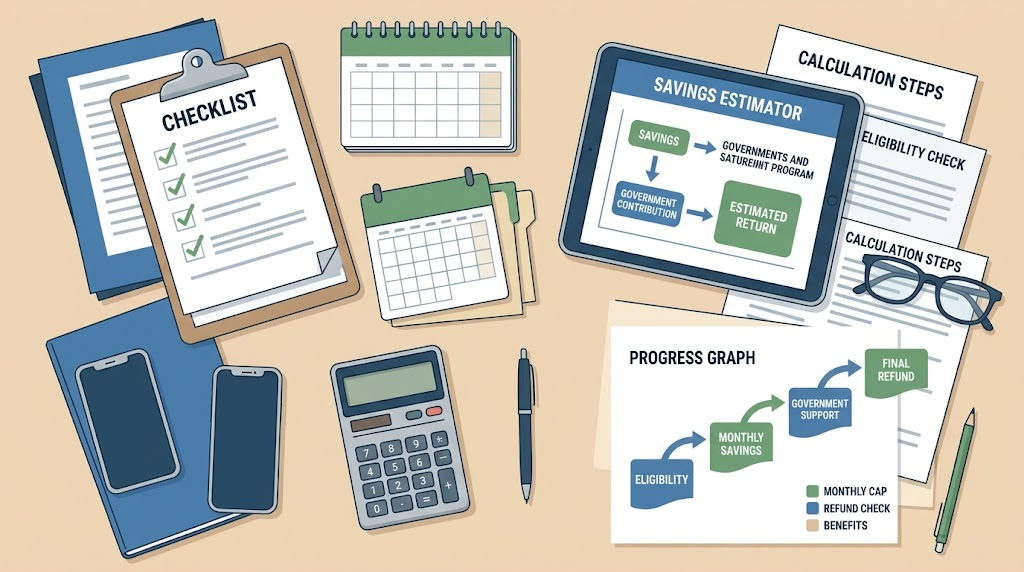
What Happens to Returns upon Early Termination? (Tips to Minimize Losses)
A deposit period of 5 years (60 months) is by no means a short time for young adults entering society. Situations may arise where a lump sum is urgently needed for job transitions, marriage, moving out, or independence, forcing you to break open your savings. Here is a breakdown of how cumulative government contributions and tax exemption benefits are settled if you terminate the Youth Leap Account before maturity, along with safety nets to minimize losses.
- Disadvantages Incurred upon Standard Early Termination
This applies when terminating earlier than 3 years without special justifiable grounds, purely due to a simple change of mind or an urgent need for cash.
Full forfeiture of government contributions: Not a single won of the monthly accumulated matching government contributions can be received; they are forfeit entirely.
Revocation of tax exemption benefits: The 15.4% interest income tax reduction is canceled, and taxes are withheld at the source from the accrued bank interest.
Application of early termination interest rates: Instead of the bank’s agreed contractual rate (4.5% to 6.0% per annum), a very low penalty rate of merely 10% to 50% of the base rate is applied, sharply reducing interest income.
Result: You receive only your contributed principal (there is no loss of principal) plus the meager early termination interest minus 15.4% tax.
- Policy Improvement: Preservation of Benefits upon “Termination after Maintaining for 3+ Years”
To address the long mandatory enrollment period cited as the biggest drawback of the early Youth Leap Account, the government introduced relaxed regulations that substantially preserve benefits when terminating early after paying for 3 years or longer.
Retention of tax exemption on interest income: If the account is maintained for 3 years (36 months) or longer, the 100% tax exemption on the 15.4% interest income tax is recognized for all interest accrued up to that point, even if terminated early.
Matched payout of government contributions: Government contributions reaching up to roughly 60% of the maturity payout rate are recognized and added to the refund amount.
Higher applied interest rates: Early termination rates are guaranteed up to approximately 70% to 80% of the bank’s contractual interest rate, enabling you to secure net proceeds higher than those from completing a 3-year standard installment savings account.
Tip: If you are considering terminating the account and have already surpassed 2 years and 6 months of enrollment, holding out to reach 3 years (36 installments) before closing the account is overwhelmingly advantageous in terms of contributions and tax benefits.
- Receiving 100% of Maturity Benefits under “Special Early Termination” Grounds
If terminating due to unavoidable reasons recognized under statutory “Special Early Termination” qualifications, you can secure full disbursement of government contributions and interest tax exemption benefits, exactly identical to completing the 5-year maturity.
Recognized grounds:
Subscriber’s death or overseas emigration
Retirement or closure of business operations
Natural disasters
Injury or disease requiring 3 months or more of inpatient medical treatment or nursing care
First-time home purchase in a lifetime
Marriage and childbirth (special early termination permitted when incurring significant expenditures due to marriage or childbirth)
Application method: Preparing and submitting documents verifying the qualifying reason (sales contract, marriage certificate, retirement certificate, etc.) to the bank allows you to receive 100% of the contractual interest rate and government subsidies in full without any penalties.
- Using “Leap Account Collateral Loans” to Overcome Emergencies without Terminating
If you urgently need cash right away, do not meet special early termination grounds, and have not yet reached 3 years, taking advantage of a Youth Leap Account collateral loan (savings collateral loan) is much wiser than breaking open the account.
Borrowing up to 90% to 95% of deposited principal: You can access emergency funds while keeping the account principal and government contribution accrual status intact.
Low spread rates: Loans are disbursed with only a low spread of around 0.6%p to 1.0%p added to the savings interest rate, resulting in a much lighter interest burden compared to credit loans or card cash advances.
Completion to maturity: Paying off the loan after overcoming the immediate crisis ensures you can fully safeguard the 50 million KRW lump sum receivable upon reaching the 5-year maturity.

Epilogue: Optimal Contribution Strategies to Reach 50 Million KRW at Maturity
The ultimate goal of the Youth Leap Account—”building a 50 million KRW lump sum in 5 years”—does not happen automatically just by depositing as much money as possible without a plan. Here are three practical contribution strategies to fully capture government subsidies and tax benefits while completing the 5-year (60-month) marathon without dropping out midway.
- Set Your Income Bracket’s “Government Contribution Matching Limit” as Your Primary Defense Line
Even in months when depositing the full 700,000 KRW feels overwhelming, you should never skip securing the recognized government contribution limit corresponding to your income level.
Essential minimum defense lines by income:
Total earned income of 24 million KRW or less: 400,000 KRW/month (receive maximum government contribution of 24,000 KRW/month)
Total earned income over 24 million to 36 million KRW: 500,000 KRW/month (receive maximum government contribution of 23,000 KRW/month)
Total earned income over 36 million to 48 million KRW: 600,000 KRW/month (receive maximum government contribution of 22,000 KRW/month)
Amounts exceeding the matching limit accrue only bank interest, but amounts within the matching limit essentially earn an additional 3.7% to 6.0%p in yield. During months when living expenses are tight, rather than straining to deposit the entire 700,000 KRW and risking overdue status or account cancellation, it is necessary to remain flexible by prioritizing the matching limit amount to secure the government contribution.
- Lock in Your Bank’s “Preferential Rate Conditions” through Automated Systems
A preferential interest rate of 1.0% to 1.5%p results in a difference of hundreds of thousands of won in your net maturity payout. Rather than trying to manually manage monthly requirements, setting up automation right at the time of account opening is safer.
Salary direct deposit: Designate your salary account at the bank where you opened your Leap Account, or schedule an automatic monthly transfer above a certain threshold the day after your salary arrives from another bank.
Card usage performance: Link 1 to 2 fixed recurring monthly expenses (such as phone bills or public transit costs) to automatic payments using the bank’s debit card to solidly meet the minimum requirement.
Marketing consent and app activity: Maintain necessary consents to ensure preferential terms remain active until maturity, and check bank apps quarterly to verify whether requirements are being met.
- Keep “Early Termination Safeguards (3-Year Retention and Collateral Loans)” in Mind Along the Way
While crossing the 5-year finish line is ideal, keeping the rules for emergency exits in mind prepares you for unexpected life variables and prevents prematurely terminating the account.
Reach a minimum of 3 years (36 installments): Once you surpass 3 years, you retain tax-free benefits and 60% of government contributions even upon early termination; make a full 3-year completion your first major milestone.
Use collateral loans when urgent cash is needed: Canceling an account you have contributed to for 2 to 3 years due to temporary cash shortages entails far too great an opportunity loss. Utilizing savings-collateralized loans—which allow borrowing up to 90% or more of your deposited balance—serves as a stepping stone to keep the account alive until the end.
💡 In Summary: The Future That a 50 Million KRW Seed Fund Delivers
For someone entering society, 50 million KRW is not merely a number. It serves as a deposit toward a Stepping Stone mortgage loan for buying a first home, a safety cushion for career shifts and job transitions, or the initial seed capital for serious wealth building.
Now that you have accurately grasped the complex payout calculations and criteria by income bracket, all that remains is the consistent discipline to save each month without faltering. Determine your personal optimal monthly contribution amount and take on the challenge of completing the 5-year journey step by step.
Would you like to review the complete consolidated text (from prologue to epilogue)?
Yes
Korean version: 한국어로 읽기