
Financial Manager Certification Overview and Employment Utility
This is a main body draft formatted with highly readable line breaks, key point highlights, and comparison tables so that Naver blog readers can easily understand it at a glance.
- Financial Manager Certification Overview and Employment Utility
As the barrier to entry in the financial sector job market continues to rise, we have entered an era where simply saying “I have a lot of interest in finance” is not enough to pass document screening.
The factor that hiring managers evaluate as most important is whether you have the fundamental strength to independently analyze financial statements and corporate value when put into practical work. The representative license that most objectively proves this job fitness is none other than Financial Manager.
💡 What kind of certification is the Financial Manager?
Financial Manager is a professional certification exam that verifies practical decision-making competency across overall corporate finance, including corporate financing, capital structure optimization, investment decision-making, valuation, and risk management.
It does not stop at simple rote accounting processing (bookkeeping), but comprehensively covers the following core practical areas:
- Financial Accounting and Statement Analysis: Ability to accurately read a company’s financial condition and business performance
- Corporate Finance: Calculating the cost of capital (WACC), designing optimal capital structures, and dividend policies
- Investment Theory & Corporate Valuation: Practical valuation such as DCF (Discounted Cash Flow) and relative valuation (PER, EV/EBITDA)
- Derivatives and Financial Risk Management: Hedging strategies to respond to interest rate and exchange rate fluctuations
In other words, it can be called a certified indicator that proves practical analysis skills capable of looking at numbers and deriving a company’s future cash flows and intrinsic value.
🏢 Actual Preferential Treatment During Employment in the Financial Sector and Large Corporations
Many test-takers ask the question: “Does this certification actually help with passing document screening or interviews?” Here is the job-specific utility viewed from the perspective of field hiring.
| Application Field | Main Applicable Job | Actual Hiring Merit and Evaluation Points |
|---|---|---|
| Commercial Banks & Public Financial Institutions | Corporate Banking (RM), Credit Screening, Risk Management | Proves financial risk analysis competency during corporate credit screening, directly connects to document extra points and written exams (major finance) |
| Securities Firms & Asset Management Companies | Research (RA), IB (Corporate Finance / DCM·ECM), Fund Management | Proves basic competency in writing corporate analysis reports and valuation modeling, strengthens practical interview defense capability |
| General Large Corporations / Mid-sized Enterprises | Financial Planning Team, Treasury Team, IR, Management Control | Appeals competency in establishing financing plans and executing financial analysis projects, eases entry barriers for non-majors |
Especially for applicants to IB (Investment Banking), research, or credit screening departments, it is optimized to weave specific episodes into personal statements, such as “through preparing for the Financial Manager exam, I mastered the practical mechanisms of cash flow estimation and discount rate calculation.”
🔄 Differences from Other Financial Certifications and Linked Tech Tree
Building up financial certifications in order according to your desired career path is the secret to reducing wasted time.
[Introductory/Basic] [Practical Competency Verification] [Advanced/Professional]
AFPK / Maekyung TEST ──▶ Financial Manager & Certified Investment Manager ──▶ CFA Level 1 or higher / FRM
(Establish financial basics) (Two-track: Corporate analysis & stock management) (Complete global professional specs)
- vs Certified Investment Manager (CIM)
- CIM is focused on asset management, fund managing, and stock management practice (essential for retail/PB/managers).
- Financial Manager specializes in ‘the financial soundness and valuation of the company itself,’ making it a much better match for corporate banking (IB) or finance teams at large corporations.
- Tip: Because there is an overlap of more than 40% between the two certifications in the areas of investment theory and financial products, the strategy of acquiring them simultaneously or back-to-back is very effective.
- vs CFA (Chartered Financial Analyst)
- CFA is### Financial Manager Certification Overview and Employment Utility
- Financial Manager Certification Overview
Financial Manager is a professional certification that verifies practical competency to plan and control a company’s cash flow, analyze investment feasibility, and perform risk management. Beyond simple accounting slip processing or bookkeeping, it focuses on diagnosing a company’s current financial status and predicting future cash flows to support strategic decision-making.
- Main Evaluation Areas: Corporate finance (capital structure, financing, dividend policy), investment theory (portfolio analysis, corporate valuation), financial accounting and cost management, derivatives and financial risk management
- Orientation of the Certification: Cultivating practical finance and accounting professionals who maximize enterprise value based on number interpretation skills and financial statement analysis
- Employment and Practical Utility
| Career Field | Main Responsibilities | Practical Utility and Competitiveness |
|---|---|---|
| Corporate Finance and Planning Teams in General Companies | Financing and capital management, budgeting, new business feasibility analysis | Proves cash flow projection and ROI analysis competency based on financial statements |
| Financial Sector (Banks, Insurance, Securities) | Corporate credit screening, risk management, corporate banking (IB) assistance | Differentiates in document screening and interviews with corporate insolvency risk evaluation and credit analysis competency |
| Investment and Asset Management Companies | Portfolio performance analysis, fund management support, valuation | Reflects basic understanding of enterprise valuation modeling such as Discounted Cash Flow (DCF) |
| Consulting and Accounting Firms | Financial due diligence (FDD) support, management diagnosis, strategic consulting | Facilitates participation in cost reduction structure design and financial problem-solving projects |
- Core Strengths in the Job Market
- Proving Job Fit: For non-majors or entry-level applicants, it is used as an objective indicator that proves quantitative financial knowledge and practical interest.
- Synergy with Linked Certifications: When pursued alongside Computerized Tax Accounting / Financial & Management Accountant (accounting-focused) or CFA / FRM (advanced financial analysis), you can demonstrate competency covering everything from accounting measurement to financial strategy establishment.
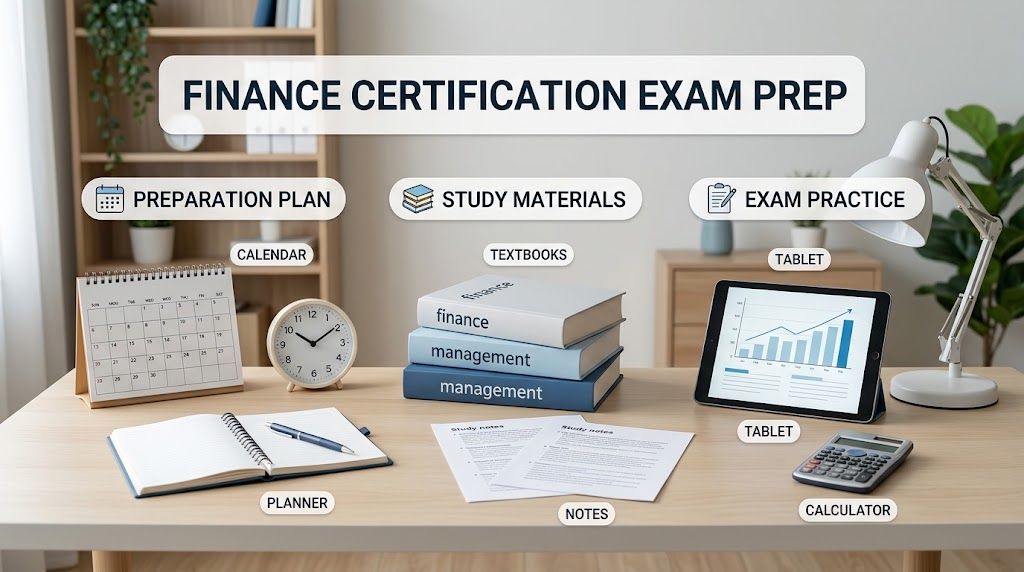
2026 Exam Information at a Glance
This is a main body draft structured so that Naver blog readers can quickly scan on mobile and PC to check necessary schedules.
- 2026 Exam Information at a Glance
The first step in preparing for a certification is to accurately understand the exam schedule, eligibility requirements, and evaluation methods to build a specific D-day plan. Here is a summary of the core guide for the Financial Manager exam as of 2026.
📅 2026 Exam Schedule and Registration Guide
The Financial Manager exam is administered according to a regular annual schedule, with exam opportunities concentrated right before the major hiring seasons in the first and second halves of the year.
| Classification | Registration Period | Exam Date (Sat) | Announcement of Successful Candidates |
|---|---|---|---|
| First Half (1st Round) | Early March to mid-March | Mid-April | Early May |
| Second Half (2nd Round) | Late August to early September | Mid-October | Early November |
- Eligibility: No restrictions on age, educational background, or major (Anyone, including non-majors and university students, can apply)
- Registration Method: Online registration through the administering institution’s official qualification testing website
- Exam Format: 4-choice multiple choice (CBT or PBT paper-and-pencil evaluation)
- Required Items: Prescribed ID, test admission ticket, standard four-operation calculator (or model approved by the organizer)
💡 Registration Tip: Popular test centers fill up quickly on the morning of the first day of registration, so to secure a testing site near your residence, it is recommended to apply immediately at 10:00 AM on the day registration opens.
📚 Exam Subjects and Question Structure
The exam is composed of 3 to 4 core modules to comprehensively test the financial and accounting competencies required in corporate practice.
- Period 1: Corporate Finance and Financial Statement Analysis (40 questions)
- Financial statement structure and major ratio analysis, cash flow statement interpretation
- Working capital management, financing methods, and capital structure determination theory
- Period 2: Investment Theory and Corporate Valuation (40 questions)
- Time Value of Money (TVM), capital budgeting techniques (NPV, IRR)
- Portfolio theory and CAPM model
- DCF (Discounted Cash Flow), relative valuation (PER, PBR, EV/EBITDA)
- Period 3: Financial Markets and Risk Management (40 questions)
- Basic structures of derivatives (futures, options, swaps) and hedging principles
- Measuring and managing interest rate and exchange rate fluctuation risks
🎯 Passing Criteria and Perceived Difficulty
- Passing Criteria: An average of 60 points or higher across all subjects (However, failing if scoring below 40 points in any single subject)
- Difficulty and Perceived Assessment:
| Classification | Majors (Business / Economics) | Non-Majors |
|---|---|---|
| Recommended Preparation Period | 3 to 4 weeks (Intensive study) | 7 to 8 weeks (Concept buildup needed) |
| Primary Perceived Difficulty | Moderate (Familiar terminology, focus on organizing calculation questions) | Medium-High (Burden of unfamiliar financial terms and memorizing formulas) |
| Vulnerable Points | Derivative structures and detailed calculation errors | Time value of money formulas and valuation models |
Because there is a tendency to balance conceptual questions (solvable by simple memorization) and calculation questions at a ratio of about 6:4, mastering calculation formulas and repeatedly reviewing past exam questions makes it entirely possible to enter the short-term passing range (average in the 60–70 point range).
Would you like to continue writing the next step?

Core Strategies by Subject for Short-Term Passing
Apologies for the confusion in the previous response. We have organized the frequently tested points and short-term passing strategies by subject so that blog readers can immediately gain practical test-taking tips and study efficiency.
- The success or failure of short-term passing does not lie in studying every subject perfectly, but in an ‘allocation strategy that secures high scores in strategic subjects and defends the average by avoiding failing scores in weak subjects.’ Here is a 3-step core attack method by subject to cross the passing line within a limited time.
- Strategic Subjects (Aiming for High Scores): Mechanical Memorization of Frequently Tested Types
For main subjects that will drive the passing cutoff score, you should set a goal of 80 points or higher and raise both speed and accuracy simultaneously.
- Patterning the Past 5 Years of Exam Questions: Organize core chapters that account for more than 70% of the exam questions first, and master recurring keywords and statements entirely.
- Consolidation Centered on Incorrect Answer Options: Instead of simply checking the correct answer and moving on, consolidate why attractive incorrect options were wrong into the standard textbook or summary notes, and review them repeatedly until right before the exam.
- Solving Time Reduction Training: Increase intuitive questions where you can pick out the correct answer the moment you see the question, thereby saving time to spend on weak subjects or calculation questions.
- Defensive Subjects (Aiming to Avoid Failing): Sharp Separation Between Questions to Discard and Questions to Secure
For difficult subjects where scores do not easily rise even after investing time, set a goal of stable defense around 60 points.
- Bold Elimination of Peripheral Parts: Boldly discard peripheral theories or complex applied questions that appear barely once a year, and focus only on basic formulas and core concepts that appear fixedly in every exam.
- Mastering Calculations at the Basic Example Level: Skip complex multi-step calculation questions during the actual test, and take a strategy of reliably getting only the basic questions solved directly with a single formula right.
- Memorizing Frequently Tested Clauses and Definitions: Be sure to secure basic points in chapters (general introduction, definitions, legal provisions, etc.) that can be solved through simple memorization instead of calculations or deep application.
- Memorization and Legal Subjects: Compressed Review Right Before the Exam to Control Volatility
For subjects requiring detailed memorization of numbers, periods, and procedures, cramming right before the exam is more efficient than aiming for perfection in the early stages.
- Organizing Comparison Tables for Keyword Contrasts: Organize easily confused comparison items, such as numbers (30 days vs. 60 days, 3 years vs. 5 years) and subjects (minister vs. mayor/provincial governor), into table form to get familiar with them visually.
- Multiple Reviews Using Spare Time: Use fragmented spare time, such as transit time or right after waking up, to repeatedly activate short-term memory through blank-page recall or fill-in-the-blank quiz formats.
- Final Review 2 Weeks Before the Exam: Given the nature of memorization subjects, the number of reviews during the final 2 weeks directly connects to the actual score, so compress the scope so that you can complete a full read-through of the entire range in the final week before the exam.
| Classification | Target Score | Time Investment Share | Core Execution Strategy |
|---|---|---|---|
| Strategic Subjects | 80 points or higher | 40% | Mechanical memorization of frequently tested statements and reduction of solving time |
| Defensive Subjects | 55 to 65 points | 35% | Bold exclusion of high-difficulty parts, perfect mastery of basic formulas |
| Memorization Subjects | 70 points or higher | 25% | Organizing comparisons of confusing indicators and cramming right before the exam |
The core of short-term passing is not ‘studying for 100 points,’ but ‘strategic design to cross the passing standard line (average of 60 points or higher, preventing failing scores under 40 points).’ You can reduce trial and error only by first confirming the boundary between parts to secure and parts to discard by subject before diving into past question reviews.
Next steps for completing the blog post:
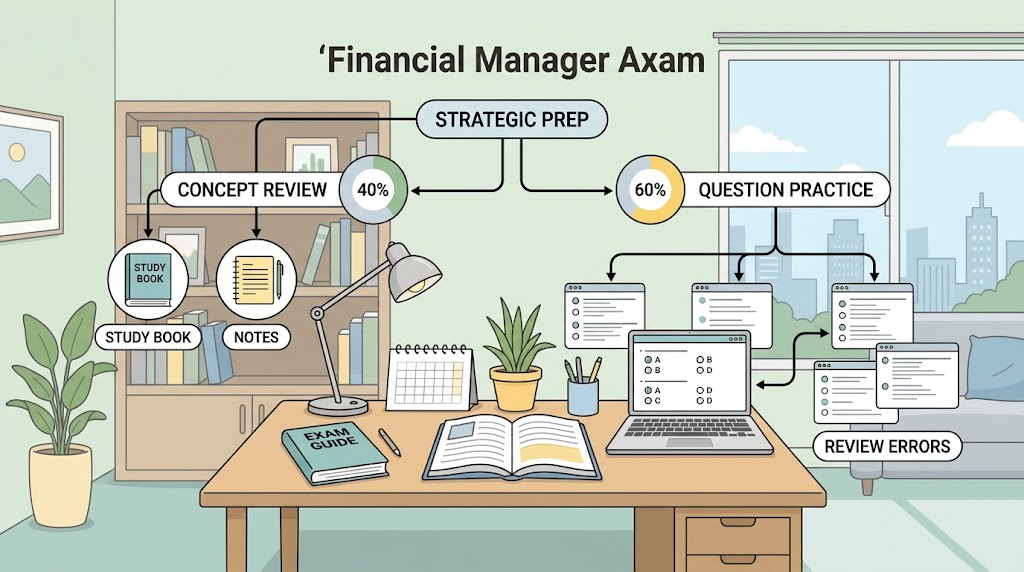
Best Study Roadmap Based on Successful Candidates’ Data
The biggest reason study periods stretch out is the perfectionism of trying to read through the main textbook from page 1 like a novel. The core formula derived commonly from the data and study reviews of actual short-term successful candidates is a practical-centered cycle of ‘40% concept comprehension + 60% past paper review and error analysis.’ Here are weekly plans optimized for majors and non-majors respectively.
⏱ Recommended Plans by Type (8-Week Plan vs. 4-Week Compressed Plan)
① 8-Week Completion Plan for Non-Majors and Beginners
It is easy to get frustrated if you jump straight into solving questions when terminology is still unfamiliar. Concentrate the first 3 weeks on internalizing essential concepts and calculator usage methods.
- Weeks 1 to 3 [Foundation Buildup & Basic Lectures]:
- Set a goal to complete basic online lectures at 1.2x to 1.4x speed
- Focus on organizing essential foundational concepts such as Time Value of Money (TVM), basic financial statement structure, and CAPM
- The key is to simply check off peripheral theories you do not understand and keep moving forward
- Weeks 4 to 6 [Chapter-by-Chapter Past Question Application & Formula Consolidation]:
- Solve chapter-by-chapter past exam questions in parallel (trace incorrect questions back to the standard textbook)
- Create compressed summary notes of only frequently used calculation formulas spanning 2 to 3 A4 pages
- Weeks 7 to 8 [Practical Mock Exams & Error Review of Weak Parts]:
- Solve past exam questions from the recent 3 to 5 years according to actual exam time limits (around 1 minute per question)
- Repeat at least 3 reviews of frequently missed answer choices and incorrect formulas until the day before the exam
② 4-Week Compressed Plan for Business/Economics Majors and Those with a Foundation
If you have a background in financial management or principles of accounting, boldly skip long theory lectures and head straight to past questions.
- Week 1 [Summary Lectures & Selecting Weak Parts]: Take key summary lectures or complete 1 reading of a summary book, refresh calculator operations and formulas
- Weeks 2 to 3 [Intensive Multiple Reviews of Past Questions]: Conduct 3 reviews of 5-year past exam questions (highlight incorrect options and calculation mistake types with a highlighter)
- Week 4 [Final Review & Actual Exam Simulation]: Solve 2 practical mock exams, conduct final memorization centered on error notes, and defend weak chapters
📊 Successful Candidates’ Weekly Timeline by Subject
| Week (Based on 8 Weeks) | Focus Study Area | Weekly Study Goal | Core Output |
|---|---|---|---|
| Weeks 1 to 2 | Financial Accounting & Corporate Finance Basics | Memorize financial ratio formulas, understand cash flow statement structure | Core financial ratio flashcards |
| Weeks 3 to 4 | Investment Theory & Cost of Capital (WACC) | Master the calculator for time value of money, understand valuation models | Valuation formula summary sheet |
| Weeks 5 to 6 | Derivatives & Financial Risk | Grasp basic profit/loss structures of futures and options, solve chapter-by-chapter past questions | Past exam error checklist by chapter per subject |
| Weeks 7 to 8 | Full-Scope Real Past Papers & Final | Complete 3 reviews of 5-year past papers, train time allocation with mock exams | Practical error notes (to bring to the exam center) |
🛠 Textbook Selection and Online Lecture Review Tips
- Do not separate the standard textbook and the question bank: Choosing an integrated test-prep book where theory and past questions are organized in one volume is the shortcut to shortening the review cycle.
- Abandon first-read perfectionism: It is normal to understand only 50% on your first read. The reverse learning method of reinforcing concepts through answer explanations while solving past questions yields a much larger score increase.
- Solve calculation questions directly by hand and calculator: Reading explanations with your eyes will inevitably lead to calculation mistakes at the exam site. You must completely familiarize your hands with the formula entry order and memory functions (M+, MR).
Choose the section or supplementary material to follow next:

After Passing: Utilizing Specs 200% in Documents and Interviews
If you only write a single line saying ‘Acquired Financial Manager’ in the certifications section of your resume after passing, you are utilizing less than 30% of the value this certification holds.
Rather than the mere fact that the applicant holds the certification, hiring managers want to verify ‘what practical competencies you developed through this exam preparation process, and how they can contribute to our department’s actual work.’ Here are specific appeal strategies to transform the certification into a powerful weapon in document screening and practical interviews.
📝 Weaving Job Competency into Personal Statements (Before & After)
A common mistake when writing a personal statement is focusing on ‘how hard I studied to acquire the certification.’ Instead of study duration or diligence, you should describe analytical perspectives and quantitative thinking methods that can be applied to actual job tasks.
- ❌ Before (Simple Listing Type):
“During college, I acquired the Financial Manager certification, gained overall knowledge of corporate finance and accounting, and developed meticulous analytical skills through this.”
- ⭕ After (Practical Linkage Type):
“While acquiring the Financial Manager certification, I went beyond simply reading financial statements to systematically internalizing working capital management and the mechanism of calculating WACC (Weighted Average Cost of Capital). Particularly in the mock valuation process, by directly estimating the future Free Cash Flow to Firm (FCFF) of a specific company using DCF (Discounted Cash Flow), I established insights into which quantitative indicators should be prioritized during credit screening and risk assessment in corporate banking (RM) practice.”
💬 Expected Questions & Defense Points in 1st-Round Working-Level Interviews
Working-level interviewers probe sharply to see whether an applicant is a ‘rote-learning passer’ who simply memorized past question answers to get the certification, or a ‘practical talent’ capable of applying theory to real business phenomena.
Q1. “You have the certification. Explain how the recent stance of interest rate hikes (or cuts) affects a company’s cost of capital (WACC).”
- Answer Core: Connect to market conditions rather than stopping at reciting formula memorization.
- Model Point: “The cost of debt increases directly due to rising borrowing rates and corporate bond issuance rates. The cost of equity also faces upward pressure because the required rate of return under the CAPM model increases due to the rise in the risk-free rate, which consequently puts upward pressure on the company’s WACC. Accordingly, because the Net Present Value (NPV) can drop during large-scale facility investments (CAPEX), I realized through exam prep and corporate analysis that a more conservative capital management and working capital efficiency strategy is needed.”
Q2. “When looking at a company’s cash flow statement, what is the very first indicator you check?”
- Answer Core: Pointing out the discrepancy (divergence rate) between net income and operating cash flow.
- Model Point: “I check first whether cash flows from operating activities are showing net inflows in a direction consistent with net income. Even if net income shows a surplus, if actual operating cash flow records a negative (-) figure due to a surge in accounts receivable or accumulation of inventories, there is a risk of profitable bankruptcy. I believe this serves as an indispensable safety device in actual credit screening or corporate credit analysis.”
📂 Tips on Linking to Portfolios and Intern Applications
| Applied Job | Recommended Portfolio Output | Linkage Points |
|---|---|---|
| Corporate Finance / Credit Screening | Financial soundness and insolvency warning sign analysis report for a specific listed company (3–5 pages) | Practical application of liquidity ratios, interest coverage ratio, and cash flow pattern analysis |
| Securities Research / RA | Valuation model for a representative company in an industry of interest (Excel DCF and relative valuation) | Verification of projected income statement preparation ability and valuation multiple (PER, EV/EBITDA) calculation |
| Corporate Finance / Planning in Large Corporations | New business feasibility review document (including NPV and IRR sensitivity analysis) | Proves understanding of the project decision-making process using capital budgeting techniques |
During actual internships or new-hire recruitments, attaching a 1 to 2-page analysis sample created by directly applying formulas covered in the exam to an Excel sheet to your portfolio can leave interviewers with the powerful impression of being ‘an applicant who can work with Excel templates immediately after joining the company.’
Subsequent work to complete the entire post:
Korean version: 한국어로 읽기