Basic Checklist Before Taking Practical Training with Government Funding
Because practice-oriented vocational training involves high equipment usage and material costs, regular academy enrollment costs millions of won in tuition. Using the Ministry of Employment and Labor’s Tomorrow Learning Card can dramatically reduce this cost burden, but there are key criteria you must review before applying for a course.
① Checking Eligibility for Issuance
In principle, any South Korean citizen can apply for vocational competency development, but you should first check whether you fall under the support exclusion categories.
- Eligible recipients: Job seekers (unemployed individuals preparing for employment), career changers, employed workers, workers in special types of employment, self-employed individuals, etc.
- Exclusion categories:
- Current public officials and private school faculty/staff
- Individuals aged 75 or older
- University students with more than 2 years of remaining coursework until graduation (enrolled students are eligible mainly if they are expected to graduate or are in their 3rd or 4th year)
- Self-employed individuals with annual sales of 400 million won or more
- Large corporation workers (monthly wage of 3 million won or more, under age 45), etc.
② Support Limits and Validity Period
- Basic grant: 3 million won per person
- Additional support: Expanded up to a total of 5 million won with an additional maximum of 2 million won depending on income level or employment type (National Employment Support Program participants, Earned Income Tax Credit recipients, etc.)
- Validity period: Basic checklist before taking practical training with government funding
Because government-funded hands-on courses offer substantial tuition support, attendance management and self-pay deduction criteria are strict. You should review the following items in order before clicking the course registration button to prevent dropping out or wasting unnecessary costs.
- Checking Eligibility and Card Validity
- Check Tomorrow Learning Card balance and expiration date: Verify on My Page in HRD-Net that your card balance (basic 3 million to 5 million won) and expiration date (5 years from issue date) will remain valid through the end of the course period.
- Check for exclusion categories: Make sure you do not meet restricted participation conditions such as public officials, private school faculty/staff, large corporation employees above a certain income, or high-income self-employed individuals.
- Check penalty history: Review whether there are grant deductions (up to 1 million to 3 million won) or course enrollment restrictions resulting from past dropouts in government-funded programs.
- Calculating Costs and Refund Conditions
- Check actual self-pay copay ratio: The self-pay ratio (0 to over 50%) varies based on the employment rate of the job sector and your applicant category (general job seeker, National Employment Support Program Type I/II, employed worker, etc.).
- Identify additional expenses in advance: Confirm with the training institution whether separate costs arise aside from basic training fees, such as certification exam fees, individual practice tools, and textbooks.
- Meet requirements for training allowances: To receive the training allowance when participating in a course of 140 hours or more, an attendance rate of at least 80% must be maintained, so check for dual-benefit restrictions like receiving unemployment benefits.
- Preparing for Attendance and Learning Environment
- HRD-Net beacon/QR attendance system: Attendance management is core to hands-on training. Check regulations thoroughly, as accumulating 3 instances of tardiness, early departure, or outing (treated as 1 absence) risks expulsion.
- Accessibility of the offline training facility: Check equipment availability, practice room open hours, and commute time in advance to assess whether regular daily travel is feasible.
- Hardware/software practice requirements: For practice-heavy courses such as IT, design, and CAD, check whether PC specifications or license support are available for reviewing at home in addition to the training institution’s facilities.
| Inspection Area | Key Checkpoints | Notes |
|---|---|---|
| Card / Limit | Card balance, expiration date, presence of drop-out penalty | Check on HRD-Net |
| Cost / Expenditure | Self-pay copay ratio, training allowance eligibility, additional material costs | Inquire at academies and Job Centers |
| Attendance / Environment | Schedule capable of meeting 80% attendance, commute distance, equipment specifications | In-person visit recommended |
Would you also like me to summarize the penalties and balance deduction criteria that apply when dropping out of government-funded practical training?
100% Practice-Immersive Promising Government-Funded Certifications & Job Roles
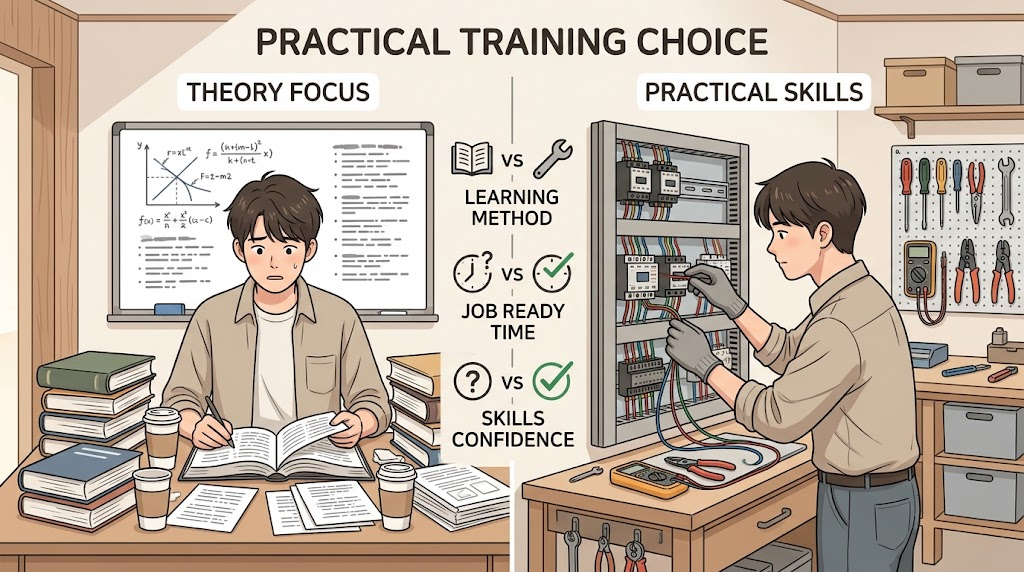
Certifications focused on theoretical memorization still require retraining upon starting work, whereas courses where equipment operation and project practice account for 70 to 80% or more allow immediate field deployment after completion, making them highly favored in the hiring market. Here are major promising fields that can be learned with full or high support through government subsidies (such as National Core and Strategic Industry Occupations Training and K-Digital Training).
① Technology & Engineering: Industrial Facilities and Automation
This is a field where practical skill in operating equipment determines passing, making it the most suitable path for using government funds to access an academy’s training infrastructure (tools, wiring panels, welding booths, etc.).
- Craftsman Electricity / Industrial Engineer Electricity
- Practice essentials: Sequence circuit diagram interpretation, wiring/piping board practice, multimeter and control panel wiring
- Career fields: Apartment and building facility management, smart factory process control, renewable energy facility construction
- Craftsman Special Welding / Industrial Facilities
- Practice essentials: TIG (argon) welding, CO2 welding, pipe butt welding, and training to satisfy non-destructive testing (NDT) criteria
- Career fields: Shipyard plants, construction piping, semiconductor piping construction, precision machine manufacturing
- Craftsman Air-Conditioning and Refrigerating Machinery / Air-Conditioning Facilities
- Practice essentials: Copper pipe work (expansion, bending, brazing), operating refrigerant recovery/charging units, configuring refrigerator control circuits
- Career fields: HVAC equipment engineer, operating large distribution center refrigeration facilities, HVAC installation contractors
② IT & Software: Project-Based Practical Work
This is a portfolio-focused track where students design and deploy real service architectures rather than merely memorizing syntax.
- Cloud Infrastructure Operations & Security Engineer (Linked with AWS / Network Administrator / CCNA)
- Practice essentials: Linux server setup, virtualized environment (Docker/Kubernetes) deployment, network traffic control, and firewall configuration
- Career fields: Cloud MSP companies, system operations (SM), security operations centers
- Big Data Analytics & AI Service Development (Linked with Big Data Analysis Engineer / SQLD)
- Practice essentials: Python data preprocessing, machine learning/deep learning model pipeline construction, web dashboard visualization
- Career fields: Data engineering, business analysis (BA), AI solution development firms
③ Design, Content & Drafting: Mastering Production Tools and Creating Deliverables
The core focus is repeatedly practicing standard industry tools and building an employment portfolio.
- Mechanical Design (CAD / 3D Inventor / CATIA) & CAM Machining
- Practice essentials: 2D drawing interpretation, 3D part modeling, CNC/MCT machine tool processing simulation
- Career fields: Automotive parts design, mold making, automated equipment design
- Video Editing & Motion Graphics (Premiere / After Effects)
- Practice essentials: Cut editing pacing, 2D motion graphics, color correction (LUT), short-form and commercial video packaging
- Career fields: Media agencies, in-house marketing video teams, YouTube production studios
④ Services, Food & Beauty: Manual Skill-Intensive Occupations
These specialized hand-skill courses lead directly to entrepreneurship, low-capital freelancing, and specialized service professions.
- Confectionery & Baking / Craftsman Cook (Korean / Western Cuisine)
- Practice essentials: Ingredient scaling by standard, dough fermentation and oven temperature control, standardized plating within time limits
- Career fields: Bakery cafes, hotel culinary departments, food manufacturing, and institutional catering
- National Technical Qualification in Skin Care / Nail Art
- Practice essentials: Deep cleansing, manual techniques, gel nail art techniques, hygiene management compliance training
- Career fields: Aesthetic clinics, nail salon employment, and solo beauty salon startups
| Job Track | Recommended Certifications & Core Skills | Practice Method and Characteristics | Career Direction |
|---|---|---|---|
| Tech & Engineering | Craftsman Electricity, Special Welding, HVAC Refrigeration | Work panel wiring, hands-on equipment operation, repetitive welding beads | Facility management, plant construction, manufacturing automation |
| IT & Development | Network Administrator, SQLD, Big Data Analysis Engineer | Team-based system building, cloud deployment practice | Cloud engineer, data analyst |
| Design & Drafting | Mechanical Design (CAD/Inventor), Video Editing | Drawing reverse engineering, 3D modeling, portfolio deliverables | Equipment design teams, content agencies |
| Services & Beauty | Baking & Pastry, Craftsman Cook, Nail/Skin Care | Recipe demonstrations in every session and manual technique training | Food franchises, beauty salons, local startups |
Would you also like me to summarize filter setup methods on the Vocational Training Portal (HRD-Net) to help you pick academies with high proportions of real hands-on practice?

How to Select ‘Truly Practice-Oriented Courses’ on the Vocational Training Portal (HRD-Net)
While thousands of training courses are listed on HRD-Net, quite a few are conducted primarily as theory lectures even when their titles include words like “Practical” or “Project.” To avoid regret after enrolling, you must examine portal details and schedules thoroughly.
① Download Timetable (Curriculum) and Compare ‘Practice Hours per Subject’
The most reliable verification method is to directly open the ‘Training Course Operation Plan’ and ‘Detailed Timetable’ attached to the course details page.
- Check NCS competency units: See how the training hours listed next to each subject title are divided between ‘Theory (Knowledge)’ and ‘Practice (Skill/Performance Evaluation)’.
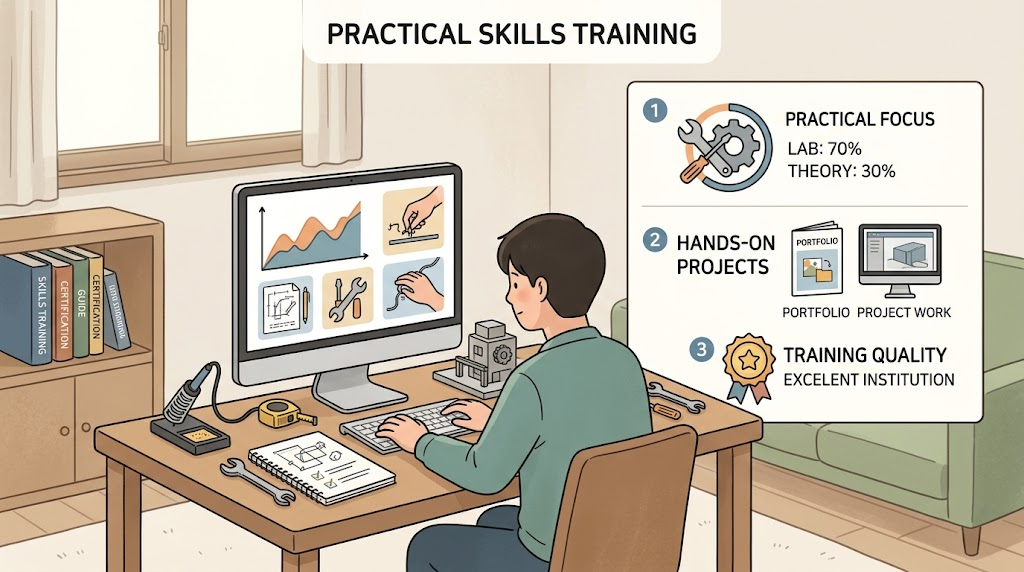
- Look for a 70% or higher practice ratio: True hands-on courses allocate at least 60 to 70% of total training time to practical training.
- Check project/capstone design time: For IT, design, and drafting courses, verify whether separate, dedicated blocks of 100 hours or more are allocated in the latter half for ‘Industry-Linked Projects’ or ‘Portfolio Creation Practice’.
② Check Training Institution Evaluation Grades (Excellent Institution Mark)
The Ministry of Employment and Labor and the Korea Skills Quality Authority comprehensively assess employment rates, completion rates, trainee satisfaction, and facility/equipment infrastructure every year to grant institution certification grades.
- Verify certification marks: Look for badges next to the academy’s name such as ‘Excellent Training Institution (3-Year/5-Year Certification)’ or ‘Best Vocational Training Institution (BHA)’.
- Be cautious with new institutions: Institutions with deferred certification or 1-year certification may have relatively unverified equipment setup in practice labs or instructor feedback know-how, so an in-person site visit is recommended.
③ Look Up Facility and Equipment Lists (Check 1-to-1 Practice Environment)
Opening the [Training Facilities/Equipment] tab on the course detail page displays the list and quantity of equipment held by the institution.
- Compare equipment count against class capacity: If the capacity is 20 students but major practice equipment (PLC control panels, welding machines, high-spec PCs, etc.) only numbers 5 to 10 units, classes will run in groups of 2 to 4, significantly reducing individual practice time.
- Check the 1-unit-per-person principle: To acquire skills thoroughly, verify whether at least 1 workboard or 1 practice kit per person is guaranteed.
④ Filter Negative Keywords in the ‘Course Reviews’ Tab
Rather than relying solely on review ratings (star scores), reading specific text reviews left by trainees reveals the actual state of the practice environment.
- Complaint keywords to look out for: It is safer to avoid academies where reviews frequently mention things like “Equipment breaks down often,” “Could not practice much because materials ran short,” “The instructor only showed the screen and told us to follow along,” or “Too much self-study time.”
- Positive indicators: Places with many reviews stating “Provided meticulous 1-on-1 portfolio feedback” or “Practice rooms were kept open outside of class hours for practice” are advantageous for building practical skills.
| Review Item | Verification Location | Key Criteria |
|---|---|---|
| Practice Hours | Course Operation Plan / Timetable file | 70% or more of total hours dedicated to practice |
| Institution Grade | Course title and academy info section | Presence of 3-Year / 5-Year Excellent Training Institution certification badge |
| Equipment Infrastructure | Course Details > [Facilities/Equipment] tab | 1 piece of equipment per student relative to class capacity |
| Review Analysis | Course Details > [Reviews] tab | Feedback regarding aging equipment and support for practice materials |

Registration Procedures and Precautions for Government-Funded Practical Courses
Once you find the practice-focused course you want, you should complete the enrollment steps in order according to the opening schedule. Long-term courses of 140 hours or more require scheduling with extra time, as Job Center consultation and diagnostic procedures can take 1 to 2 weeks or longer.
① 4-Step Registration Procedure
- Worknet Job Search Registration (Applicable to job seekers)
- To participate in fully funded courses or job-seeker tracks while unemployed, you must register a basic resume and self-introduction on Worknet and receive ‘Job Application’ approval.
- HRD-Net Video Viewing and Diagnosis/Consultation
- Watch the introductory training video for Tomorrow Learning Card issuance on the Vocational Training Portal (HRD-Net).
- For courses of 140 hours or more, you must receive approval for ‘training necessity’ through a visit to your local Job Center or an online diagnosis/consultation before you can enroll. (Courses under 140 hours allow immediate enrollment on HRD-Net)
- Preliminary Consultation and Level Testing with the Training Institution (Academy)
- Practice-oriented courses (especially IT bootcamps, mechanical design, electricity, etc.) often include internal interviews, basic knowledge tests, or preliminary interviews conducted by the institution.
- At this stage, visiting in person to check the actual practice room environment, individual equipment layout, and the quality of portfolio output is recommended.
- Course Registration Confirmation and Copayment Settlement
- Once you are selected and course confirmation is processed on HRD-Net, final registration is completed by paying the self-pay amount (if applicable) with your issued Tomorrow Learning Card (Shinhan/NH Nonghyup debit or credit card).
② Precautions to Observe During Course Attendance
- Penalty regulations for attendance below 80%
- You must attend at least 80% of total training days (or training hours) to qualify for course completion.
- Dropping out or being expelled incurs disadvantages, including deductions from your Tomorrow Learning Card balance (200,000 won for 1st occurrence, 500,000 won for 2nd, and 1,000,000 won for 3rd) and card usage suspensions for a specified period.
- Cumulative management of tardiness, early departure, and outings
- Every 3 instances of tardiness, early departure, or outing are counted as 1 absence.
- Attendance must be checked personally every day using the HRD-Net app (beacon/QR code) or fingerprint scanner, and failing to check due to personal negligence may be counted as an absence.
- Checking whether practice material/supply fees are billed separately
- Fully funded government courses, such as National Core and Strategic Industry Occupations Training or K-Digital Training (KDT), include practice material costs and textbook fees in principle.
- However, some institutions require personal purchases for select consumable items, such as specialized baking tools, individual beauty/cosmetology sanitation tool sets, or welding protective gear; therefore, you should verify the required supplies list and additional costs with the academy before enrolling.
- Checking eligibility criteria for training allowances
- Taking a course of 140 hours or more with an attendance rate of 80% or higher per unit period qualifies you for a training allowance of up to 116,000 won per month (varies by condition).
- However, you will be excluded from receiving this allowance if you are receiving unemployment benefits or earn earned income above a certain threshold, so check your eligibility in advance.
| Step / Category | Key Checkpoints | Precautions |
|---|---|---|
| Preliminary Steps | Worknet job search registration, Job Center diagnostic consultation | Long-term courses require at least 1–2 weeks for approval |
| Academy Consultation | Inspect actual equipment condition, prepare for interview/test | Check whether 1 unit of practice equipment per person is guaranteed |
| Attendance Management | Maintain 80% or higher attendance (3 tardies/early departures = 1 absence) | Penalty deductions from card balance upon dropping out |
| Incidental Costs | Inclusion of personal tools, textbooks, practice consumable fees | Advance inquiry with the academy is essential |
Would you also like me to draft an epilogue (closing) paragraph to smoothly conclude the entire article?
Korean version: 한국어로 읽기