
The 3 Main Types of Youth Rental Housing at a Glance
When you open an announcement to look into youth rental housing for the first time, it is easy to feel overwhelmed by unfamiliar terms and complicated types.
However, the basic framework is simple. The programs that young people apply for most frequently and that offer substantial benefits are divided into three types: ① Happy Housing, ② Youth Purchased Rental Housing, and ③ Youth Jeonse Rental Housing. It is important to select the right program suited to your living sphere, financial situation, and lifestyle for independence.
- Happy Housing: Pleasant New Large Complexes Centered Around Transit Stations
Happy Housing is public rental housing supplied near transit stations with convenient public transportation, university neighborhoods, or areas close to workplaces to ensure housing stability for university students, young professionals entering the workforce, and youth.
- Housing characteristics: Many are built in the form of large apartment complexes or mixed-use residential-commercial buildings, offering excellent residential comfort and community amenities (libraries, fitness centers, etc.).
- Rent level: Set at around 60% to 80% of surrounding market prices.
- Recommended for: Young people who prefer station-area infrastructure that makes commuting to work or school easy, as well as an apartment complex living environment.
- Residency period: Basically 6 years for the youth group (extendable up to a maximum of 10 years depending on employment and marriage status).
- Youth Purchased Rental Housing: Urban Living Without Worrying About Appliances or Furniture
Purchased rental housing is a method where public agencies such as LH (Korea Land and Housing Corporation) or SH (Seoul Housing & Communities Corporation) purchase existing newly built multi-unit houses, multi-family homes, and officetels in urban centers and re-lease them to youth at rates below market prices.
- Housing characteristics: Many come fully furnished with essential appliances and furniture, including a refrigerator, washing machine, air conditioner, and cooktop, substantially reducing initial moving-out costs (appliance purchase expenses).
- Rent level: At 40% to 50% of surrounding market prices (based on Priority 1), representing the lowest monthly housing cost burden among the three main types.
- Recommended for: People preparing for single independence who find the cost of purchasing home appliances and furniture burdensome, and those looking for urban villas or officetels available for immediate move-in.
- Residency period: Up to 6 years (extended in 2-year increments upon meeting renewal requirements).
- Youth Jeonse Rental Housing: Customized Support Where You Find and Contract Your Own Desired Home
While Happy Housing and Purchased Rental involve moving into designated housing, Jeonse Rental Housing is a program where applicants find the home they want directly on the private market. Once a young applicant selected as a beneficiary locates a jeonse rental home, a public corporation (LH, SH, etc.) signs the jeonse contract with the homeowner and re-leases it to the young person at a low interest rate.
- Housing characteristics: You are not tied to a specific complex and have the freedom to directly choose your desired neighborhood and housing type (studio, two-room, officetel, etc.).
- Support and interest rates: Supported within the jeonse deposit support limit (up to around 120 million KRW for single occupancy in the Seoul metropolitan area), and you only pay a low annual interest rate of around 1% to 2% on the supported amount as monthly rent.
- Recommended for: People with a clear preference for a specific neighborhood, or those for whom the locations of publicly provided housing do not fit their daily living radius.
- Points to note: The property must meet the jeonse rental support criteria (collateral mortgage ratio, designated usage on the building ledger, etc.), and the landlord must agree to an LH contract, which requires legwork to search for properties.
[Key Summary] Comparison of the 3 Main Youth Rental Housing Types at a Glance
| Category | Happy Housing | Youth Purchased Rental Housing | Youth Jeonse Rental Housing |
|---|---|---|---|
| Supply Method | Construction of new apartment/mixed-use residential-commercial complexes | Purchase of multi-unit houses/officetels in urban areas | Tenants directly search for private jeonse homes |
| Rent Level | 60–80% of market price | 40–50% of market price (Priority 1 basis) | Jeonse deposit supported; annual 1–2% interest paid |
| Biggest Advantage | Station-adjacent location, excellent housing infrastructure | Fully furnished (refrigerator, washing machine, etc.) | Wide range of choices for living area and home type |
| Key Point | Relatively high competition rate for move-in | Must check supply complexes within daily living radius | Requires directly finding properties that meet LH support criteria |
Shall we continue with drafting the next stage of content?

Am I Eligible to Apply? Checklist for 3 Key Requirements
When an announcement for youth rental housing is posted, it is easy to give up before even starting due to dozens of pages of detailed requirements.
However, regardless of the specific type (Happy Housing, Purchased Rental, Jeonse Rental), the criteria determining acceptance or rejection are common across the board. Here is a summary of the 3 key requirements (age and marital status, income standards, assets and vehicle value) that you must self-diagnose before applying for a subscription.
- Age, Non-Homeownership, and Marital Status Requirements: “Unmarried, Non-Homeowner Aged 19 to 39”
This is the most fundamental personal qualification requirement.
- Age requirement: Young people aged 19 to 39 as of the announcement date (for university students or job seekers, there are types that allow applications even if over age 39 provided separate conditions are met).
- Marital status: Must currently be unmarried (married individuals should apply under the ‘Newlywed Couples / Single-Parent Families’ category).
- Non-homeownership requirement:
- You must not own a home or pre-sale housing rights under your own name.
- However, for the youth group, there are many types (Happy Housing youth group, Youth Purchased Rental 2nd and 3rd priorities, etc.) where you can apply as long as you do not own a home yourself, even if your parents own a home; therefore, there is no need to give up beforehand simply because your parents own a residence.
- Income Standards: “Applicant Alone vs. Combined with Parents (The Key to Priority Ranking)”
The most decisive criterion dividing rental housing eligibility and chances of selection is the average monthly income per household by number of household members for urban workers in the preceding year.
In the youth category, priority is determined by “whose income is combined” during income calculation.
- Youth Purchased Rental Housing Priority System:
- Priority 1: Basic livelihood, housing, or medical benefit recipient households, near-poverty groups, single-parent families, etc.
- Priority 2: Those whose combined monthly average income of self and parents is 100% or less, and who meet the asset criteria for national rental housing
- Priority 3: Those whose individual income alone is 100% or less regardless of parents’ income (eligible to apply based solely on applicant’s income criteria even if parents’ income is high)
- Happy Housing Income System:
- 100% or less of the average monthly income based on household members (or single householder) (an eased addition criteria applies: +20%p for 1-person households, +10%p for 2-person households).
- Because applicants are classified into ‘young professionals (with income)’ and ‘university students/job seekers (without income)’ depending on income-generating activities, you must verify your documentation status in advance.
💡 Tip: For freelancers or part-time workers, income is calculated based on recent comprehensive income tax filings with the National Tax Service or National Health Insurance premium assessment records.
- Total Assets and Vehicle Value: “The Most Frequent Pitfall for Disqualification”
Even if you meet the income requirements, exceeding the asset or vehicle standards will result in disqualification.
- Total asset criteria:
- Calculated by deducting liabilities from the combined sum of financial assets (savings, installment deposits, stocks), real estate, automobiles, etc.
- The youth group usually has a standard of around 270 million to 300 million KRW in individual assets (varies by announcement).
- Vehicle value criteria (Key cautionary point):
- The youth category strictly restricts vehicle ownership itself or only permits vehicles valued below a benchmark value (around 37 million KRW).
- For university students and job seekers, non-ownership of a vehicle is often a fundamental requirement in principle (excluding certain exceptions such as vehicles for livelihood or for persons with disabilities).
- Not only vehicles owned solely under your name, but even partial joint-ownership shares may result in the full vehicle value being counted toward assets, so you must review deregistration or transfer of ownership beforehand.
[Self-Check] Self-Diagnosis Table for Youth Rental Housing Eligibility
| Verification Item | Mandatory Checklist Details | Self-Diagnosis Result |
|---|---|---|
| Age / Marital Status | Aged 19–39 & Unmarried status | [ ] Eligible / [ ] Ineligible |
| Home Ownership | Non-ownership of home or pre-sale housing rights under own name | [ ] Non-homeowner / [ ] Homeowner |
| Income Level | Applicant (or household) income relative to urban workers’ average monthly income of preceding year | [ ] 100% or less / [ ] Exceeds |
| Asset Scale | Whether (Financial Assets + Real Estate – Liabilities) is within the asset threshold | [ ] Met / [ ] Exceeds |
| Vehicle Ownership | Whether non-ownership conditions are met or vehicle value meets criteria | [ ] Met / [ ] Exceeds criteria |
Shall we continue with drafting the next stage of content?
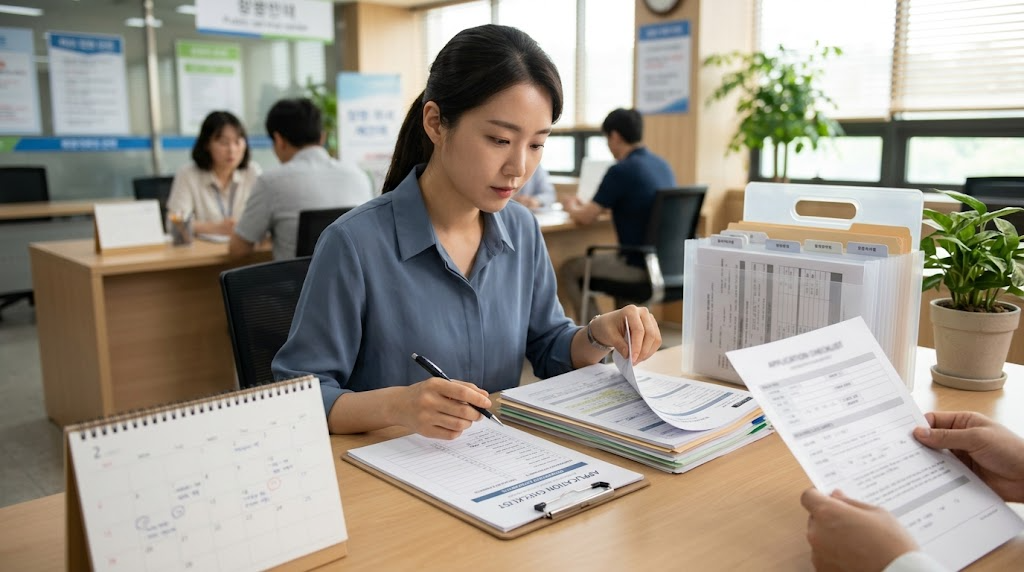
Comprehensive Overview of Linked Financial Benefits to Reduce Deposit and Monthly Rent Burdens
After receiving a notification of selection for rental housing, practical concerns begin. Namely: “How will I prepare the move-in deposit and recurring monthly rent?”
Taking out general jeonse loans or credit loans from commercial banks without planning can cut the cost-saving benefits of public rental housing in half due to high interest rates. Because the government and local municipalities operate low-interest policy loans along with direct monthly rent subsidy programs for young people, you should actively link these programs to minimize your housing costs.
- Youth-Exclusive Beotimmok Jeonse Loan: “Resolving Up to 80% of the Deposit at Low Interest Rates”
This is a representative youth jeonse loan product supported by the Housing and Urban Fund, most frequently used to arrange move-in deposits for rental housing (Happy Housing, Youth Purchased Rental, etc.).
- Target recipients: Non-homeowner single householders (including prospective householders) aged 19 to 34, annual income of 50 million KRW or less (75 million KRW or less for certain exceptions such as newlywed households), net assets of 345 million KRW or less.
- Loan limit: Up to 200 million KRW (within 80% of the lease deposit).
- Applicable interest rate: Low fixed or variable interest rates at 2.0% to 3.1% per year depending on annual income and deposit brackets.
- Practical tip (Linking with converted deposits):
- Rental housing operates a ‘mutual conversion system (converted deposit)’ that raises the base deposit to lower the monthly rent.
- Because the rent reduction rate from paying additional converted deposit (usually 6% to 7% per year) is much higher than the Beotimmok loan interest rate (2% range per year), it is most advantageous to maximize the Beotimmok loan to raise the deposit to the maximum and minimize monthly rent.
- Jeonse and Monthly Rent Deposit Loan for Youth Employed at Small and Medium Enterprises (SMEs): “A Customized Product for Working Youth”
This is a product that early-career professionals employed at SMEs or middle-market enterprises, or those who have received youth startup support, must examine.
- Target recipients: Aged 19 to 34, employees of SMEs or middle-market enterprises (annual income of 35 million KRW or less for single householders, 50 million KRW or less for couples combined), non-homeowners.
- Loan limit: Up to 100 million KRW (within 100% or 80% of the lease deposit).
- Applicable interest rate: 1.5% fixed interest rate per year (applied for initial 2 years; maintained at same rate for 1 extension, after which it converts to the standard Beotimmok interest rate).
- Characteristics and points to note: Although it is one of the lowest-interest loans on the market, documents verifying the employer’s business registration certificate and industry type (excluding entertainment services, non-profit corporations, etc.) are strictly required, so you must check your eligibility on the Gigeum e-Deundeun site in advance.
- Special Youth Monthly Rent Support & Local Government Monthly Rent Support: “Monthly Rent Returned in Cash”
While loans solve large lump-sum deposit needs, monthly rent going out as fixed expenses can be offset by central and local government monthly rent support programs.
- Central Government Special Youth Monthly Rent Support:
- Support details: Paid in installments of up to 200,000 KRW per month from actual rent paid, for up to 12 months (or 24 months depending on program round criteria) (equivalent to up to 2.4 million–4.8 million KRW).
- Eligibility criteria: Unmarried non-homeowner youth aged 19 to 34 living separately from parents, youth household median income 60% or less & original household median income 100% or less.
- Applicability to rental housing: Residents of public rental housing can also apply if they bear actual monthly rent and satisfy income and property criteria.
- Local Government Youth Housing Cost Support (Seoul Youth Monthly Rent Support, etc.):
- Municipalities such as Seoul and Gyeonggi-do provide housing cost support of around 200,000 KRW per month through announcements 1 to 2 times a year, separately from central government initiatives.
- Because duplicate benefits with central government support are restricted, you should compare your income criteria and payment periods to apply for the more advantageous option.
[Key Summary] Comparison of Youth Housing Financial Support Benefits
| Financial Support Program | Youth-Exclusive Beotimmok Jeonse Fund | SME Youth Loan | Special Youth Monthly Rent Support |
|---|---|---|---|
| Support Type | Low-interest deposit loan | Ultra-low-interest deposit loan | Monthly rent cash support (subsidy) |
| Support Limit | Up to 200 million KRW (80% of deposit) | Up to 100 million KRW (80% / 100%) | Up to 200,000 KRW per month (up to 12–24 months) |
| Applied Interest Rate / Cost | 2.0% – 3.1% per year | 1.5% fixed interest rate per year | Interest-free (grant-type subsidy) |
| Major Requirements | Youth with annual income of 50 million KRW or less | SME/middle-market employees (annual 35 million KRW) | Median income 60% or less (original household 100%) |
| Recommended Usage | Deposits exceeding 100 million KRW and converted deposit utilization | Solving initial deposits for early-career SME workers | Deducting recurring out-of-pocket monthly rent costs |
Shall we continue with drafting the next stage of content?
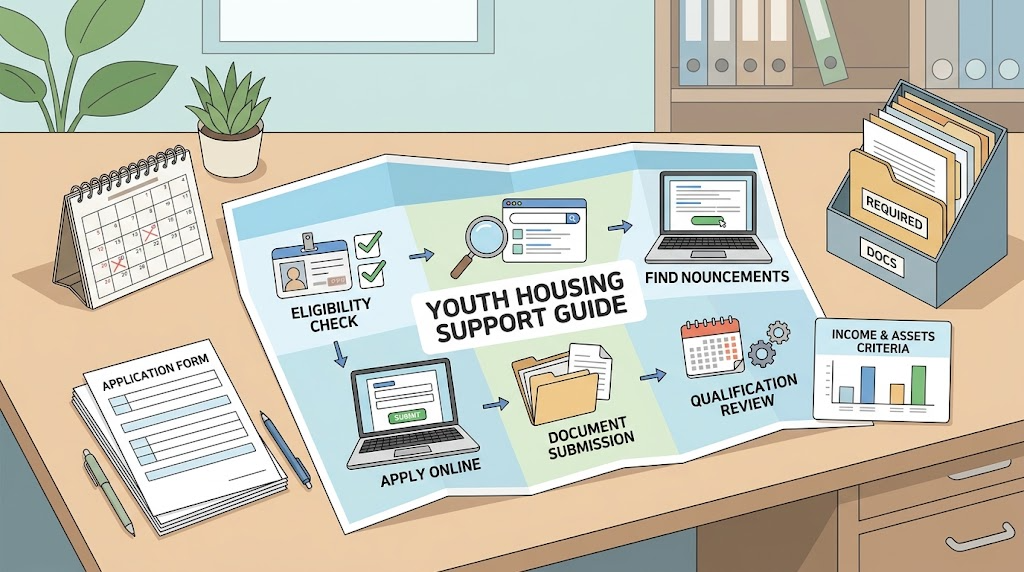
Practical Guide! Step-by-Step Flow for Checking Youth Rental Housing Announcements and Applying for Subscriptions
For youth rental housing (Happy Housing, Youth Purchased Rental, Youth Jeonse Rental, etc.), preparing only after an announcement is published can leave you rushed by document issuance and eligibility verification schedules. Here is the practical progression sequence from announcement search to designated move-in date.
1
Setting Up Customized Platform Notifications and Searching Announcements
Recommended to check regular weekly updates
Major platforms: Access LH Apply Plus, SH Seoul Housing & Communities Corporation, GH Gyeonggi Housing & Urban Corporation, and local urban corporation websites/apps for your desired area of residence
Setting notifications: Register push notifications for ‘Areas of Interest Notification Service’ and ‘Rental Type (Youth Purchased, Happy Housing)’ on each platform’s mobile app
Utilizing integrated portal: Identify recruitment types matching your income and asset brackets in advance via the ‘My Home (myhome.go.kr)’ self-diagnosis service
2
Thorough Analysis of the Tenant Recruitment Announcement
Eligibility requirements determined as of announcement date
Checking baseline date: Age (19 to 39 years), non-homeowner status, and income/asset standards are evaluated strictly based on the day of the ‘Recruitment Announcement Date’
Checking supply type and priority: Confirm priority (Priority 1, 2, or 3) based on single householder status, parents’ homeownership status, and combined income of applicant and parents
Calculating additional point items: Check continuous residence period in the relevant local government area, number of Housing Subscription Savings payments, and bonus points for vulnerable groups
3
Internet/Mobile Subscription Submission
Joint certificate or simple authentication required
Where to submit: Access LH Apply Plus or the relevant urban corporation subscription system
Selecting housing type: Check exclusive area (16㎡, 26㎡, 36㎡, etc.) and building/unit assignment method, then select desired complex/type
Entering information: Enter applicant personal details, family relationships, subscription savings account bank information, and number of payments (incorrect entries cause disqualification, so enter strictly according to the announcement)
Keeping receipt: Capture and store the receipt number and submission details issued after completing application
4
Announcement of Document Submission Candidates and Document Submission
Submit via registered mail or online within 3 to 5 days after announcement
Confirming candidate status: Check candidate announcement for ‘eligibility verification candidates’, not confirmed selectees
Issuing mandatory common documents (Gov24 and Electronic Family Relation Registration System):
Resident Registration Certificate / Abstract (including past address change history and all digits of Resident Registration Number)
Family Relations Certificate (detailed certificate basis)
Consent Form for Personal Information Collection, Use, and Provision to Third Parties (designated form)
Additional documents by type: Certificate of Income Amount, Health Insurance Eligibility Confirmation, Certificate of Enrollment, or Health Insurance Payment Confirmation
Submission method: Send via registered mail within designated deadline (heed post office postmark validity date) or upload scanned PDF files on the platform
5
Income/Asset Explanation and Final Announcement of Winners
File an objection within designated deadline if notified of disqualification
Social Security Information System verification: Electronic verification of financial assets, vehicle values, and real estate ownership of applicant and household members
Explanation procedure: If notified as disqualified, submit explanatory documentation (proof of scrapping relevant vehicle, proof of sale, student loan documents, etc.) within 7 to 14 days
Final announcement: Check winner list and waitlist ranking sequence
6
Signing Electronic Contract and Preparing Deposit
Utilize Real Estate Electronic Contracting System
Contract signing: Online digital signature via the Ministry of Land, Infrastructure and Transport’s ‘Real Estate Electronic Contracting System’ or on-site contract execution
Contract deposit payment: Deposit 10% of lease deposit (or designated flat amount) into virtual account
Loan linkage: After obtaining a fixed date (Hwakjeong-ilja) on the contract, apply for Youth Beotimmok Jeonse Loan or KakaoBank/commercial bank youth jeonse loan screening via Gigeum e-Deundeun
7
Paying Balance and Moving In
Complete within designated move-in period of 30 to 60 days
Executing loan and paying balance: Pay off remaining rental deposit in full on loan execution date
Paying maintenance fee deposit and receiving keys: Visit management office and complete facility inspection checklist
Moving-in notification (Jeonip-singo): Complete moving-in notification via Gov24 or local community center on moving day to secure opposing power (legal protection)
Blog Writing Tips & Reader Checkpoints
Priority 1 competition tip: Highlighting that even if registered separately from parents, announcements looking at ‘combined parental income’ (Youth Purchased Rental) and announcements looking only at ‘applicant’s individual income’ (Happy Housing youth category) differ depending on youth-only types will increase dwell time.
Document validity period: All certificates must be issued after the announcement date, and all 13 digits of the Resident Registration Number must be displayed to prevent disqualification.
If you need additional components for a blog posting, please make a selection:
Generate 5 search engine optimization (SEO) title candidates for blog
Create a document preparation checklist table to insert in body text

Real-Life Winning Tips from Seniors to Boost Acceptance Chances (Q&A)
Youth rental housing is not a simple random draw; selection is determined by priority ranking, additional points, and detailed criteria by type. Here is a compilation of practical winning strategies derived commonly from subscription communities and actual winner data in a Q&A format.
Q1. I qualify for Priority 2 or 3 rather than Priority 1. Is there realistically a chance of winning?
A. Yes, it is entirely possible if you target strategically according to region and housing supply volume.
Popular, highly accessible station areas (Gangnam, Mapo, Yeongdeungpo, etc.) or large Happy Housing complexes mostly see lotteries held among top-point earners even within Priority 1. However, targeting niche openings opens up opportunities for Priority 2 and 3 applicants as well.
- Outer Seoul metropolitan area and large simultaneous supply complexes: In new towns where move-in supply pours out in large quantities at once (Yangju, Paju Unjeong, Hwaseong Dongtan, Namyangju Wangsuk, etc.), remaining units frequently carry over to Priority 2 and 3 even after Priority 1 applications.
- Less preferred floor plans (ultra-compact areas): Units with an exclusive area of 16㎡–21㎡ (studio type) face noticeably lower competition than those of 36㎡ or more (two-room type). Winning first to secure housing stability and then aiming for the next subscription is a valid stepping-stone strategy.
- Targeting waitlist numbers: Rental housing sees a dropout rate of 30–40% due to failure to submit documents, income/asset disqualifications, or simple contract waivers. Securing a high waitlist number in Priority 2 or 3 often brings your turn within 6 months to 1 year.
Q2. Are the number of subscription account payments and recognized amounts as important in rental housing as in general sales housing?
A. Unlike public sales housing, meeting only the upper threshold for the ‘number of payments’ is sufficient for rental housing.
While general public sales housing favors having hundreds of monthly payments of 100,000 KRW to reach a high total recognized amount, the point-scoring criteria for youth rental housing (Happy Housing, Youth Purchased Rental) are much simpler.
- Upper point limit criteria: Most announcements award full points (3 points) when 2 years have elapsed since opening a subscription savings account and 24 or more payments have been made.
- Cautionary note: Whether the balance is 10 million KRW or 2.4 million KRW, satisfying the 24-payment condition earns an equal perfect score. Rather than the size of the recognized amount, the key is ‘whether you completed 24 recognized installments prior to the announcement date’.
- Account depletion status: Even if you win, move into rental housing, and sign a contract, your subscription account does not lose validity and remains active. You can use it as-is for future general sales housing or other public rental subscriptions.
Q3. Between ‘Youth Purchased Rental’ and ‘Happy Housing’, which offers a higher winning probability?
A. The advantageous category divides completely depending on parents’ income and homeownership status.
| Category | Youth Purchased Rental Housing | Happy Housing (Youth Group) |
|---|---|---|
| Income Evaluation Standard | Evaluated based on combined income of applicant + parents | Evaluated based on applicant’s individual income (parents’ income not factored in) |
| Parents’ Homeownership | Parents must not own a home when applying for Priority 1 | Parents’ homeownership irrelevant (eligible as long as applicant is non-homeowner) |
| Advantaged Group | Youth whose parents have low income/assets and do not own a home | Independent youth whose parents own a home or have high income |
| Housing Type | Purchased new officetels/studios near stations (mostly fully furnished) | Large apartment complexes (high proportion without furnishings) |
- Strategic judgment: If your parents own their home or have high combined income due to dual incomes, Priority 1 for Purchased Rental is impossible; therefore, focusing on the Happy Housing youth group—which looks solely at your individual income—is the way to maximize your winning probability.
Q4. What is the ‘unexpected winning cheat key’ mentioned by past winners?
A. Catching the ‘existing housing rolling announcements’ and ‘vacant housing tenant recruitment’ that recruit year-round.
Regular large-scale announcements attract tens of thousands of applicants through media coverage and social media, recording competition ratios of hundreds to one. In contrast, experienced applicants monitor the following announcements weekly.
- Tenant recruitment with relaxed qualifications: For remaining uncontracted households after regular recruitment across Priorities 1, 2, and 3, income standards are relaxed from 100% to 120–150%, and parental homeownership or regional restrictions are completely lifted to select tenants on a first-come, first-served basis or via random draw.
- Rolling waitlist recruitment: Filtering by keywords such as ‘first-come, first-served’, ‘unit designation’, and ‘relaxed qualifications’ in the LH Apply Plus sales/rental announcement category allows you to target rolling announcements for immediate contracting without competition.
Please select if you need additional components for your blog posting:
Korean version: 한국어로 읽기