
Core Basic Pension Eligibility: Age, Nationality, and Recognized Income Criteria
The Basic Pension is a representative public pension system introduced to support a stable livelihood for seniors with vulnerable post-retirement security. It is paid to seniors aged 65 and older who belong to the lower 70% income bracket, and the core eligibility requirements that must be met before applying are largely divided into age, nationality, and residence requirements, as well as recognized income criteria by household type.
- Basic Demographic Requirements (Age, Nationality, Residence)
- Age requirement: Age 65 or older
- Advance application is available starting 1 month before the month containing your birthday (the 1st day of the previous month). (e.g., For someone with an October birthday, application is available starting September 1st)
- Nationality and residence requirements: You must hold Republic of Korea nationality and reside (be registered as a resident) domestically under the Resident Registration Act.
- Among registered overseas Koreans, those who enter the country for the purpose of residing for 30 days or longer may be included under certain conditions, but if an overseas stay continues for 60 days or more, pension payments are temporarily suspended.
- Selection Standard Amount by Household Type (Lower 70% Income)
The Basic Pension does not merely evaluate salary or pension receipt amounts; it becomes payable when the ‘recognized income,’ calculated by combining owned assets and income, is at or below the selection standard amount officially announced by the Ministry of Health and Welfare.
| Household Type | Selection Standard Amount Requirement | Target Characteristics |
|---|---|---|
| Single-person Household | Recognized income is at or below the standard amount for single-person households | Seniors residing alone without a spouse |
| Couple Household | Combined recognized income of the couple is at or below the standard amount for couple households | Households with a spouse in a legal marriage or de facto marriage relationship |
Precautions When Checking Selection Standard Amounts
- Even if only one member of a couple is aged 65 or older, the couple household standard is mandatory upon application, and the income and assets of both spouses are evaluated jointly.
- Because the selection standard amount is newly announced at the beginning of each year (January) to reflect inflation rates and changes in seniors’ income and asset levels, it must be verified based on the officially announced amount for the application year.
- Exclusion Criteria for Occupational Pension (Civil Service, Military, Private School Teachers, etc.) Beneficiaries
Even if basic requirements are satisfied, beneficiaries of occupational pensions—such as the Civil Service Pension, Teachers’ Pension (Private School Teachers’ Pension), Military Pension, and Specially Designated Post Office Staff Pension—and their spouses are, in principle, excluded from Basic Pension eligibility.
- Exceptions Eligible for Recognition:
- Cases corresponding to statutory exceptions, such as recipients of occupational injury/disease compensation or individuals where a certain period has elapsed after receiving lump-sum payments
- Special cases partially recognized according to their own contribution period among beneficiaries of the Public Pension Linkage Retirement Pension
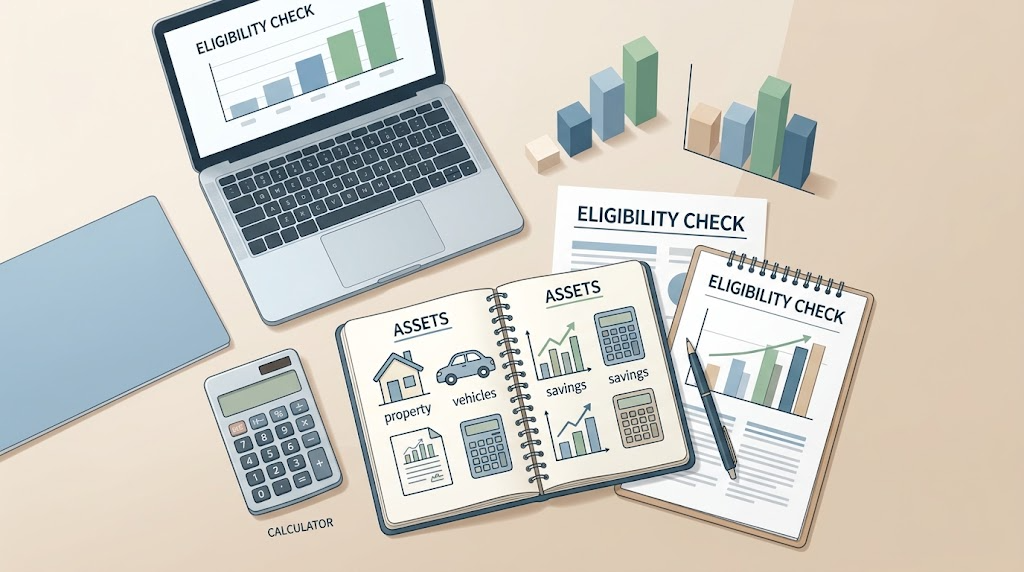
How Are My Assets Converted into Income? (Recognized Income Calculation Formula)
The core element determining Basic Pension eligibility is not merely the salary deposited into your bank account. The government comprehensively evaluates real estate, financial assets, vehicles, and other properties owned by the applicant, and calculates ‘recognized income’ by summing the evaluated income amount—which assumes that “possessing this amount of assets is equivalent to generating this much income each month”—and the monthly income conversion amount of assets.
Basic Pension Recognized Income Calculation Basic Formula
Recognized Income = Evaluated Income Amount + Asset Monthly Income Conversion Amount
- Income Evaluation Amount Calculation Method: Applying the Basic Deduction for Earned Income
Earned income, such as monthly salary or daily wages, is not reflected in full as is, and basic deduction and additional deduction benefits are applied to encourage the motivation to work.
Earned income evaluation formula:
Earned income evaluation amount = (Monthly earned income − Basic deduction amount) × (1 − 0.3)
The basic deduction (approximately around 1.1 million KRW, based on the public notification for the relevant year) is first deducted from monthly income.
From the remaining amount, an additional 30% is deducted again (reflecting only 70%) to calculate the final earned income evaluation amount.
Other income: Business income, financial income such as interest and dividends, and public pension receipts (National Pension, etc.) are, in principle, reflected at 100% without a separate basic deduction.
- Method for Calculating the Monthly Income Conversion Amount of Assets: Classification of 4 Core Assets
Owned real estate, financial assets, liabilities, etc., are converted into virtual income generated each month by applying an annual conversion rate of 4% according to the formula below.
Monthly income conversion amount of assets =
12 months
[(General assets − Basic asset amount) + (Financial assets − Basic deduction amount) − Liabilities] × 4%
+ P
(Provided that P = 100% monthly reflected portion of the value of luxury automobiles and memberships)
① General assets (Houses, buildings, land, etc.)
Evaluation standard: It is based on the standard market value (officially announced price) notified by the Ministry of Land, Infrastructure and Transport, not the market price.
Basic asset amount deduction (Differentiated by region): A certain amount is deducted by region for minimum housing stability.
Metropolitan cities (Special Cities, Metropolitan Cities, and ‘Gu’ districts): Deduction of approximately 135 million KRW
Medium and small cities (Cities under provincial jurisdiction, Sejong City, etc.): Deduction of approximately 85 million KRW
Rural areas (‘Gun’ unit areas): Deduction of approximately 72.5 million KRW
② Financial assets (Deposits, savings, stocks, insurance, etc.)
Evaluation standard: Based on the balance inquiry from banks and financial institutions.
Living preparation fund deduction: A basic deduction of 20 million KRW per household is applied.
Only the remaining amount after subtracting 20 million KRW from checking/savings accounts, time deposits/installment savings, mutual funds, insurance cash surrender values, etc., is added to the asset value.
③ Liabilities (Loans and rental deposits)
Loans from financial institutions (actual executed balance, not the limit of a minus bank account) and rental deposits (Jeonse deposit, etc.) are deducted from the combined total of general assets and financial assets.
However, private loans or borrowings between individuals are difficult to verify through official proof, making them hard to be recognized as liabilities.
④ Intensive management targets calculated as 100% full income (Item P)
This is an exceptional item where the entire value of the vehicle/membership is directly tied to monthly income without going through the general asset deduction or the 4% conversion rate.
Luxury automobiles: Passenger cars with an engine displacement of 3,000 cc or more, or a vehicle value of 40 million KRW or more (Provided that exceptions are recognized for vehicle age of 10 years or older, livelihood use, disability use, etc.)
Golf and condo memberships: The entire value is aggregated into monthly income, effectively becoming a cause for disqualification, making prior verification essential.
- Simple Calculation Example of Recognized Income (Senior Residing in a Metropolitan City)
Possession details: Residing in an apartment in Seoul with an officially announced price of 300 million KRW, holding 50 million KRW in bank deposits and 30 million KRW in loans
General asset recognized amount: 300 million KRW – 135 million KRW (Metropolitan city deduction) = 165 million KRW
Financial asset recognized amount: 50 million KRW – 20 million KRW (Living preparation fund deduction) = 30 million KRW
Total net assets: 165 million KRW + 30 million KRW – 30 million KRW (Liabilities) = 165 million KRW
Monthly income conversion amount: (165 million KRW × 4%) ÷ 12 = 550,000 KRW
If there is no other income, this senior’s final recognized income is calculated as 550,000 KRW per month, easily falling within the standard amount range for a single-person household.

How to Use the Bokjiro ‘Basic Pension Simulation’ Site (Step-by-Step Guide)
If it is difficult to calculate the complex formula directly, utilizing the ‘Basic Pension Simulation’ service provided by the Ministry of Health and Welfare’s welfare portal, Bokjiro, is the fastest and most accurate way. Without needing a separate joint certificate login, you can gauge eligibility in advance simply by entering a few pieces of basic information and asset details.
- Access Path for Bokjiro Simulation
- Access the Bokjiro official website (bokjiro.go.kr) or the mobile app.
- Sequentially select [Welfare Services] ➔ [Simulation] ➔ [Basic Pension] from the top menu.
- Click the ‘Start Simulation’ button at the bottom of the service guidance screen.
- Step-by-Step Entry Guide by Category
Step 1: Entering Basic Information
Household classification: Select whether it is a single-person household or a couple household with a spouse. (Even if only one member of the couple is aged 65 or older, you must select ‘Couple Household’ so that the combined assessment is accurately reflected.)
Residential area classification: Select one among Metropolitan City (Special City, Metropolitan City, ‘Gu’ district), Medium and Small City (City, Sejong City), and Rural Area (‘Gun’ district) matching your registered address. The basic property deduction amount will be automatically deducted accordingly.
Step 2: Entering Income Information
Earned income: Enter the monthly salary (pre-tax basis) of yourself and your spouse. The basic deduction (30% additional deduction after deducting 1.1 million KRW per month) is automatically calculated by the system.
Other income: Enter all business income (sales minus necessary expenses), financial income such as interest and dividends, and monthly public pension benefits such as the National Pension and Survivor Pension without omission.
Step 3: Entering Asset Details
General assets: Enter the standard market value (officially announced price by the Ministry of Land, Infrastructure and Transport), not the market price of owned houses, land, or buildings. If you are a Jeonse or monthly rent tenant, enter the deposit amount.
Financial assets: Enter the combined sum of checking/savings accounts, installment savings, stock valuations, and insurance surrender values for the couple. (The living preparation fund of 20 million KRW is automatically deducted.)
Liabilities: Enter loan balances from financial institutions (mortgage loans, credit loans, etc.) and rental deposits that must be returned to tenants as a lessor. (For minus bank accounts, based on the actual executed balance)
Automobiles and memberships: Enter luxury vehicles with an engine displacement of 3,000 cc or more or a value of 40 million KRW or more, or golf/condo memberships, if any.
- Interpretation of Simulation Results and Precautions
Checking results:
After entering all items and clicking ‘View Results’, the system compares the automatically calculated ‘recognized income’ with the ‘selection standard amount’ for the relevant year.
If the recognized income comes out below the selection standard amount, a notice stating “There is a possibility of being selected as an eligible recipient” is displayed.
Differences from actual screening:
The simulation is merely a simplified diagnosis based on figures entered directly by the user.
During actual application, discrepancies may occur between the simulation result and actual eligibility because National Tax Service income data, financial institution balances, and official register prices of land/buildings are automatically retrieved electronically through Haengbok-e-um (Social Security Information System).
Reduction Rules to Check Before Applying & Frequently Asked Questions (FAQ)
Even if selected as an eligible recipient of the Basic Pension, not all recipients receive the full officially announced standard pension amount. Because parts of the amount may be reduced depending on household type, receipt of public pensions, and income level, the following three core reduction systems must be checked when estimating the expected receipt amount.
- The 3 Major Reduction Systems That Reduce Receipt Amounts
Couple Reduction (20% reduction):
When both spouses receive the Basic Pension, a 20% deduction is applied to each calculated basic pension amount, taking into account equity with single-person households and living cost reductions resulting from living together.
For example, if the standard amount per person is around 330,000 KRW per month, about 264,000 KRW is paid per person during simultaneous receipt by a couple, making the combined receipt amount of the couple around 160% of the standard amount.
National Pension Linkage Reduction:
Linkage reduction may apply if you are receiving the National Pension (Old-Age Pension).
The Basic Pension is partially deducted if the monthly National Pension receipt amount exceeds 150% of the Basic Pension standard pension amount, or according to the formula based on the National Pension contribution period and the A-value (average monthly income of all National Pension insured persons). (However, no matter how much it is reduced, a level of 50% of the standard pension amount is guaranteed as the minimum floor.)
Income Reversal Prevention Reduction:
This is a mechanism to prevent income reversal between those who receive the Basic Pension and those who do not.
If your recognized income + Basic Pension amount exceeds the selection standard amount for the relevant year, the Basic Pension is reduced and paid by that excess amount.
- Frequently Asked Questions (FAQ)
Q1. Can I receive the Basic Pension even if my children are high-income earners or own multiple homes?
A. Yes, you can receive it. Unlike the past Basic Old-Age Pension era, the support obligor standard has been completely abolished for the Basic Pension. Children’s assets or income have no impact whatsoever on parents’ Basic Pension screening, and only the income and property of the applicant themselves and their spouse### Reduction Rules to Check Before Applying & Frequently Asked Questions (FAQ)
Even if selected as an eligible recipient of the Basic Pension, not all recipients receive the full officially announced standard pension amount. This is because there are 3 major reduction rules that partially reduce the payment amount depending on household type, income level, and whether other public pensions are received. We have organized the reduction requirements and key questions easily confused before applying.
- The 3 Major Reduction Systems of the Basic Pension You Must Know
Couple Reduction (20% reduction):
Applicable targets: When both spouses receive the Basic Pension
Details: Considering the living expenses (housing costs, cooking costs, etc.) saved when a couple lives together compared to a single-person household, each basic pension calculated amount is reduced by 20% and paid.
For instance, if the standard pension amount is at the level of 330,000 KRW, about 260,000 KRW each (with 20% reduced) is paid, totaling about 520,000 KRW combined for the couple.
National Pension Linkage Reduction:
Applicable targets: Beneficiaries whose monthly National Pension (Old-Age Pension) receipt amount exceeds 150% of the Basic Pension standard pension amount
Details: According to the A-benefit amount (the portion reflecting the average monthly income of all National Pension insured persons) calculated in proportion to the National Pension receipt amount and the National Pension contribution period, the Basic Pension can be differentially reduced by up to 50%. (However, recipients of Survivor Pension or Disability Pension are excluded from the linkage reduction targets.)
Income Reversal Prevention Reduction:
Applicable targets: Recipients whose recognized income is very close to the selection standard amount
Details: This is a mechanism to prevent the contradiction where, if the full Basic Pension were paid, the total income would actually reverse and become higher than the immediately superior bracket that cannot receive the Basic Pension (those exceeding the selection standard amount). The Basic Pension amount is partially reduced in a stepped manner matching the difference level with the selection standard amount and paid.
- Top 4 FAQs Asked Most by Actual Applicants
Q1. Can I be disqualified because of my children’s (sons/daughters) income or assets?
No. Unlike the National Basic Living Security System, the ‘support obligor standard’ has been completely abolished for the Basic Pension. Even if your children work at major corporations or own expensive homes, only the income and assets of the applicant themselves and their spouse are screened.
However, please note that if you reside in an expensive house owned by a child (standard market value of 600 million KRW or more), an amount corresponding to 0.78% per year is added to your evaluated income amount as ‘free rental income’ of the applicant, so caution is required.
Q2. Can I be disqualified even if I have only one house and no other income at all?
It depends on the standard market value (officially announced price) of the house you reside in. Because an annual income conversion rate of 4% is applied to the remaining amount after subtracting the regional basic property deduction (approx. 135 million KRW based on metropolitan cities), even a person without income who owns an expensive house with a very high officially announced price (e.g., an apartment exceeding 800 to 900 million KRW in a metropolitan city) can exceed the selection standard amount and be disqualified purely through asset-converted income.
Q3. I am currently working at a company and receiving a monthly salary; can I apply?
Yes, you can. For regular earned income and daily earned income, after deducting a basic deduction of around 1.1 million KRW per month, an additional 30% is deducted from the remaining amount (reflecting only 70%).
Therefore, even if your monthly salary is around 2 million KRW, the actual evaluated income amount drops significantly to the 600,000 KRW range, making you fully eligible to be a beneficiary if you do not have other high-value assets.
Q4. I have already received all of my National Pension in a lump sum; is there any disadvantage?
If you have already received the National Pension as a lump-sum refund instead of in pension form, there is no monthly National Pension income occurring, so the National Pension linkage reduction is not applied. If the received lump sum currently remains as deposits or real estate, it will only undergo general and financial asset evaluations for the corresponding assets.

Online (Bokjiro) & Offline (Community Service Center · National Pension Service) Application Procedures and Required Documents
The Basic Pension is an “application-based” system that is not paid automatically even if eligibility requirements are satisfied. Therefore, you must apply directly matching the timing of reaching age 65, and you can choose the more convenient method between the offline method of visiting your local Community Service Center or a National Pension Service branch office, and the online method via Bokjiro.
- Available Application Period: “From the 1st Day of the Month Preceding Your Birthday”
- Application reference date: You can apply starting 1 month before the month containing your 65th birthday (the 1st day of the previous month).
- Example: For someone born in November 1961, advance application is available starting October 1st
- Disbursement commencement timing: Payments begin starting from the month containing your birthday. Even if the application is delayed by several months, retroactive payments are not made for the past period, so applying in advance during the month before your birthday is the most advantageous.
- Application Methods: Online vs. Offline
① Online Application (Bokjiro Website / Mobile App)
This method allows convenient 24-hour submission from home or workplace without visiting in person.
- Access and Login: After accessing Bokjiro (bokjiro.go.kr) or the Bokjiro app, log in using simple authentication or a joint/financial certificate.
- Service Selection: Sequentially select ‘Basic Pension’ under [Apply for Services] ➔ [Apply for Welfare Services] ➔ [Senior] category.
- Enter Household Member Information and Income/Asset Details: Enter personal details, financial assets, real estate, lease information, etc., of the applicant and spouse in order.
- Attach Required Document Files: Upload required documents such as lease agreements and bankbook copies via smartphone camera or scanned files (PDF/JPG).
- Complete Application: Once submission is completed after electronic signature, it is assigned to the competent local government along with a receipt number.
- Note: When applying for both spouses or when inquiry into the spouse’s information is necessary, an online joint authentication consent procedure by the spouse is required.
② Offline In-Person Application (Community Service Center or National Pension Service Branch Office)
Visiting in person is safer if internet use is difficult or individual consultation regarding Jeonse, monthly rent, liabilities, etc., is required.
- Application Locations:
- Eup, Myeon, and Dong Administrative Welfare Centers (Community Service Centers) nationwide: Visit the Community Service Center having jurisdiction over your registered address (Submission may be restricted when visiting Community Service Centers in other jurisdictions)
- National Pension Service branch offices nationwide: Applications are accepted at any nearby branch regardless of registered address
- In-Person Application Tip:
- For seniors with mobility difficulties, you can request the “Outreach Service” where staff visit your home directly to assist with the application via the National Pension Service Call Center (1355 without area code).
- Required Documents Checklist
This is the list of documents that you must prepare in advance, in addition to the forms filled out on-site during an in-person application.
| Category | Submitted Documents | Detailed Verification Items |
|---|---|---|
| Identity Verification | Identification Card | Resident Registration Card, Driver’s License, Passport, etc. (Agent ID and Power of Attorney are mandatory when applying via an agent) |
| Disbursement Account | Copy of Bankbook in Your Own Name | Deposit/withdrawal account to receive the Basic Pension (Sequestration-protected dedicated account ‘Haengbok Jikimi Bankbook’ is available) |
| Housing Verification | Lease Agreement (Applicable persons) | Jeonse and monthly rent residents (stamped with a fixed date), Rent-Free Housing Confirmation for rent-free accommodation |
| Forms Filled On-Site | Social Security Benefit Application Form
Income and Property Declaration Form Consent Form for Provision of Financial Information, etc. |
Forms provided at Community Service Centers or Pension Service branches; mandatory to bring spouse’s handwritten signature or personal seal |
Precautions for Document Preparation
- Because the spouse’s signature must be included on the ‘Consent Form for Provision of Financial Information, etc.’ for financial asset inquiries, if a couple does not visit together, you must print the form in advance to obtain the spouse’s signature or bring the spouse’s identification card and personal seal.
- General real estate or earned income data verifiable through official registers (National Tax Service, National Health Insurance Service, Ministry of Land, Infrastructure and Transport) are retrieved electronically, so they do not need to be submitted separately.
Korean version: 한국어로 읽기