Commercial Banks vs. Beotimmok Jeonse Loan Interest Rate Comparison (Interest Savings Effect)
For tenants using a Jeonse loan, reducing the interest burden going out every month is the most sure-fire personal finance strategy. In particular, if you have been using a commercial bank (Tier 1 financial sector) Jeonse loan with a variable interest rate, it is worth considering refinancing to the Housing and Urban Fund’s policy loan, the Beotimmok Jeonse Loan.
Comparing the interest rate levels and actual interest-saving effects of the two products clearly reveals the difference.
📊 Comparing the Interest Rate Gap at a Glance
| Classification | Commercial Bank Jeonse Loan | Beotimmok Jeonse Loan (Policy Product) |
|---|---|---|
| Applied Interest Rate | Usually around 3.8% to 4.5% per annum (variable basis) | 2.1% to 2.9% per annum (differentiated by income and deposit) |
| Youth / Newlywed Household Preferential Rate | Limited scope of preferential interest rate application | Around 1.8%~ per annum for youth, 1.5%~ per annum for newlyweds |
| Interest Rate Characteristics | High reflection of market interest rate fluctuations such as COFIX | Stably maintained with fixed / quasi-fixed policy characteristics |
Interest rates on commercial bank Jeonse loans vary depending on credit score and banking relationship track records, and the burden surges during base rate hike cycles; however, because government fiscal funds are injected into Beotimmok loans for the housing stability of low-income citizens, significantly lower interest rates are applied.
💰 Simulation of Actual Interest Savings Effect
Assuming you hold a Jeonse loan of 150 million KRW, calculating the monthly/annual interest burden according to the interest rate difference is as follows.
- Commercial bank (based on 4.2% per annum):
- Annual interest: Approximately 6.3 million KRW
- Monthly payment: Approximately 525,000 KRW
- Beotimmok loan (upon refinancing at 2.4% per annum):
- Annual interest: Approximately 3.6 million KRW
- Monthly payment: Approximately 300,000 KRW
- 👉 Savings effect:
- Saves approximately 225,000 KRW each month
- Total housing cost savings of approximately 5.4 million KRW based on a 2-year maturity
If you meet the requirements for the newlywed or youth-exclusive Beotimmok loan and receive an interest rate in the late 1% to early 2% range, the savings will increase even further to over 3 million to 4 million KRW per year.
Therefore, if you are currently using a high-interest commercial bank Jeonse loan, switching to a Beotimmok loan at the time of maturity extension or moving (property change) alone can dramatically reduce fixed expenses.
However, since not all borrowers can refinance, you must clearly verify the type of existing loan, income/net asset requirements, and householder conditions in advance.

Beotimmok Jeonse Loan Refinancing Conditions and Eligibility Requirements for Candidates
In order to switch to the Beotimmok Jeonse Loan to relieve the burden of high interest rates from commercial banks (refinancing), both the borrower requirements set by the Housing and Urban Fund and the nature of the existing loan must be satisfied. Just like a new application, strict public examination criteria apply, so you must carefully check each item in advance.
- Existing Loan Requirements (Which Loans Can Be Refinanced?)
Holders of Tier 1 Financial Sector Jeonse Loans: It must be a Jeonse loan normally handled by commercial Tier 1 financial sector banks such as KB Kookmin, Shinhan, Hana, Woori, and NH NongHyup.
Loan Purpose and Delinquency History: It must be a pure Jeonse loan executed for the purpose of a lease deposit on residential housing, and there must be no history of delinquency or insolvency as of the application date.
Same Property or Moving Time: Both refinancing that lowers interest rates while continuing to reside in the existing house, and refinancing that transfers the deposit while moving (property change) are possible. (However, credit loans or Tier 2 financial sector loans may be excluded from general Beotimmok Jeonse refinancing, so advance verification is required.)
- Requirements for Homeless Household Head
Household Head Requirement: Must be a household head or prospective household head aged 19 or older as of the loan application date.
All Members Homeless: Not only the loan applicant but also all household members listed on the resident registration certificate must be homeless. (Even if holding a pre-sale right or occupancy right, one is considered a homeowner and excluded from eligibility.)
- Income and Net Asset Holdings Criteria
Since the Beotimmok Loan is a policy financial product for the housing stability of low-income and vulnerable groups, there is an upper limit on combined couple income and held assets.
Income Criteria (Combined Annual Income of Couple)
General Household: Combined couple income of 50 million KRW or less
Newlywed Household (Married within 7 years or scheduled to marry within 3 months): Combined couple income of 75 million KRW or less
Multi-child / 2-child Household: Combined couple income of 60 million KRW or less
Youth-Exclusive Beotimmok (Single household heads aged 19 to 34, etc.): Annual income of 50 million KRW or less
Net Asset Criteria
Combined net asset value of loan applicant and spouse of 345 million KRW or less (Annually announced criteria typically applied matching the average net asset level of all households in income quintile 3)
If net assets after deducting liabilities from real estate, financial assets, and vehicle values exceed the criteria, loan approval is rejected or an additional interest rate is imposed.
- Credit Rating and Duplicate Loan Restrictions
Delinquency, subrogation/advance payment, bankruptcy, and financial order disturbance information must not be registered in the Korea Credit Information Services network.
Household members already using the Housing and Urban Fund’s existing Jeonse loan (Beotimmok) or mortgage loan (Didimdol, etc.) are restricted from duplicate use.
If both existing loan conditions and income/asset requirements are met, the probability of refinancing approval is very high. If planning to move to a new Jeonse home along with this refinancing, you must also check the next section, ‘How to Simultaneously Proceed with Property Change and Refinancing Loan’.
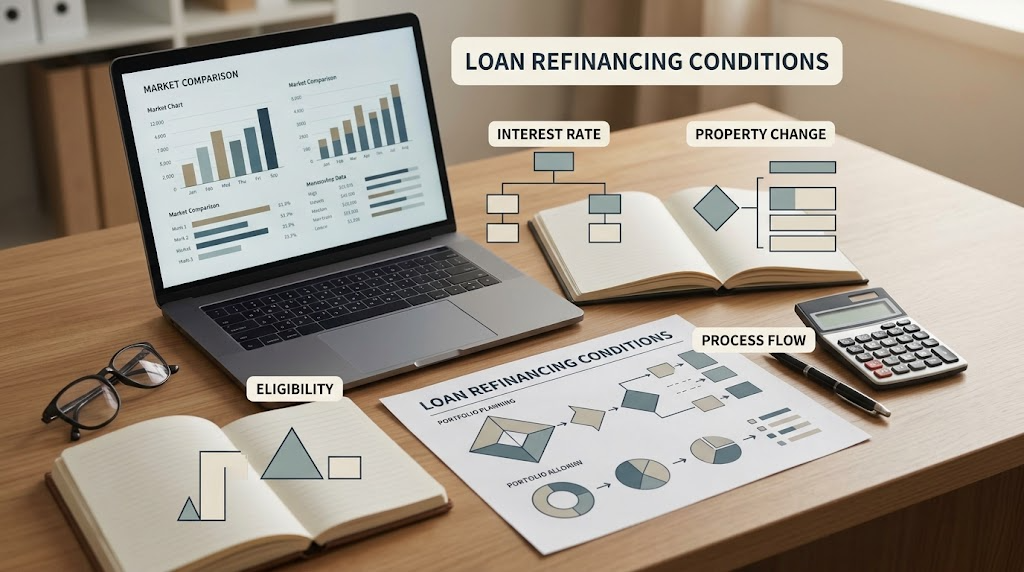
Essential Check When Moving! How to Proceed with ‘Property Change’ and Refinancing Simultaneously
While moving from an existing Jeonse home to another Jeonse home and switching from a high-interest commercial bank loan to a Beotimmok Jeonse loan is possible, unlike a regular extension that simply hands over documents, ‘rights analysis of the new house’ and ‘the same-day fund repayment timeline’ are intertwined, requiring much more sophisticated preparation.
Here is a summary of key points to align the conditions of the new house to move into with the fund flow on moving day.
- Mandatory Requirements of the New House (Property) to Move Into
The target property for refinancing must also meet the strict collateral and area criteria of the Housing and Urban Fund. Even if you like the house, it will be rejected in the loan review if it deviates from the requirements below.
Lease Deposit Upper Limit
General Beotimmok: 300 million KRW or less for the capital area, 200 million KRW or less for non-capital areas (400 million KRW or less for the capital area and 300 million KRW or less for non-capital areas for multi-child households with 2 or more children)
Newlywed Couple Beotimmok: 400 million KRW or less for the capital area, 300 million KRW or less for non-capital areas
Youth-Exclusive Beotimmok: Deposit of 300 million KRW or less
Exclusive Area Criteria
Houses with an exclusive area of 85㎡ or less (including residential officetels / 100㎡ or less possible in non-urban areas other than the capital area such as eup/myeon areas)
However, single household heads under the age of 25 may be subject to a restriction of 60㎡ or less in exclusive area, so checking the area is essential.
Infringement of Rights on the Certified Copy of Real Estate Register
There must be no provisional attachment, provisional disposition, decision to commence auction, etc., and it must be a safe house where the sum of maximum debt amount (senior claims) and deposit does not exceed a certain percentage of the house price.
- Aligning the Moving-Day Deposit Return and Loan Repayment Timeline (The Most Critical Key)
On moving day, funds move simultaneously among multiple parties, including the existing lending bank, the current landlord, the new lending bank (the bank handling the Beotimmok loan), and the new landlord. If this timeline gets disrupted, the final payment on that day may be delayed.
STEP 1. Current Landlord Returns the Deposit and Fully Repays the Existing Loan
On the morning of moving day, the current landlord directly deposits the principal and interest of the existing loan into the tenant’s virtual account (or repayment account) provided by the bank handling the existing loan to complete full repayment.
Tip: Inquire with the bank in advance to obtain the required ‘prepayment principal and interest amount’ and the ‘virtual account for repayment’ on that day to prevent confusion.
STEP 2. Existing Lending Bank’s System Processing of Completed Repayment (Release of Pledge and Assignment of Claims)
Once the existing loan is fully repaid, the completion of repayment appears in the bank’s computerized system.
STEP 3. Execution of the New Beotimmok Loan and Transfer to the New Landlord’s Account
After verifying the system record of full repayment (complete settlement) of the existing loan, the bank handling the Beotimmok loan executes the loan for the new house and directly transfers the funds to the account specified in the lease agreement of the new landlord.
The tenant transfers their self-funded balance of the deposit to the new landlord and settles the remaining payment.
STEP 4. Moving-In Notification, Fixed Date Confirmation, and Submission to the Bank
On the moving day, you must immediately complete the moving-in notification (Jeonip Singo) by visiting the competent community service center or via Gov24, obtain a copy of the resident registration certificate stamped with a fixed date, and submit it to the loan branch on the same day or by the next day to finalize the loan process.
💡 Precautions During Contract Execution (Utilizing Special Terms)
Advance Eligibility Check Before Contract: Before paying a preliminary contract deposit, bring the certified copy of the real estate register and building ledger of the new home to an authorized Beotimmok trustee bank (Kookmin, Shinhan, Woori, Hana, NongHyup, etc.) to check loan availability and estimated limits in advance.
Specifying Safety Special Terms in the Lease Agreement: It is safe to include a special clause stating: “If the tenant’s Beotimmok Jeonse loan refinancing and new execution cannot proceed due to attributable reasons such as defects in the lessor or the target property (housing), this agreement shall become invalid, and the lessor shall immediately return the deposit.”

Application Timeline and Step-by-Step Procedure (From Gigeum e-Deundeun Screening to Bank Visit)
Unlike regular loans, refinancing into a Beotimmok Jeonse loan requires sequentially going through two procedures: the asset screening by Korea Housing & Urban Guarantee Corporation (HUG) and the document/property review by the trustee bank. If you apply too late, you may face the trouble of being unable to settle the remaining balance on moving day; therefore, you must proceed step by step according to the recommended timeline.
⏳ Most Ideal Application Timeline
Application Start Date: Approximately 1 to 2 months prior to the balance settlement date (moving day)
Recommended Deadline: At least 3 to 4 weeks prior to the balance settlement date
Asset screening via Gigeum e-Deundeun typically takes 3 to 7 business days, while the bank’s on-site property inspection and loan review take around 2 weeks. Considering unexpected document supplementary requests or appeal procedures, starting a month and a half before the balance payment date is the safest.
📋 5-Step Process
STEP 1. Executing the New Lease Agreement and Obtaining a Fixed Date
Sign the lease agreement for the new home to move into and secure a receipt confirming payment of at least 5% of the lease deposit.
Immediately after signing the contract, obtain a fixed date on the lease agreement by visiting the competent community service center or through the online registry office.
STEP 2. Non-Face-to-Face Loan Application on ‘Gigeum e-Deundeun’
Access the Housing and Urban Fund’s ‘Gigeum e-Deundeun’ website (enhuf.molit.go.kr) or mobile app.
Log in with a joint or financial certificate and select the loan application type (such as Beotimmok Jeonse Loan Refinancing).
Submit the application by entering income/household details of the applicant and spouse, new home information, existing loan details, and selecting the preferred bank and branch for execution.
STEP 3. Non-Face-to-Face Asset Review (Pre-Asset Screening)
The net asset value of the applicant couple is automatically reviewed via scraping through Korea Credit Information Services and relevant agency systems.
Result Determination: Qualified / Ineligible
In case of ineligibility: If rejected due to exceeding asset limits (e.g., omitted property sale details, unreflected existing debt), you can file an appeal by uploading supporting documents.
Once deemed ‘Pre-Asset Screening Qualified’, an approval notification arrives via KakaoTalk notification talk or SMS.
STEP 4. Visiting Designated Trustee Bank and Submitting Main Documents
After receiving the ‘Qualified’ text message, visit the trustee bank branch (Woori, KB Kookmin, Shinhan, Hana, NH NongHyup, etc.) designated in STEP 2.
Submit all prepared documents regarding income, employment, and lease agreements, and fill out the official loan agreement.
The bank verifies submitted documents, conducts telephone confirmation with the landlord, analyzes property rights (reviewing the certified real estate register and building ledger), conducts on-site inspections if needed, and determines the final approved loan amount and applicable interest rate.
STEP 5. Post-Asset Review and Loan Execution on Balance Date
Signing Loan Agreement: Once approved, complete the electronic agreement (mobile agreement) guided by the bank a few days prior to the loan execution date.
Execution on Balance Day: On moving day, once the certificate of full repayment (proof of complete payment) for the existing loan is registered in the system, the bank transfers the new Beotimmok loan directly to the new lessor’s (landlord’s) account.
Post-Asset Review: Within approximately 1 to 2 months after loan execution, the post-review verifying final asset changes automatically concludes through the Ministry of Land, Infrastructure and Transport network.

List of Mandatory Required Documents for Refinancing and Property Change
Refinancing a Beotimmok Jeonse loan and changing properties requires a relatively large number of items to prepare, as both ‘existing loan verification documents’ and ‘new property documents’ are required alongside standard new loan screening paperwork.
Documents must, in principle, be issued within 1 month of the application date, and printing them with all 13 digits of the Resident Registration Number displayed can save you the hassle of reissuance.
📄 1) Identity and Household Verification Documents (Common)
ID Card: Resident registration card or driver’s license
Resident Registration Certificate: Including address change history for the past 5 years and the trailing digits of the Resident Registration Numbers of household members
Resident Registration Abstract: Including past address change history and military service details (if applicable)
Family Relation Certificate (Detailed): Mandatory for verifying unmarried status, single household heads, spouses residing in separate households, etc.
Marriage Relation Certificate (Detailed): When applying for the newlywed-exclusive Beotimmok loan (a wedding hall contract or wedding invitation may substitute)
💼 2) Income and Employment Verification Documents (By Income Type)
Employees (Earned Income Earners)
Certificate of Employment (stamped with company seal)
Withholding Tax Receipt for Earned Income for the past 2 years (or Certificate of Income Amount)
Employees with less than 1 year of service: Certificate of Withholding Tax for Class A Earned Income, pay stubs, bank account deposit records for salary
Health Insurance Eligibility Certificate
Business Owners (Sole Proprietors)
Certificate of Business Registration
Certificate of Income Amount for the past 2 years
Freelancers and Special Type Workers
Certificate of Appointment (Employment)
Certificate of Income Amount for the past 2 years or Business Income Withholding Receipt (3.3%)
Individuals Without Income (Job seekers, homemakers, etc.)
Certificate of Facts (for verifying no income reported to the National Tax Service)
Health Insurance Eligibility Certificate
🏠 3) New Property (New Jeonse Home) Documents
Copy of Lease Agreement with Fixed Date: Agreement concluded through a licensed real estate agent and stamped with a fixed date from a community service center or the online registry office
Receipt for Payment of 5% or More of the Contract Deposit: Bank transfer slip or receipt issued by the brokerage agency
Certificate of All Registered Matters (Certified Copy of Real Estate Register) for the Leased Housing: Issued including canceled items
Building Ledger: For checking violation building status
🔄 4) Existing Loan and Repayment Documents (Refinancing Core)
Financial Transaction Confirmation for Existing Loan: Issued by the bank handling the existing Jeonse loan (specifying loan title, loan amount, outstanding balance, maturity date, and delinquency status)
Copy of Existing Housing Lease Agreement: For comparing previous contract details
Virtual Account (or Deposit Account) Confirmation for Existing Loan Repayment: May be requested for the new bank to wire the repayment amount to the existing bank or to verify repayment on moving day
💡 TIP Before Visiting the Bank
If you call the loan officer at the branch of the trustee bank (Kookmin, Shinhan, Woori, Hana, NongHyup, etc.) you plan to visit and request a text message listing the “documents for Beotimmok property change refinancing review” in advance, you can complete the application in one stop without being flustered by branch-specific document requests.

Practical Precautions to Prevent Rejection and Frequently Asked Questions (Q&A)
Refinancing a Beotimmok Jeonse loan and changing properties involves stricter review criteria than a standard Jeonse loan extension. To avoid the trouble of loan rejection or limit reduction after having already paid the contract deposit, you must familiarize yourself with advance precautions and frequently asked questions.
⚠️ Practical Precautions to Prevent Loan Rejection and Limit Reduction
- Caution on Limit Reductions Due to Differences in Guarantee Institutions (HUG vs. HF)
HUG (Korea Housing & Urban Guarantee Corporation): Because limits are determined based on housing price and officially announced price (senior claims, etc.), relatively high limits are granted even with low income, but property rights relationships and guarantee limit requirements for the house itself are very strict.
HF (Korea Housing Finance Corporation): Guarantee limits are calculated primarily based on the applicant’s annual income and credit score. If you have no income or low annual income, the approved limit can be reduced significantly, so you must verify the guarantee institution that suits your conditions through preliminary consultation.
- Timing for Release of Pledge and Notice of Assignment of Claims on Existing Loans
Pledges or assignments of claims placed with the bank handling the existing loan must be definitively released in the system on the morning of the balance payment date so that the new bank can remit the new loan funds. You must contact the existing loan bank branch in advance to request cooperation for “immediate repayment processing and system release on the morning of moving day.”
- Checking for ‘Violation Buildings’ and Mortgages on the New Housing
If there is a ‘Violation Building’ notation on the building ledger, or if the sum of the maximum mortgage amount (landlord’s collateral loan) and your deposit exceeds the housing price (a certain percentage of the officially announced price), approval for the Beotimmok loan is fundamentally blocked. Reviewing the certified copy of the real estate register and the building ledger prior to the provisional contract is essential.
- Settlement of Prepayment Penalties and Guarantee Fees
When refinancing within 3 years from the execution date of the existing commercial bank loan, a prepayment penalty of 0.5% to 1.5% may occur.
Conversely, because the portion corresponding to the remaining period among guarantee fees paid in advance when signing up for the existing loan is refunded on a pro-rata daily basis, you must verify the guarantee fee refund account along with the repayment receipt.
❓ Frequently Asked Questions (FAQ)
Q1. What happens if I do not receive the deposit for the existing home on the morning of moving day?
A. If the existing loan balance is not completely repaid in the system, the new bank will not execute the Beotimmok loan. Therefore, you must coordinate the schedule clearly with the existing landlord in advance so that they prioritize depositing the principal and interest into the virtual account for Jeonse loan repayment according to the time of move-out and moving of belongings.
Q2. Does having a credit loan or an overdraft account affect the loan limit?
A. When using an HF guarantee, the applicant’s DTI (Debt-to-Income ratio) and existing loan details are reflected in the screening, so the limit may be deducted. Conversely, because HUG guarantees center on the value of the target property, the impact of personal debt is relatively low, but if there are credit issues such as delinquency history or excessive card loans, the application may be rejected during screening.
Q3. Is it possible to know whether the loan is confirmed by the bank before signing a contract?
A. Confirmed approval is not granted without a formal contract and a fixed date. However, if you visit the bank counter with the certified copy of the register, building ledger of the home you plan to move to, and your personal income documents (withholding tax receipts, etc.), you can undergo a ‘preliminary review (inquiry into approximate loan eligibility and estimated limit)’. If you find a property you like, it is recommended to undergo a preliminary review before transferring the contract deposit.
Q4. Can the move-in report be done late on the moving day after Beotimmok loan approval?
A. Absolutely not. For the Beotimmok loan, you must complete the move-in report immediately on the day of moving to maintain opposing power. Typically, if a certified copy of the resident registration confirming move-in completion is not submitted to the lending bank by that day or the following day, loan redemption measures (forfeiture of the benefit of time) may be taken.
Korean version: 한국어로 읽기