Prologue: Monthly Fixed Spending on Supplements, Do We Really Need It All?
Waking up in the morning and looking at a corner of the dining table, you often find bottles of supplements lined up before you even realize how they multiplied.
From vitamin B complexes that are said to be good for fatigue recovery, to lutein for eye health, probiotics for the gut, and omega-3, which is said to be essential for improving blood circulation…. Adding them to your shopping cart one by one with good intentions to take care of your health, before you know it, the monthly fixed spending going out on supplements easily exceeds 100,000 KRW, or as much as 200,000 KRW.
“Could I be overspending on supplements without even realizing it?”
Looking at your bank account balance, thoughts like this might suddenly cross your mind.
“Are all these pills I’m taking right now actually being used properly in my body?”
“Did I just buy them out of anxiety simply after seeing advertisements or trends?”
In fact, if you examine the supplements on the dining table one by one, there are quite a few products where ingredients overlap leading to unnecessary excess intake, or that are neglected after being taken for a few days until their expiration dates pass. Spending that started with the intention of becoming healthier has instead hardened into yet another “subscription fee” that burdens the household budget each month.
The core of health management is “standards,” not “quantity”
Cutting supplement spending does not mean extreme frugality that unconditionally eliminates even necessary nutrients.
Just by setting priorities for what essential nutrients you truly need right now and establishing a standard to smartly evaluate the daily dosage cost even for the same ingredient, you can save nearly half of your monthly expenses.
As we lightly sort through the supplement bottles sitting on the dining table, let’s now look one by one at practical supplement buying and intake tips that protect both your bank account and your health.

Step 1: Shopping Cart Diet — Organizing Intake Priorities and Ingredient Duplications
The fastest and surest way to reduce supplement spending is not finding the lowest price, but weeding out unnecessary items from your shopping cart.
Many people tend to add a new product whenever a single symptom increases, such as fatigue, dry eyes, or joint pain. However, during this process, ingredients overlap, leading to double spending or excessive intake that burdens the body.
- Distinguishing between ‘Basic Nutrients’ and ‘Target Nutrients’
You do not need to take every supplement every single day for the rest of your life. To control spending, you must first divide supplements into two categories.
- Base Foundation (Daily Maintenance): Nutrients that are difficult to obtain sufficiently from diet and are essential for bodily metabolism (e.g., vitamin D, omega-3, magnesium, etc.)
- Target/Periodic Intake (Taken as Needed): Nutrients taken intensively for 2–3 months depending on specific periods or physical conditions, followed by a break (e.g., lutein, milk thistle, MSM, etc.)
If you keep only base foundation products on hand at all times and take supplemental target nutrients alternately according to your condition, your monthly recurring fixed costs will visibly decrease.
- Checking Nutrition Facts Panels: Weeding Out Overlapping Ingredients
Gather the “Nutrition/Supplement Facts” labels on the back of the supplements at home and check them. In particular, duplications such as the following frequently occur.
| Frequently Overlapping Ingredients | Type of Duplication Occurrence | Resolution & Cost-Saving Tips |
|---|---|---|
| Vitamin B Complex / Zinc | Multivitamin + Fatigue Recovery Supplement + Hair/Nail Supplement | Consolidate into 1 multivitamin or organize single-ingredient products |
| Vitamin D | Multivitamin + Calcium/Magnesium Complex + Probiotic Secondary Ingredients | Check the sum of the daily recommended amount (usually 1,000–2,000 IU) and exclude overlapping products |
| Vitamin C / E | Antioxidant + Eye Supplement (Lutein Complex) | If a sufficient amount is already included in the complex product, hold off on purchasing a separate single vitamin C product |
In this way, simply cross-checking labels and clearing out just 1 to 2 overlapping products instantly saves tens of thousands of won per month.
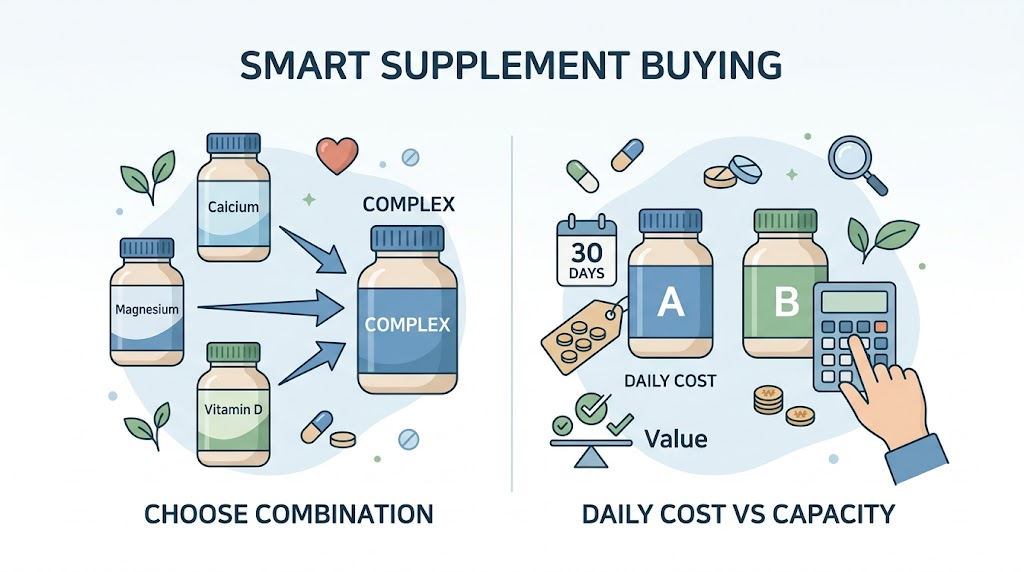
- When 1 well-formulated combination product is more advantageous than multiple single-ingredient products
Purchasing each ingredient separately as a top-tier single product can ensure ingredient quality, but it multiplies both purchasing costs and the hassle of taking them.
- Example: Choosing 1 bottle of eye health complex formula rather than buying lutein, zeaxanthin, and astaxanthin separately
- Example: Choosing 1 bottle of Cal-Mag-D complex rather than keeping calcium, magnesium, and vitamin D separately
Identifying the essential core combination you truly need and compressing it into a single complex product with a reliable formulation is the key to a “shopping cart diet.”
Step 2: How to Calculate ‘Daily Dose Cost (Cost-Effectiveness) Relative to Active Ingredient Content’
When choosing supplements, it is easy to be swayed by phrases like “3-month bulk supply 29,900 KRW” on sales pages. However, just because the price of a single bottle is cheap does not mean its actual cost-effectiveness is high.
To practically reduce supplement purchasing costs, you must convert value based on the “daily intake cost” and the “actual content of core active ingredients” rather than marketing phrases.
- The trap of per-bottle price: Converting to ‘daily intake cost’
Each supplement has a different number of capsules per bottle and recommended intake per serving.
- Product A: 1 bottle (60 capsules) 24,000 KRW (intake of 2 capsules per day = 30-day supply) ➔ Daily cost: 800 KRW
- Product B: 1 bottle (60 capsules) 36,000 KRW (intake of 1 capsule per day = 60-day supply) ➔ Daily cost: 600 KRW
On the surface, Product A looks 12,000 KRW cheaper, but the actual daily maintenance cost is 25% cheaper for Product B. Before adding supplements to your cart, you must first check [Total payment amount ÷ Total days of intake = Daily intake cost] to prevent spending leaks.
- Checking ‘core marker active ingredients’, not total capacity
The most common mistake is confusing the total weight (mg) of the capsule with the amount of active ingredients. A large capsule size does not make it a good supplement; you must check the marker active ingredient content on the back label.
| Representative Supplement | Front Label (Total Amount) | Core Marker Active Ingredient to Actually Check | Criteria for Judging Cost-Effectiveness |
|---|---|---|---|
| Omega-3 | Fish oil 1,000mg | Sum of EPA + DHA | Check if it is at least 6001,000mg or more (purity 6080% or higher) |
| Milk Thistle | Milk thistle extract 260mg | Silymarin | Check whether it meets 130mg based on silymarin (MFDS daily intake amount) |
| Lutein | Marigold flower extract | Pure lutein content | Check whether it meets the 10~20mg range |
| Probiotics | Input count (e.g., 50 billion) | Guaranteed count (CFU) | Compare based on viable guaranteed bacteria count through expiration date (minimum 1 billion~10 billion) |
If the proportion of active ingredients is low, even if it appears inexpensive on the surface, you are effectively paying a premium for excipients or oil residue.
- Checking for Trusted Brand Raw Material Marks
You do not necessarily have to buy expensive premium products, but buying unverified low-quality raw materials cheaply and seeing no effect is actually a waste of money.
- Omega-3: IFOS 5-Star certified raw materials such as KD-Pür, Solutex, GC RIEBER, etc.
- Vitamin C: Quali-C (DSM)
- Vitamin B Complex / Multi: Global raw material suppliers such as Quali-B, etc.
- Probiotics: Global strain suppliers such as Chr. Hansen, Danisco (DuPont Danisco), Rosell, etc.
Among products that explicitly state the raw material manufacturer’s brand logo or patent designation, selecting direct-import PB products with reduced distribution margins or practical domestic brands allows you to consume top-grade raw materials at a much more reasonable unit price than standard products.
You can choose to write the next step or expand the body text:

Step 3: Smart Buying Channel Tips: Direct Import vs. Domestic Products
Even for supplements using identical or comparable levels of raw materials, the expenditure can differ by up to 30~50% depending on where and at what timing you purchase them.
Because domestic products and overseas direct imports each have distinct advantages and price formation structures, a strategy of separating purchasing channels according to item characteristics is needed.
- Domestic Health Functional Foods vs. Overseas Direct Import: What to Buy Where?
You do not need to buy every supplement via overseas direct import or standardize exclusively on domestic products. It is advantageous to divide them by item category considering regulatory standards and price differences.
Items where overseas direct import is advantageous:
Omega-3, magnesium (chelate, etc.), high-potency vitamin D, joint supplements (MSM, chondroitin)
Reason: Compared to domestic options, high-potency and specialized bonded ingredients (chelation, etc.) have high price competitiveness, and large-capacity (120~240 capsules) choices are diverse.
Items where domestic product purchase is advantageous:
Live probiotics, liquid/film formulations, traditional functional raw materials such as red ginseng
Reason: Live probiotics carry risks of exposure to temperature and humidity during overseas shipping, making refrigerated/fast delivery safer, and quality control is strictly guaranteed by the domestic Ministry of Food and Drug Safety ‘Health Functional Food’ certification mark.
- Smart Tactics for Overseas Direct Import Platforms (iHerb, Ople, Amazon, etc.)
Purchasing at regular retail prices on direct-import platforms is practically a loss. You must lower unit costs by utilizing regular promotions and payment methods.
Prioritize Exploring PB (Private Brand) Brands:
Major platforms’ own PB or cost-effective brands, such as California Gold Nutrition (CGN), NOW Foods, Doctor’s Best, etc., use the same raw material manufacturers (IFOS-certified Omega-3, Quali-C, etc.) while stripping away marketing expenses, making prices very affordable.
Sale Cycles and Stacking Discount Codes:
Time purchases to major sales throughout the year (Black Friday, Cyber Monday, Lunar New Year/Chuseok, quarterly category 2025% sales) and buy a 36-month supply at once.
Combine reward codes (referral discounts) + promo codes + payback (card issuer events/cashback sites) to complete payment.
Prevent Double Currency Conversion:
When making payments for overseas direct imports, paying in ‘local currency (USD)’ rather than ‘Korean Won (KRW)’ avoids Dynamic Currency Conversion (DCC) fees ranging from 3~8%.
- Frugal Purchasing of Domestic Products: ‘Bulk Promotions’ and ‘Official Mall Memberships’
Domestic health functional foods carry large distribution margins when purchased as individual 1-month single items at pharmacies or open markets.
Brand Official Mall Family Sales & Live Commerce:
Major health functional food brands (Chong Kun Dang Healthcare, Dong Wha Pharm, GC Green Cross, etc.) sell 3+1 and 6-month package bundles at 40~60% discounted prices during live commerce or quarterly family sales.
Point Accumulation and Subscription Delivery Benefits:
For products consumed steadily, you can lower unit costs by setting up Naver Brand Day membership rewards (maximum 510%) or official mall subscription deliveries (additional 510% discount), and canceling immediately when no longer needed.
Mandatory Verification of MFDS ‘Health Functional Food’ Mark:
Many people buy based solely on low prices and end up purchasing ‘general foods (candies, mixed beverages, other processed foods)’ that fall short of functional ingredient requirements. You must check that the package carries the MFDS health functional food mark to avoid wasting money.
Step 4: Eliminating Wasted Costs Through Expiration Date Management and Spoilage Prevention
No matter how low the purchase price was, if you cannot finish everything and throw it away midway, that cost becomes pure waste.
In particular, it is common to be tempted by bulk discount events, buy multiple bottles, and then throw half away because they turned rancid or soggy. Just as important as lowering unit purchase prices is ‘consuming purchased products completely to the end’, which is key to defending your supplement budget.
- Understanding Characteristics by Packaging Type: Bottle vs Individual Packaging (PTP)
Depending on formulation and ingredients, the degree of vulnerability to oxygen, light, and moisture is entirely different. Storage spec## Step 4: Eliminating Wasted Costs Through Expiration Date Management and Spoilage Prevention
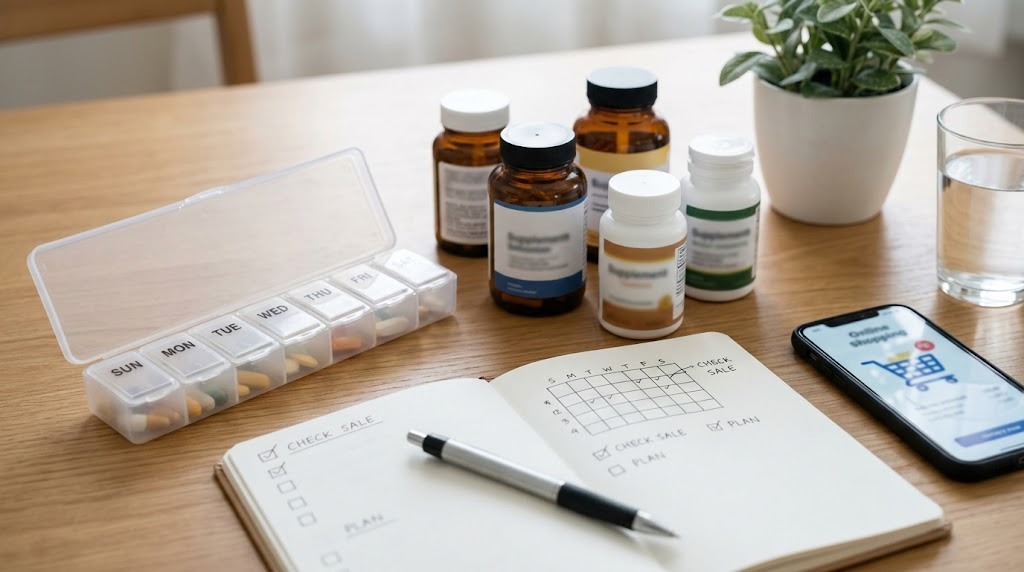
What is the most expensive way to take supplements? Not buying top-tier raw materials, nor buying at regular prices without sales, but precisely ‘failing to finish everything, having it spoil midway, and throwing it in the trash.’
If you give in to the temptation of bulk discounts, buy a 1-year supply, and end up tossing half because it turned soggy or smelled foul, your actual daily dose cost skyrockets by 2 times. Just as critical as purchasing is ‘storage and inventory management’ to completely finish bottles to the end.
- Purchase Criteria According to Packaging Type: Bottle vs Individual (PTP/Unit)
From the moment you open and close the cap, supplements are exposed to moisture and oxygen in the air, beginning rancidification. Choosing the appropriate packaging method according to formulation characteristics helps reduce wasted money.
- Soft capsules (oil ingredients like omega-3, lutein, vitamin D/E):
- Exposure to air and light rapidly accelerates oxidation and worsens the characteristic fishy odor.
- In hot and humid summer environments, capsules easily stick together, so choosing products with individual PTP (blister) aluminum packaging is generally safer.
- If you purchased a large-capacity bottle product, do not tear off the inner cap seal completely; open only half to minimize moisture ingress.
- Tablets/powders (vitamin B complex, magnesium, probiotics):
- They are highly hygroscopic; absorbing moisture leads to brown spots on the surface or a soggy texture.
- Rather than ultra-large capacities with 200300 pills per bottle, purchasing a 60~90 tablet size that can be consumed within 12 months is the shortcut to safely taking them to the end.
- Correcting Commonly Made Storage Mistakes
If you encourage spoilage by leaving them in the wrong place, months’ worth of supplements can be ruined in an instant.
| Common Storage Location | Problem | Correct Storage Location |
|---|---|---|
| Refrigerator (general supplements) | Due to temperature differences upon removal, condensation (dew) forms, causing pills to dissolve instantly or develop mold | A cool, dry room temperature away from direct sunlight (15~25℃) |
| Next to water purifiers / kitchen sinks | Water splashes, cooking heat, and high humidity accelerate rancidity | A dry place without moisture, such as a bedside nightstand or living room drawer |
| Sunny windowsill above the dining table | Ultraviolet rays and direct sunlight accelerate fatty acid oxidation in softgel capsules | Inside an opaque storage box or on a shaded shelf |
Exception: Store only live probiotic products labeled “refrigeration required” in the inner door shelves of the refrigerator.
- Limiting Supplement Quantities to a “Maximum 3~6-Month Supply”
No matter how unprecedented the discount is, it is economical to purchase only up to a maximum 6-month supply for one person’s consumption.
- Risk of changes to intake routines: After 2~3 months, situations may arise where you need to discontinue intake or switch to other ingredients due to blood test results or changes in physical condition.
- Imminent expiration dates: Overseas direct-purchase sale items often have a high probability of being “near-expiry products” with only 3~6 months remaining, so you must verify the Expiration Date in the detailed specifications before payment.
- First-in, first-out principle: Simply adhering to the rule of placing newly purchased supplements in the back and opening a new bottle only after completely finishing the existing opened one can 100% prevent disposal due to passed expiration dates.

Epilogue: Sustainable Supplement Consumption Habits for Healthy Living
Supplements are not magic pills where taking more makes you proportionally healthier. Rather, the burden of taking them while stacking up dozens of bottles can cause unnecessary fatigue not only to household finances, but also to metabolic organs in our body such as the liver and kidneys.
True health management begins with knowing your body’s condition accurately and steadily maintaining only what is genuinely necessary, without being swayed by flashy advertisements or other people’s recommendations.
3 Key Checklists for Practical Supplement Consumption
Based on what was covered today, ask yourself just 3 questions before pressing the payment button for your next supplement purchase.
- “Do ingredients not overlap with the products I am currently taking?”
Compare labels among multivitamins, fatigue recovery formulas, and joint/eye supplements to filter out redundant excessive intake of B-complex vitamins, vitamin D, zinc, and more.
- “Have I checked the daily dose cost and core active contents rather than just the price of a single bottle?”
Divide the total number of capsules by the recommended daily intake to calculate the daily maintenance cost, and inspect actual indicator ingredients such as the sum of EPA+DHA in omega-3 or silymarin in milk thistle.
- “Is it an amount that can be consumed completely within 3~6 months without spoiling?”
Rather than falling for the temptation of bulk discounts, purchase only the quantity you can take fresh to the end, considering the formulation (bottle vs. PTP) and storage environment.
Adding 2 to 3 core supplements tailored to you at wise prices on top of a solid foundation of a basic diet, sleep, and regular exercise: this is the smartest way to keep both your body and wallet healthy while cutting monthly fixed costs in half.
Start today by lightly organizing the supplements sitting on your dining table.
Next action options to finalize the post:
Generate SEO title candidates for top Naver search exposure
Generate featured thumbnail/body image prompts
Korean version: 한국어로 읽기