
2 to 3 Hours a Day After Work! Features, Pros, and Cons of ‘Weekday Night Classes’
When office workers contemplate self-development or strengthening job competencies, the very first option they explore is ‘weekday night classes.’ It is a classic study-by-night model where one focuses on company work during daytime hours and carves out time after work to visit the classroom.
While there is a powerful merit of fully securing weekend rest, attendance risks stemming from stamina management and sudden overtime coexist, so one must carefully compare them against one’s own work characteristics.
- Basic Operating Structure of Weekday Night Classes
Class hours: Usually begins in the evening at 19:00–19:30 and finishes around 21:30–22:30. (2–3 hours of class per session)
Operating format: Organized as twice a week (Tue/Thu), 3 times a week (Mon/Wed/Fri), or short-term intensive 4 times a week (Mon–Thu).
Main offered subjects: Dominated by office certification courses such as Excel, Computer Literacy, and Computerized Tax Accounting, video editing (Premiere, After Effects), web/app publishing basics, and short-term courses closely related to job duties such as Photoshop and Illustrator.
- Core Advantages of Weekday Night Classes
Securing full weekend leisure and family time:
Because all study schedules are handled on weekdays, the two days of the weekend after Friday evening can be utilized fully for personal relaxation, hobbies, family gatherings, and more.
Establishing weekday routines and review effects:
Because classes continue at intervals of just a few days, practical exercise content learned the previous day can be quickly reviewed at work or at home, providing high learning continuity.
Appropriate single-class concentration level:
Compared to weekend classes that run for 6 to 8 hours a day, it consists of 2 to 3 hours per session, making it less burdensome to immerse yourself for a short time and keep up with practical assignments.
- Disadvantages and Realistic Risks to Watch Out For
Risk of attendance rate (80%) plummeting during sudden overtime or company dinners:
The lifeblood of a government-subsidized course is ‘maintaining an attendance rate of 80% or higher.’ If consecutive absences occur 2 to 3 times due to sudden overtime, company dinners, deadline schedules, etc., it will drop below the baseline in an instant, potentially resulting in completion failure and penalties (deduction from card support limit).
Cumulative fatigue:
Listening to classes immediately in an exhausted state right after work and returning home leads to insufficient sleep time, posing a burnout risk where main job concentration and academic achievement decline simultaneously.
Constraints of post-work travel route:
To meet the 19:00 on-time check-in, the physical travel time between the workplace location and the academy should stably be within 20 to 30 minutes via public transportation. Even a slight delay in departure time can easily lead to accumulated tardiness (3 accumulated instances count as 1 absence).
💡 Weekday Night Class Selection Guide
Recommended targets: Regular employees/public institution workers with relatively guaranteed on-time departure, those who must definitely rest or have plans during both weekend days, those with close distances between workplace and academy
Practical tip: It is safe to first check public transportation dispatch intervals during the evening commute via portal map directions to see if it is a route where you can arrive at least 15 to 20 minutes earlier than class start time.

Complete Analysis of ‘Weekend Classes (Sat/Sun)’ for Office Workers Who Have Trouble Making Time on Weekdays
For office workers who cannot commute to an academy on weekday evenings due to frequent overtime or irregular off-work hours, the most realistic alternative is ‘weekend classes (Saturday/Sunday).’ It is a representative intensive model where one invests one or two weekend days entirely without interfering with one’s main weekday job to acquire certifications and build practical skills.
While there is a clear advantage in being able to completely separate weekday work stress from studies, one must calculate beforehand the fatal impact a single day’s absence has on attendance rate and physical stamina consumption to successfully finish through to completion.
- Operating Formats and Class Schedules of Weekend Classes
Class hours: Generally starts in the morning at 09:30–10:00 and concludes around 16:30–18:00 in the afternoon. (Excluding 1 hour of lunch time, 6–8 hours of high-intensity immersive classes per day)
Organization types:
Saturday full-day class / Sunday full-day class (once a week): Completing 6–8 hours intensively on only one day of the weekend and securing personal rest and family time on the remaining day, which has the highest preference among office workers.
Weekend two-day class (Sat·Sun twice a week): Primarily organized for certification practical exam preparation classes or fast-track practical classes that require quick completion in a short period (around 1–2 months).
Main offered subjects: Heavily populated with subjects where continuous long-duration practical exercises are advantageous, such as AutoCAD, architectural/interior 3D modeling (SketchUp·Revit), computerized tax accounting level 1/level 2, Python data analysis, and video production practice.
- Core Advantages of Weekend Classes
‘Zero’ impact on weekday work (eliminating worries about overtime and business trips):
Even if sudden overtime, company dinners, or regional business trips occur on weekdays, there is no impediment to class participation. Work schedules and academy schedules do not overlap, so there is no need to be conscious of bosses or colleagues at work.
Metropolitan commuting possible (expansion of accessibility):
Unlike weekday classes where you commute daily, you only move once a week, so even if there are no desired specialized courses near your home, you can accept and register for a metropolitan commute of over 1 hour to areas dense with excellent training institutions, such as Gangnam and Jongno in Seoul.
In-depth continuity of practical exercises:
Unlike weekday classes that break off in 2-hour increments, you can immerse yourself and complete project creation or past exam question solutions in one continuous breath for 6–8 hours a day, keeping the practical training flow uninterrupted.
- Fatal Disadvantages and Attendance Risks to Watch Out For
Risk of attendance rate (80%) collapse upon a single day’s absence:
Weekend classes have far fewer total class days compared to weekday classes. For instance, in a course with a total of 4 class days per month (based on once a week), being absent for just one day immediately drops the monthly attendance rate to 75%, resulting in falling short of the 80% attendance rate (0 KRW training allowance for the relevant unit period and risk of non-completion).
The severe blow of tardiness and early leave:
Under government-subsidized course regulations, 3 instances of tardiness/early leave are converted to 1 absence, and participating in less than 50% of that day’s class hours is treated as an absence. Being late just 1–2 times due to oversleeping on weekend mornings delivers a much bigger attendance penalty blow than in weekday classes.
Disappearance of weekends and fatigue equivalent to a 7-day workweek:
Staying at the academy all day on Saturday or Sunday leaves insufficient time to relieve physical fatigue accumulated over the weekend, easily leading to severe chronic fatigue and burnout when heading to work on Monday.
💡 Weekend Class Selection Guide
Recommended targets: Employees in large corporations, IT, or sales with irregular weekday off-work hours; those who want to commute to central areas once a week because there are no desired government-subsidized courses near home; those who prefer uninterrupted long-duration practical training
Practical tip: Because a single absence is fatal, during the spring and autumn seasons when weekend family occasions such as weddings and first birthday parties are concentrated, you should check personal schedules 2–3 months in advance before starting courses to avoid attendance penalties.

How to Utilize ‘Weekday Daytime Classes’ for Those Preparing for Job Changes or Resignations and Shift Workers
The format that accounts for the highest proportion in government-subsidized training and has exceptional curriculum depth is undeniably ‘weekday daytime classes (Mon–Fri full-time).’ While typically perceived as exclusive to job seekers (the unemployed), it is the most powerful track for achieving career transitions in a short period for office workers preparing for job changes on the verge of resigning, those exhausting annual leave, those on paid leave, and day-night shift workers.
As it proceeds at high intensity for 7–8 hours a day, the learning density and portfolio completeness are overwhelming, but one must clearly examine Employment Insurance regulations and physical attendance requirements while employed before entering.
- Operating Structure and Class Schedule of Weekday Daytime Classes
Class hours: Runs every week from Monday to Friday, from around 09:00 in the morning to 17:30–18:00 in the afternoon. (7–8 hours of full-time intensive education per day)
Course scale: Mostly long-term project courses spanning usually 3 months to more than 6 months, organized with a total of 300 to 900 hours or more.
Main offered subjects: Dominated by specialized technical fields directly linked to employment, such as K-Digital Training (AI, big data, cloud, full-stack development bootcamps), National Strategic Industry occupations (smart factory, semiconductor design, machining), practical UI/UX web design, and video CG/motion graphics job portfolio classes.
- 3 Types of Office Workers Who Utilize Weekday Daytime Classes
For standard nine-to-six (09:00–18:00) regular full-time employees, daytime full-time attendance is realistically impossible, but individuals in the following work patterns or transition phases can take courses strategically.
Resignation and job transition period (exhausting annual leave right before resignation or immediately after resignation):
Cases where one aims to complete a job-change portfolio within a short period by acquiring specialized skills right away without a career gap during the period of exhausting accrued annual leave all at once or immediately after the resignation date
Flexible/shift workers such as 3-shift or 2-shift schedules:
Workers who are regularly assigned to night shifts or scheduled days off (OFF weeks), making daytime lecture participation possible
Precautions: If shift rotation cycles change and daytime class hours overlap with work, the risk of falling short of the 80% attendance rate is high, making schedule consultations with the academy essential.
Workers on paid leave or parental leave:
Cases where there are no restrictions on dual employment or educational participation under company regulations, and conditions are established to handle full-time classes during the leave period
- Core Advantages of Weekday Daytime Classes
Overwhelming learning density and short preparation period:
The amount of learning that would take 6 months to over a year in night or weekend classes can be compressed and absorbed in 2 to 3 months, minimizing career gaps.
Completion of practical portfolios and projects:
Going beyond simple theory lectures or feature practice, team-based projects and industry mentoring are combined to derive outputs that translate directly into the actual hiring market.
Concentration of employment support and allowance benefits:
As it is a long-term course of 5 hours or more per day and 140 hours or more in total, fulfilling eligibility requirements (such as unemployed status) allows full receipt of the training allowance of up to 116,000 KRW per month, along with full employment support services from the academy such as resume editing and corporate matching.
- Administrative and Attendance Risks That Employed Workers Must Verify Before Enrolling
Exclusion from training allowance payment under employed worker status:
General employed workers enrolled in Employment Insurance for 15 hours or more per week are, in principle, excluded from training allowance (meal and transportation expenses) eligibility even with 100% full attendance in weekday daytime classes. (Except for exception criteria such as Earned Income Tax Credit recipients)
Mandatory employment center preliminary diagnosis and counseling for courses of 140 hours or more in total:
Because daytime intensive courses are mostly large-scale courses of hundreds of hours, completing training plan preparation and preliminary counseling approval through an employment center is required at least 1 to 2 weeks before the start date.
High dropout risk of ‘1 day absence = 7–8 hours loss’:
Missing just one day widens the progress gap dramatically, and an unexcused absence of just a few days can plunge the overall attendance rate below 80%, potentially resulting in penalties that deduct from the card limit (200,000 to 1,000,000 KRW).
💡 Weekday Daytime Class Selection Guide
Recommended targets: Office workers planning 3 to 6 months of immersive preparation after resignation with a firm job transition goal; shift workers and workers on leave whose daytime attendance is definitely guaranteed
Practical tip: To ensure stable learning immersion, check unemployment benefit receipt schedules or National Employment Support Program eligibility criteria first after resigning, and coordinate and register for the optimal opening schedule to participate without allowance gaps.
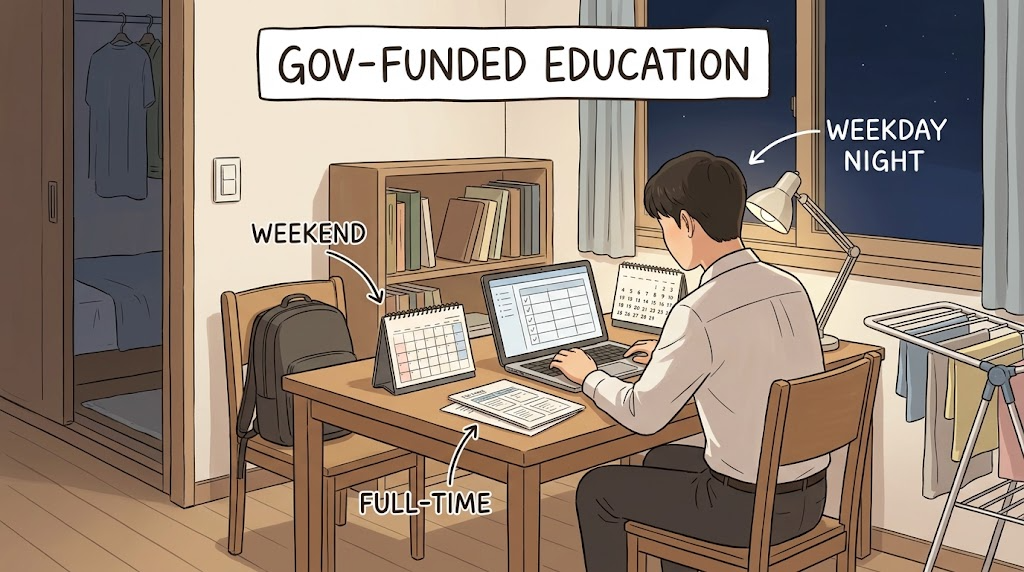
Core Condition Comparison by Time Slot: Self-Pay Copayment Rates, Training Hours (Based on the 140-Hour Benchmark), and Support Benefits
Depending on which time slot you choose among weekday night classes, weekend classes, and weekday daytime classes, not only does your schedule change, but institutional conditions also vary significantly—from self-pay copayment rates and administrative procedures based on total training hours to whether you can receive monthly training allowances.
Here are 3 core comparison points you must check to minimize actual out-of-pocket expenses from your wallet and maximize the benefits supported by the government.
- Core Condition Comparison Table by Time Slot at a Glance
| Category | Weekday Night Classes | Weekend Classes (Sat/Sun) | Weekday Daytime Classes (Full-Time) |
|---|---|---|---|
| Main Targets | Office workers seeking self-development after work | Office workers with frequent overtime, long-distance commuters | Those preparing for job transitions/resignations, shift workers |
| Weekly Training Hours | Approx. 6–12 hours (2–3 hours per session) | Approx. 6–16 hours (6–8 hours per session) | Approx. 35–40 hours (7–8 hours per day) |
| Total Training Hours | Generally under 140 hours (short-term) | Generally under 140 hours (short/mid-term) | Generally 140 hours or more (long-term) |
| Employment Center Pre-Approval | Exempt (immediate online application possible) | Exempt (except for some mid-term courses) | Mandatory (diagnosis/counseling and training plan approval) |
| Self-Pay Copayment Rate (Standard) | Around 15% to 55% | Around 15% to 55% | 0% (fully free) to partial copayment |
| Training Allowance Payment | Not paid (under 5 hours per day) | Conditional small amount (limited to transportation expenses) | Up to 116,000 KRW per month (unemployed standard) |
| Attendance Management Difficulty | Moderate (beware of absences due to frequent overtime) | High (1 absence causes severe damage) | High (stamina and burden of maintaining full-time attendance) |
- Differences in Registration Administrative Procedures Based on the 140-Hour Benchmark
Kookmin Tomorrow Learning Card courses have completely bifurcated application procedures based on total training hours of 140 hours.
- Courses under 140 hours (applies to most night and weekend classes):
- Without the need to visit an employment center or undergo counseling, you can search for your desired course on the Employment24 portal and apply online immediately.
- Even a few days before the start date, as long as seats remain, you can enroll quickly, which is convenient for office workers short on time.
- Courses of 140 hours or more (daytime full-time and some long-term weekend classes):
- Because large government subsidies are invested, after submitting through the Employment24 portal, preliminary diagnosis/counseling and training plan approval procedures through your competent Employment Welfare Plus Center are mandatory.
- Document reviews and counseling approvals take at least 1 to 2 business days to weeks, so preparation must begin well ahead of the start date.
- Self-Pay Copayment Calculation Standards and Additional Reduction Benefits for Office Workers
Government subsidies do not mean courses are unconditionally 100% free; government support rates (45%–85%) and self-pay copayment rates (15%–55%) are determined according to employment rates and supply-demand conditions in each occupational field.
- Self-pay copayment rates for general employees:
- Excluding specialized courses covered fully by government subsidies such as National Key and Strategic Industry Occupations (National Strategic Industries) or K-Digital Training (KDT), general office, IT, and design occupational courses fundamentally incur self-pay copayments of around 15% up to 55%.
- Targets for additional self-pay reductions (low-income and vulnerable employees):
- Earned Income Tax Credit (EITC) recipients: Verifying your receipt of the Earned Income Tax Credit in the most recent year grants an additional 50% discount on regular self-pay copayments.
- Participants in National Employment Support Program Type II (youth, middle-aged, etc.): Copayment rates decrease significantly depending on participation type.
- Workers in employment crisis zones and special employment support sectors: Copayment exemption or additional reduction benefits apply.
- Whether Training Allowance (Meal and Transportation Expenses) Can Actually Be Received by Time Slot
Whether you receive the ‘training allowance’ deposited into your bank account each month when exceeding an 80% attendance rate also diverges depending on the time slot.
- Weekday night classes: Because daily training time is merely 2 to 3 hours, it does not meet the standard of 5 hours or more per day, so training allowances are not paid.
- Weekend classes: Often conducted for 5 hours or more per day, but due to the characteristic of running 1 to 2 times a week, the total monthly attendance days are few, meaning actual expense support is negligible or limited to the level of transportation expenses (calculated pro rata based on 2,500 KRW per day) depending on course nature.
- Weekday daytime classes: Unemployed job seekers or resigned individuals participating in long-term courses of 140 hours or more in total can receive the full amount up to a maximum of 116,000 KRW per month upon perfect attendance, based on 5,800 KRW per day (meal + transportation expenses). (However, general employed workers enrolled in Employment Insurance are excluded from eligibility.)
💡 Final Selection Guide
If you want to minimize self-pay copayments and complete an employment/job change portfolio in a short period, ‘weekday daytime classes’ are best; if you want to reduce absence risks without interfering with work and protect your weekends, ‘weekday night classes’ are best; and if off-work hours on weekday evenings are irregular and you want intensive practical exercises, choosing ‘weekend classes’ is the most efficient.

Combining Online and Offline! The ‘Blended Training’ Alternative That Reduces Attendance Burden
If both the risk of frequent overtime in night classes and the immersive fatigue of weekend classes feel burdensome, it is worth paying attention to ‘blended training (Blended Learning),’ which has recently gained spotlight as the most realistic alternative among office workers.
Blended training is a modern government-subsidized education model that combines online video lectures (remote e-learning), which are free from constraints of time and place, with offline practical training (classroom training) for learning on-site skills in designated proportions.
- Basic Operating Structure and Learning Method of Blended Training
Theory conducted online (remotely): Theoretical parts such as basic concepts, fundamental software tool operations, regulations, and accounting principles are taken via video lectures on the subway during the evening commute or at home on weekends through a dedicated Learning Management System (LMS) linked to Employment24.
Practice conducted offline (in classroom): Core practical training requiring direct instructor guidance, such as portfolio creation, project feedback, mock practical exams, and equipment operation, is conducted by attending academy classrooms once a week on weekends (Sat/Sun) or on alternate week nights.
Combination ratio: Usually organized flexibly at a level of online 30%–50% + offline 50%–70% out of total course hours.
- 3 Core Reasons Blended Training Is Advantageous for Office Workers
Significant reduction in attendance burden (minimizing commuting fatigue):
Unlike pure offline night classes requiring trips to the academy faithfully 3 to 4 days every weekday, in-person attendance days are greatly reduced to around once a week, allowing long-distance commuters or frequent overtime workers to participate without physical strain.
Advantageous for defending the attendance rate (80%):
Online e-learning sections are recognized as attendance once a 100% progress rate is achieved within a set week (1-week unit, etc.). Even with frequent company dinners or business trips, you can fill your progress rate by utilizing weekends or pocket time after work, effectively preventing the 80% attendance baseline from collapsing.
Self-directed repeat learning possible:
While missing an offline class once is the end of it, online e-learning lectures allow repeated reviews of confusing coding syntax or tax journal entry formulas at 2x to 3x playback speed, optimized for non-major office workers to solidify fundamentals.
- Attendance Recognition Rules That Must Be Noted Before Enrolling
Attendance management is by no means completely lax just because it is blended training. Rather, since evaluation requirements for both online and offline areas must be met, the standards below must be understood in advance.
Online progress rate recognition criteria:
To prevent merely leaving video playback running unattended, there is usually a viewing restriction time per session (watching more than a certain percentage of actual video length), and progress is digitally recorded as 100% only after passing per-session quizzes (progress assessments) with a certain score or higher.
Failing to complete sessions within the designated period (e.g., every Sunday midnight) results in that corresponding online class day being treated as an absence.
Mandatory offline classroom session attendance:
Even if online progress is completed perfectly, being absent on an offline practical training day causes a fatal score deduction to the overall attendance rate. Classroom sessions are strictly managed via QR codes/beacon tags identical to conventional classes.
💡 Tips for Exploring Blended Training Courses
Employment24 search path:
Enter [Employment24 (work24.go.kr)] > [Vocational Competency Development] > [Search & Apply for Training] > [Kookmin Tomorrow Learning Card Training Courses]
Enabling the [Training Type] > ‘Blended Training’ checkbox in the detailed search filter allows easy screening of blended courses near your residence.
Recommended occupational fields: Particularly suitable for IT and office fields where ‘conceptual understanding + project practice’ are required together, such as web design/publishing, UI/UX planning, Python data analysis, Computer Literacy Level 1 practical exam, and digital marketing.
Korean version: 한국어로 읽기