Prologue: The Start of Learning, Do Not Miss the Government Subsidy Benefit of 3 to 5 Million KRW
When learning new skills, preparing for a career change, or getting ready for a second chapter in life after retirement, the very first barrier you encounter is undoubtedly the “burden of training costs.” Whether it is computer certifications, video editing, taxation/accounting, or currently booming fields like AI data labeling or web development bootcamps, taking a proper hands-on practical lecture costs anywhere from hundreds of thousands to millions of KRW.
The representative system established by the government to ease this burden and help citizens develop their own job capabilities is the National Tomorrow Learning Card. With government funding supporting training expenses from a base of 3 million KRW up to a maximum of 5 million KRW per person depending on income type, it is practically an essential support measure for anyone considering education.
Why the National Tomorrow Learning Card is Needed, from Self-Development to Job Changes and Reemployment
The National Tomorrow Learning Card goes beyond a simple tuition discount to become a solid stepping stone for career transition.
A Reliable Learning Account Valid for up to 5 Years: Valid for 5 years with a single card issuance, allowing you to select your desired courses and use the funds in installments within the limit whenever necessary.
Practical Customized Employment Linkage: It teaches skills directly applicable in the corporate field rather than theory-centered education, and upon completion, you can also receive employment recommendation benefits linked to employment support centers.
Meal and Transportation Allowance Support: Unemployed trainees who meet certain criteria (courses lasting 140 hours or more in total, with an attendance rate of 80% or higher) are even provided with a monthly training incentive allowance, allowing them to concentrate on studying with fewer concerns about living expenses.
Simpler Application Process Through Integration into the Employment24 Portal
Previously, there was the inconvenience of having to visit multiple websites back and forth, such as accessing HRD-Net to view vocational training information and separately visiting Worknet for job search registration.
Now, however, everything has been fully unified into the ‘Employment24 (work24.go.kr)’ portal, which integrates all employment and training services under the Ministry of Employment and Labor.
A Single Login: With just one simple authentication (Kakao, Naver, PASS, etc.), you can handle everything in a one-stop process from card application to job search registration and training course search.
Mobile Optimization: You can easily diagnose your issuance eligibility and submit your application not only on a PC, but also via a smartphone mobile web or app.
Government subsidy benefits are not just for those in the know to claim, but a right that anyone can enjoy once informed. Let us now carefully check whether you qualify for support and whether there are any conditions that might exclude you from applying.

Am I Eligible? Basic Support Qualifications for the National Tomorrow Learning Card
The greatest advantage of the National Tomorrow Learning Card is that it has significantly lowered the threshold to target “all citizens.” In the past, cards were separated for the unemployed and the employed, requiring complicated procedures whenever one’s status changed; currently, however, it has been integrated so that anyone can receive support for developing job competencies with a single card.
The door is widely open not only to general job seekers, but also to workers dreaming of a career change, freelancers, the self-employed, and even university students. Let us examine the basic support requirements for specific types.
- Job Seekers (Unemployed) and Career Changers
Application Requirements: Any unemployed job seeker who is currently not enrolled in the four major social insurances (Employment Insurance) can apply.
Those Preparing for a Career Change: Those who have resigned from their previous job and are preparing for employment in a new field are also eligible to take courses with unemployed status, and when taking long-term courses, benefits such as training incentive allowances can also be reviewed together.
- Employed (Workers and Employees)
Application Requirements: Workers employed at small and medium-sized enterprises (SMEs) and priority support target enterprises are mostly eligible regardless of age or income.
Large Enterprise Employees: Even when working at a large enterprise, you can apply if you are aged 45 or older, or if you are under age 45 with an average monthly wage below a certain threshold (less than 3 million KRW). You can build job expertise through night classes, weekend classes, and remote e-learning courses.
- Special Types of Workers, Freelancers, and Small Business Owners
Clear support criteria are also in place for those who are easily placed in the blind spot of employment insurance.
Special Types of Workers & Freelancers: Special types of workers and freelancers such as delivery riders, insurance planners, and home-tutor teachers are eligible for issuance if their average monthly income over the past 3 months is less than 5 million KRW.
Small Business Owners: In the case of self-employed individuals holding a business registration certificate, they can receive government subsidy benefits if their annual revenue is less than 400 million KRW. (For real estate leasing businesses, separate supply value criteria apply)
- University and Graduate Students (Within 2 Years Until Graduation)
Previously, only prospective graduates were eligible to apply, but the scope has been significantly expanded to strengthen the rapid employment capabilities of young people.
Bachelor’s Degree Programs (4-Year Universities): Students who have completed their second semester of their second year and have 2 years or less of prescribed coursework remaining until graduation (usually starting from the point of entering their third year) can apply.
Junior Colleges (2–3 Years): Applications are possible right after admission or at the end of the second semester of the first year, provided that 2 years or less remain until graduation.
Graduate Students: Those enrolled in master’s or doctoral programs who have 2 years or less of prescribed coursework remaining until graduation can likewise receive a card and take courses in IT, data analysis, professional certifications, and more.
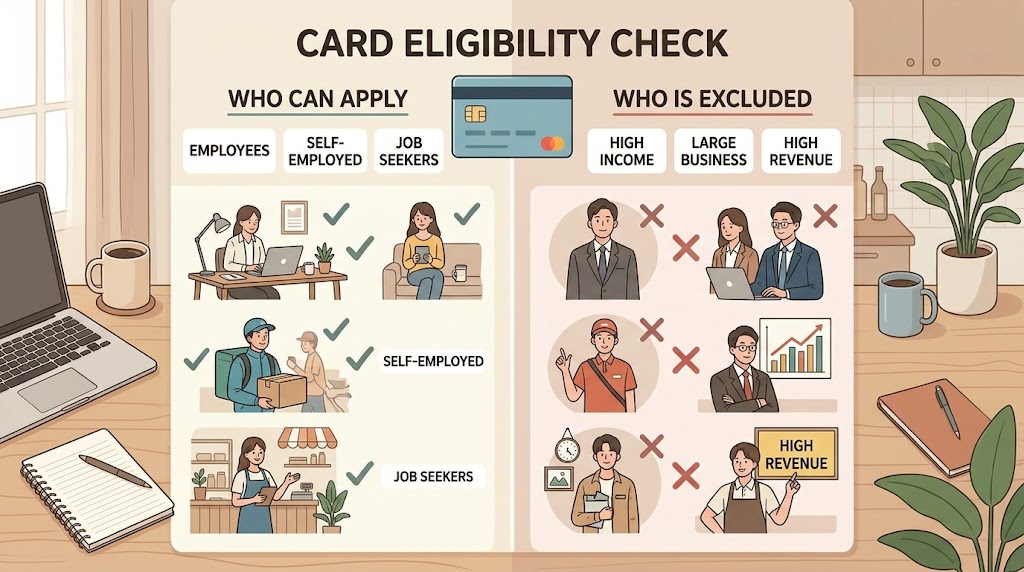
Essential Pre-Application Check! Self-Diagnosis for 6 Exclusion Categories
While the National Tomorrow Learning Card is open to most citizens, clear exclusion criteria are legally established because the program operates on a limited national budget.
Applying without properly checking these requirements only wastes time if rejected during the review stage. Before clicking the apply button on Employment24, carefully check whether you fall into any of the 6 exclusion categories below.
- Current Public Officials and Private School Faculty/Staff
Reason for Exclusion: National public officials, local public officials, military personnel (career military), private school teachers, and administrative staff are completely excluded from the Ministry of Employment and Labor’s government-subsidized vocational training, as separate welfare and in-house training systems are established for civil servants and faculty members.
Note: For contract or non-regular workers, eligibility may vary depending on whether employment insurance is maintained and specific employment arrangements, requiring verification with the competent employment center.
- Age Limit: Persons Aged 75 or Older
Reason for Exclusion: The primary purpose of the National Tomorrow Learning Card lies in strengthening job capabilities and promoting economic activities (employment and reemployment). Consequently, under the program’s operating regulations, individuals who reach 75 years of age or older are excluded from receiving new card issuances.
Note: As long as you are under 75 years of age, the upper age ceiling does not apply, allowing middle-aged and older adults to apply freely.
- High-Income Employees Under 45 Years Old at Large Enterprises (Large-Scale Corporations)
Reason for Exclusion: While employees of priority support target enterprises (SMEs) can apply regardless of income, certain restrictions apply to workers at large-scale corporations (large enterprises).
Criteria: Employees working at a large enterprise who are under 45 years of age and have an average monthly wage of 3 million KRW or more over the past 3 months are considered fully capable of self-funding, restricting them from receiving card issuance.
Exceptions: Even when employed at a large enterprise, individuals aged 45 or older, or those under 45 whose average monthly income is less than 3 million KRW, are eligible to receive issuance.
- High-Income Workers in Special Types of Employment (Specially Employed)
Reason for Exclusion: Workers in special types of employment—such as insurance planners, golf caddies, home-tutor teachers, parcel delivery drivers, and delivery riders—are also included in the support scope, but are excluded if they exceed a certain income threshold.
Criteria: Individuals whose average monthly income over the past 3 months from the date of application is 5 million KRW or more are excluded from issuance. When applying, submission of withholding receipts or income certificates proving recent earnings may be required.
- Individual Business Owners (Self-Employed) Exceeding Annual Revenue Thresholds
Reason for Exclusion: Self-employed individuals may also apply for the card to transition careers or seek reemployment after closure, but business operators generating revenue above a certain threshold are excluded.
Criteria: Among general taxpayers holding a business registration certificate, those with annual revenue of 400 million KRW or more are ineligible for issuance.
Real Estate Leasing Businesses: For real estate rental businesses, separate criteria apply, excluding those whose annual rental supply value (sum of rent and deemed rental income) meets or exceeds a certain threshold (48 million KRW).
- Enrolled University (Graduate) Students with More Than 2 Years Remaining Until Graduation
Reason for Exclusion: Although support for university students has expanded significantly, lower-grade students are still excluded because they are considered to be in a period that requires dedication to academic coursework.
Criteria: Students whose remaining prescribed coursework until graduation exceeds 2 years cannot apply. (e.g., first-year students and second-year first-semester students at 4-year universities)
Eligible Application Timing: For 4-year universities, students who have finished the second semester of their second year (entering their third year) will have 2 years or less remaining until graduation and can normally receive card issuance. The same criteria apply to students on leave of absence based on their remaining semesters.
If you do not fall into any of the 6 criteria above, you are fully qualified to receive the National Tomorrow Learning Card. In the next step, let us examine the actual support limit you can enjoy.

How Much Support Can You Receive? Overview of Basic Limits and Additional Subsidies
Once you have decided to apply for the Tomorrow Learning Card, the question you are most curious about is undoubtedly: “So, exactly how much government support can I receive?”
The Tomorrow Learning Card does not operate on a method of paying out the same fixed amount in a lump sum to everyone; instead, it is structured to grant a base limit first, and then add supplementary subsidies depending on an individual’s financial situation or whether they belong to a vulnerable group. Here is a clear breakdown of the maximum support limit you can utilize and tips for managing its validity period.
- Basic Support Limit: A Total of 3 Million KRW Over 5 Years
When first issued the Tomorrow Learning Card, everyone is commonly granted a virtual account limit of a basic 3 million KRW.
5-Year Validity Period: It is valid for 5 years from the date of issuance, and instead of having to spend the entire 3 million KRW at once, it can be deducted in installments (used incrementally) whenever you take desired courses.
Deduction Method: Rather than the entire academy course tuition being withdrawn from your bank account, the corresponding government subsidy amount is automatically deducted from the card system limit (3 million KRW), and you only pay a portion of the “out-of-pocket copayment.”
- Up to 5 Million KRW! Eligibility and Requirements for Additional Subsidies
For those in vulnerable groups who have exhausted the basic limit of 3 million KRW or require further support, an additional limit of 1 million to 2 million KRW can be granted through a review, expanding the total up to 5 million KRW.
Eligible for 1 Million KRW in Additional Support:
Non-regular workers, including fixed-term, dispatched, part-time, and daily workers
Workers employed at priority support target enterprises (SMEs) who have experienced unpaid wages
Workers in employment crisis zones and special employment support sectors
Eligible for 2 Million KRW in Additional Support (Up to 5 Million KRW in Total):
Participants in Type I of the National Employment Support Program (low-income job seekers)
Specific classes under Type II of the National Employment Support Program (Basic Livelihood Security recipients, near-poverty groups, single-parent families, North Korean defectors, etc.)
Vulnerable groups such as persons scheduled for release from prison and female heads of household
Key Tip: Additional support is approved through a separate supplementary application and review via the Employment24 portal or your competent Employment Welfare Plus Center when the basic limit (3 million KRW) has been almost entirely exhausted.
- 100% Fully Free with No Limit Deduction? “Specialized Training” Benefits
Even if your card’s remaining balance is only 3 million KRW, there are special policy courses where long-term intensive courses—costing anywhere from several million to 10 million KRW—can be taken entirely funded by the government (0 KRW copayment).
K-Digital Training (KDT): Intensive training in digital new technology fields such as AI, big data, cloud, and full-stack development, where 100% of the training costs are supported by the government once in a lifetime. (Only the basic support level is pro forma deducted from the card’s remaining limit, and the excess amount is fully covered by government funds)
National Key and Strategic Industry Training (Gukgi): Covers national strategic occupations including manufacturing, machinery, smart factories, and root industries, where in most cases no copayment is incurred or only a minimal fraction applies.
- Validity Period (5 Years) Management and Remaining Limit Expiration Rules
Automatic Expiration of Remaining Limits: When 5 years elapse from the date of issuance, the card’s validity period expires, and any remaining balance in the account is automatically recovered to the national treasury and forfeited.
Reissuance Eligibility: If you still need job competency development after the 5-year validity period ends, you can settle your existing card, reapply anew, and receive a 3 million KRW limit once more. However, if there is an accumulated history of penalties for course dropouts or non-completion while using the previous card, reissuance may be deferred for a certain period or reduced in amount, making diligent course completion essential.
Once you have grasped the limits available to you—ranging from the base 3 million KRW up to 5 million KRW, as well as fully funded government courses—it is now time to access Employment24 and apply for the card directly. In the next step, we will walk you through the 4-step online application process that can be completed in just 5 minutes.
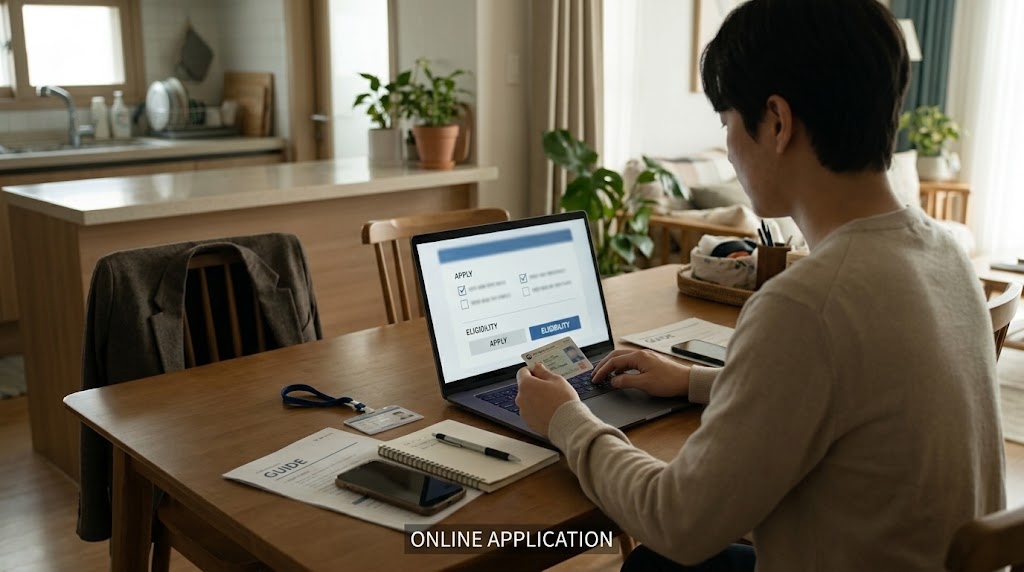
4 Steps to Complete the Online Application on Employment24 in 5 Minutes
Once you have checked both the support qualifications and exclusion criteria, it is now time to actually get your card issued. Without needing to visit an Employment Welfare Plus Center in person, you can easily complete the application in about 5 minutes via PC or smartphone using the Ministry of Employment and Labor’s integrated portal, “Employment24 (work24.go.kr).”
To ensure a smooth process without getting stuck midway, here are the essential procedures broken down into 4 steps.
Step 1: Log in to Employment24 and Prepare Basic Requirements (Verify Job Search Registration)
Accessing Employment24 and Logging In:
Access the Employment24 website (work24.go.kr), and log in via identity verification using your preferred method among Joint Certificates, Financial Certificates, or Simple Authentication (KakaoTalk, Naver, PASS, Toss, etc.).
Verify Job Search Application (Mandatory for the Unemployed and Job Seekers):
If you are applying with the status of an unemployed job seeker, “Worknet Job Search Application (Job Search Registration)” must be completed before applying for card issuance. Register your basic resume and self-introduction letter under the [Employment Support] menu in Employment24, and secure your job search certification number in advance.
(※ Employed workers, currently enrolled students, and self-employed individuals may proceed directly to the next step without job search registration.)
Step 2: Watch the Mandatory Online Pre-Training Video (Approx. 10–15 Minutes)
To apply for the Tomorrow Learning Card, watching an online informational video explaining the policy’s purpose, card usage rules, attendance criteria, and course drop penalties is a statutory requirement.
Path: Employment24 Home > [Vocational Competency Development] > [Tomorrow Learning Card] > Select [Apply for Issuance]
Before entering the application form screen, a “Watch Video” pop-up or guidance banner will appear.
Watch the short briefing video lasting about 10 to 15 minutes all the way through, and complete the simple comprehension quizzes presented during or at the end of the video to fulfill the video completion requirement.
Step 3: Select Card Type, Partner Bank, and Receipt Method
Once you finish watching the video, you will proceed to the official application form screen. After entering basic personal information such as your name, residential address, and emergency contact, you need to designate financial information.
Select Partner Financial Institution: Choose either Shinhan Card or NH NongHyup Card based on which bank is more convenient to use as your settlement account.
Select Card Type:
Check Card (Debit Card): Copayments are debited immediately from your bank account balance (most commonly chosen)
Credit Card: Billed in arrears on designated payment dates just like standard credit cards
Designate Receipt Method:
Postal Mail (Home or Workplace) Delivery: The physical card is delivered via registered mail to your home or workplace; this requires in-person receipt and usually takes about 3 to 5 business days.
Bank Branch Pick-Up: If you want faster receipt, you can visit a designated branch in person to collect the physical card immediately. (Visiting only after receiving the center’s approval completion SMS is required)
Step 4: Self-Diagnosis of Support Eligibility, Attach Supporting Documents, and Submit
Finally, conduct a final review of your employment status and eligibility requirements, then submit the application.
Check Support Target Self-Diagnosis Items:
Carefully check off the items verifying that you do not fall under statutory exclusion criteria such as public officials, private school faculty, high-income corporate employees, or business owners exceeding revenue thresholds.
Attach Supporting Documents (Applicable Individuals Only):
General unemployed individuals and SME employees do not need separate documents, as their qualifications are verified automatically via interconnected administrative networks. However, the individuals below must upload photo or scan files of supporting documentation.
University (Graduate) Students: Certificate of enrollment, transcript, or certificate of expected graduation proving that 2 years or less remain until graduation
Small Business Owners: Revenue verification documents such as a Value-Added Tax Taxable Base Certificate or VAT-Exempt Business Revenue Certificate
Special Types of Workers: Income certificate, withholding receipt, etc., confirming average monthly income over the past 3 months
Final Application Submission:
Designate your competent Employment Welfare Plus Center and click the [Apply] button to securely finalize your online submission.
Once the application is properly submitted, the screening process takes approximately 3 to 7 business days, and the approval outcome will be notified via KakaoTalk notification talk or SMS text message. In the next step, we will explore tips for receiving the physical card after application approval and wisely searching for courses to take.

Procedures After Applying for Issuance: From Card Receipt to Course Exploration
Once you have submitted your online application for the National Tomorrow Learning Card on Employment24, you enter the stage of preparing for your learning journey in earnest.
Rather than merely waiting until the card arrives, it is smart to check the screening progress, securely receive the physical card, and proactively scout out the training courses best suited for you in advance. Here is a summary of the key procedures you will go through from immediately after application submission until course opening.
- Checking Card Issuance Review and Approval Notification (3 to 7 Business Days)
Once the application is transmitted to your competent Employment Welfare Plus Center, the officer in charge begins reviewing your eligibility.
Review Processing Time: It usually takes about 3 to 7 business days. (It may be delayed by a few more days during early-year periods or vacation seasons when applicants surge.)
Real-Time Progress Tracking:
Log in to Employment24 > [My Page] or [Vocational Competency Development] > [Tomorrow Learning Card] > [Issuance Application History] to check the current processing status (Received → Under Review → Approved/Rejected) at any time.
Receiving Approval Notification: Once eligibility is approved, the employment center sends a “Card Issuance Decision (Approval)” KakaoTalk notification talk or SMS text message to the registered mobile phone number.
Caution: If you receive a document supplement request or a rejection message, check the rejection reason (missing supporting documents, uncompleted job search registration, etc.), correct the corresponding item on Employment24, and reapply.
- Receiving the Physical Card and Registering for Use
Once the employment center grants approval, the information is forwarded to the card issuer selected during application (Shinhan Card or NH NongHyup Card), proceeding with card creation and issuance.
Receipt via Postal Delivery:
Registered mail designated exclusively for personal receipt is delivered to the home or workplace address entered during the application. (Usually takes 3 to 5 business days from approval to delivery)
When received directly in person upon ID verification, it is mostly activated automatically, but in cases of proxy receipt or safe delivery, payment becomes possible only after completing “Card Activation” via the card company’s app or ARS.
Immediate Pick-Up at a Bank Branch:
If urgent course registration and payment are needed, you can visit the designated financial institution branch chosen during your application to receive it in person.
You must bring your ID card along with the employment center’s “Issuance Approval Confirmation” or approval notification text message to complete same-day issuance processing.
- Smartly Exploring and Bookmarking Training Courses on Employment24
Instead of passively waiting while the card is being shipped, you should carefully explore the training courses you want to take on Employment24 in advance. This is because popular courses often close 2 to 3 weeks before the start date.
Region and Schedule Filtering:
In the Employment24 training search box, set filters for areas near your residence (within commuting distance) and your desired start schedules (weekday daytime class, night class, weekend class).
Check Total Training Hours (140-Hour Benchmark):
Long-Term Courses of 140 Hours or More: Eligible for unemployed training incentives (meal and transportation allowances), and a training consultation procedure with an employment center counselor may be required after online course application.
Short-Term Courses Under 140 Hours: You can apply for courses online immediately without a training consultation procedure.
Check Academy Evaluation Grades and Course Reviews:
Carefully compare the Ministry of Employment and Labor-certified training institution evaluation grades (e.g., 3-year/5-year certification), past completion rates, and actual trainee satisfaction ratings provided on each course detail page to select a location with proven lecture quality.
Register “Courses of Interest” (Bookmarking):
When you find a course you like, click the heart icon (Add to Courses of Interest) on the detail page to save it, allowing you to transition directly to the course registration step without delay the moment the physical card is in your hands.
- Inquiring in Advance About Academy In-House Consultation (Selection) Procedures Before Course Registration
Among government-funded courses, employment-linked bootcamps (K-Digital Training) and specialized advanced courses conduct separate in-house document screening, interviews, or level tests by the academy itself, in addition to registration on Employment24.
It is recommended to call the counseling desk of the academy offering your course of interest in advance and check: “I am inquiring after viewing Employment24; are there any internal selection schedules or preparation requirements for this course?”
If remaining spots are limited, securing a seat safely can be done by arranging advance pre-registration or a consultation schedule with the academy even during the card issuance screening period.
Now you fully understand everything from receiving your card to course exploration preparation. Lastly, let us wrap up by reviewing frequently asked questions (FAQ) and a final pre-application checklist to ensure nothing has been missed.
Frequently Asked Questions (FAQ) & Application Precautions
We have compiled questions that many people find confusing or frequently encounter during the screening process when applying for the National Tomorrow Learning Card online. Here they are, along with essential points to note just before submitting your application.
Frequently Asked Questions (FAQ)
Q1. If I was issued the card while employed, do I need to re-issue it if I quit midway?
A. There is no need to get it re-issued. The National Tomorrow Learning Card is an integrated card for both the unemployed and the employed, so even if your status changes during the 5 years from the issuance date, the physical card and account limit remain intact.
However, if you wish to participate in a long-term course of 140 hours or more while unemployed to receive training incentives (meal and transportation allowances), you must change your status to ‘Job Seeker’ on Employment24 (linked to Worknet job search registration) to be eligible for normal support.
Q2. Is it possible to apply for issuance on a smartphone mobile app or mobile web?
A. Yes, 100% of the application can be completed on mobile. If you download the Employment24 mobile app or access it via a smartphone browser and log in with simple authentication (KakaoTalk, Naver, PASS, etc.), you can submit your application in the exact same way as on a PC. For supporting documents, you can simply attach photo files taken with your smartphone camera.
Q3. My application was ‘rejected (returned)’ after applying. How should I handle this?
A. Over 90% of rejection reasons are due to ‘missing job search registration (unemployed)’, ‘insufficient required supporting documents (self-employed/students)’, or ‘incorrectly checked self-diagnosis items’. The specific reason for rejection is stated on the Employment24 [Issuance Application History] detail page or in the text message sent by your competent center, so you can immediately re-apply after supplementing the missing parts.
Q4. Will there be any disadvantage or cancellation if I do not use the card immediately after issuance?
A. There is no disadvantage whatsoever. Even if you do not take a course right away after issuance, the limit is safely maintained for the 5-year validity period. You can freely use it whenever the training course you want becomes available.
Before Final Submission of the Application! Essential Checklist
Make sure to check off all items below before clicking the apply button.
[ ] Check unemployed job search registration status: Verify that job search registration within Employment24 is properly completed when applying under unemployed status
[ ] Complete pre-training video: Confirm completion of watching the 10–15 minute mandatory informational video and submitting the quiz
[ ] Prepare required supporting documents: Check whether necessary documents such as enrollment/transcripts for university (graduate) students or VAT certificates for self-employed individuals are attached
[ ] Select partner card issuer and settlement account: Select a card linked to your primary everyday bank between Shinhan and NH NongHyup
[ ] Verify contact details and delivery address: Re-check the mobile number for receiving screening result notification messages and the address to directly receive the physical card
The National Tomorrow Learning Card is the most practical government-subsidized benefit open to everyone embarking on learning. We encourage you to carefully prepare the eligibility requirements and procedures to apply, and we support you in achieving your desired competency development and career growth!
Do you need subsequent tasks to finalize your post drafting?
Drafting a concluding ending paragraph for the overall post
Generating Naver Blog-optimized titles and hashtags
Korean version: 한국어로 읽기