The Terrifying Legal Liability Hidden Behind a Clean Environment
In our daily lives, we often mindlessly dispose of or process trash. When doing spring cleaning, moving, or carrying out interior renovations, people frequently dismiss various waste materials as “surely this little bit is fine,” mixing them into standard volume-rate bags or abandoning them in unregulated locations. However, such minor carelessness and complacent attitudes not only cause environmental pollution, but can also lead to unexpected, terrifying legal liabilities and financial blows.
Recently, local governments and environmental authorities have tightly reined in their crackdowns on illegal dumping and improper waste treatment. With constant surveillance cameras (CCTV) operating around the clock, alongside resident reporting systems built on mature civic consciousness, the enforcement net is growing tighter by the day. Minor violations that previously passed with mere guidance are now trending toward inevitable fines or administrative dispositions without exception, following a zero-tolerance principle.
In particular, according to the Wastes Control Act, disposing of waste through unauthorized methods or dumping it illegally can result in fines ranging from several hundred thousand to several million won, depending on the frequency of violations and the type of waste. In serious cases, offenders may become targets of criminal prosecution, leaving a criminal record or facing even greater legal disadvantages.
This is precisely why actions taken with the mindset that “just me being like this will be fine” boomerang back not as a way to protect precious assets, but as massive fine bombs and legal liabilities. We must fully recognize that just as heavy as the waste we generate is, the legal standards and responsibilities accompanying its treatment are equally severe. Let us thoroughly examine what types of violations exist and why they are inevitably caught.
Illegal Dumping of Municipal Solid Waste and Business Waste
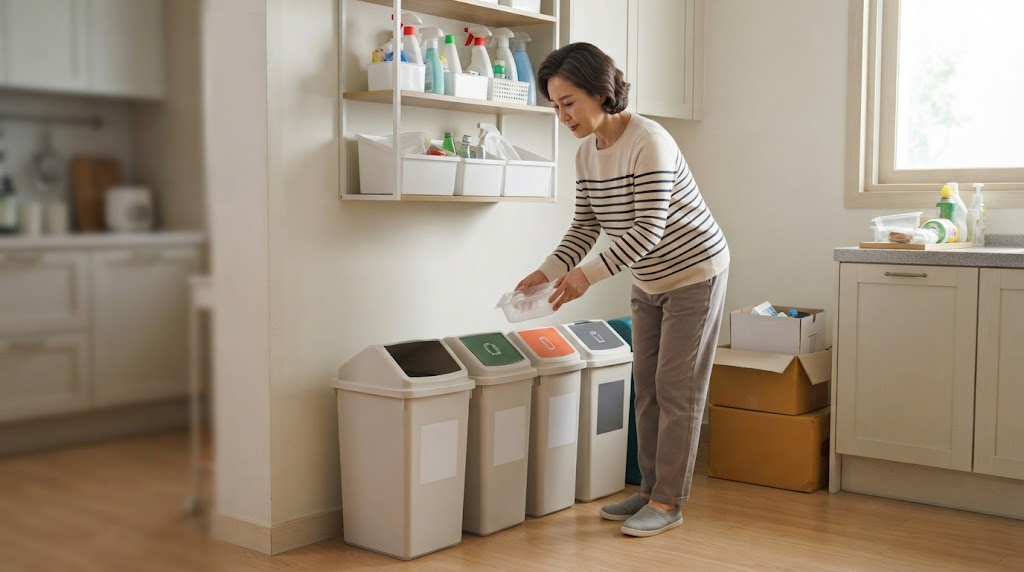
One of the most commonly detected cases of waste treatment method violations is the illegal dumping of municipal solid waste and business waste. Trash generated in daily life or waste produced at workplaces must be processed according to designated separate disposal guidelines and standards under relevant laws and regulations, but failing to follow these frequently leads to getting hit with heavy fine bombs.
- Representative Types of Illegal Municipal Solid Waste Dumping and Fines
Municipal solid waste refers to general trash generated in homes or small business establishments.
Failure to use volume-rate garbage bags and mixed disposal: Disposing of trash in general plastic bags or hemp sacks instead of using designated standard volume-rate bags, or illegally mixing recyclables with food waste, constitutes a clear violation.
Failure to attach large waste stickers: Leaving large waste items such as furniture or home appliances unattended on the street without prior reporting and fee payment (such as attaching stickers) to the jurisdiction’s local government.
When such illegal dumping of municipal solid waste is caught, fines ranging typically from 100,000 won up to a maximum of 1 million won are imposed according to the Wastes Control Act and local government ordinances. These are levied differentially depending on the dumped volume and frequency, ranging from minor violations like discarding carried waste such as cigarette butts or tissues to secretly dumping large-scale waste.
- Severe Legal Liability for Illegal Dumping of Business Waste
Business waste refers to waste generated due to business activities in factories, commercial stores, construction sites, etc., and much stricter standards apply compared to municipal solid waste.
Illegal discharge and consignment treatment violations: Waste generated at workplaces must be processed through legitimate treatment facilities or authorized collection and transportation companies. Discharging waste mixed with general trash to save costs or secretly dumping it in deserted areas is a subject of strict enforcement.
Arbitrary landfill disposal and abandonment of construction waste: Forcing waste generated during interior renovations or small-scale demolition work into volume-rate bags or discharging it out of standard specifications also falls under illegal business waste disposal.
When regulations related to business waste are violated, fines on a completely different scale from municipal solid waste fines imposed on individuals are assessed. Depending on the scale of the violation, fines ranging from several million won up to a maximum of over 10 million won, as well as business suspension or criminal prosecution depending on the case, can follow, requiring special caution.
Illegal dumping that occurs while trying to save the “cost and hassle” of throwing away trash ultimately returns as a heavy price of legal punishment as well as economic loss. Proper separate disposal and compliance with specifications are the most reliable ways to protect one’s assets.
Improper Treatment Methods Such as Incineration and Landfill
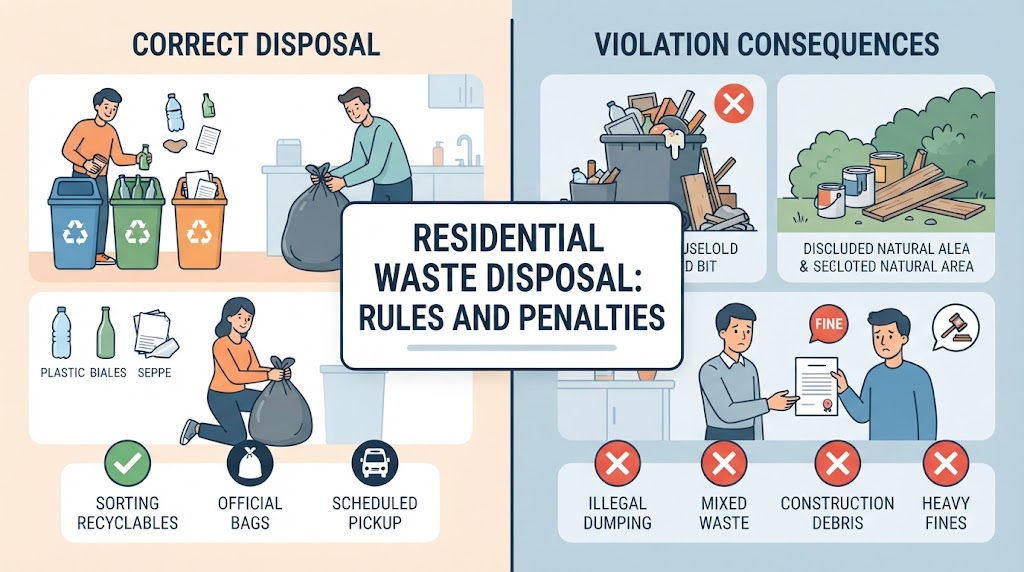
Among violations of waste treatment methods, the types that invite the most serious environmental destruction and severe legal punishments are unauthorized incineration and arbitrary landfill disposal. People often mistakenly think that incinerating trash or burying it in the ground in rural villages, vacant lots, or even near urban centers is an “efficient method for quick processing,” but this is a clear illegal act.
- Unauthorized Illegal Incineration Activities and Risks
The act of arbitrarily burning trash generated in homes or businesses in yards or vacant lots falls under violations of the Clean Air Conservation Act and the Wastes Control Act.
Hazardous substance emissions and fire risks: Incinerating trash in the open air emits massive amounts of human-fatal hazardous substances such as dioxins, carbon monoxide, and fine dust directly into the atmosphere without filtration. Furthermore, there is a very high risk of easily leading to large-scale wildfires or fire accidents.
Fines and penalty standards: When caught illegally incinerating household trash or agricultural waste (vinyl, pesticide containers, etc.), fines ranging from several hundred thousand won to over 1 million won can be imposed according to local government ordinances and relevant laws. In particular, if caught incinerating waste in the open air at a business site, the level of punishment becomes much higher, making it difficult to avoid multi-million won fines and administrative dispositions.
- Legal Responsibilities for Illegal Landfill and Arbitrary Disposal within Land
Secretly burying construction waste, business waste, or bulky trash that is cumbersome to process in land, mountain forests, or vacant lots is a major crime that causes severe soil and groundwater contamination.
Environmental pollution and restoration orders: Waste buried in the ground does not decompose for a long time or leaks hazardous chemicals, ruining the surrounding ecosystem and agricultural land. When caught, a strong ‘restoration order’ is issued by the competent authority, and the offender has to bear the enormous costs incurred in directly digging up the waste and processing it legally.
Targets for criminal prosecution: Illegal landfilling does not stop at simple fine imposition, but can lead to criminal prosecution under the Wastes Control Act, leaving a criminal record or leading to heavy criminal punishments such as prison sentences.
Trash must be processed only through designated incineration or landfill facilities, or companies with legitimate permits. Improper incineration and landfill chosen to save costs and effort can never be concealed and will return as massive economic and legal consequences that cannot be undone.
Analysis of Main Causes for Getting Caught in Crackdowns
There are solid reasons why trash mindlessly discarded with the thought, “Surely nobody will notice this much,” gets caught without fail. People think they can avoid the eyes of local government enforcement teams, but modern illegal waste dumping enforcement networks are much denser and more scientific than imagined. When we examine the main causes for getting caught in crackdowns, it becomes clear why illegal dumping inevitably gets exposed in the end.
- Advanced Equipment and Constant Surveillance Networks (CCTV and Drones)
In the past, blind spots were numerous because enforcement personnel patrolling the sites directly to catch violators was the main method. However, the situation has completely changed recently.
Expansion of unmanned surveillance cameras (CCTV): High-definition mobile and fixed CCTVs are operating 24 hours a day in habitual dumping areas or alleyway blind spots. Even at night or during deserted hours, the suspect’s appearance, clothing, and vehicle license plate are entirely captured as evidence through infrared shooting functions and motion detection functions.
Introduction of intelligent surveillance systems: Recently, smart warning signs and AI-based surveillance systems are linked in areas with frequent illegal dumping, making systems widespread where notifications are sent to government office control rooms or automatic recording starts the moment trash is discarded.
- Mature Civic Consciousness and Resident Reporting (Informers)
Even in places without any CCTV, it is difficult to completely fool the eyes of nearby neighbors or passersby.
Dashcam and smartphone reporting: There are very many cases where sites of illegal dumping are entirely captured on passing vehicles’ dashcams or pedestrians’ smartphones. Because secretly discarding trash makes people around frown, cases of citizens actively taking photos or videos and reporting them through the e-People (Kukinmungo) portal or local government civil petition counters are surging.
Activation of reward systems: Some local governments operate systems that pay a certain percentage of the imposed fine amount as a reward to illegal dumping reporters, leading to an increasing trend of citizens acting as voluntary monitors.
- ‘Reverse Tracking (Tear-Open Trash Inspection)’ via Traces Inside Trash
It is easy to feel relieved thinking you hid it perfectly because there were no CCTV cameras or witnesses, but cases where violators get caught by the so-called ‘trash stalking’ technique—where enforcement teams directly tear open and investigate the trash left at the scene—happen frequently.
Personal information and receipt clues: When digging through trash contained in non-standard bags or boxes, clues that can identify individuals are often left intact, such as names, addresses, and phone numbers attached to delivery waybills, receipts paid for with cards at convenience stores or marts, hospital prescriptions, and utility bills.
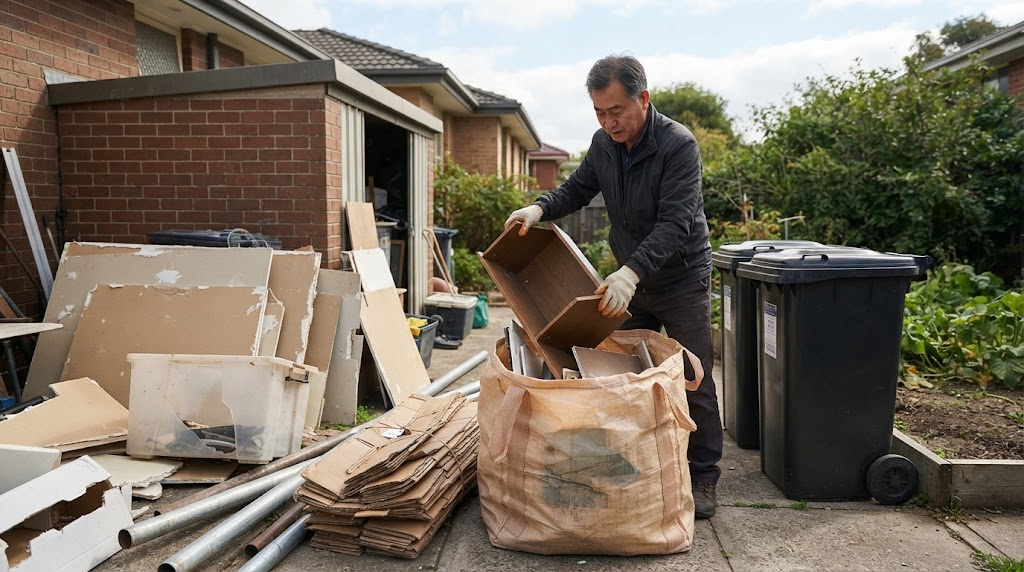
Tracking traces of business waste: In the case of construction or interior waste, experts can easily deduce which site it came from by analyzing the characteristics of the materials used or the types of architectural by-products discharged.
Illegal dumping stems from the complacent gamble that “just me getting away with it will be fine,” but the eyes of enforcement are always operating closer than expected. Because attempting dumping itself carries risks, once you know the causes, not hoping for a shortcut in the first place is the best policy.
Legal and Safe Waste Disposal Guide
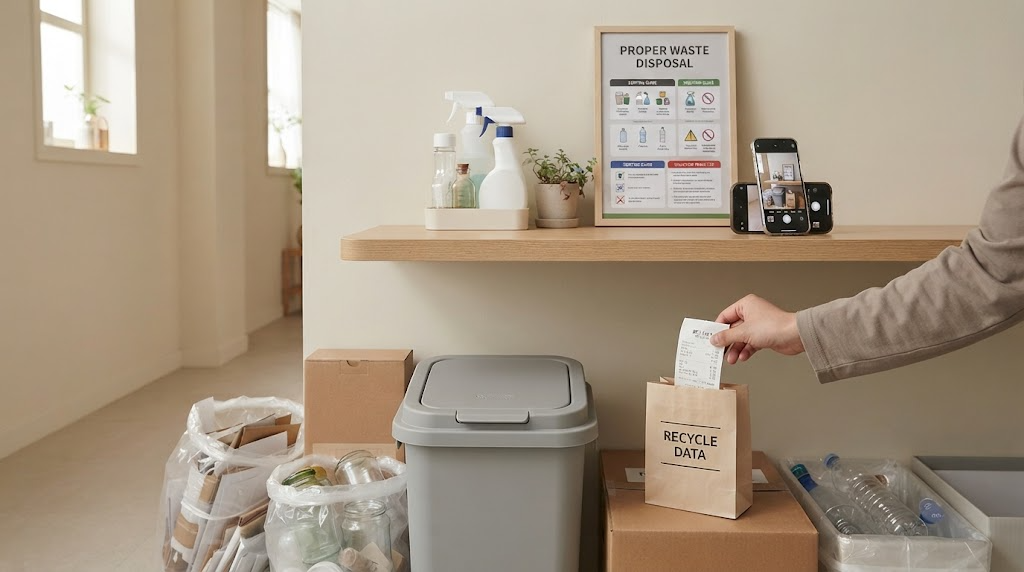
The most reliable way to avoid fine bombs resulting from violations of waste treatment methods is naturally ‘legal and safe disposal’ that fits laws and local government ordinances. It might vaguely feel difficult and complicated, but if you remember just a few principles, anyone can process waste easily and correctly. We have organized the correct disposal guidelines by situation.
- Municipal Solid Waste and Bulky Waste Disposal Guidelines
Making the use of standard volume-rate garbage bags a habit: General trash must be discharged by putting it into volume-rate bags designated by the respective local government. Recyclables must be thoroughly separated by type, and food waste must be discarded by using dedicated collection bins or attaching fee payment certificates.
Prior reporting of bulky waste and fee payment: Bulky waste such as wardrobes, beds, desks, and home appliances must not be arbitrarily left out on the street.
Reporting method: Visit the official website of the competent local government (city, county, or district), community service center (administrative welfare center), or use a mobile app designated by the local government to report items and pay fees.
Disposal method: You must print and attach the fee payment certificate (sticker) issued after payment, or write down the designated reporting number on a blank piece of paper and attach it before discharging at the designated date, time, and location.
- Legitimate Processing Guidelines for Construction Waste and Business Waste
Waste generated during interior renovations, self-remodeling, or business operation processes must be managed completely separately from municipal solid waste.
Processing a small amount of architectural waste: When a small amount of waste is generated due to interior work or similar, do not forcefully cram it into volume-rate bags, but purchase non-combustible waste-dedicated hemp sacks (special standard sacks) approved by the competent local government and discharge it inside them.
Consigning large-scale construction waste: Construction waste whose discharge volume exceeds certain standards must be strictly consigned to officially licensed collection, transportation, and treatment companies registered with the Ministry of Environment and local governments. When signing a contract, it is safe to check whether the company has legitimate processing capabilities and transparently manage the processing procedure through simplified waste transfer notes.
- Separate Discharge of Agricultural Waste and Special Items
Agricultural plastic waste or empty pesticide bottles generated in rural areas should be taken to village-specific shared collection yards to ensure safe collection.
In the case of waste home appliances, using the free home appliance visiting collection service operated by the Korea Electronics Recycling Cooperative allows you to safely discharge large home appliances for free at home without having to move them yourself or purchase stickers.
Proper waste disposal is not a cumbersome procedure, but the smartest practice to protect your wallet, our neighborhood, and the natural environment. A small habit of complying with regulations completely clears away unnecessary worries about fines.
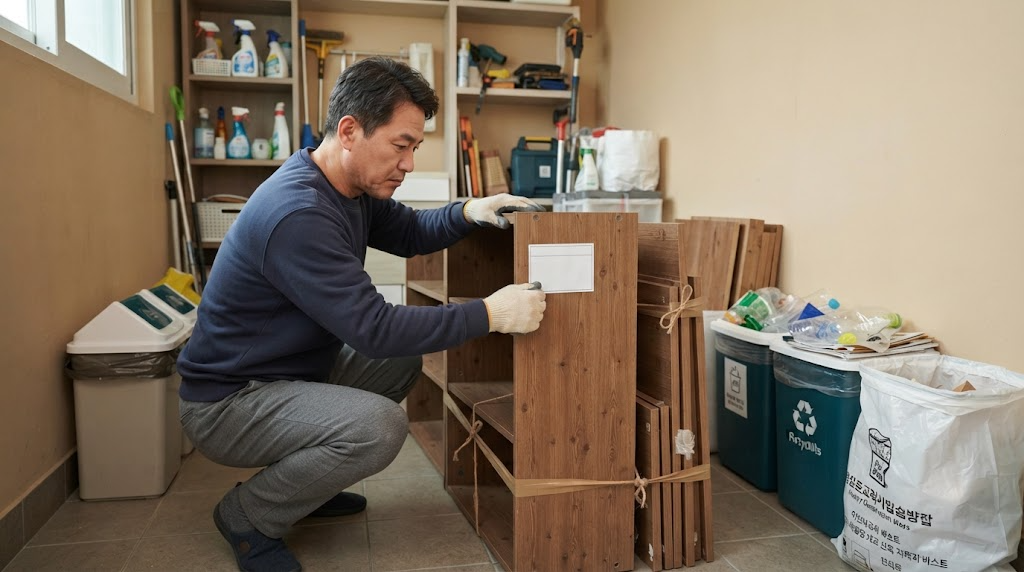
Preventing Fines through Proper Separate Discharge and a Law-Abiding Spirit
Fines and legal punishments imposed during the waste disposal process mostly stem from minor carelessness or complacent thoughts such as “surely it will be fine.” The attitude of checking relevant regulations and keeping principles even when discarding a single piece of trash goes beyond simply obeying the law; it is the most reliable way to protect our precious assets and maintain a pleasant residential environment.
As we have explored through this article, illegal dumping or unauthorized incineration and landfilling are bound to be exposed through advanced CCTV, active reports from residents, and thorough waste tracking investigations. The risks of fines amounting from hundreds of thousands to several million won imposed upon violation, administrative dispositions, and even criminal prosecution are entirely preventable in advance.
Therefore, rather than choosing illegal methods to alleviate minor inconveniences in daily life, we should make the following principles a habit:
Check specifications and methods before disposal: Always use volume-rate bags for general trash, and discharge bulky waste at designated locations after prior local government reporting and fee payment.
Utilize professional treatment facilities: Do not arbitrarily mix and discard waste generated from interior renovations or business sites, but process it safely using special standard hemp sacks or through officially licensed companies.
Have a mature consciousness thinking of the environment: The proper separate disposal habit practiced by one person like myself protects our neighborhood’s environment and serves as a solid shield preventing unnecessary economic losses.
Please remember the truth of waste treatment: “Trying to save hassle and costs leads to paying a far greater price.” We hope you protect a clean and safe daily life free from worries about fines through a thorough law-abiding spirit and the practice of proper separate disposal.
Korean version: 한국어로 읽기