
The National Tomorrow Learning Card with Expanded Access: What Has Changed?
Background of the Changes and Expansion of the National Tomorrow Learning Card
Amidst a changing labor market and rapidly developing technology, building job competencies and preparing for new challenges is now a necessity rather than an option.
Broad Expansion of Eligible Recipients: As the previously segregated systems for job seekers and employed workers were integrated, the system actively reflected the realities of a modern labor market with diversified employment forms, such as special-type employment workers, freelancers, and small-scale self-employed individuals.
Lowering Entry Barriers: By significantly reducing strict restrictions based on income or employment status, the gateway has been widened so that any Korean citizen can continue self-development and vocational skill development throughout their lifetime.
Increased Flexible Usability: With a single issued card, individuals can now systematically plan and take various online and offline training courses at the right time for up to 5 years.
Choose additional topics you are curious about:
What are the eligibility requirements for the 2026 National Tomorrow Learning Card?
I’m curious about how to apply online through Goyong24 (HRD-Net).
What is the limit for training cost support available through the National Tomorrow Learning Card?
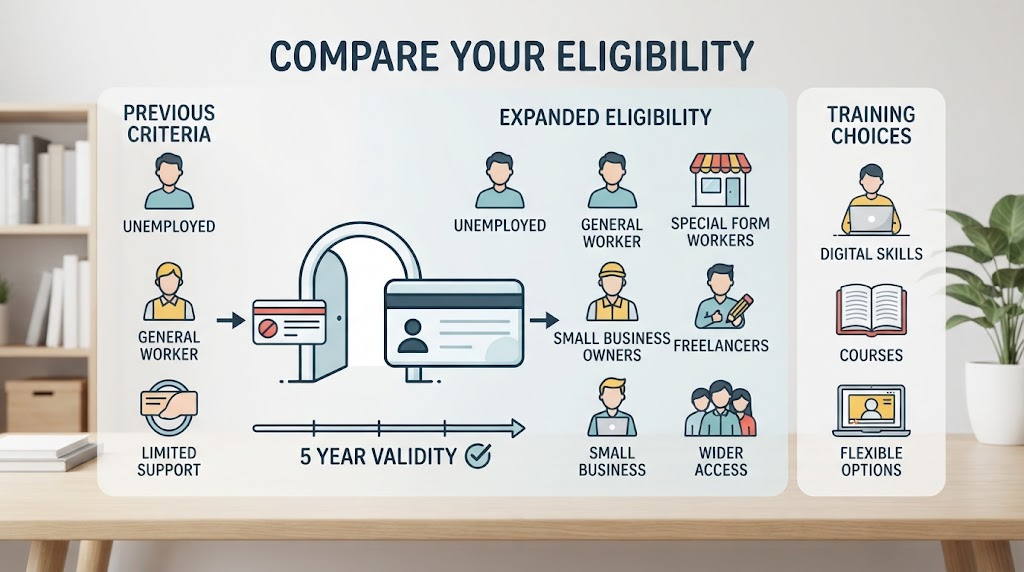
Limitations of Previous Eligibility Criteria and Key Change Points
Until the National Tomorrow Learning Card established itself as South Korea’s representative lifelong vocational skill development system, the system has undergone steady evolution alongside changes in the labor market. The support systems implemented in the past had fairly high, invisible barriers to entry for anyone to easily access. It is worth comparing what limitations the past criteria had and which points of today’s system have innovatively changed.
- Key Limitations of Past Support Systems
Strict Separation of Job Seekers and Employed Workers: In the past, the “unemployed card (Tomorrow Learning Card)” and “employed worker card (worker card)” were completely separated. This caused inconvenience of having to re-issue a card or go through qualification transitions when quitting a job and transitioning to a job-seeking status, or conversely, when starting new studies while employed.
Lack of Reflection on Employment Form Changes: It was difficult to fully embrace the modern labor structure—where diverse employment forms like freelancers, special-type employment workers (teuk-go), and platform workers are surging—under past uniform criteria. Those whose proof of employment was unclear or who fell into employment insurance blind spots had to go through cumbersome verification to receive government funding benefits.
One-time Support and Constraints on Utilization: Once a training course was taken, the card’s validity period was short or re-issuance conditions were strict, making it difficult to pursue long-term and systematic career design tailored to rapidly changing technological trends.
- Key Change Points After System Integration (Expanded Criteria)
To overcome these limitations, the government completely overhauled the system and integrated/launched it as today’s “National Tomorrow Learning Card.” The core change points are as follows:
Integrated into a Single Card (Valid for 5 Years): By removing the distinction between job seekers and employed workers and integrating them into a single card, individuals can continue to use it for up to 5 years without needing to reissue a card even if their employment status changes.
Significant Expansion of Eligible Recipients (Opening the Gateway): A large number of people who were previously in employment insurance blind spots—such as special-type employment workers, small-scale self-employed individuals, and freelancers, as well as unemployed people and general workers—were included in the card issuance targets.
Strengthened Self-Directed Training Design: Breaking away from the rigid, supplier-centered support of the past, flexibility has been greatly enhanced so that individuals can proactively select and take various online and offline courses, including digital and new technology education, tailored to their career goals.
Now that the rigid framework of the past has been broken and the gateway has been greatly expanded, an environment has been created where anyone can easily enjoy the benefits of government funding support if they have the will. Let us look at the specific scope of benefits in the next step to see how my conditions have changed.

Detailed Requirements and Scope of Benefits by Expanded Category
The biggest reason why the National Tomorrow Learning Card was integrated and launched and the system became flexible is that the eligible targets and scope of benefits have expanded significantly. In the past, many classes were alienated from benefits depending on their employment insurance subscription history or specific employment format, but after the reorganization, detailed requirements were made realistic by reflecting changes in the labor market. Let’s take a closer look at the key requirements and specific scope of benefits for each expanded category.
- Special-Type Employment Workers and Freelancers (Resolving Employment Insurance Blind Spots)
Detailed Requirements: A large number of tutors, insurance planners, door-to-door salespersons, golf course caddies, courier drivers, and various freelance workers who were previously placed in support blind spots due to cumbersome proof of employment were included.
Scope of Benefits: Individuals who meet certain income and sales criteria can be issued a card regardless of their employment format. Even those who work in platform labor or freelance formats with irregular income structures can take IT, design, and practical certification courses with government support to enhance their job competencies.
- Small-Scale Self-Employed Individuals and Small Business Owners
Detailed Requirements: In the past, self-employed individuals were excluded from support if their sales scale exceeded a certain level, or the verification process was very complicated. The reorganized criteria lowered the entry barriers for small business owners facing the risk of business closure or small-scale self-employed individuals hoping to change their business category.
Scope of Benefits: Small-scale business owners whose annual sales fall below a certain standard (e.g., annual sales of less than 400 million KRW, adjusted according to detailed criteria) are included as issuance targets. While running their stores, they can take practical education courses that can be directly applied to their business sites—such as marketing, tax and accounting, distribution and logistics—at a low cost, establishing a stepping stone for management improvement.
- University and High School Students (Early Support for Future Talent)
Detailed Requirements: In the past, it was limitedly allowed only to university graduates-to-be or certain senior students, but reflecting the trend of accelerated career exploration periods, the target scope has become flexible.
Scope of Benefits: For general universities (graduate schools), enrolled students with 2 years or less remaining until graduation can apply. In particular, enrolled students of remote universities, such as cyber universities and Korea National Open University, can be issued the card regardless of their school year, providing practical career design opportunities for those juggling studies and job preparation.
- Strengthened Preferential Benefits for Low-Income and Vulnerable Groups
Detailed Requirements: Vulnerable groups who urgently need economic self-reliance, such as recipients of National Basic Livelihood Security, next-lower-income class individuals, and workers in employment crisis areas.
Scope of Benefits: In addition to the basic training cost account limit of 3 million KRW, they can receive additional support of up to 2 million KRW, enjoying benefits within a total limit of 5 million KRW. In addition, the out-of-pocket expenses incurred in general training courses are significantly reduced or completely exempted, allowing them to focus solely on education without economic pressure.
Thanks to these much more flexible criteria, a structure has been completed where the vast majority of South Korean citizens can enjoy benefits regardless of employment format, age, or income level. In the next step, we will examine strict exception criteria where card issuance is still restricted despite such a broad target range.
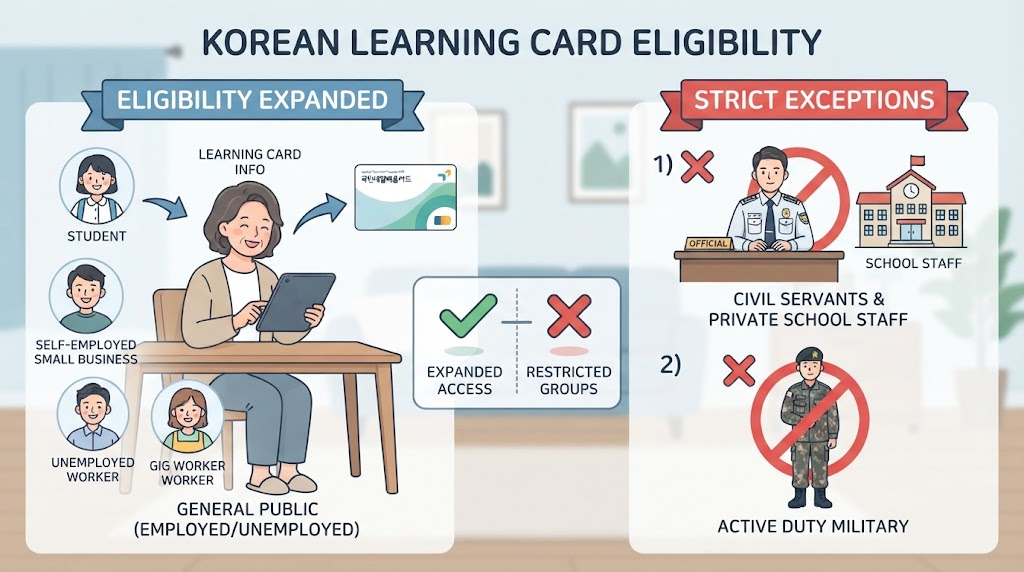
Exception Criteria Where Issuance Is Restricted Despite Expanded Eligibility
Although the National Tomorrow Learning Card has greatly opened its doors to embrace the majority of South Korean citizens, not everyone can get it unconditionally. To efficiently allocate limited national finances to where they are most needed and prevent overlapping benefits or equity issues with other government support systems, clear issuance-exclusion targets (exception criteria) are strictly maintained.
You must carefully check whether you fall under the restriction rules below before applying to prevent unnecessary waste of time.
- Public Sector and Stable Occupational Groups
Active-duty public officials and private school faculty members: National and local public officials, as well as private school faculty members, are excluded from eligibility for the National Tomorrow Learning Card due to their employment stability and separate job training systems.
Military personnel: Active-duty military personnel (excluding those who meet certain exceptional regulations such as imminent discharge or intermediate/junior officers and non-commissioned officers) are excluded from general issuance eligibility.
- Exceeding the Age Limit
Individuals aged 75 or older: Considering the effectiveness of the lifelong vocational skill development system and safety management standards, card issuance is restricted for elderly individuals aged 75 or older.
- Lower-Grade University Students (More Than 2 Years Remaining Until Graduation)
Lower-grade university students: To support career exploration opportunities, the gateway is open to expected graduates (within 2 years), but lower-grade university students with more than 2 years remaining until graduation are excluded from issuance in principle. (※ However, enrolled students at remote universities such as cyber universities or Korea National Open University can be issued cards regardless of grade.)
- High-Income Large Enterprise Workers (Linked to Age and Wage Criteria)
Large-scale corporate workers under 45 years of age with a monthly wage of 3 million KRW or more: Among employees at large corporations who are relatively economically secure and have abundant in-house employee welfare benefits, young and middle-aged adults exceeding a certain income (3 million KRW or more per month) and under 45 years of age are excluded from support. (※ However, issuance is exceptionally allowed for those 45 years of age or older or non-regular workers.)
- High-Income Self-Employed Individuals and Special-Type Employment Workers
High-income business owners and special-type workers exceeding a certain scale: Small-scale business owners and self-employed individuals are protected, but high-income business owners exceeding certain criteria are excluded. For example, self-employed individuals whose annual sales exceed a certain standard (e.g., annual sales of 400 million KRW or more) or special-type employment workers whose monthly income exceeds a baseline (e.g., 5 million KRW or more per month) may have restricted card issuance.
- Other Overlapping Support Restrictions
Duplicate recipients of government training cost support under other laws: Individuals who are already receiving full support for education and training costs of a similar nature from the state, or those currently under a sanction period for receiving subsidies through other fraudulent methods, cannot be issued a card.
As the target has expanded, the scope of enjoying benefits has widened, but if you fall under specific occupational groups, high-income, or age criteria like the above, issuance may be denied. If your eligibility conditions are ambiguous, using the eligibility inquiry service on the Goyong24 portal first rather than applying blindly is the surest way.

Smart Strategies to 100% Leverage the Expanded Eligibility Criteria
As the support eligibility for the National Tomorrow Learning Card has been significantly relaxed and access has opened up, any South Korean citizen now has a powerful self-development weapon that they can actively utilize. However, simply getting a card issued does not automatically lead to a career leap. Several smart strategies are needed to fully make the benefits of the expanded system your own and extract the best efficiency for your cost.
- Precise Pre-Check of Eligibility and Limits via Goyong24 (work24.go.kr)
Prioritize Accurate Inquiry Over Blind Application: You must first check on the official portal whether your conditions perfectly match the expanded criteria and whether you are included in the target for additional support (up to 2 million KRW) beyond the basic 3 million KRW account.
Understand Out-of-Pocket Expenses and Training Types: It is wise to establish an economic expenditure plan in advance by figuring out whether a course is a general training program or a digital new technology (K-Digital Training) field that can receive 100% full government funding support.
- Selecting ‘Strategic Training Courses’ Tailored to Career Goals
Set Clear Purposes Rather Than Simple Curiosity: You should choose courses tailored to your clear goals, such as employment, job transition, strengthening job expertise, or preparing for a second life after retirement.
Carefully Compare Employment Rates and Course Reviews: Thoroughly compare the employment rates of graduates by training institution, vivid satisfaction reviews from actual students, and the expertise of the teaching staff in advance to reduce the probability of failure so you do not waste time and effort.
- Defending an 80% Attendance Rate and Consistently Claiming Training Allowances
Sincere Attendance Management Is the Secret to Maintaining Benefits: If your attendance rate drops below 80% during the training course, you may be treated as dropping out midway, which can cut off support or disadvantage your card usage. You must thoroughly manage your daily attendance check (via the Goyong24 app or academy terminal tag).
Utilize Training Allowances: When meeting requirements such as courses for job seekers, actively utilize the training allowances of up to several hundred thousand KRW paid per month to ease the burden of living expenses and concentrate so that you can completely finish your studies and capacity building.
In the ever-changing labor market, lifelong vocational skill development is not an option but an essential survival strategy. Taking the expanded eligibility criteria and smart utilization strategies confirmed today as a stepping stone, I hope you confidently take the first step in the self-development and new challenges you have postponed. Thorough preparation and sincere implementation will bring a dazzling leap to your career.
Korean version: 한국어로 읽기