Introduction: The First Step to Choosing a Government-Funded Certification Without Failure
Every year, countless job seekers and office workers knock on the door of government-funded certifications for a new leap forward. However, unfortunately, not everyone achieves the desired results. Even after taking the time to complete a course, many feel lost once they step into the job market, or panic when they find that what they learned is difficult to apply in the actual field.
As such, the most decisive factor determining the success or failure of government-funded training is ‘which training institution you choose.’ It is common to experience setbacks after picking an institution simply because it is close to home or has low tuition fees.
So, what should we check first to choose a government-funded certification without failure? In this article, we will take a detailed look at practical search know-how for identifying training institutions with high employment rates and the core criteria you must check.

Understanding Core Concepts: Government-Funded Certifications and the Structure of Training Institutions
Before looking into government-funded certification courses in earnest, it is important to understand the framework of how the system operates and how training institutions are structured. Only by accurately understanding the structure can you filter out blind, promotional information and weed out valuable institutions that truly help you.
- Understanding Training Courses Available with the National Tomorrow Learning Card
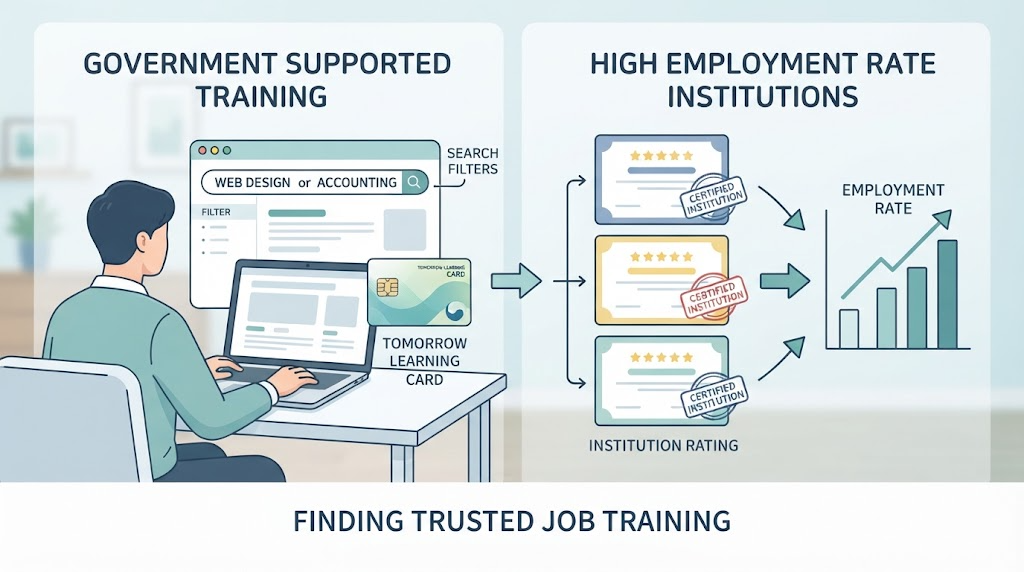
The National Tomorrow Learning Card, which anyone who is a South Korean citizen can currently receive, is a representative system where the government supports a portion (or all) of the training costs to help develop vocational skills.
National Key and Strategic Industry Sectors Training: Targeting labor-shortage occupations and national key industries, this is a representative employment-linked course where you can receive full coverage of training costs as well as a monthly training allowance.
General Courses: These are courses taken by job seekers and employed workers to strengthen individual competencies, and a certain percentage of self-pay fees occur depending on the job category and employment status.
The important point here is that the core purpose of government support is not ‘acquiring a certification’ but ‘strengthening practical competencies and linking to employment.’ Therefore, you must be able to distinguish whether a class focuses simply on memorizing certifications or on practical field-centered curricula.
- The Decisive Difference Between General Academies vs. Excellent Training Institutions
There are countless private academies and government-designated training institutions on the market. On the surface, they all seem to run similar certification courses, but looking into their internal structures reveals clear differences.
Differences in Accreditation Evaluation and Management Systems
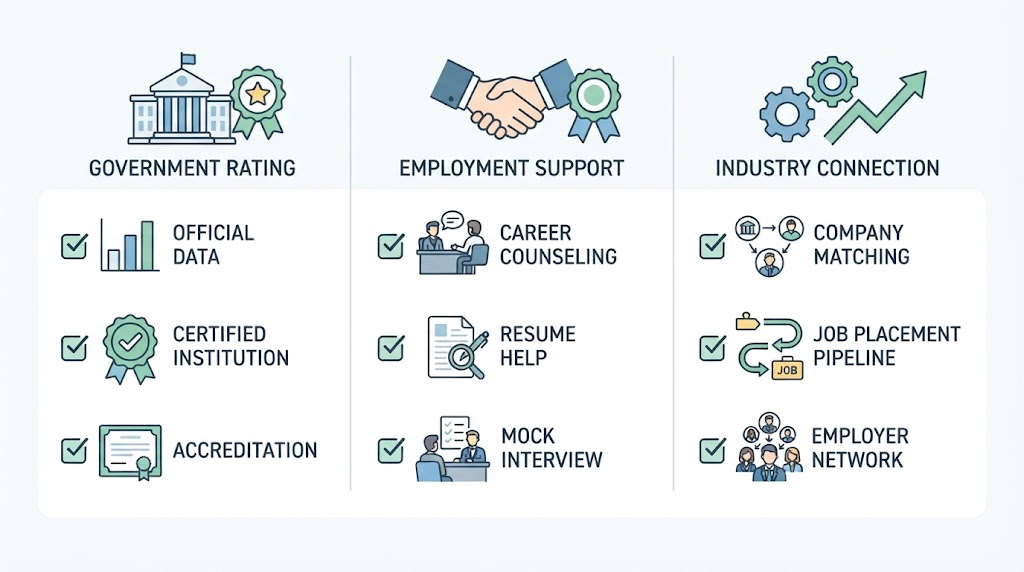
The Ministry of Employment and Labor and the Human Resources Development Service of Korea comprehensively review the employment rate, completion rate, dropout rate, and trainee satisfaction of vocational training institutions every year to grant ‘accreditation grades (Excellent Training Institution, 3-year accreditation, 1-year accreditation, etc.).’ The more excellent a training institution is, the more strictly it is managed and supervised by the government, so the transparency of the educational course and the qualification requirements of the instructors are solidly maintained.
Presence or Absence of Employment Support Systems
While general profit-making academies simply aim to pass exams, official government-funded excellent training institutions operate dedicated employment counselors (employment support offices) and are obligated to run a series of processes ranging from resume proofreading and mock interviews to matching partner companies. In other words, the biggest difference is whether a pipeline leading to ‘real employment’ after acquiring a certification is in place.
In the next section, we will look at specific criteria for identifying ‘places that are truly good at securing employment’ among these training institutions using objective indicators.
3 Core Indicators for Identifying Training Institutions with High Employment Rates
The most common mistake made when looking into government-funded certification courses is choosing an academy solely based on flashy advertisements or student reviews on portal sites. To identify “institutions with genuinely high employment rates” using objective data, you must check the following 3 core indicators.
Indicator 1: Ministry of Employment and Labor Accreditation Grades and Official Employment Rate Data
The first objective indicator to check is the official institutional accreditation evaluation grades announced by the government (Ministry of Employment and Labor, Human Resources Development Service of Korea) and the average employment rate of training institutions by NCS (National Competency Standards) job category.
Checking Accreditation Grades: When searching on Work24 (HRD-Net), check whether the institution has earned the title of ‘Excellent Training Institution’ or ‘3-year/5-year Accreditation.’ Institutions that receive high scores in government evaluations have verified educational infrastructure and financial soundness.
Official Employment Rate Interpretation Tips: Rather than being misled by phrases like “90% employment rate” simply advertised by academies, you must check the ‘official employment rate based on employment insurance enrollment within 6 months after the training end date’ specified on Work24. In particular, it is safe to compare whether the average employment rate of institutions by NCS job category for your desired course is above the industry average.
Indicator 2: ‘Qualitative Employment Indicators’ Verified Through Graduate Data
You must also watch out for empty shells that simply have high employment rate figures. Truly competent institutions differ in the detailed indicators that show the ‘quality’ of employment.
Average Wage Level of Employed Persons and Business Scale:
Work24 detailed information transparently provides the scale of companies where graduates mainly advanced (large enterprises/medium-sized companies with 300 or more employees vs. small and medium-sized enterprises with fewer than 300 employees) and the average wage level. An institution that sends many people to places with favorable salary conditions or employee benefits is an excellent place.
Training Institution Information Details | HRD-Net – Work24
Checking Completion Rate and Dropout Rate: If classes are too overwhelming or management is poor, many people quit halfway. If the dropout rate is excessively high, it is a sign that there are problems with class quality or communication between instructors and trainees is not smooth, so it is best to avoid such places.
Indicator 3: Dedicated Employment Support System and Scale of Partner Companies (Pool)
Acquiring a certification is not the end, but the beginning. You must check whether a system is in place within the training institution to closely and thoroughly track and guide job seekers.
Dedicated Employment Counselor and Follow-up Management Process: Check whether an ’employment support office’ is operated on a regular basis, systematically coaching resume and cover letter proofreading, 1:1 mock interviews, and certification-linked portfolio creation.
Effectiveness of the Partner Company Pool: You need to examine how solid the partner companies are that have signed MOUs with the institution or consistently link job postings. Rather than places that formally connect you to any random company every graduation season, institutions with active industry-academia cooperation so that graduates can be immediately deployed to the actual field have a distinct advantage.
In the next section, we will learn specific ways to actually search for excellent institutions in our neighborhood using Work24 and HRD-Net based on these indicators.

Practical Search Know-How: Smart Usage of Work24 & HRD-Net
Now that you know the theoretical judgment criteria, it is time to actually tap into public portals and discover valuable institutions. By smartly utilizing the ‘Work24’ website, which integrates the functions of the former HRD-Net, you can quickly narrow down the best institutions tailored for you among countless training courses.
We have organized step-by-step practical know-how for a search without failure.
- Entering the Work24 Integrated Search Menu and Sorting Filters
First, access the official Work24 website, and navigate through the top menu in order: [Vocational Competency Development] > [Find/Apply for Training].
First set your region filter to your neighborhood or the maximum allowable commuting distance.
In the training type filter, check ‘National Tomorrow Learning Card’ and select either general courses or job seeker-only national key and strategic industry sectors depending on your purpose.
BizNavi
- Tips for Setting Keywords and Conditions to Filter Out Valuable Institutions
If you simply enter a ‘certification name’ in the search bar, hundreds of promotional courses will pour out, increasing fatigue. At this time, you should combine the following filters and search tips.
Utilizing NCS Job Sub-categories:
Enter keywords for the job you want to learn (e.g., computer-based tax accounting, web design, etc.), and pay attention first to places marked with an ‘Excellent Training Institution’ mark or accreditation grade in the search results list.
Work24
Comparing Training Costs and Self-Payment Rates: Carefully check whether the self-payment fee is absurdly high compared to your Tomorrow Learning Card balance, or whether it is a full-support (national key sector) target course where you can fully receive training allowance benefits.
- Final Data That Must Be Verified on the Detail Page
If you find a course you like, do not immediately click course registration, but click [View Details] to finally check the following items.
Average Employment Rate Figures of Training Institutions by NCS Job Category:
Check the official employment rate indicated at the bottom of the detailed information, and see if it is noticeably higher or maintains a stable figure compared to the industry average.
Work24
Checking Opening Sessions and Remaining Seats: Since popular excellent training institutions close rapidly, it is a good tip to gauge student reviews and the status of waiting lists relative to capacity.
In the next section, we will look at a list of core questions that you must ask training institution staff when conducting an in-person consultation through this search process.
Essential Questions List You Must Ask During Consultation
If you have shortlisted training institutions that catch your eye through internet searches and Work24 data analysis, you will go through an in-person consultation (or phone consultation) before final enrollment. Rather than blindly trusting the friendly explanations of the academy and making a hasty contract, you must throw sharp questions to verify the truth of practical competencies and employment linkages.
We have organized the 4 essential questions you should ask with confidence in front of the consultation manager.
- “After completing this course, which companies are graduates actually linked to for employment?”
Purpose Understanding: To figure out the scale and industry sector of actual partner companies hidden behind formal employment rate figures.
Check Point: Instead of vague answers like “Employment works out fine on its own,” specifically request “a list of 3 to 5 major partner companies or job fields where recent graduates have mainly advanced.” This becomes the criterion for judging whether it aligns with the target company group you want to go to.
- “How are certification acquisition rates and practical portfolio creation supported?”
Purpose Understanding: To check how closely they care for ‘portfolios’ or ‘practical experience,’ which determine success or failure in today’s recruitment market, beyond the basics of acquiring certifications.
Check Point: You must specifically question whether there are separate certification special lectures or past exam problem-solving sessions outside of regular class hours, and whether a system is in place where instructors give 1:1 feedback to increase the completeness of the portfolio.
- “Are there supplementary measures for dropouts or trainees who find it burdensome to keep up with classes?”
Purpose Understanding: A question to filter out shoddy institutions that unilaterally push forward with the curriculum and neglect stragglers.
Check Point: Check whether supplementary classes, study group operations, dedicated mentoring systems, etc. are supported if you cannot keep up with the progress. The more meticulous care an institution provides, the lower the dropout rate and the higher the completion rate.
- “Are there any hidden additional costs that I have to bear besides government subsidies, such as textbook fees or material costs?”
Purpose Understanding: To prevent financial burdens and unnecessary overcharging that you may experience during the course period due to out-of-budget expenditures.
Check Point: It is safe to clearly check the exact total amount of additionally incurred costs such as practice textbook fees, material costs, and exam application fees besides the training cost or self-payment fee.
In the next section, we will wrap up everything we have learned and deliver warm advice for successful government-funded certification acquisition and employment.

Conclusion: Succeeding in Employment with a Government-Funded Course Tailored to You
So far, we have looked step-by-step at practical search know-how for choosing training institutions with high employment rates by utilizing the Ministry of Employment and Labor’s National Tomorrow Learning Card.
Acquiring a government-funded certification means much more than simply holding a single piece of paper called a certificate in your hand. Depending on which institution and what kind of instructors you build your practical competencies with, and whether you meet a dedicated mentor who will guide you with sincerity, your future career direction and the doors to employment will change completely.
Amidst the unfamiliar Work24 system and numerous training courses, it can feel daunting to know where to start. However, if you carefully evaluate based on the three core indicators we looked at today (accreditation grade, qualitative employment indicators, and dedicated employment support system) and ask sharp questions through an in-person consultation, your precious time and effort will not go to waste.
Rather than being swept away by flashy advertisements or other people’s choices out of impatience, we hope you will calmly compare whether it is a place that can provide the most practical help for your target job. With thorough preparation and wise institutional selection added, successful employment and a new leap forward in the field you desire will surely be achieved.
We sincerely cheer that the search tips and checklists we organized today will serve as your reliable guide!
Korean version: 한국어로 읽기