
Introduction: Government-Funded Training Tuition, Should You Choose Fully Free or Self-Paid?
When exploring government-funded education for a new leap forward, the crossroad that catches your eye first is between “fully free courses” and “partially self-paid courses.” While a 100% free course where you do not pay a single penny in tuition right away looks attractive, the question sometimes arises: “Would a course where I pay even a little of my own money be more systematic and advantageous for employment?”
To tell you the conclusion first, fully free and self-paid courses have clear pros and cons depending on each individual’s support qualifications, learning purpose, and job characteristics. It is not necessarily good just because the cost is waived, nor is it necessarily superior just because a cost is incurred; how well it aligns with your own current situation and career goals is the core.
From now on, let’s carefully compare the structural differences and selection criteria of the two learning types step-by-step to find out how to use your precious National Employment Tomorrow Card support limit most wisely.
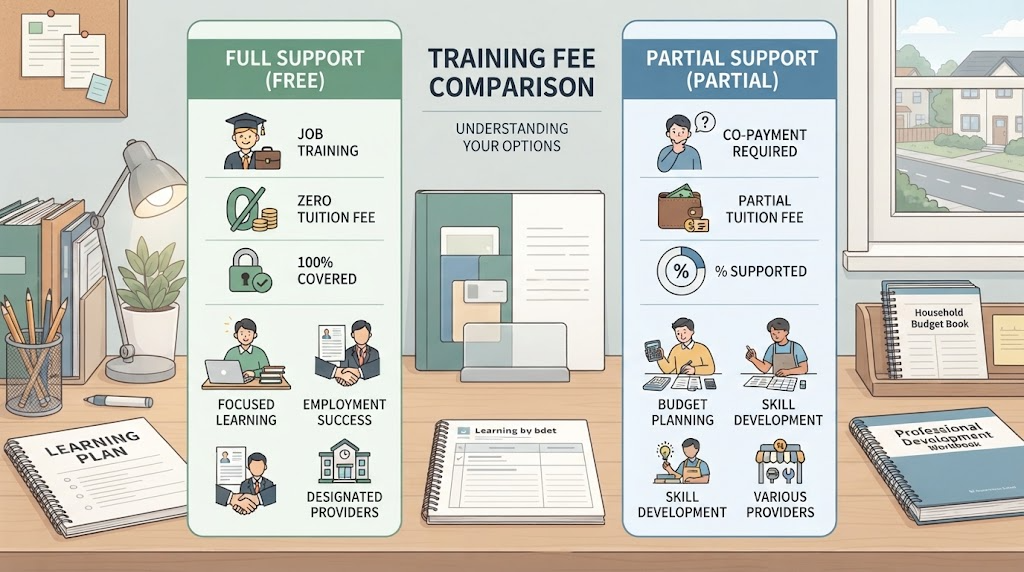
Step 1: Complete Understanding of the Advantages and Eligible Recipients of Fully Free Government-Funded Training Courses
When searching for government-funded education, the form with the highest preference is by far the “fully free course” with zero tuition burden. However, not all citizens can take courses completely free of charge without conditions; clear standards and benefit structures set by the government exist according to the target audience. Let’s carefully examine the practical advantages of free courses and whether you are included in the eligible support group.
- Key Characteristics and Benefit Structures by Target Audience for Fully Free Government-Funded Training
Zero Economic Burden: When utilizing the National Employment Tomorrow Card, no self-payment occurs whatsoever, allowing you to focus entirely on learning and job preparation without pressure regarding tuition fees.
Support Centered on Vulnerable Employment Groups and Job Seekers: Fully free benefits are widely applied to National Basic Livelihood Security recipients, near-poverty households, participants in employment success packages (or employment support programs), and job seekers or the unemployed whose income falls below a certain percentage of the median standard income.
Linkage with Training Allowance Payments: For certain long-term training sessions among fully free courses, if attendance rate conditions are met, you can receive support for a certain amount of training allowance (such as meal and transportation expenses) every month, which is well worth utilizing for economic stability.
- Precautions to Consider When Choosing Free Courses
Guarding Against Excessive Expectations: Due to the advantage of costing nothing, popularity tends to surge, causing courses to close early or competition rates to become fierce.
Strictness of Attendance Management: Since it is a course where 100% government subsidies are injected, attendance checks and completion criteria are extremely strict; therefore, you must be careful about penalties or card limit deductions in case of early withdrawal.

Step 2: Understanding the Structure and Cost Calculation Method of Partially Self-Paid Government-Funded Training Courses
In addition to fully free courses, ‘self-paid courses,’ where individuals bear a portion of the tuition, are also actively operated. It might feel like a loss since you have to pay money, but when you understand the exact structure and calculation method of the self-paid system, you can see that this is not a simple expense.
- National Employment Tomorrow Card Self-Payment Ratio and Calculation Criteria
Differential Imposition by Occupation and Employment Rate: The self-payment ratio is set differently depending on the training course’s employment rate, training cost, the student’s employment status (employed, unemployed, etc.), and income level. Generally, the higher the employment rate and the more popular specialized technical courses are, the more a certain percentage of self-payment may occur.
- Correlation Between the Reason Self-Paid Courses Exist and Education Quality
Virtuous Cycle of Instructor and Facility Investment: Courses that include self-payments are often practice-oriented curricula that require relatively expensive equipment or high professionalism (e.g., advanced IT development, professional design, etc.). From the academy’s perspective, this creates the leeway to invite excellent active-duty instructors and modernize the practice environment based on sufficient financial resources.
Enhancement of Immersion in Course Participation: Because a small amount of one’s own private funds is invested, students themselves take classes with a greater sense of responsibility, and positive effects such as a lower dropout rate can also be expected.
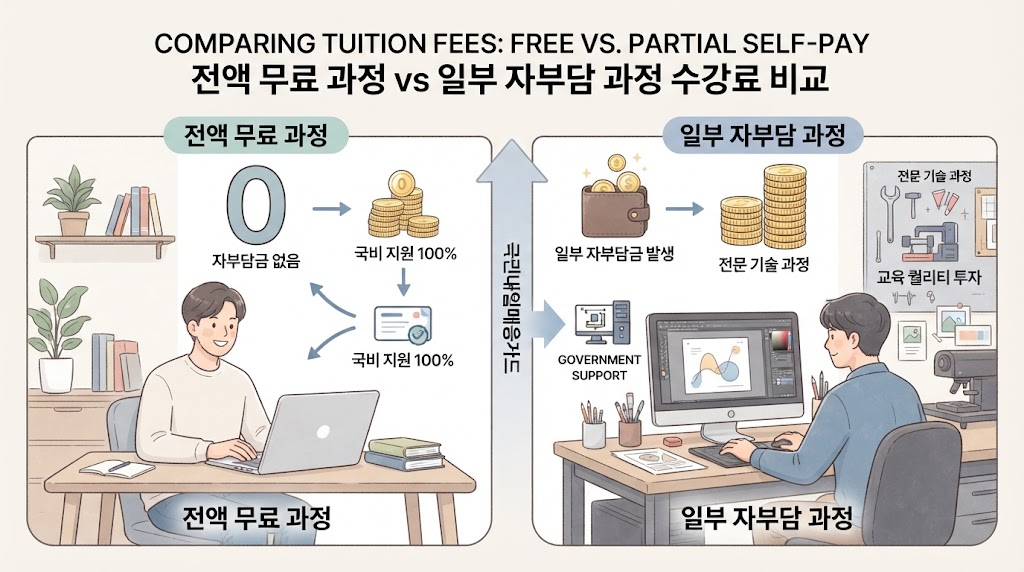
Step 3: Guide to Choosing the Government-Funded Training Enrollment Type Suited for Your Career Goals
Once you have grasped the characteristics of fully free courses and partially self-paid courses respectively, it is now time to decide which format is the wisest choice in light of your personal career goals and learning objectives. Since it is not automatically good just because costs are waived, nor bad just because there is a self-payment, you must coldly compare them according to the following criteria.
- Types Recommended When Acquiring Short-Term Employment and Basic Skills
When Rapid Entry into Practical Work Is the Goal: For job seekers whose purpose is acquiring basic certifications or fast employment linkages, such as office automation, computerized accounting, or simple application skills, actively utilizing ‘fully free courses’ is a shortcut to eliminating economic burdens and maximizing efficiency.
Checking Compliance with Income Levels and Support Target Eligibility: If you immediately lack financial leeway or fall into a vulnerable employment group, it is best to prioritize courses where you can simultaneously secure fully free benefits and training allowances.
- Matters to Consider When Designing Advanced Professional Courses and Long-Term Careers
Leaping to Advanced Technologies and Professional Jobs: For long-term advanced courses requiring high-completeness practical competencies, such as full-stack IT development, advanced UI/UX design, and professional technical jobs, choosing a course well-equipped with instructor expertise and state-of-the-art equipment infrastructure is far more advantageous in the long run, even if a modest self-payment occurs.
Calculating Return on Investment (ROI): Even if a small self-payment occurs, if the quality of education is high and leads to definite employment and salary increases, this can be viewed not as a cost, but as the most valuable investment for your career.

Conclusion: Learning Efficiency and Successful Employment and Job Transition Strategies More Important Than Costs
When preparing for government-funded training, whether the tuition fee is ‘fully free or requires partial self-payment’ is certainly an important consideration. However, if you hastily choose a course that does not fit your learning objectives simply by chasing immediate cost savings, and end up wasting precious time and your National Tomorrow Learning Card support limit due to a shoddy curriculum, there would be no greater loss than that.
If your goal is short-term certification acquisition or improving basic practical skills, it is wise to maximize efficiency through ‘fully free courses’ with no financial burden at all. Conversely, if you want to acquire advanced professional skills and secure employment linkage, it is wise to boldly choose ‘advanced courses’ where instructors and facility infrastructure are verified, even if there is a small self-payment fee.
Ultimately, the most important thing is not whether there is a cost or not, but how well it aligns with your career goals and whether it can properly foster your practical competencies. We hope you will thoroughly evaluate based on the comparison criteria we looked at today and meet a wise government-funded education partner that will achieve your successful employment and job transition.
Korean version: 한국어로 읽기