Introduction: Why Are So Many Office Workers and Job Seekers Paying Attention to the “Financial Manager” Qualification?
For job seekers, it serves as a “cheat key” that boosts competitiveness in document screening; for current office workers, it is renowned as an “all-around spec” that secures a definitive advantage in departmental transfers or promotion evaluations. That qualification is none other than the “Financial Manager.”
In the past, when people thought of accounting or finance, traditional tax and accounting certifications like Tax/Accounting Manager or Computerized Tax/Accounting were the mainstream. However, over the past few years, as the importance of corporate financial soundness management and efficient resource allocation has grown, an explosive number of people are taking on the challenge of the “Financial Manager” certification regardless of their major.
What on earth is driving so many office workers and job seekers toward becoming a Financial Manager? Let’s examine the reasons one by one from a realistic perspective.
- Accounting and Financial Competency: The “Common Business Language” That Breaks Down Job Boundaries
Modern companies demand the “ability to read numbers” regardless of job role, whether it’s marketing, planning, human resources, or sales.
If you are in the planning department, you must be able to calculate the profit and loss structure of the proposal you draft.
If you are on the marketing team, you need to know how to analyze actual ROI (Return on Investment) against campaign budgets.
The preparation process for the Financial Manager goes beyond simple rote memorization, allowing you to macroscopically grasp the flow of how corporate money comes in and goes out. The fastest way to understand the business mechanism of the entire company, transcending departmental barriers, lies right here.
- A Curriculum Enabling “Practical Application” Beyond Mere Certificate Acquisition
While many certifications are consumed as a mere “one-line spec” for employment and prove hard to use in actual work, the Financial Manager is closely intertwined with practical knowledge such as financial analysis, fund management, and budget management encountered in the field.
Rather than accounting learned solely through books, it fosters practical instincts for interpreting corporate financial statements and evaluating corporate value, making it a practical weapon for those dreaming of career changes or job transitions.
- A Systematic Entry Barrier Open Even to Non-Majors
Many non-majors and beginners worry, “I’ve never even heard of accounting since commercial class in high school; can I really do this?” However, the Financial Manager exam is well-equipped with guides to build up basic concepts solidly from the ground up.
The terminology itself may be unfamiliar, but as you step-by-step build the framework, you can experience the thrill of reading what once looked like complex financial statements like a single story. With the right learning method and consistency, it is an attractive certification that non-majors can conquer successfully as well.
Accounting and financial knowledge is a powerful career asset that you can use for the rest of your life once mastered. Beyond simply earning another certification, if you want to elevate the value of your work and build genuine skills in reading corporate numbers, now is the optimal timing to begin your challenge for the Financial Manager.
In the subsequent sections, we will step-by-step explore everything from solidifying basic knowledge to build the fundamental framework of accounting, to exam trends, and practical field application strategies. Prepare for a successful career leap with solid accounting fundamentals!

Step 1: Building the Fundamental Framework of Accounting (Solidifying Basic Knowledge)
The very first gateway you encounter when starting to study for the Financial Manager is getting familiar with the “language of accounting.” When you first open an accounting book, unfamiliar terms like assets, liabilities, equity, debit, and credit come pouring out, making it easy to feel intimidated. However, since accounting is a discipline made up of thorough rules and logic, once you firmly build that basic framework, the subsequent application processes become much easier.
We will step-by-step organize the core basic concepts of accounting that even beginners can understand right away.
- Understanding the 3 Core Elements of Financial Statements
“Financial statements,” which show a company’s health status and report card, are the alpha and omega of accounting. Among them, you must remember the 3 most basic core elements.
Balance Sheet: A table showing the state of property owned by a company at a specific point in time. It indicates, “How much money does our company have in the vault, and how much debt do we have?”
Income Statement: A report card showing how much a company earned and how much it spent over a certain period. It proves, “Did we do well in business this quarter and leave a profit?”
Cash Flow Statement: It shows how cash actually came in and went out of the company. It is a very important indicator to prevent “profitable bankruptcy,” where a company goes bankrupt because cash doesn’t circulate even if profits were made on paper.
- Unraveling the Basic Principles of Debits, Credits, and Double-Entry Bookkeeping
“Double-entry bookkeeping,” the basic principle of accounting, is a method of recording all transactions by dividing them into two sides: cause and effect. The concepts that appear here are debits (left) and credits (right).
Increase and decrease of assets: When money comes in (increase in assets), it is recorded on the debit side, and when money goes out (decrease in assets), it is recorded on the credit side.
Fund procurement and utilization: Credit means “Where did this money come from? (liabilities or equity)”, and debit means “Where was that money spent? (assets).” Understanding only the “principle of double-entry equilibrium,” which dictates that the sums of both sides must always match, means you have conquered half of accounting.
- Developing the Habit of Becoming Familiar with Accounting Terminology
Before memorizing complex formulas, you need practice translating everyday language into accounting language.
Assets: Property with economic value owned by the company (cash, deposits, buildings, land, accounts receivable, etc.)
Liabilities: Debts or obligations that the company must repay (borrowings, accounts payable, etc.)
Equity: Pure personal money obtained by subtracting liabilities from assets (capital stock, retained earnings, etc.)
Revenues and Expenses: Money earned through business activities (revenues) and money spent or value consumed (expenses).
The fundamental framework of accounting is like reinforced concrete when building a house. At first, the terms will be unfamiliar and confusing, but try practicing by writing down simple transactions directly in a notebook and balancing the debits and credits. Once these basic knowledge foundations are solidly reinforced, you can move forward confidently without losing your way in the next stages of exam subject analysis and practical application.

Step 2: Analysis of Financial Manager Certification Exam Subjects and Question Trends
Once you have built the basic framework of accounting, it is time to officially take steps toward passing the exam. As the saying goes, “Know the enemy and know yourself, and you will fight a hundred battles without danger” in any test, you must accurately grasp what subjects the Financial Manager certification exam consists of and what recent question trends it shows to establish an efficient test preparation strategy.
We analyze the core subjects that determine the pass or fail and recent question trends.
- Major Evaluation Areas and Core Subject Composition of the Financial Manager Examination
The Financial Manager examination goes beyond simple bookkeeping to evaluate your comprehensive perspective on how a corporation raises funds, invests, and manages risks. It is typically composed of the following core subjects:
Financial Accounting: Covers basic accounting regulations and practical standards, such as financial statement preparation standards, accounting treatment for assets, liabilities, and equity, and revenue and expense recognition. It serves as the foundational subject where calculation and theory problems are distributed evenly.
Cost & Management Accounting: Evaluates your ability to allocate costs incurred by a company in producing products and to derive information necessary for managerial decision-making (such as break-even analysis and budgeting). Formula memorization and application skills are crucial.
Financial Management: Covers corporate finance’s core investment and financing decisions, including the time value of money, capital cost, capital budgeting (investment project evaluation), and portfolio theory. It features somewhat challenging calculation problems.
- Frequently Tested Concepts and Difficulty-Based Approach Strategies Governing Passing
The questions encountered in the examination room are not randomly selected; ‘core recurring topics’ that appear every year are distinct.
Conceptual Theory Questions: You must build a scoring foundation by organizing incorrect answer notes so that you never miss text-based theory questions, such as accounting standard definitions or financial management principles.
Practice-Oriented Calculation Questions: Beyond simply plugging in formulas, application questions are presented where you must look at given financial statement figures and derive appropriate indicators. In particular, the time value of money and break-even analysis sections appear on every exam, making repeated problem-solving essential.
Select and Focus Strategy: For non-majors or beginners, rather than trying to master every chapter perfectly, a wiser strategy is to avoid failing and secure solid points in core subjects with high testing weight (such as the basic parts of financial accounting and cost management accounting).
- Selection Guide for Learning Methods Suited for You Between Self-Study and Online Lectures
Pros and Cons of Self-Study: Preparing solely with textbooks and past exam question banks saves costs, but trial and error can be significant in understanding complex formulas in financial management or cost accounting. It is suitable for those who are already comfortable with numbers or possess basic accounting knowledge.
Pros and Cons of Utilizing Online Lectures: While costs are incurred, professional instructors pinpoint test points and intuitively break down complex calculation processes, making it the most effective way to shorten the study period. For non-majors or working student applicants in particular, it is strongly recommended to build a solid framework through online lectures.
Grasping the exam subjects and testing trends is like turning on the ‘navigation system’ for your studies. Rather than blindly digging through thick study books from cover to cover, establish a smart learning strategy centered around core areas with high testing weight.
In the next step, we will examine practical application strategies on how to integrate the theoretical knowledge learned here into actual field operations and connect it to your career!

Step 3: Practical Application Strategies Beyond Theory (Field Utilization Methods)
Studying solely for a certification exam ends up as textbook knowledge alone, which is nothing more than a half-baked qualification for office workers or job seekers. The true value of the accounting and finance knowledge acquired while preparing for the Financial Manager certification shines only when it functions as a weapon to read numbers and make decisions in actual business operations.
Here are practical utilization strategies to immediately integrate what you’ve learned into your field work, going beyond textbook theories.
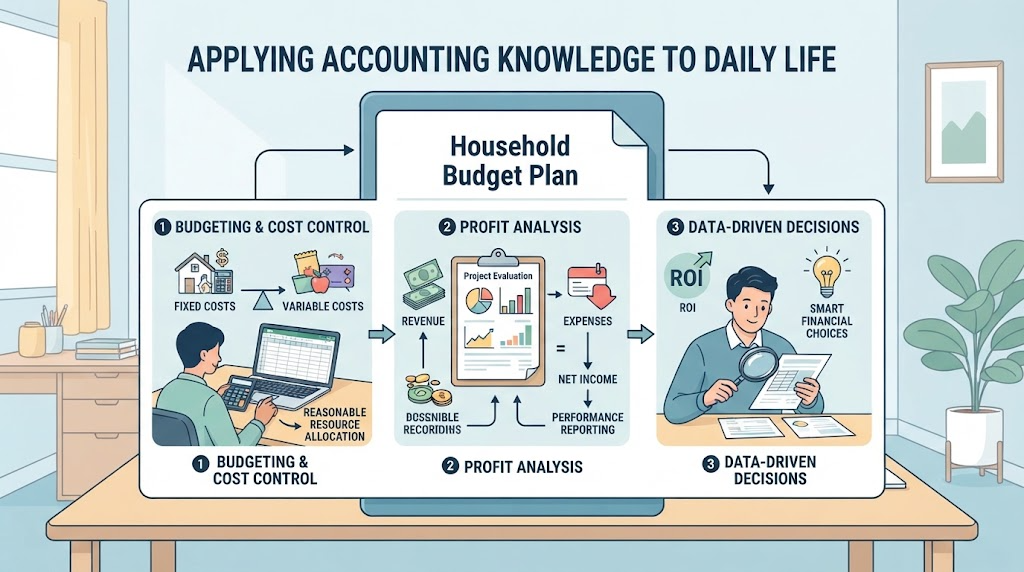
- Integrating Accounting Knowledge into Actual Work (Budgeting, Fund Management, Profit and Loss Analysis)
Once you understand financial statements and cost management concepts, a macro perspective opens up on how your department’s work impacts the company’s overall financial structure.
Budgeting and Cost Control: When planning departmental budgets or establishing annual business plans, you can apply the concepts of fixed and variable costs to derive rational resource allocation plans. Instead of making unconditional budget cuts, you gain the ability to write proposals that quantitatively prove return on investment (ROI).
Appealing Performance Through Profit and Loss Analysis: After completing a project, rather than simply stating “I worked hard,” you can quantitatively report performance from a net income perspective by analyzing the revenue and cost structures generated by that project. This becomes your most powerful weapon for gaining management’s trust.
- Practical Excel Utilization Tips to Boost Financial Data Analysis Skills
Excel is an indispensable partner when handling accounting and financial data in the field. You need to practice implementing formulas and concepts learned during the Financial Manager course as Excel functions.
Using Essential Financial Functions: Apply Excel functions used for time value of money or investment project evaluation—such as PV (Present Value), FV (Future Value), NPV (Net Present Value), and IRR (Internal Rate of Return)—to actual business data.
Pivot Tables and Chart Visualization: Developing the ability to summarize complex accounting books or large-scale financial data using pivot tables and visualize them into graphs that management can understand at a glance dramatically improves work speed and accuracy.
- Strategies to Maximize Certification Utility for Career Upgrades and Job Changes
Proving Job Competency During Job Changes: Rather than simply listing a certification on your resume or cover letter, it is much more attractive to weave it into specific, practice-linked experiences, such as: “Derived a proposal that reduced departmental costs by 15% based on cost analysis and budget management skills acquired during the Financial Manager certification process.”
Differentiation from Other Job Roles (Planning, Sales, Marketing): Marketers who understand numbers and planners who know how to handle budgets are always evaluated as irreplaceable talent within corporations. Financial Manager knowledge allows you to secure smooth communication and leadership in cross-functional collaborations.
Connecting theory to practice may feel unfamiliar and difficult at first, but simply asking yourself questions in your daily work like, “Is this cost fixed or variable?” or “What does our team’s profit and loss structure look like this month?” can drive significant growth.
In the next step, we will design an efficient study plan and daily study routine to help you steadily advance toward passing, even amidst a busy schedule!
Step 4: Building an Efficient Study Plan and Daily Study Routine
No matter how good your study materials and lectures are, without a consistent ‘personal routine’ to digest them, it is difficult to cross the passing threshold. Especially for working professionals juggling full-time jobs or job seekers, available time is severely limited. Therefore, an efficient study plan and a time-boxed daily routine become absolute variables that determine success or failure.
Here is how to design a realistic routine that prevents you from quitting after three days and keeps your pace steady all the way to the exam.
- Custom Timetable for Office Workers and Job Seekers (Weekday vs. Weekend Study Methods)
To eliminate the excuse of not being able to study because of a lack of time, you need a flexible timetable that utilizes micro-moments in your daily life.
Weekday Routine (Securing 1 to 2 hours before/after leaving work):
During your morning commute or lunch break (30 minutes), lightly review accounting terms or core theories learned the previous day using your smartphone or summary notes.
After returning home in the evening, focus for just 1 to 1.5 hours to advance into new material or take core lectures. Rather than trying to cover a large volume in a day, it is crucial to maintain the ‘feeling of sitting at your desk consistently every day’.
Weekend Routine (Focused Immersion Learning and Problem Solving):
Make up for any progress you fell short on during weekdays, and focus heavily on problem-solving based on the material learned over the week.
During morning hours (e.g., 10:00 AM to 1:00 PM) when your mind is sharpest, tackle complex calculation problems or mock exams to maximize your practical adaptability.
- Boosting Practical Adaptability Through Past Exam Analysis and Incorrect Answer Note Creation
Finishing only theory study and entering the exam room is like going to a battlefield without a weapon or shield. The second half of your study period must be invested entirely in solving problems.
Past Exams Are a Mirror Reflecting You: When you solve past exam papers from the last 3 to 5 years, you can see at a glance which concepts the examiner persistently questions. Do not simply brush off wrong answers as ‘a regrettable mistake’; you must figure out which formulas or concepts you missed.
Compensating for Weaknesses with Incorrect Answer Notes: Separate calculation formulas you frequently get wrong or confusing accounting treatment standards into your own incorrect answer notes to use as your most powerful weapon right before the exam.
- Final Closing Checkups and Condition Management Tips Right Before the Exam
D-2 Weeks D-Day Schedule: Rather than digging deeper into new content, focus on rapidly reviewing the problems you have solved so far and your incorrect answer notes 2 to 3 times to solidify what you know so you never miss those points.
Practical Simulation: Solve mock exams at the exact same time as the actual exam to build practical adaptation skills and align your biological rhythm with the exam hours. Managing your condition on the day itself ultimately dictates your final score.
An efficient study plan does not start with grandiose goals. Small yet solid practices like “Tonight for 1 hour, I will properly finish just one section” accumulate to ultimately bear fruit in the form of a passing certificate.
In our final sequence, we will share closing remarks on achieving a successful career leap based on solid accounting foundations and thorough study routines!

Conclusion: A Successful Career Leap Beginning with Solid Accounting Foundations
In the world of business, the ability to read numbers is no longer the exclusive domain of finance and accounting departments. Whether you are in planning, marketing, sales, human resources, or any other role, the power to see through a company’s cash flow and profit-and-loss structure is the most potent weapon to dramatically elevate your individual work competitiveness.
The preparation process for the ‘Financial Manager’ certification that we explored together is not merely formal exam studying to fill a single line on a resume.
It is a systematic journey of establishing the framework of accounting that once felt unfamiliar and complex (balance sheets, income statements, double-entry bookkeeping),
passing the exam gateway through efficient study routines tailored to testing trends,
and making the ‘language of high-performing professionals’ your own—extending all the way to real-world budgeting, profit-and-loss analysis, and practical Excel utilization.
At first, you might feel bewildered in front of confusing concepts like debits and credits and complex financial formulas. However, the solid accounting foundations you build by carving out 30 minutes to an hour of spare time every day will eventually shine during an important project presentation or a job transition moment, proving your true value.
There is no need to rush. Small everyday practices of understanding the meaning of numbers and applying them to practical work will ultimately culminate in the massive achievement of a successful career leap.
We sincerely root for your fresh and bold career leap initiated with solid accounting fundamentals!
Korean version: 한국어로 읽기