Introduction: Pre- and Post-Moving Waste Disposal—Why Is the “Elevator Schedule” the Key?
When you are about to move, when is the moment your heart starts racing the most? Even after the excitement of a new home settles, looking at piles of accumulated belongings naturally brings a sense of overwhelming anxiety: “When on earth am I going to sort through and throw away all these things?” In particular, disposing of moving waste—which requires getting rid of large furniture, appliances, and items that have piled up over the years—causes major chaos on moving day without meticulous planning.
Among all factors, the core key that determines the success or failure of a smooth moving waste disposal process is the **”elevator schedule.”** For residents of apartments, officetels, or high-rise multi-family housing units where elevators are mandatory rather than detached houses or low-rise villas, this elevator schedule functions as the ultimate “timetable” for the entire moving and waste discharge process.
So why on earth is the elevator schedule the core of moving waste disposal? There are several realistic reasons.
- Management Office Advance Reservation War: The Importance of Securing Time Slots
Most residential complexes strictly limit elevator usage on peak moving days or weekends, or operate them on an advance reservation system. For high-rise complexes where ladder trucks cannot be used, both moving cargo transportation and waste removal must rely entirely on a single elevator traffic route.
If you attempt to make a reservation as the moving date approaches, it becomes difficult to secure your desired time slot, and the time spent carrying down household goods intertwines with the route for disposing of waste, making it easy to face friction with apartment residents or sanctions from the management office.
- Preventing “Route Congestion” Between Moving Cargo and Waste Disposal
On moving day, your mind is spinning with moving company staff members and belongings moving back and forth in every direction. If bulky waste or miscellaneous items that need to be discarded are blocking the living room or entryway without being sorted beforehand, work efficiency drops drastically.
Under circumstances where the available elevator usage time is limited, attempting to carry down waste intermittently while moving luggage completely throws off your time calculations. This is why a scenario must be pre-established in alignment with the elevator usage timeline: “At what time should which items be brought down, and when should the waste be discharged?”
- Preventing Friction with Neighbors and Complying with Complex Waste Disposal Regulations
During moving seasons, waiting times for elevators increase, and residents’ complaints easily accumulate. On top of this, if waste is piled up without permission or elevators are occupied during unauthorized hours, it easily becomes a target for civilian complaints.
You must move in accordance with the exact discharge time designated by the management office and the elevator protection (protective board) installation schedule to successfully complete the process without causing harm to your neighbors.
As such, moving waste disposal is not simply “taking out the trash,” but a meticulous time management process that operates in sync with the apartment management system and the moving schedule.
In the ensuing steps, we will carefully examine everything step-by-step: from management office reservations that must be handled first immediately after confirming the moving date, to advance waste disposal tips, and efficient route-customized tips for moving day. Complete a clean, stress-free move through thorough elevator schedule management!
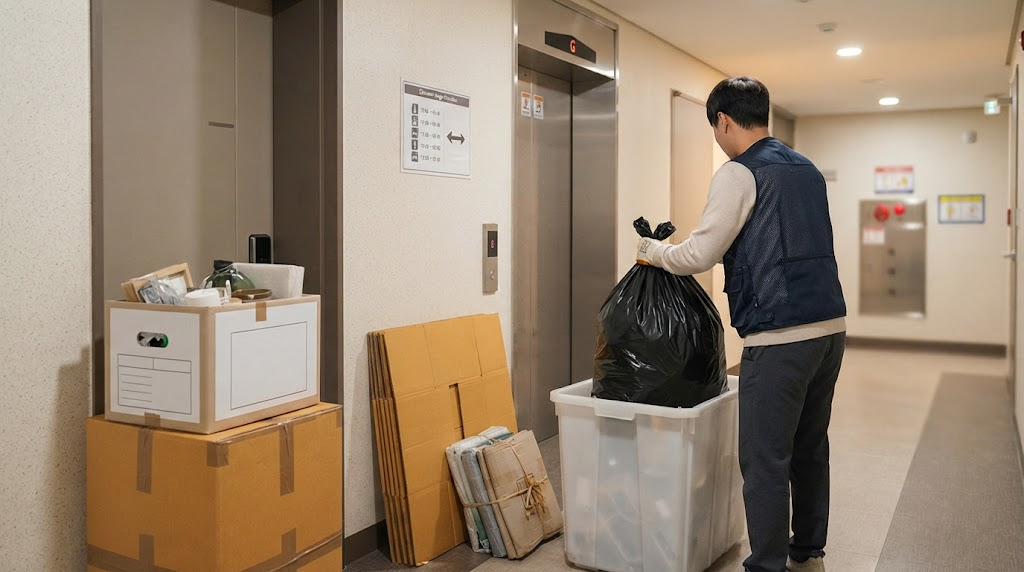
Step 1: Management Office Reservation and Preliminary Investigation Immediately After Confirming Moving Date
When preparing to move, people often think of real estate contracts or selecting a moving company first, but the actual first step of administrative and physical preparation is “visiting the management office and preliminary coordination.” As soon as your moving date is confirmed, you must check the complex’s regulations through the management office and secure necessary reservations in advance to prevent unexpected situations on moving day.
Here are the core practical items you must check at this stage.
- Elevator Usage Approval and Protection (Protective Board) Installation Reservation
Reservation timing is better the earlier it is: Especially during peak moving seasons (such as lucky days, weekends, etc.), it is often fully booked weeks in advance to secure desired time slots.
Checking protection costs and regulations: Most apartments or officetels require “protection work,” which involves wrapping plywood or protective mats to prevent interior damage to the elevator. Since the management office often designates the vendor directly or bills the cost to your maintenance fees, you need to check the exact cost and construction method.
Compliance with available times: Since allowed time slots for elevators vary by complex (such as morning/afternoon times), you must share this regulation when coordinating schedules with your moving company.
- Preliminary Investigation of Complex Waste Disposal Regulations
The methods and regulations for processing bulky waste differ slightly for each apartment or multi-family housing complex. Before moving, you must understand the following matters in advance through the management office or complex notices.
Checking designated discharge locations: Find out if there is a separate collection spot within the complex to gather bulky waste, or if it should be placed next to the 1st-floor recycling area.
Disposal days and time restrictions: Since you must discharge items according to the days when collection vehicles arrive, you need to consider whether temporary storage space is necessary if your moving date and collection day do not align.
Checking whether a management office confirmation certificate is attached: Even if you issue a sticker online, there are complexes where you must obtain a disposal report confirmation certificate or a stamp from the management office and attach it. Advance verification is essential to avoid being mistaken for illegal dumping.
- Listing Items to Discard and Classifying Bulky Waste & Small Appliances
Look around every corner of your home and classify items in advance that you will not be taking on this move.
Bulky waste targets: Large furniture such as old wardrobes, mattresses, dining tables, sofas, and dressers.
Small appliances and recycling targets: Create processing plans by dividing broken fans, small electronics, and clothing by category.
Tip: It is best to report bulky waste in advance via the local government website or mobile app to receive a discharge number, and for small appliances, schedule ahead so you can utilize the free visiting collection service.
Management office reservations and preliminary investigations are like a “safety net” for your entire moving schedule. As soon as your moving date is locked in, drop by the management office to secure your elevator schedule and familiarize yourself with the waste disposal rules for your complex. This small preparation will surely reduce unnecessary stress and wasted effort amid the busy schedule of moving day.
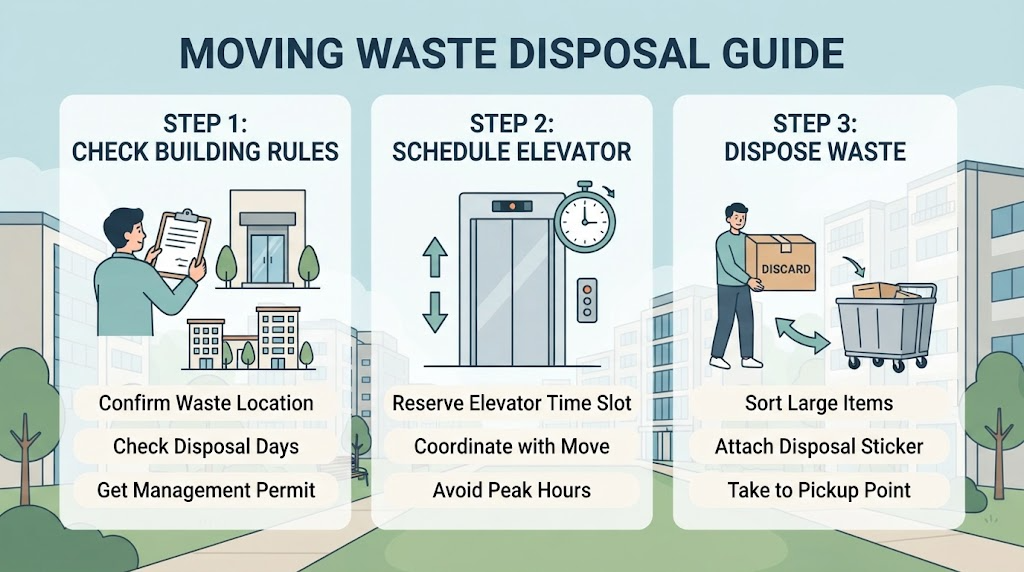
Step 2: Tips for Advance Discharge of Bulky Waste and Recyclables
Once you have finished making reservations with the management office and checking the complex’s regulations, it is time to dive into the “emptying work” to substantially reduce your moving cargo. If you try to process large furniture or luggage all at once on moving day, you will run short on time and become physically exhausted fighting the elevator war. Therefore, it is wise to sequentially empty out items that can be discharged ahead of time starting a few days before the move.
Here is a step-by-step breakdown of efficient tips for advance discharge of bulky waste and recyclables.
- Internet Reporting for Bulky Waste and Sticker Issuance Methods
Bulky waste items with large volumes, such as wardrobes, mattresses, sofas, and dining tables, can easily tangle up your moving route if you try to throw them away on moving day. It is best to dispose of them in advance.
Local Government Online/Offline Reporting: Access the official city, county, or district office website or mobile app of your place of residence to proceed with the bulky waste disposal report. Once you select the items and pay the fee, a disposal number (report certificate number) is issued.
Alternative Certificate Tip: If you don’t have a printer and find it difficult to print out the payment certificate (sticker), it is still valid to handwrite the [receipt number, item name, fee, and disposal location] accurately on a blank sheet of paper and attach it securely to the waste.
Adjusting Disposal Timing: Considering the collection schedule of the collection company (usually taking 2 to 3 days after application), move the items down to the designated 1st-floor location according to the scheduled time, such as the night before the move or the dawn of moving day.
- Utilizing the Free Home-Visit Large Household Appliance Collection Service (‘E-Circulation Governance’)
For large appliances such as refrigerators, washing machines, TVs, and air conditioners, or a certain quantity or more of small appliances, it is much more economical and convenient to use the free home-visit large household appliance collection service instead of buying paid local government stickers.
How to Use: Reserve a collection schedule through the official ‘Free Home-Visit Appliance Collection’ website (or E-Circulation Governance) or call center.
Reservation Timing: As soon as your moving date is set, it is recommended to make a reservation at least a week to ten days in advance. Especially during the moving season, reservations fill up quickly, so you must secure your spot early.
Precautions: Since the collection technician visits directly inside the house to collect the home appliances, if you leave one day of the previous week open before moving or match the date to the day before the move, you can proceed with the move with your luggage drastically reduced.
- Household Residual Waste to Be Emptied in Advance So It Doesn’t Come Out on Moving Day
Aside from large furniture and appliances, miscellaneous items neglected in the veranda, under the kitchen sink, or in the corners of the shoe rack are difficult to touch until right before the move.
Utilizing Separation and Volume-Rate Bags: Except for daily necessities you will use during the remaining few days, kitchen utensils you don’t use, seasonings past their expiration date, and shoes you don’t wear should be placed into volume-rate bags and recycling bags a little at a time and disposed of.
Prohibition of Stacking in Front of the Front Door: The act of leaving trash out in the corridor or the shared space in front of the elevator before moving day under the pretext of clearing it out early causes serious conflicts with neighbors or warnings from the management office. You must plan your route so that you can head straight from inside the house to the designated 1st-floor location strictly on the day of disposal.
Simply clearing out bulky waste and appliances in advance drastically reduces the amount of luggage you need to load on moving day. If you want to save time monopolizing the elevator and wrestling with heavy luggage, be sure to execute the ’emptying schedule’ a few days before the move.
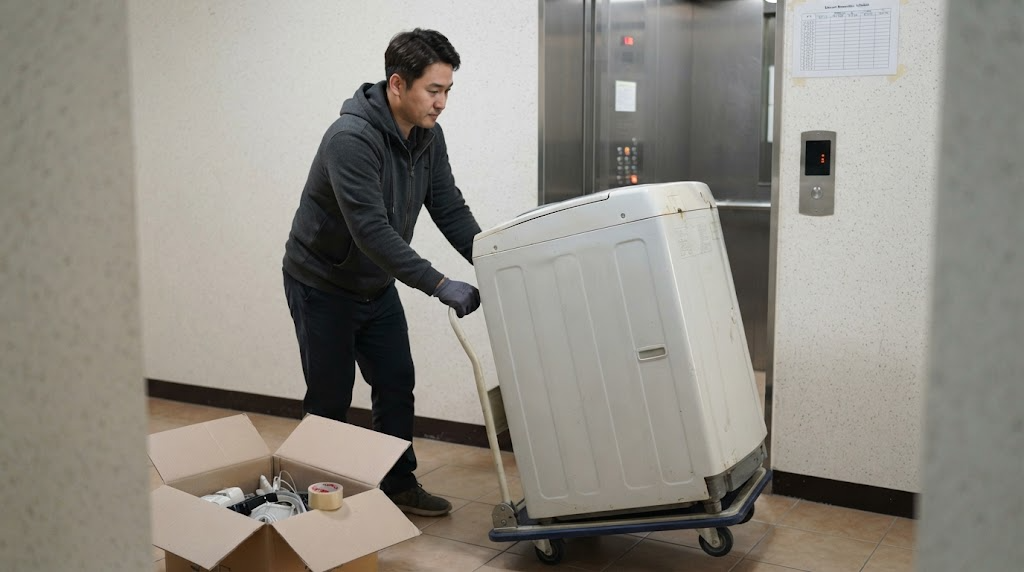
Step 3: Efficient Processing Order Tailored to Elevator Routes on Moving Day
The day of the move has finally dawned. Even if you finished the management office reservation and bulky waste arrangement in advance, countless variables are bound to occur on-site that day. Especially in multi-family housing where elevator usage times are limited, ‘time-slot route design’ becomes the decisive factor determining the success or failure of the move.
Here is the time-slot processing order to minimize elevator congestion and maximize efficiency on moving day.
- Tips for Allocating Moving Volume and Waste Disposal by Time Slot
Since there is only a single elevator or only a limited number can be used, if the moving luggage outflow and the disposal route for the final remaining residual waste get tangled, working time is inevitably delayed.
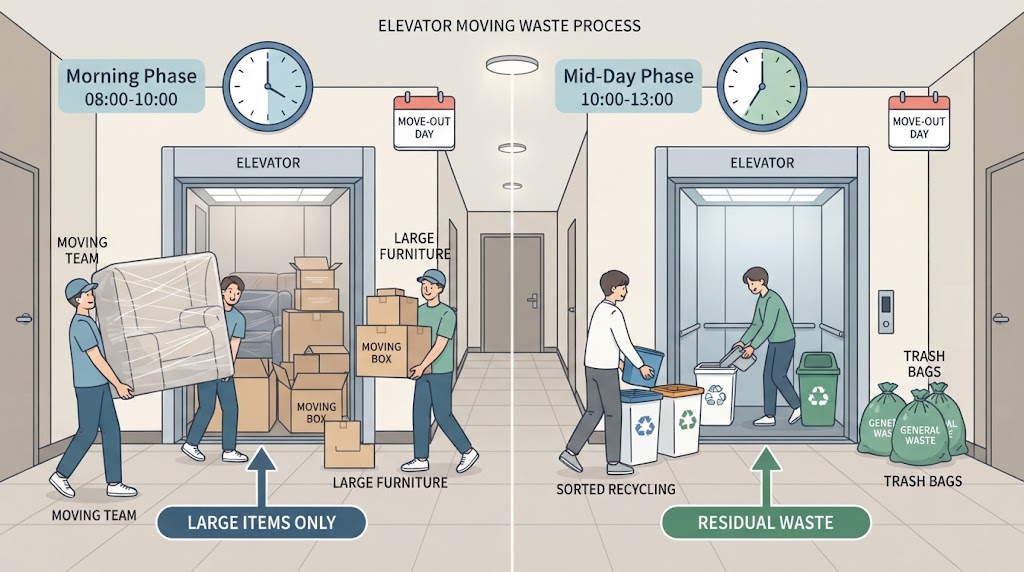
Early Morning (08:00 ~ 10:00 – Concentration of Large Moving Luggage Outflow): When the moving company employees arrive, bulky large furniture and box-packaged luggage are loaded onto the elevator and sent down first. During this time slot, elevator capacity must be concentrated exclusively on moving luggage outflow.
Mid-Phase Time (10:00 ~ 13:00 – Residual Waste and Volume-Rate Bag Disposal): When the large items have cleared out to a certain extent and the house feels much lighter, the recyclables, small amounts of residual trash, and volume-rate bags that need to be separated and disposed of last are organized. Taking advantage of the gap when the moving ladder truck or large cargo truck temporarily leaves its spot or the moving company takes a lunch break, they are swiftly sent down to the designated 1st-floor location.
- Collaboration with Packaged-Moving Company: Designating Waste Separation and Disposal Zones
When contracting with a packaged-moving company, items to throw away and items to take must be clearly distinguished to avoid confusion.
Pre-Marking and Zone Separation: The day before the move, attach post-its or noticeable tape to items to be thrown away to mark them as ‘Do Not Move / Disposal Target’. Designating a corner of the living room or a specific room as a ‘Temporary Waste Assembly Point’ allows moving company employees to work without getting confused.
Communication with Moving Employees: Before work begins, clearly notify the on-site team leader, saying, “The items in this room are to be thrown away, so please be careful not to mix them into the moving truck.” This prevents the grand disaster of usable items being mistakenly loaded and hauled away.
- Tips for Avoiding Elevator Congestion Time Slots (Commuting Hours, Lunch Hours, etc.)
Apartment complex elevators are shared spaces where regular residents commute or go out in addition to moving households.
Yielding During Commuting Hours (Before 08:00 or Right After): During the apartment commuting hours (usually 8:00 AM to 9:00 AM), resident usage demand explodes, so seeking the consent of the moving company or temporarily stopping elevator operation during these times according to the management office guidelines or yielding to residents is the shortcut to preventing civil complaints.
Utilizing Lunch Hours: Around 12:00 PM is a time when the moving company also takes a break and the complex elevators become relatively quiet. Taking advantage of this gap to neatly organize and send down the final scrap waste or recyclables remaining inside the house makes the latter half of the moving work much easier.
The elevator route on moving day is all about strict ‘time management’ and ‘communication with the moving company’. Organically matching the timing of unloading luggage and disposing of trash, complete a smooth move without hassle!
Step 4: Post-Move Wrap-Up and Organization
Even though there is hardly a moment to catch your breath and unwind after unloading luggage at your new home, an important homework assignment remains that must be completed at your former residence (the house you lived in). Only after completely moving out all the luggage, cleanly emptying the vacant house, and wrapping up the management office procedures can the moving process be said to have truly ended.
Here is a checklist of finishing touches and organization tasks that are easily overlooked right after a move.
- Removal of Elevator Protection Materials and Final Confirmation at the Management Office
Confirmation of Protection Material Removal and Restoration to Original State: Once the moving company finishes all work, the protective panels (protection materials) installed inside and outside the elevator must be removed. Most moving companies handle collection and organization, but you should carefully check to ensure no parts were missed.
Final Inspection of the Management Office: Check finally with the management office representative to see if there are any damaged spots or scratched marks inside the elevator, in the shared corridor, or in the lobby. If there are no issues, the deposit placed when booking the elevator use is returned or the settlement procedure is wrapped up.
Maintenance Fee Settlement and Return of Prepaid Maintenance Fees: Accurately settle the maintenance fees up to the moving day, and if there are ‘prepaid maintenance fees (such as long-term repair reserves)’ paid when purchasing the apartment, request final settlement from the landlord (lessor) and get them back.
- Finalizing the Disposal of Remaining Trash and Volume-Rate Bags
Collection of Final Scrap Waste: Go around every corner of the empty house after all moving luggage has been taken out to make a final check that no dust, pieces of tape, or miscellaneous items remain.
Final Disposal of Volume-Rate Bags and Recyclables: Pack the final trash generated during the cleaning process into prepared volume-rate bags and dispose of them at the designated location. You must be careful not to vacate while leaving trash abandoned in front of the front door or in the corridor. (Unless you negotiated separate cleaning costs or waste disposal fees with the moving center, it is the rule to handle the final household waste yourself.)
- Checklist for Final Inspection Items Before Move-In Cleaning
Furniture Arrangement and Defect Check: If it is a new home you are moving into, mentally plan out the final placement locations for furniture and appliances before move-in cleaning or full-scale luggage organization, and leave photos of any damaged spots in existing facilities.
Ventilation and Basic Cleaning: Remove dust accumulated from busy movements on moving day through ventilation, and lightly sweep the floor before a full-scale move-in cleaning company visits to make subsequent organization work much more comfortable.
Just as the saying goes that it’s not over until it’s over, the grand finale of a move depends precisely on this ‘finishing organization’. You can complete a refreshing, worry-free move only by neatly wrapping everything up from the removal of elevator protection materials and management office settlements to the final trash processing of the vacant house.
Try bringing your moving journey—which was smooth from start to finish through thorough preliminary research and elevator schedule management—to a pleasant close!
Conclusion: Completing a Stress-Free Move Through Thorough Schedule Management
Moving is not simply a physical relocation of moving items from one place to another. Behind the excitement of preparing for a new start, it is closer to a high-level ‘schedule coordination project’ where dozens of variables are intertwined, including real estate, management offices, moving companies, and numerous waste disposal tasks.
Particularly, as we examined today, designing the entire schedule centered around the elevator usage schedule within the complex is the surest way to prevent confusion on moving day and minimize physical and mental exhaustion.
Shall we trace back the core points once more?
As soon as the moving schedule is confirmed: Visit the management office to secure elevator use approval and protection schedules, and understand the complex’s waste disposal rules in advance.
Emptied in advance a few days before the move: Drastically reduce the volume of luggage in advance by utilizing the local government’s bulky waste internet report and ‘E-Circulation Governance’ free home-visit collection service.
Route management by time slot on moving day: Concentrate on large moving luggage outflow early in the morning, select quiet time slots to neatly dispose of remaining waste, and actively communicate with the moving company.
Perfect grand finale: Meticulously wrap up the removal of elevator protection materials, maintenance fee and prepaid maintenance fee settlements, and the final trash processing of the empty house.
If such thorough advance planning and organic route management tailored to the elevator schedule are supported, you can completely escape from the chronic stress and friction experienced on every moving day.
We root for a fresh and pleasant start in your new home. We hope that the systematic procedures and tips guided today serve as a reliable guide for your successful and comfortable move!
Korean version: 한국어로 읽기