Introduction: Government-Funded Job Training, Are There Different Benefits Tailored for Me?
Many office workers heading out on their morning commutes find themselves wondering, “Should I build my skills and try changing careers or job functions?”, while many job seekers face worries about qualifications and costs during an uncertain job search process. We deeply feel the need for self-development, but whenever we encounter academy and lecture fees reaching into the millions of won, hesitation naturally follows.
The very first thing people look into during times like this is the National Tomorrow Learning Card, a representative vocational training system supported by the government.
However, many people face setbacks after blindly applying with the thought, “Since it’s government-funded, it must all be the same.” This is because government-funded training programs vary completely depending on your status and employment type (whether you are an office worker or a job seeker), including the range of benefits provided, the self-payment rate, and the training allowances deposited into your bank account every month.
For office workers: You should focus on after-work courses or non-face-to-face lectures that can be balanced with work, as well as practical-centered curricula designed to strengthen current employee competencies.
For job seekers: You need to carefully examine intensive training programs operated rigidly on a full-time schedule aimed at successful employment, alongside lucrative training allowance support benefits.
Rather than blindly registering just because “others say it’s good,” accurately understanding the maximum benefits available from your current position is the shortest path to saving time and money.
So, how exactly do the benefits given to office workers and job seekers differ? From here on, let’s carefully compare the tailored benefits and key differences for each category one by one.

Comprehensive Summary of Government-Funded Job Training Benefits for Office Workers
For office workers leading busy daily lives, self-development always feels like homework. Trying to start studying with an exhausted body after getting off work brings financial burdens and initial worries over whether it will truly help with actual job tasks. Here is a clean summary of key government-funded education benefits that office workers should definitely check out.
① Eligibility and Qualification Requirements: Can I Apply?
The National Tomorrow Learning Card is not issued to all office workers without exception; eligibility is divided based on employment type and income criteria.
Eligible Targets:
Workers at small and medium-sized enterprises (priority support companies)
Workers aged 45 or older employed at large enterprises
Non-regular workers including fixed-term, part-time, and dispatched workers
Parental leave workers with remaining employment insurance subscription periods
Micro business owners and special-type workers (teuk-go) / freelancers below a certain annual sales threshold
Exclusion Targets: Public officials, private school teaching staff, high-income business owners exceeding a certain annual sales amount, and individuals aged 75 or older may face partial restrictions.
② Major Benefits and Support Details: What and How Much Support Is Provided?
Training Cost Support (Account Limit): Once the National Tomorrow Learning Card is issued, an education and training cost account of 3 million won to 5 million won is provided per individual.
Mitigation of Self-Payment Rates: For office workers, a portion of the tuition fee (approximately 10% to 50%) is paid personally depending on the size of the employing company (whether it is a small/medium enterprise) or the type of course, though full support is sometimes provided depending on national strategic industry sectors or courses.
Office Worker Specialized Curricula: Various flexible courses tailored to office workers’ schedules—such as evening classes, weekend classes, and 100% non-face-to-face online lectures—are open, making it easy to balance work and studies.
③ Recommended Course-Taking Methods and Utilization Tips for Office Workers
Utilizing After-Work/Weekend Classes: If attending an offline academy, choose courses that utilize weekday evening or weekend hours. Since completion requires meeting the attendance rate (typically 80% or higher), pacing your physical endurance is important.
Utilizing Non-Face-to-Face and Internet Remote Training: If travel time is burdensome or overtime is frequent, taking 100% online non-face-to-face courses without spatial constraints is the shortcut to raising completion rates.
Connecting to Career Changes and Job Competency Enhancement: Rather than simple hobbies, it is advantageous to choose certification and specialized courses in fields like accounting, tax, coding, design, and marketing that can be put to immediate practical use or help even a little more on future career changes and resume building.
Next, we will continue by summarizing the benefits and specific support details for job seekers. Please let me know whenever you need any assistance!
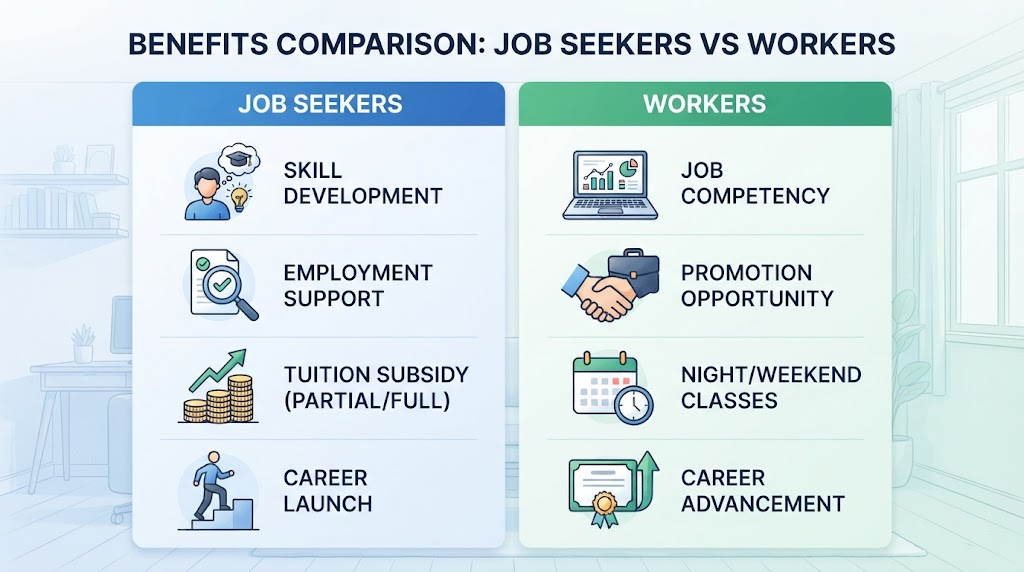
Comprehensive Summary of Government-Funded Job Training Benefits for Job Seekers
When you have just quit your company or are about to take your first steps into society in earnest, the pressure of massive academy fees and living expenses is what weighs most heavily on your mind. For job seekers struggling with thoughts like, “I need to get certifications and build practical skills to find a job…”, government-funded education serves as the most reliable lifeline.
We meticulously summarize the groundbreaking benefits and support details you can enjoy when you have job seeker status.
① Eligibility and Qualification Requirements: Is It Open to Any Job Seeker?
The National Tomorrow Learning Card is open to most job seekers who are currently unemployed or exploring new career paths.
Eligible Targets:
Unemployed individuals and non-employment seekers currently looking for a job
College (graduate) prospective graduates and final graduates
High school prospective graduates (those wishing for non-higher education career paths)
Job seekers after closing micro-businesses, etc.
Characteristics: In many cases, cards can be issued regardless of income level, so anyone with the will to find a job can take on the challenge.
② Major Benefits and Support Details: What and How Much Support Is Provided?
Up to 5 Million Won Support for Training Costs: Through the National Tomorrow Learning Card, you can receive an education cost account of up to 3 million won to 5 million won for 5 years to take the training courses you want.
Lucrative Training Allowances (Linked to the National Employment Support System):
If requirements such as attendance rates are met, monthly training incentives are paid during the training period, helping ease the burden of living expenses.
In particular, when linking government-funded job training with the National Employment Support System (Type 1, Type 2), you can receive overlapping benefits including job search promotion allowances or additional subsidies, significantly reducing your economic burden.
Employment Linkage and Follow-up Management: Rather than just simple course completion, dedicated job support services—such as partnered company matching, resume and cover letter clinics, and interview coaching—are frequently provided together.
③ Recommended Course-Taking Methods and Utilization Tips for Job Seekers
Actively Utilizing K-Digital Training (KDT): If you are interested in digital and new technology fields (AI, big data, cloud computing, full-stack development, etc.), keep an eye on KDT courses. They are operated around corporate-customized practical projects, providing near full support along with intensive employment linkage benefits.
Strictly Observing Attendance Rates and Completion Standards: Job seeker courses often feature long daily attendance hours and run intensively. Since falling below an 80% attendance rate can result in expulsion or subsidy deductions, thorough time management is essential.
Simultaneous Preparation of Certifications and Portfolios: Preparing relevant national certification written/practical exams concurrently during the training period and organizing practical project results into a personal portfolio will become a powerful weapon on the job search and career transition frontlines.
Next, we will continue by presenting the ‘Office Worker vs. Job Seeker Benefits Comparison Table’ where you can compare both systems at a glance. Please feel free to let us know if there are any contents that need modification or addition!

Comparison at a Glance: Office Worker vs. Job Seeker Benefits Comparison Table
So far, we have examined the key government-funded job training benefits applied to office workers and job seekers, respectively. We have organized the differences in support ratios, allowances, and education selection directions into a table so you can compare them at a glance.
| Category | Office Workers (Employed, etc.) | Job Seekers (Unemployed, Non-Employment Seekers, etc.) |
|---|---|---|
| Core Objective | Strengthening current job competencies, preparing for career changes and job transitions | Early employment, acquiring new skills, completing practical portfolios |
| Subsidy Account Limit | 3 million won to 5 million won (National Tomorrow Learning Card) | 3 million won to 5 million won (National Tomorrow Learning Card) |
| Tuition Self-Payment Rate | Partial personal burden (approximately 10% to 50%) depending on the size of the employing company (whether it is a priority support company) and the course | High proportion of full support for national strategic industry sectors and KDT (differing by course) |
| Training Allowance (Living Expenses) | Separate training incentive payments restricted for general worker courses (excluding some exceptional courses) | Monthly training incentives paid upon meeting attendance requirements (overlapping receipt of additional allowances possible when linked with the National Employment Support System) |
| Recommended Course Format | Weekday evening classes, weekend classes, 100% non-face-to-face online lectures | Intensive full-time courses, K-Digital Training (KDT) |
| Follow-up Management & Linkage | Focused on personal career development and acquiring certifications | Dedicated job counseling, partnered company interviews, and employment matching services |
💡 Comparison Point Summary
- Cost Perspective: Because job seeker courses presuppose employment, there is a wider range of full training cost support and training allowance benefits available. On the other hand, office workers may incur personal tuition expenses depending on the size of their employing company or the nature of the course.
- Time Utilization Perspective: While flexible learning utilizing after-work hours, weekends, or online methods is essential for office workers, job seekers have relatively free time flexibility, making it advantageous for them to digest immersive full-time government-funded training or new technology intensive courses.
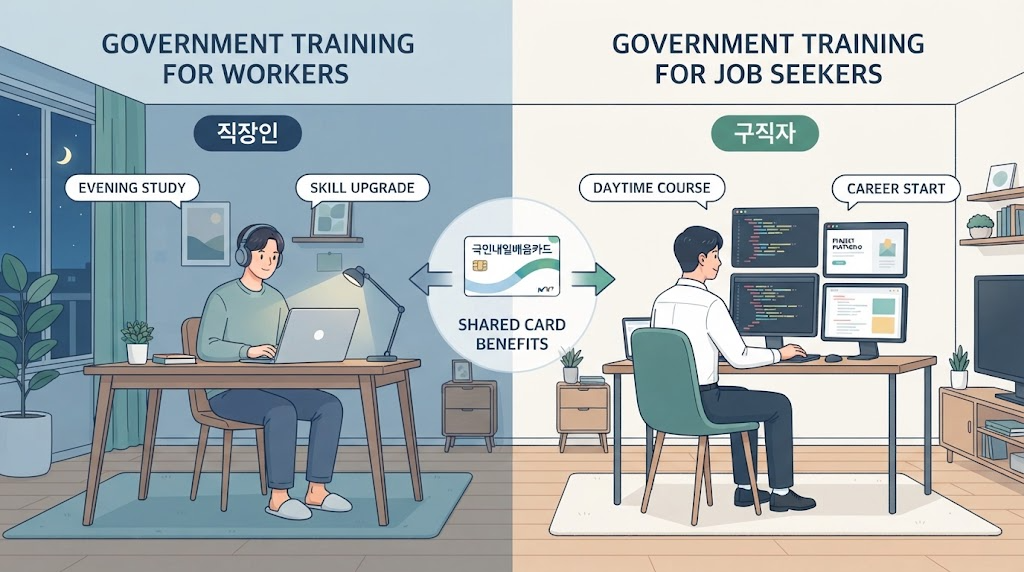
Inquiry and Application Methods for Government-Funded Benefits Suited for Me (3 Steps)
Once you have thoroughly reviewed the theories and benefits, it is now time to take direct action to step-by-step issue your card and apply for a course. We introduce 3 steps for applying for government-funded support that can be conveniently processed via PC or mobile.
Step 1. HRD-Net Membership Registration and Card Application
Access the Official Website: Search for ‘HRD-Net (Vocational Training Portal)’ on a portal site to access the official website or download the mobile app.
Identity Verification and Login: Log in via simple authentication or a joint certificate.
Apply for the National Tomorrow Learning Card: Go to the ‘National Tomorrow Learning Card Application’ menu on the main screen, check the issuance eligibility requirements, and fill out the application form. (During application, you will select the card company from which you wish to receive the physical card.)
Step 2. Exploring Courses Suited for Me and Applying for Enrollment
Search for Customized Courses: Filter in the ‘Training Courses’ menu of HRD-Net by setting your region of residence, fields of interest (e.g., coding, accounting, design, tax, etc.), and your status (office worker or job seeker).
Carefully Check Detailed Information:
Total tuition fee and your expected personal burden amount
Training days and daily class hours (checking attendance availability)
Reviewing graduate reviews and employment rate information
Complete Course Application: Choose a course you like and proceed with online course application. (Some courses may involve academy- 자체 interviews or preliminary selection procedures.)
Step 3. National Tomorrow Learning Card Issuance and Final Registration
Card Issuance Screening and Receipt: Once the card is issued following qualification screening by the competent employment center, receive the physical card through your requested card company (Shinhan, Nonghyup, etc.).
Self-Payment Settlement and Final Registration: After your course application is approved, settle your personal contribution (self-payment) using the Tomorrow Learning Card to finally complete course registration.
Participate on Opening Day: Attend the academy or online platform according to the opening day to begin your full-fledged education.

Conclusion: Essential Practical Tips to Know Before Starting Government-Funded Job Training
So far, we have thoroughly examined everything from government-funded education benefits by target group (office workers vs. job seekers) to application methods. Finally, we share 3 practical tips you must know to successfully finish your hard-earned government-funded training and achieve maximum results.
① Attendance Management Is Lifeline! (The 80% Rule)
The most important thing in government-funded training is, above all, ‘attendance rate’.
Most courses require you to attend at least 80% of total training days to get your hands on a completion certificate.
If your attendance rate falls below 80%, you will be treated as prematurely dropped out (expelled), and disadvantages such as deduction of your remaining Tomorrow Learning Card limit amount may occur, so you must pay special attention to managing tardiness, early leaves, and absences.
② Be Sure to Check ‘Student Reviews’ and ‘Employment Rates’ Before Choosing a Course
When searching for courses on HRD-Net, they can all look similar at first glance, making it easy to worry about which one to choose.
Carefully check the instructor’s lecturing ability, academy facilities, and vivid reviews from actual graduates.
Particularly for job seeker courses, checking how systematically the institution’s actual employment rate or post-completion follow-up management programs are operated is the shortcut to making a choice with no regrets.
③ Actively Utilize Additional Support Systems Suited for You
As briefly mentioned earlier, government-funded training creates multiplied synergy when run in parallel with other government support projects.
If you are currently looking for a job, we strongly recommend applying for the National Employment Support System first to receive job search promotion allowances while taking government-funded training courses.
If you are an office worker or freelancer, check your Tomorrow Learning Card limit and additional support requirements matching your employment type once more through HRD-Net or your competent employment center so you don’t miss out on benefits.
Government-funded education becomes a simple certification acquisition opportunity for some, and a powerful tool opening Act 2 of a new life for others. Based on the contents we organized today, we cheer for you to wisely choose the best educational course that will give wings to your career growth!
Korean version: 한국어로 읽기