
What is the Youth Monthly Rent and Deposit Loan? (Product Overview and Target Support)
For young adults burdened by both monthly rent and large lump-sum deposits, the representative housing finance product supported by the government and the Housing and Urban Fund is the “Youth Monthly Rent and Deposit Loan.” It allows you to receive support for both deposits and monthly rent simultaneously or according to your individual needs at interest rates much lower than commercial rates, serving as a reliable pillar of support for youth dreaming of independence.
Product Overview and Key Features:
It is a product that links deposit loans for youth who find it difficult to prepare jeonse deposits, and monthly rent payment loans for youth burdened by fixed monthly rent expenses.
Its biggest strength is that it can drastically lower the interest burden compared to high-interest credit loans or general monthly rent loans from commercial banks.
Support Target and Age Criteria:
As a homeless household head (including prospective household heads) who executes a housing lease agreement and pays a lease deposit (or pays monthly rent), youth generally aged 19 to 34 are eligible. (If military service obligations have been fulfilled, the age limit may be partially relaxed in proportion to the service period.)
Income Criteria:
The combined annual income of the loan applicant (and spouse) must satisfy certain criteria (e.g., 50 million won or less per year, subject to detailed product regulations). The door is often open to youth with low or irregular income, such as young professionals, job seekers, and college students.
Homeless Household Head and Target Housing Requirements:
All household members must be homeless at the time of loan application. In addition, the target housing must meet certain dedicated area criteria (e.g., 85 square meters or less) and must be a house that complies with the deposit and monthly rent upper limit criteria to enable normal loan application.
As such, the Youth Monthly Rent and Deposit Loan is a core welfare product that helps youth experiencing the double hardship of deposits and monthly rent alleviate housing cost stress and concentrate fully on their studies, employment, and work life.
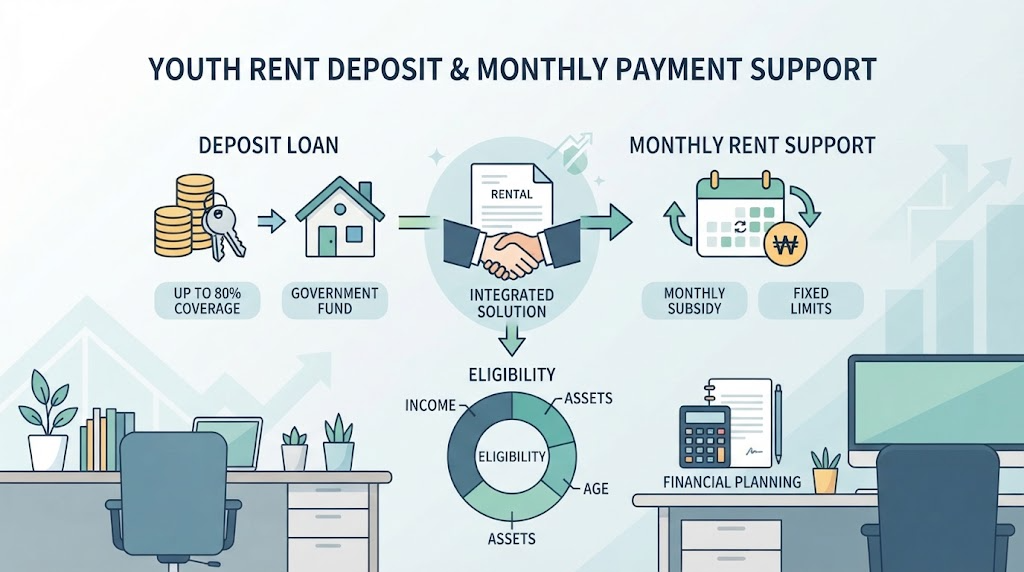
Solving Both Deposit and Monthly Rent at Once! Loan Limits and Support Structure
The most attractive point of the Youth Monthly Rent and Deposit Loan is that you can solve the lump-sum deposit loan and the monthly rent loan within a single product system at the same time. However, loans are not disbursed without limit, and it has clear limit criteria and support structures according to government fund regulations.
Deposit Loan Limit Criteria:
Maximum Limit Amount: Applied differentially depending on the product type (e.g., Youth Jeonse/Monthly Rent Deposit Loan, etc.) and personal conditions, but generally limited to a certain percentage of the deposit (within a maximum of around 80%) or within the prescribed maximum per-unit limit (e.g., maximum amount based on the metropolitan area, etc.).
Reflection Method by Deposit Scale: Calculated in proportion to the lease deposit amount of the jeonse or monthly rent home you are trying to find, and the actually executable amount is finally determined in connection with your held cash assets.
Monthly Rent Loan Limit Criteria (When Linking Monthly Rent Payment Loans):
Maximum Monthly Support Amount: Designed so that a certain limit (e.g., up to several hundred thousand won per month) is set among the monthly rent expenses and supported to a designated account every month or utilized for monthly rent payment.
Total Support Period and Frequency: Managed as a total amount for the monthly rent loan limit in accordance with the contract period or maximum supportable number of months (e.g., up to 2-year to multi-year units, review of extension availability).
Fund Structure and Process Upon Simultaneous Execution of Deposit and Monthly Rent:
Simultaneous Screening Structure: When visiting a bank or applying non-face-to-face, deposit loans and monthly rent loans are bundled into a single package and screened.
Execution Process:
Upon contract execution, the deposit loan is disbursed in a lump sum to the landlord’s account to cover the balance.
It operates in a structure where the monthly rent loan is fixedly paid to the landlord (or tenant) or repayment-managed in accordance with the agreed monthly rent payment date every month.
By effectively utilizing this support structure that simultaneously bundles and resolves the deposit and monthly rent, you can wisely disperse the pressure of preparing the initial deposit and the agony of monthly rent payments that approach every month.

3 Core Screening Criteria Determining Loan Approval
The Youth Monthly Rent and Deposit Loan has the great advantage of low interest rates and simultaneously solving deposits and monthly rent, but you must cross the screening thresholds of banks and guarantee institutions to receive final approval. The three core screening criteria that determine whether a loan is executed and its limit are as follows:
- Income and Repayment Capacity (Applicant Annual Income and Debt Screening):
The loan applicant’s annual income scale and existing debt status (credit loans, minus accounts, card loans, etc.) are the most important factors determining the success or failure of limit calculation and approval.
Due to the nature of fund loans, income screening is relatively lenient compared to general commercial banks, but if excessive credit loans or principal and interest repayment burdens (indirect criteria such as DSR) already held are excessive, you may be partially deducted from the desired loan limit or rejected. Therefore, it is advantageous to organize or manage existing debts in advance before applying.
- Physical Requirements of Target Housing (Deposit and Monthly Rent Ceilings and Dedicated Area):
The jeonse or monthly rent housing you wish to enter must itself comply with loan regulation criteria.
Area and Amount Restrictions: Generally, it must be housing with a dedicated area of 85 square meters or less (including residential officetels), and the lease deposit and monthly rent amounts must not exceed government support criteria (e.g., deposit and monthly rent ceilings by metropolitan area and local regions). Housing that exceeds the criteria by even 1 won is completely excluded from loan targets, so you must definitely check when searching for listings.
- Guarantee Institution’s Guarantee Issuance Screening (HUG or HF):
Since youth monthly rent and deposit and jeonse loans are not lent directly by banks, but rather executed based on guarantees from public guarantee institutions, approval from the guarantee institution’s screening is essential.
HUG (Korea Housing & Urban Guarantee Corporation) or HF (Korea Housing Finance Corporation): They comprehensively evaluate the applicant’s credit score, employment status, and income verification status to issue guarantees. In particular, for young professionals or college students with no income or unclear income verification, the guarantee limit may come out lower than expected, so a strategy of selecting a guarantee product more advantageous to your situation is necessary.
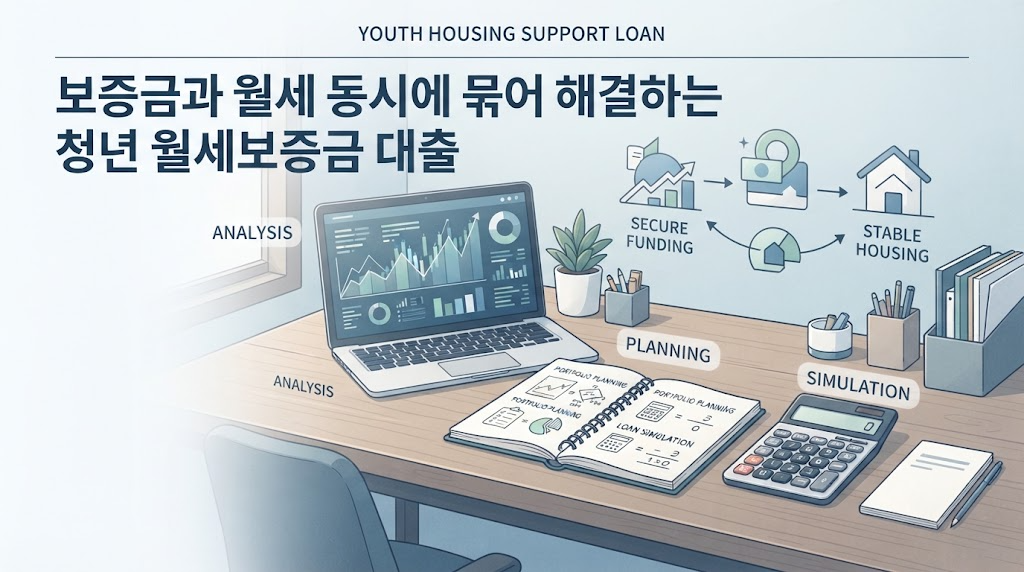
Youth Monthly Rent and Deposit Loan Interest Rates and Expected Repayment Simulation
The part you look forward to the most when executing the Youth Monthly Rent and Deposit Loan is undoubtedly the low-interest benefit, which is incomparable to commercial bank products. If you simulate in advance the interest you actually have to bear every month and the repayment structure of the monthly rent loan, you can establish your financial plan much more stably.
Applied Interest Rate Levels and Preferential Benefits:
Basic Interest Rate: The basic interest rate for youth jeonse and monthly rent-related loans supported by the Housing and Urban Fund is formed very low at around 2.0% to 3.1% per annum depending on the applicant’s annual income bracket.
Additional Preferential Interest Rates: If you receive additional interest discounts according to youth preferential product conditions (e.g., basic livelihood security recipients, next-lower-income bracket, single-parent families, etc.), electronic contract execution, or subscription period to the housing subscription comprehensive savings, applying an ultra-low interest rate in the late 1% range per annum is also possible.
Example of Deposit Loan and Monthly Rent Loan Interest Payment Calculation:
Deposit Loan Interest Simulation (Assuming a loan of 50 million won and an interest rate of 2.5%):
Annual Interest Incurred: 50 million won × 2.5% = 1.25 million won
Monthly Payment Interest: 1.25 million won ÷ 12 months = Approximately 104,000 won per month
Monthly Rent Loan Repayment and Payment Structure:
Since low interest rates are also applied to monthly rent loans supported or paid every month, you can significantly lower the risk of interest bombs compared to covering monthly rent with general private finance or commercial credit loans.
Financial Plan According to Grace Period and Repayment Method:
Repayment Method: The ‘bullet repayment (repayment of principal at maturity)’ method is mainly adopted, where you faithfully pay only the interest every month during the loan period and repay the principal all at once upon contract expiration.
Financial Management Tip: Since you can pay with minimized interest without the burden of principal repayment during the residency period (usually in 2-year units, extendable for several years upon maximum extension), it provides a very advantageous structure for accumulating seed money and forming assets during the young professional period.

Essential Checklist Before Loan Application and Mistakes to Watch Out For
The Youth Monthly Rent and Deposit Loan is a filial product that dramatically lowers the burden of housing costs, but if you miss minor procedural mistakes or contract requirements, your hard-earned preparation can go up in smoke. Check the mistakes you must avoid for safe loan approval and successful independence, and the checklist before application.
Mistake 1: Relying Only on Verbal Agreements with the Landlord and Processing Loan Applications or Transfers First
Problem: If you do not officially execute a lease agreement through a certified real estate agent, or if you remit a provisional deposit without checking loan availability first, you may not get the deposit back if the loan is rejected later, suffering huge financial losses.
Coping Method: When drafting a contract, it is safe to explicitly include a special clause stating, “In case of non-approval of the Youth Monthly Rent and Deposit Loan, this contract is null and void, and the paid contract deposit is immediately and fully refunded.”
Mistake 2: Omission of Confirmed Date Grant and Lease Report (Jeon-Wolse Report)
Problem: A ‘confirmed date’ proving the legal effect and opposing power of the lease agreement is a mandatory document during the loan screening process. If you apply to a bank without receiving this, it will be immediately rejected due to missing documents or screening will be delayed.
Coping Method: You must promptly receive a confirmed date through a community center (administrative welfare center) or Government 24 (Internet Registry) before the balance payment date or right after contract execution.
Mistake 3: Choosing a House Exceeding the Deposit and Monthly Rent Upper Limit Criteria of Target Housing
Problem: Even if it is a listing you like, if it exceeds the deposit and monthly rent limit criteria set by the government fund by even 1 won, it is completely excluded from loan targets.
Coping Method: Before going around viewing listings, you must thoroughly familiarize yourself with the exact deposit and monthly rent upper limit criteria of the Youth Monthly Rent and Deposit product you intend to utilize and set your budget range.
📌 Essential Checklist Before Applying for Youth Monthly Rent and Deposit Loan
- Whether all household members are without a home: Did you check in advance whether all household members on the resident registration copy are homeless?
- Meeting income and asset requirements: Do you meet the previous year’s annual income and asset criteria (based on fund regulations)?
- Checking target housing requirements: Is the housing within the allowable loan criteria for exclusive area, deposit, and monthly rent amount?
- Fixed date and contract payment: After signing a formal contract, did you pay a contract deposit of 5% or more and complete the fixed date?
- Ample application timing: Are you proceeding with bank applications with plenty of time, starting at least 1 month to 1 and a half months before the balance payment date (move-in date)?
Through thorough preliminary checks and meticulous document preparation, we hope you blow away housing cost stress with the youth monthly rent deposit loan and successfully secure a reliable shelter!
Korean version: 한국어로 읽기