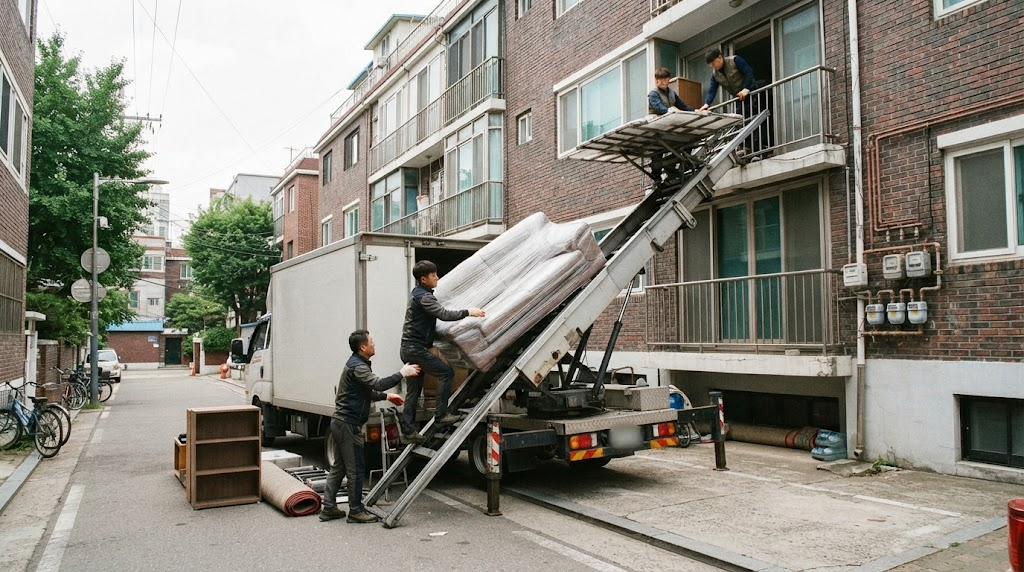
Introduction: Why are elevator and ladder truck conditions important for bulky waste home pickup?
When you need to dispose of bulky and heavy items like large furniture, massage chairs, or stone beds, many people first think of the ‘home pickup service’. It is a very convenient method because pickup crew members visit right inside your home to handle dismantling and hauling without you having to carry things out yourself.
However, before booking a home pickup, there is a core question that companies ask first:
“What floor do you live on?”, “Is elevator use available?”
This is because these questions are the key determining factors for pickup costs and feasibility.
Changes in moving routes and work crew: For a high-rise building without an elevator, the labor intensity for pickup crews increases sharply, and additional personnel may be deployed for safety reasons or pickup may even become impossible.
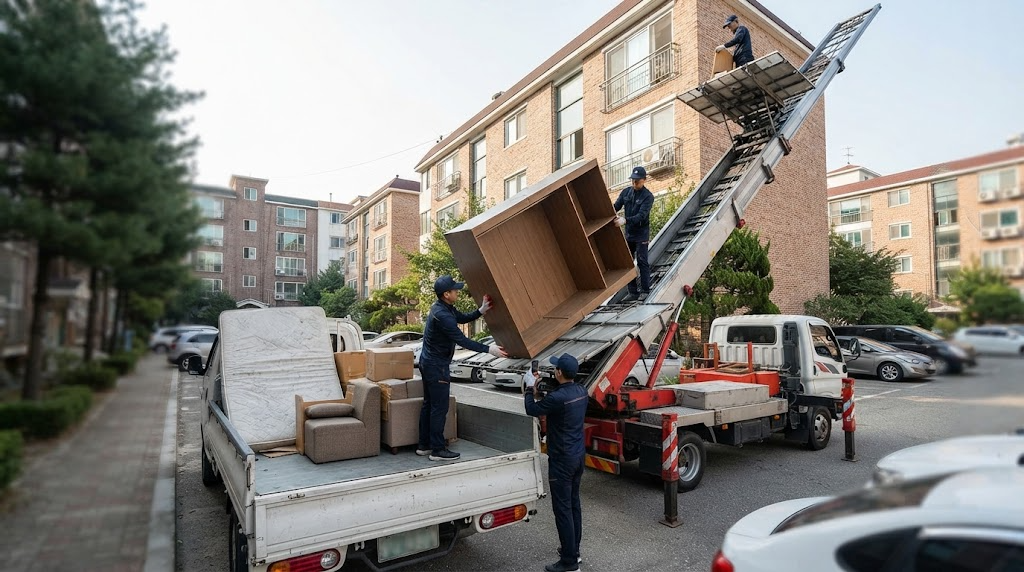
Decision on equipment deployment: Large items that are difficult to carry down the stairs require the mandatory mobilization of a ladder truck, resulting in additional equipment rental costs.
Ultimately, accurately understanding your home’s living environment (floor level, elevator availability, surrounding access conditions) can prevent setbacks such as additional fees or on-site cancellation on the day of pickup. In this article, we will take a detailed look at home pickup conditions according to elevator availability and coping methods for each situation.
Home pickup conditions when an elevator is available
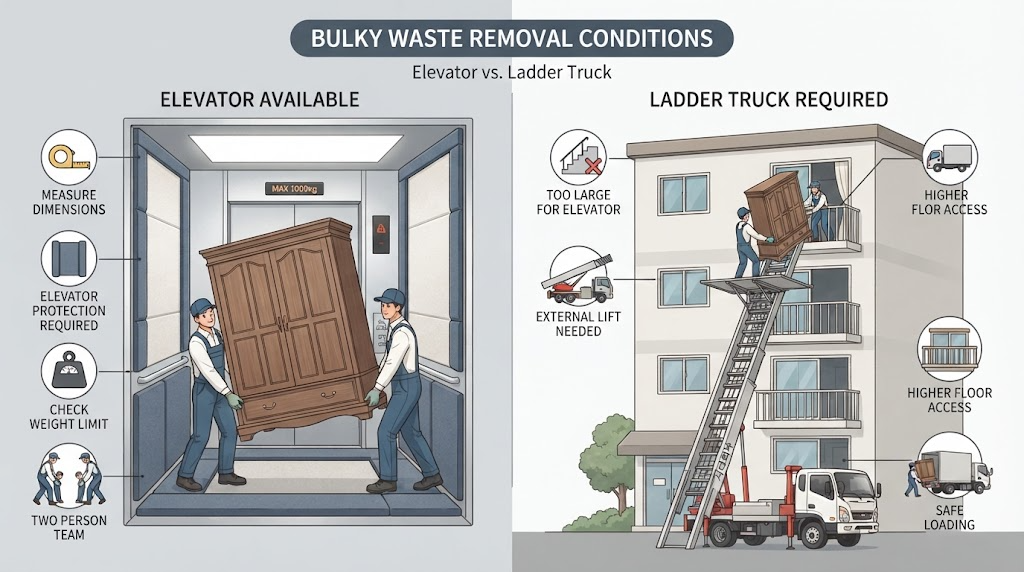
Residential types with elevators (apartments, officetels, villas with elevators, etc.) generally have a relatively easier working environment for home pickup. However, just because there is an elevator does not mean pickup is possible without any restrictions, and there are several important conditions and precautions to follow on-site.
① Weight and volume criteria for eligible items
Even when using an elevator, items that exceed the interior space or maximum load capacity of the elevator may not be able to be loaded.
Large wardrobes, top-load/front-load washing machines, large refrigerators, etc.: Most fit into standard elevator spaces, but extra-large furniture that prevents doors from closing or cannot fit even diagonally may be refused elevator boarding.
Need for prior measurement: It is safe to check the size of the items to be collected and the interior specifications of the elevator in advance, and if specifications are exceeded, the feasibility of stair transport or ladder truck deployment must be re-evaluated.
② Protective padding work (protecting the elevator interior) and cooperation with the management office
When moving heavy and sharp-edged furniture or home appliances, there is a high risk of damage accidents such as scratches or dents on the elevator walls, mirrors, or doors.
Installation of protective materials: Depending on the apartment or officetel management office, ‘protective padding work’ wrapping the interior of the elevator with cardboard or protective mats is often required when moving out large items or moving.
Prior approval and time restrictions: Since some complexes permit the removal of large items only during specific morning hours to avoid the commuting rush hours of residents, rules must be checked in advance through the management office before booking a visit.
③ Possibility of additional costs (management fee settlement, etc.)
Some apartment complexes or officetels charge a small fee as an elevator usage fee or management fee item under the pretext of protecting public facilities and cleaning. Since this is an additional condition that may occur depending on on-site conditions separately from the collection company cost, it is best to check in advance.
An environment with an elevator is a great advantage to save on ladder truck costs, but smooth collection can only be achieved by thoroughly checking the building’s own regulations and elevator specifications.
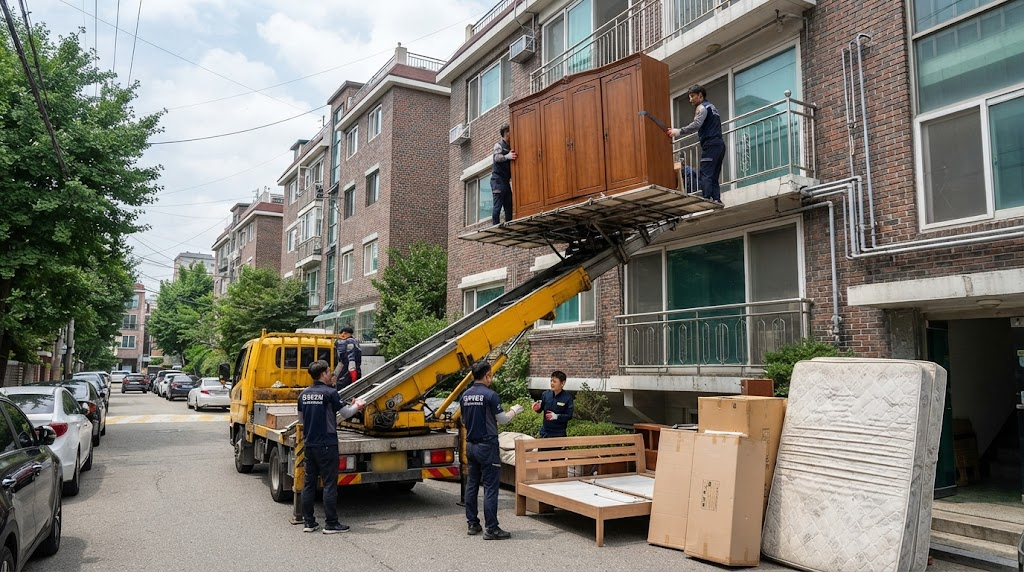
When there is no elevator or it cannot be used (Ladder truck requirement conditions)
If you live in a villa, multi-family housing, or older apartment where there is no elevator at all, or even if there is an elevator, it is too small to load bulky waste, there are special things to keep in mind during home pickup. In most cases, safe collection is only possible by mandatorily mobilizing a ladder truck.
① Situations where a ladder truck is essential
Large and heavy furniture that cannot be moved via stairs: Large wardrobes, stone beds, side-by-side refrigerators, large sofas, etc. that cannot pass through narrow and steep stairs or corridors are practically impossible to move between floors with manpower alone.
Opposition from the management office or residents: Even if there is an elevator, this applies when the management office strictly prohibits loading large cargo inside the public elevator, or permits only the use of moving-specialized ladder trucks.
Concern over building damage: There is a high risk of damaging walls or railings while carrying heavy loads down the stairs, so the company strongly recommends deploying a ladder truck.
② On-site checklist to check before using a ladder truck
A ladder truck cannot be installed just by calling one; the surrounding environment of the building must match the equipment specifications. Be sure to check the following elements before booking.
Access road and road width: The ladder truck vehicle itself must be able to smoothly enter the alleyway or parking lot. If the road is too narrow or there are many illegally parked vehicles, equipment installation becomes impossible.
Check for overhead obstacles: If power lines, communication lines, tree branches, etc. are intricately entangled toward the exterior wall of the building, it will cause major disruption to the extension of the ladder equipment.
Working floor level and angle: For high-rise villas, you must check the maximum height limit that the ladder truck can reach, and a flat floor space where the vehicle can be parked must be secured for safe work.
If you are in an environment where you must mobilize a ladder truck because there is no elevator, sharing on-site photos (building exterior, window location, alley situation) in advance when coordinating schedules with the collection company is the most reliable method. Thorough preparation is necessary to prevent situations where collection is canceled due to on-site variables.
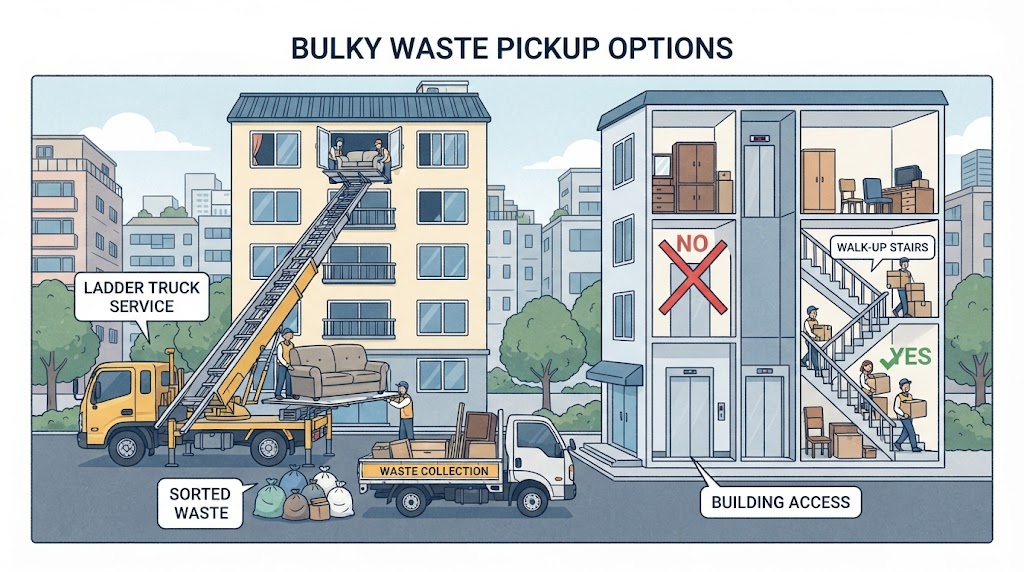
Expected costs by situation and preparation tips (Elevator vs. Ladder truck)
When using a bulky waste home pickup service, the most sensitive parts are ‘cost’ and ‘additional fees’. Depending on whether you are in an environment using an elevator or one where a ladder truck must be mobilized, the overall budget and preparation process change completely, so it is best to understand the structure in advance.
① Expected cost structure by situation
Elevator-using environment (Focused on basic collection)
Cost items: Basic home pickup cost (determined based on the type, volume, and number of items to be collected) + Elevator usage fee charged by the apartment management office (varies by complex)
Features: Costs are relatively reasonable as no additional equipment rental fees occur. However, if additional items other than the requested items are found on-site, additional charges may be billed.
Ladder truck required environment (Additional equipment rental fee)
Cost items: Basic home pickup cost + Ladder truck equipment rental/lease cost
Features: Ladder truck costs usually vary depending on the floor level, working time, and amount of items, and typically incur an additional cost of around 100,000 KRW to 200,000 KRW (varying by region and floor level). When calling a ladder truck, you must check in advance whether the company uses its own equipment or calls an affiliated company.
② Practical preparation tips for foolproof booking
- Send specific photos of the bulky waste in advance
When contacting a home pickup service, rather than just writing down the item names, it is better to take and send 1 photo of the overall appearance from a distance and 1 photo up close for size comparison. Knowing the exact volume ensures accurate vehicle size and manpower deployment.
- Secure parking and space in advance when using a ladder truck
If you have decided to use a ladder truck, you must request cooperation from the security office in advance or leave the space empty so that other vehicles are not parked in the spot where the ladder truck will enter on the morning of work. If time is delayed during this process due to a delayed contact with the vehicle owner, additional dispatch fees or waiting fees may occur.
- Check whether dismantling and disassembly work is included
For built-in closets or large furniture that requires disassembly, you must check in advance whether the crew members perform the disassembly work directly on-site (whether disassembly costs are included) or whether you need to disassemble it beforehand to prevent panicking on the day of work.
Because home pickup has many variables depending on the living environment, conveying your residential floor level, elevator presence, and alley entry feasibility honestly and in detail starting from the booking stage is the fastest and safest cost-saving tip.
Conclusion: Choosing a Wise Waste Collection Method That Fits Your Home Environment
Disposing of bulky waste is a cumbersome task that requires much more attention than one might expect. In particular, the process of moving heavy furniture or home appliances out of the house inevitably poses a significant burden, both physically and in terms of safety.
As we have seen today, the key to successful on-site collection lies in ‘accurately assessing your home’s residential environment.’
If your environment allows for smooth elevator use, it is wise to save costs by checking the elevator specifications and management office regulations in advance;
If your environment requires a ladder truck, carefully inspecting access routes and obstacle conditions to prevent disruptions on the day of service is the prudent approach.
If you are planning to book a waste on-site collection, check your residential environment first based on the checklist provided today. Conveying accurate information and thorough advance preparation will be the surest shortcut to clearing out your home most quickly and safely, without worrying about extra charges. We hope this post has been of some help in organizing a pleasant living environment for you.
Korean version: 한국어로 읽기