These days, as the threshold for employment gets higher and higher, many job seekers challenge themselves to obtain various certificates to prove their professionalism and build their specs. From computer literacy, computerized tax accounting, and financial management to various practical technical certificates, they study holding books day and night and get certificates in their hands, but whenever they submit resumes, they inevitably run into the wall of reality. This is exactly why quite a few young people and job seekers feel a sense of emptiness, wondering, “I obtained the certificate, but why doesn’t it lead directly to employment?”
This is because a mere certificate “passing certificate” alone is difficult to fully prove practical skills, and companies also prefer “immediate ready-to-work assets” who can be immediately deployed to the field. While studying alone by digging into textbooks is also meaningful, if you want to move forward fastest and most surely toward the final finishing point of employment, you must now change the paradigm of your studying method. That is why you must pay attention to the **”Job-Linking Course”** that seamlessly connects education, strengthening practical competencies, and actual job matching all at once.
Then, among numerous educational courses, what points should you look out for to choose a job-linking course that suits you best? In this post, we will thoroughly examine from A to Z the **essential items you must check when selecting a job-linking certificate course** that will lead to successful employment. If you want to refreshingly open the breakthrough for your desperate job preparation, please stay with today’s content until the end!

Main Body 1: Verifying Government Support (Employment24 & HRD-Net) and Training Institution Reliability
When selecting a job-linking certificate course, the first and most thoroughly verified gateway is to check whether the course receives official government support and how reliable the training institution in charge of education is. This is because quite a few people experience setbacks by registering hastily just seeing government-support benefits that ease financial burdens, only to waste time due to shoddy education management.
Let me point out the core points for verifying the reliability of training institutions that you must check to choose a safe and solid job-linking course!
- Checking Official Accreditation Courses and Training Institutions via Employment24 and HRD-Net
- Comparing Exaggerated Advertisement Employment Rates with Real Reviews of Actual Graduates
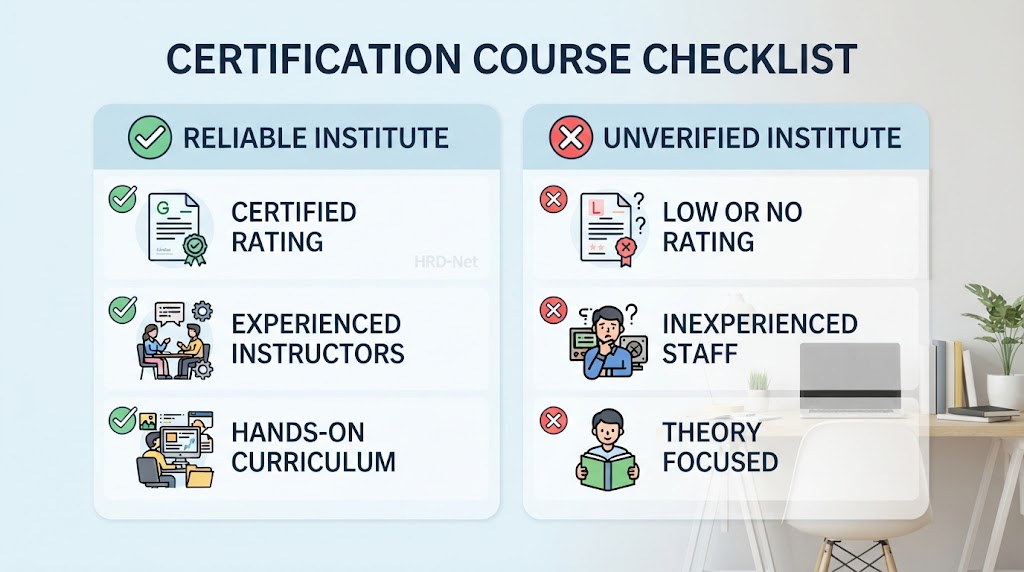
- Checking Training Institution’s Dedicated Facilities and Instructor Expertise
If it is a course that can be taken utilizing the National Tomorrow Learning Card, you must directly search whether the relevant institution and course received official accreditation through the Ministry of Employment and Labor’s official portal, **Employment24 or HRD-Net**. Sometimes, if general private academies make false or exaggerated advertisements as if they are government-supported institutions, or if they are poor institutions with low accreditation evaluation grades, it is difficult to expect high-quality job-linking benefits even after completion. It is safe to objectively check the institution’s accreditation status, employment rate, and trainee evaluation grades on HRD-Net.
In training institution consultation rooms or on homepages, students are often lured with flashy phrases such as “90% employment rate guaranteed” and “100% job linking.” However, you must carefully examine whether this figure is based on simple completion criteria or actual regular-employee employment criteria. By specifically comparing community reviews of senior graduates who went through the course or actual employment destinations (which companies they mainly join), you can gauge the true capabilities of the institution.
The success or failure of certificate acquisition and practical skills ultimately depends on “who and in what environment you learn from.” Even if it is a practice-oriented curriculum, you should avoid places that do not have the latest equipment or programs equipped, or where instructors lacking field experience just skim through theory classes perfunctorily. It is wise to visit the institution directly or carefully check the practice room environment and instructors’ practical experience through detailed consultation.
💡 Check point:
Thoroughly uncover the true grade and reputation of the institution hidden behind the titles of government support and job linking through Employment24 and HRD-Net. Choosing an accredited institution equipped with solid fundamentals is the very first secret to increasing your employment success rate tens of times.
Next, we will take a detailed look at **”Practice-Oriented Curriculum and Portfolio Production Support”**, which determines practical competency.
Main Body 2: Checking Practice-Oriented Curriculum and Portfolio Production Support
When selecting a job-linking certificate course, a core element that must be examined as importantly as the institution’s reliability is **”Practice-Oriented Curriculum and Portfolio Production Support.”** If it is education that simply memorizes theories appearing in textbooks to barely pass the certificate exam score, you may experience great difficulty failing to adapt to actual work when you actually join a company.
This is because the talent companies truly want is not someone with excellent test scores, but a “practical talent” who can be immediately deployed to the field and pull their own weight. Then, what kind of curriculum and support system-equipped courses should you choose? Let me point out the core points!
- Checking the Proportion of Field-Tailored Practice Beyond Simple Theory Memorization
- Support for Producing Individual Portfolios That Can Be Directly Written as a Line on Your Resume
- Whether Team Projects and Assignment Performance Linked with Actual Corporate Practice Are Included
No matter the field of certificate such as Computer Literacy, Computerized Tax Accounting, or Financial Management, a subtle gap exists between acquiring a certificate and practical application. When examining the curriculum, you should avoid places where the ratio of theory preparation for certificates within the total class hours is excessively high or where only old-fashioned lectures are repeated. You must carefully examine how high the proportion of the latest practical trends, programs actually used in the field, and practical assignments is.
The most powerful weapon to strongly prove a job seeker’s capability in document screening and interviews is a “portfolio” or “practical project outcome.” You must definitely check whether they guide you to complete your own outcome during the training process without stopping at certificate acquisition study, and whether the instructors enhance portfolio completion through 1:1 feedback. This is because a well-made portfolio becomes a more powerful employment weapon than multiple certificates.
Moving away from studying alone by looking at books, if a process of performing assignments or conducting team projects based on various cases and scenarios commonly occurring in the field is included, it is the icing on the cake. Since you can even cultivate collaboration skills and problem-solving skills, it becomes a precious experience that you can confidently put forward during interviews.
💡 Check point:
A certificate passing certificate is merely an “admission ticket” for employment, and a practical curriculum and portfolio are the real “certificates of capability” that will capture the interviewer’s heart. Carefully compare whether it is a theory-oriented, superficial education or a solid practical process that creates outcomes directly with your own hands.
Next, we will take a detailed look at **”Comparing the Partner Company Pool, Actual Employment Rate, and Post-Management System”**, which determines actual employment success or failure.

Main Body 3: Comparing Partner Company Pool, Actual Employment Rate, and Post-Management System
The ultimate purpose of taking a job-linking certificate course is ultimately “employment success.” No matter how excellent the curriculum is and how easily you acquire a certificate, if you are neglected in the process of actually finding a job after the education ends, that course is nothing more than half-baked. Therefore, you must carefully examine how solid an employment support system the training institution is equipped with.
Let me point out the core points that you must compare to receive successful employment matching and reliable support!
- Scale of the Partner Company Pool and Quality of Actually Linked Job Roles
- Tailored Employment Consulting Responsible from Document Screening to Interviews
- Post-Management and Re-referral System for the Unemployed Continuing Even After Completion
When consulting, you should not blindly feel reassured by words like “our partner companies reach the thousands.” What matters is how much the scale or industry of those companies actually matches the job role you desire. You must check whether industry-academia cooperation is established with large corporations or excellent mid-sized and small businesses that anyone would recognize by name, and whether it is a place that transparently discloses specific company lists or employment status regarding what job roles and salary conditions actual graduates are succeeding in employment with.
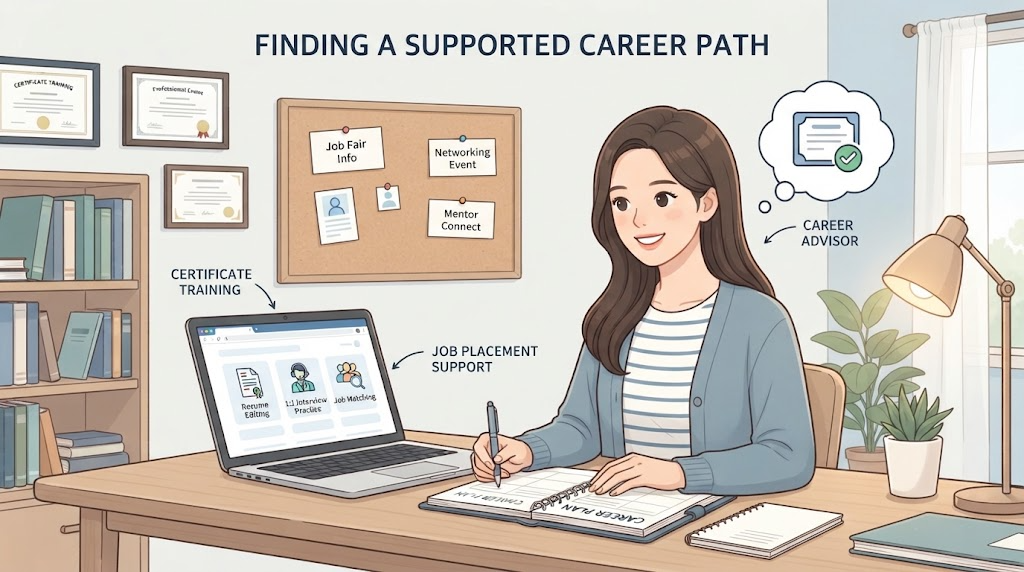
If you try to write a resume alone, you feel overwhelmed and have no sense of where or how to fix it. If it is a professional job-linking course, a dedicated employment counselor (employment support coordinator) who closely marks overall job-seeking activities—such as cover letter editing, resume photography support, 1:1 mock interviews, and actual interview accompaniment—should be stationed there. Make sure to check whether it is a structure where you are not fighting alone, but a reliable helper is running alongside you.
An institution where management ends just because education has ended can hardly be considered a good job-linking institution. You must check whether a “post-management system” is well-equipped that continuously provides job opening information and arranges interview opportunities even when you fail to get a job immediately after completion or ponder a job change. The more active the graduate community is or the more follow-up programs helping continuous growth such as special lectures for graduates exist, the more reliable the place is.
💡 Check point:
The true value of a job-linking course shines “after completing the classes.” Do not settle for just receiving a flashy completion certificate; make sure to verify whether the place is equipped with a solid pipeline that directly connects you to excellent companies that want you and a thorough post-management system.
Next, we will take a detailed look at **”Carefully Examining Hidden Costs Such as Training Allowances and Out-of-Pocket Expenses”**, smart ways to weigh tuition fees and economic benefits.
Main Body 4: Carefully Examining Hidden Costs Such as Training Allowances and Out-of-Pocket Expenses
When selecting a job-linking certificate course, a realistic factor that must be examined as carefully as the curriculum or employment rate is **”costs and economic benefits.”** Just because it is a government-supported course does not mean it is unconditionally free or completely free of cost burdens; conversely, depending on conditions, you might even reap substantial benefits where money actually flows into your bank account.
To avoid being flustered by unexpected out-of-pocket expenses or missing out on benefits you should receive, let me point out the core cost-related points you must check before applying for a course!
- Accurately Checking the “Out-of-Pocket Expense” by National Tomorrow Learning Card Type
- Conditions for Lucrative “Training Allowance (Transportation & Meal Expenses)” Benefits Paid According to Attendance Rate
- Examining Hidden Additional Costs Such as Textbook Fees, Exam Application Fees, and Material Fees
- Familiarizing Yourself with Reimbursement Regulations That Occur Upon Quitting Mid-Course or Failing Completion
When taking a government-supported course, the proportion supported by the government varies greatly depending on an individual’s employment status or income level (employed workers, job seekers, general participants, employment success package participants, national employment support system participants, etc.). There are cases where people suffer setbacks after applying, believing blindly in the words “full support,” only to incur unexpectedly large out-of-pocket expenses depending on their card type or the grade of the subject they wish to take. Before registering, you must calculate in advance through the Employment24 system how much your exact out-of-pocket expense will be.
For government-supported job-linking courses targeting job seekers, if certain criteria are met (usually an attendance rate of 80% or higher), a **”training allowance”** composed of monthly transportation and meal expenses is paid. For youths whose income has been cut off while juggling job-seeking activities and studies for several months, this allowance serves as precious living funds like rain during a drought. It is advisable to familiarize yourself in advance with how it is paid differentially according to attendance days or what the reduction regulations are for being late or leaving early.
Even if you register affordably by receiving government support for tuition, there are cases where professional textbook purchase costs, practice material costs, or official exam application fees required for the class are not included in the tuition and must be borne out of pocket separately. You must calculate the total “total cost” coming out of your wallet until completing the entire training course and plan your budget.
If you fail to complete the course midway due to unavoidable circumstances and quit midway (expulsion/midway dropout) or fail to fulfill the attendance rate, you may be subjected to the reimbursement of previously supported training expenses or allowances, or suffer disadvantages in your Tomorrow Learning Card balance. You must carefully check the absence criteria or penalty regulations in case of midway dropout in advance and verify whether it is a realistic schedule that you can complete to the end.
💡 Check Point:
Smart job seekers minimize out-of-pocket expenses while maximizing training allowance benefits. Before registering for a course, transparently check your personal out-of-pocket costs by card type, additional expenses, and allowance payment conditions to choose a valuable, risk-free program.
Next, let’s look at the **Conclusion and Closing Remarks**, which will neatly summarize the entire contents of today’s post.

Conclusion: Taking the Shortest Path to Employment Success Through Thorough Comparison and Personalized Selection
So far, we have thoroughly examined from A to Z the **’Essential Checkpoints to Consider When Choosing Recommended Certifications and Employment-Linked Programs’** that job seekers knocking on the door of employment must know.
We live in an era where simply holding a certification in your hand is no longer enough to build competitiveness in the fierce job market. From checking the official accreditation and reliability of training institutions through Employment24 and HRD-Net, to practical curricula immediately applicable in the field, portfolio production support, a strong partner company pool and post-management system that connect you with top companies you desire, and economic reviews carefully weighing training allowances and out-of-pocket costs! How thoroughly you compare and choose all these processes becomes a powerful weapon that determines your employment success.
Rather than having the mindset of “I’ll follow along because everyone else is getting it” or “It’s government-funded so I’ll just wing it,” the fastest and surest shortcut to employment is to compare and prepare as meticulously as if crossing a stone bridge after testing its safety, with the proactive attitude of “laying a precious stepping stone for my career.”
We sincerely hope that the checkpoints shared today will serve as a reliable compass during the daunting and anxious job preparation process, helping you wisely choose the best educational program tailored to you and proudly seize the glory of employment success where you want. We will be back with more useful and enriching certification and employment guides next time!
💡 **If this post was helpful, please show your support with a like (♥) and by adding us to your neighbors so you don’t miss out on weekly updated, valuable certification and employment success benefit information!**
Korean version: 한국어로 읽기