Prologue: Why Government-Funded Certifications Right Now?
This is a draft of the prologue section designed with Naver Blog tone and manner (high-readability sentence segmentation, empathy building, and emphasis on key points).
- Prologue: Why Government-Funded Certifications Right Now?
Looking at today’s job and career transition market, you can clearly feel that the atmosphere has changed significantly compared to just a few years ago.
We have reached an era where passing the document screening is difficult with so-called ‘quantitative specs’ alone, such as educational background or language test scores. In the hiring process, the question companies most persistently seek to verify ultimately converges into one.
“So, from day one on the job, what practical tasks can you handle right away?”
Recruitment trends now point toward ‘hands-on talent’ who know how to use industry tools and execute projects, rather than simple rote-memorization certifications.
However, for non-majors or job seekers looking to pivot to a new career path, proving practical competence is by no means easy. Enrolling in private bootcamps or vocational academies often holds people back with tuition burdens ranging from hundreds of thousands to millions of KRW.
At this moment, the smartest breakthrough system is government-funded training through the Tomorrow Learning Card (국민내일배움카드).
💡 3 Reasons Why Job Seekers and Career Changers Must Actively Utilize Government Funding
Overwhelming Cost Reduction: With government-funded training cost support ranging from 3,000,000 to 5,000,000 KRW per person, you can complete specialized curricula with minimal self-pay costs or completely free of charge.
Focus on ‘Hands-on Practice’ Rather Than Theory: Far beyond merely acquiring written-exam certifications, you intensively practice programs directly used in corporate operations (Excel, Douzone, Python, Figma, etc.).
Training Incentives and Job Placement Benefits: Meeting the requirements grants monthly training incentive allowances based on attendance rates to alleviate living expense burdens, along with one-stop employment matchmaking support from dedicated vocational counselors upon completion.
Rather than certifications that merely fill a line on a resume, what are the “lucrative, promising certifications that can be used immediately on the job while being acquired without financial burden”?
Let us examine the carefully selected list of government-funded certifications one by one, based on job-specific practical fit and recruitment market demand.
Would you like me to write the next section or related materials?
Next Section: Writing the main content for core administrative and management support certifications
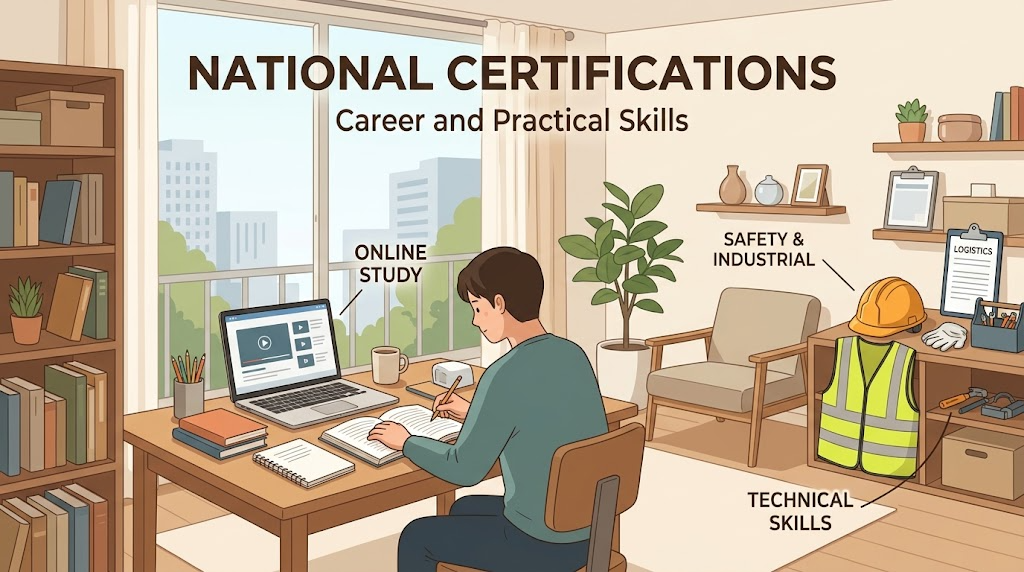
Creating a 16:9 aspect ratio image generation prompt to include in the prologue

Core Administrative & Management Support: Essential Certifications for Humanities Majors and Non-Majors
This is a draft of Section 2, crafted with enhanced key information delivery and readability so Naver Blog readers can read comfortably.
- Core Administrative & Management Support: Essential Certifications for Humanities Majors and Non-Majors
The job roles that so-called humanities-background job seekers or non-major applicants—such as those from humanities or language fields—most frequently apply for are management support, general affairs, HR, and accounting/bookkeeping.
However, looking at job postings, you will always notice phrases like “Relevant majors preferred” or “Experienced in related work.”
To increase your resume pass rate and prove practical adaptability to interviewers as a non-major, objective proof that you can immediately handle the programs companies use daily (accounting ERP, spreadsheets) is essential. Here are the 2 most representative government-funded certifications in this field, offering top-tier cost-effectiveness and practical utility.
① Computerized Tax Accounting (Computerized Accounting Level 1 / Computerized Tax Level 2)
“A practice-oriented certification in continuous hiring demand regardless of company size”
Organizing Institution: Korea Association of Certified Public Tax Accountants (KACPTA)
Practical Utilization: Directly operating the KcLep computerized accounting program, this verifies the ability to perform general journal entries, sales/purchase voucher processing, VAT filing, and closing procedures.
Recommended Acquisition Combination: For non-majors, taking a concurrent acquisition track of Computerized Accounting Level 1 + Computerized Tax Level 2 is recommended. From Computerized Tax Level 2 onward, it covers practical tasks directly tied to HR and general affairs—such as withholding tax and year-end tax settlements—which changes how you are evaluated in the hiring market.
Why Government Funding is Recommended: Accounting theory (journal entries, chart of accounts) has a fairly high barrier to entry via self-study, but government-funded academies complete the preparation through 1 to 2 months of intensive courses tailored to non-majors, covering theory organization, repeated software practice, and past exam reviews, significantly raising pass rates.
② Computer Specialist (Level 1 / Level 2)
“The basic language of office work, from public enterprise bonus points to practical Excel in large corporations”
Organizing Institution: Korea Chamber of Commerce and Industry (KCCI)
Practical Utilization: It is no exaggeration to say that 80% of company work is done through Excel. Computer Specialist demonstrates the ability to process vast amounts of data using functions, build pivot tables, apply conditional formatting, and write macros to produce reports.
Level Selection Tip:
Computer Specialist Level 2: For those aiming for general office, sales management, or customer support roles in small and medium-sized enterprises (SMEs) or mid-sized companies, requiring quick certification (2 to 4 weeks).
Computer Specialist Level 1: For those who need bonus points for public enterprise/public institution recruitment or aim for business planning roles in large corporations/mid-sized companies (includes Access database).
Why Government Funding is Recommended: The practical exam for Computer Specialist Level 1 in particular has a high dropout rate due to vast function combinations and Access query building. Taking advantage of the practical-focused intensive classes at government-funded computer academies allows you to quickly correct mistakes on the latest question trends, drastically shortening the preparation period.
💡 Practical Spec Completion Tip (Job Strategy)
In the office job market, these two certifications act as complements to each other.
- Prove data organization and report writing skills with Computer Specialist (spreadsheet analysis competency), and
- Appeal your ability to understand corporate capital flows with Computerized Tax Accounting (financial/accounting system competency) to complete a solid practical portfolio even as a humanities major or non-major.
Shall I prepare the next section or materials?
Next Section: Writing the main text for IT/Digital Role Tech Certifications
Creating a 16:9 image generation prompt for the administrative and management support section

IT/Digital Roles: Tech Certifications Accessible to Non-Majors
This is a draft for Section 3, structured to help Naver blog readers alleviate vague fears of IT roles and establish a realistic job-seeking strategy.
- IT/Digital Roles: Tech Certifications Accessible to Non-Majors
Recently, not only in the IT industry but also across recruitment notices for marketing, planning, e-commerce, and general service positions, there are keywords that frequently appear in common. These are ‘data-driven decision-making’ and ‘digital literacy.’
Even non-majors with zero coding or programming experience do not need to feel discouraged.
This is because tech competencies required in actual workplaces focus not simply on writing complex algorithms, but on “whether one can extract vast data accumulated within a company and process it into practical, useful insights.”
Here is a summary of major tech certifications and government-funded link strategies that lower barriers to entry for non-majors while establishing distinct differentiators on application forms.
① SQLD (SQL Developer)
“The core database weapon that humanities students and non-majors can acquire the fastest”
Supervising Institution: Korea Data Agency (K-DATA)
Practical Utilization: Verifies structured query language (SQL) proficiency to query and extract data under desired conditions (SELECT, JOIN, etc.) from enterprise relational database management systems (RDBMS).
Recommended Roles: Data analysts as well as performance/growth marketers, service planners (PM/PO), and platform operation managers.
Job Application Selling Points: You can highlight the ability to directly pull and analyze large volumes of customer and transaction data using queries, which are difficult to handle with Excel VLOOKUP or pivot tables alone. Formulas are not complicated and focus on logical structures, allowing non-majors to reach the passing range within 3–4 weeks of focused study.
② ADsP (Advanced Data Analytics Semi-Professional)
“A certification demonstrating foundational skills from data planning to statistical analysis modeling”
Supervising Institution: Korea Data Agency (K-DATA)
Practical Utilization: Comprehensively covers data understanding, data analysis planning, and actual data analysis techniques (R / statistical fundamentals).
Synergy with SQLD:
SQLD: “The skill to extract data directly from databases exactly as desired”
ADsP: “The competency to plan which statistical perspectives and frameworks to apply when analyzing that extracted data”
Equipping both certifications as a set creates a strong impression in marketing and planning roles as a ‘planner strong with numbers.’
③ Engineer Information Processing / Industrial Engineer Information Processing & Government-Funded K-Digital Training (KDT)
“A state-certified qualification for career transition into development and engineering”
Supervising Institution: Human Resources Development Service of Korea
Practical & Recruitment Reality:
For non-majors seeking to fully pivot careers into web/app development (frontend/backend) or cloud engineering, obtaining the Engineer Information Processing (or Industrial Engineer) certification provides substantial leverage, as it serves as a baseline for grade determinations when applying to system integration (SI) companies or public project-awarded firms.
Government-Funded Link Tip (K-Digital Training):
In IT software development, ‘GitHub code and project portfolios actually deployed’ dictate hiring decisions far more than certifications alone.
Therefore, rather than stopping at studying for written and practical certification exams, it is crucial to combine strategies by utilizing fully 100% government-funded K-Digital Training (KDT) bootcamp courses to complete full-stack web development or collaborative AI/big data project portfolios.
💡 Recommended Tech Career Roadmap for Non-Majors
[Step 1] Acquire SQLD (Solidify data query fundamentals)
↓
[Step 2] Combine Python/R basics or ADsP (Data visualization and analytics)
↓
[Step 3] Participate in government-funded KDT projects (Build practical service planning and development portfolios)
Rather than opening heavy computer science textbooks right away, building small wins through SQLD or data certifications with quick results and following up with government-funded practical programs is the most realistic path to complete the journey toward employment without dropping out.
Shall I prepare the next section or materials?
Next Section: Writing the main text for Design & Content Role Certifications
Creating a 16:9 image generation prompt for the IT/Tech section
Design & Content Roles: Certifications That Complete Job Portfolios
This is a draft for Section 4, written to help Naver blog readers understand practical processes and clearly gain portfolio preparation strategies.
- Design & Content Roles: Certifications That Complete Job Portfolios
Design, web publishing, and marketing content production roles share a very distinct characteristic in the hiring market.
“Rather than the number of certifications, ‘outputs (portfolios) made with your own hands’ determine passing.”
However, for non-majors or self-taught job seekers, the very process of creating that initial output presents a steep barrier to entry. This is because creating impressive outputs out of thin air is challenging when one is not even accustomed to Photoshop or Illustrator shortcut keys.
Therefore, government-funded courses and certifications in design should be utilized as “a launching pad to rapidly internalize core graphic tool techniques and complete practical project portfolios.” Here is a breakdown of core certifications and utilization methods ideal for proving hands-on skills in the recruitment market.
① GTQ / GTQi (Graphic Technology Qualification Levels 1 & 2)
“A state-accredited certification to master Photoshop and Illustrator practical techniques in a short period”
Supervising Institution: Korea Productivity Center (KPC)
Practical Utilization:
Conducted 100% via computer practical examinations without written tests. Using Photoshop (GTQ) and Illustrator (GTQi), it tests basic hands-on techniques for practical content production, such as image compositing, pen tool cutout work, brush and filter effects, vector path drawing, and emblem creation.
Recommended Roles: E-commerce detail page designers, SNS marketers, card news and blog editors, YouTube thumbnail and graphic designers.
Job Application Selling Points:
Demonstrates proficiency beyond amateur levels, verifying workflow speed and familiarity with keyboard shortcuts used daily by working professionals. Obtaining Level 1 grants state-accredited certification status, providing high credibility during application screenings at public institutions and corporations.
② Craftsman Web Design and Development (formerly Craftsman Web Design)
“Adding responsive publishing (HTML/CSS/JS) coding competency to design sensibility”
Supervising Institution: Human Resources Development Service of Korea
Practical Utilization:
Evaluates the capability to construct visual user interfaces (UI) with graphics, as well as implement responsive web layouts functioning in live browsers using HTML5, CSS3, and JavaScript/jQuery.
Recommended Roles: Web designers, UI/UX designers, web publishers, entry-level frontend applicants.
Why Government Funding is Recommended:
Those with no coding background often get stuck on layout architectures (CSS Flex, Grid) or writing dynamic scripts. Through government-funded computer publishing courses, learners can systematically master everything from foundational coding syntax to building functional websites that adhere to web standards and accessibility guidelines step by step.
💡 Leveraging Design Government-Funded Courses 200%: “Certification + Portfolio” Concurrent Completion Strategy
While many assume they should build portfolios only after acquiring all certifications, that approach unnecessarily lengthens the preparation period. The most successful government-funded training routine is as follows:
[Months 1–2: Establish Fundamentals]
Government-funded coursework practice + Acquire GTQ Level 1 (Complete Photoshop & Illustrator hands-on mechanics)
↓
[Months 3–4: Application & Coding]
Craftsman Web Design and Development practical exam + Learn Figma UI prototyping
↓
[Completion Point: Produce Final Deliverables]
Complete real-world brand renewal projects or responsive website portfolios & Register on Behance/Notion
In design roles, certifications serve as “minimal proof that you can navigate foundational graphic programs without friction,” while what truly catches the interviewer’s eye is ultimately “the design deliverables crafted with deliberate thought during government-funded projects.” Be sure to actively utilize the 1-on-1 portfolio feedback sessions provided by government-funded academies to build your own distinct portfolio.
Shall I prepare the next section or materials?
Next Section: Writing the main text for Field, Technical & Logistics Professional Certifications
Creating a 16:9 image generation prompt for the Design/Content section

On-Site, Technical & Logistics Professions: Lifelong Certifications with No Retirement Age
This is a draft for Section 5, designed to serve as a practical guide for those preparing for employment or re-employment (career transition) in technical, logistics, and field professions.
- On-Site, Technical & Logistics Professions: Lifelong Certifications with No Retirement Age
Recently, technical, on-site, and logistics certifications have garnered the hottest interest not only among young job seekers in their 20s and 30s, but also among the middle-aged demographic in their 40s and 50s.
While office work and general service jobs inherently carry anxieties about retirement age even as career experience accumulates, jobs based on technical skills and licenses are professions where “skills learned with your body become a lifelong livelihood.”
In particular, fields with mandatory legal hiring requirements or continuous demand driven by large-scale logistics infrastructure expansions boast solid resilience in the job market, as barriers concerning age and academic background are relatively low. Here is a summary of 3 representative credentials that help you build reliable, lifelong assets while reducing tuition burdens through government support.
① Forklift Driving Craftsman
“Overwhelmingly No. 1 in Worknet job postings! The free-pass certification for logistics and manufacturing sites”
Supervising Institution: Human Resources Development Service of Korea
Practical Utilization:
A national technical qualification essentially required across all industrial sectors where cargo transportation is needed, such as large e-commerce fulfillment centers, general logistics warehouses, ports, construction sites, and manufacturing plants.
Employment Strengths:
Unlike general labor roles, holders of a forklift driver’s license receive stable regular employment and preferential allowances. In particular, it grants immediate application eligibility when hiring for major logistics company centers such as Coupang and CJ Logistics.
Why Government Funding is Recommended:
Since the forklift practical test requires operating actual equipment, self-study is impossible. While tuition fees at private heavy equipment academies easily exceed hundreds of thousands of KRW, utilizing the heavy equipment government-funded course through the Tomorrow Learning Card allows you to receive intensive training without burden, covering everything from course driving to cargo loading/unloading practical practice.
② Craftsman Electricity / Industrial Engineer & Engineer Electricity
“From facility management to industrial plants, the ultimate peak of technical jobs with no retirement age”
Supervising Institution: Human Resources Development Service of Korea
Practical Utilization:
Required in all buildings and plant sites where electricity flows, including apartment and building facility management (disaster prevention/maintenance), factory equipment preservation, electrical construction, and supervision firms.
Employment Strengths:
Buildings above a certain scale are legally mandated to appoint an ‘Electrical Safety Manager,’ ensuring steady hiring demand regardless of economic downturns. It is recognized as a lifelong certification without retirement, allowing individuals to work steadily in the facility management sector even past their 60s.
Why Government Funding is Recommended:
The electrical field involves numerous mathematical formulas and theories that are unfamiliar to non-majors, such as circuit theory and electrical machinery, and the hands-on practical exam (wiring work) is also demanding. Preparing for the hands-on test by assembling actual practice wiring boards at a government-funded electrical academy is the quickest path to passing.
③ Industrial Safety Engineer / Industrial Safety Industrial Engineer
“Fierce competition among companies to recruit safety managers due to the strengthening of the Serious Accidents Punishment Act”
Supervising Institution: Human Resources Development Service of Korea
Practical Utilization:
Performs duties to prevent occupational accidents among workers in workplaces such as manufacturing, construction, and logistics, as well as establishing and inspecting statutory safety management standards.
Employment Strengths:
As the scope of application of the Occupational Safety and Health Act and the Serious Accidents Punishment Act continues to expand, safety manager appointment mandates have become extremely strict for workplaces with 50 or more regular employees (or construction projects of 5 billion KRW or more). Consequently, even entry-level applicants holding an industrial safety engineer certification can secure a very advantageous position when applying to safety teams in manufacturing companies or construction sites.
Study Tips:
Because the clauses of the Occupational Safety and Health Act and on-site standards that need to be memorized are extensive, it is efficient to target the core frequently tested areas through government-funded online/offline courses in a condensed manner.
💡 Guide to Choosing Technical & Logistics Certifications
If you need fast employment and immediate results?
👉 Forklift Driving Craftsman (Available for immediate deployment to logistics centers and job sites after short-term acquisition)
If you want stable facility management without retirement age past 60?
👉 Obtain Craftsman Electricity and build experience to qualify for electrical safety manager appointment
If you aim to enter safety management positions at large or mid-sized enterprises in manufacturing/construction?
👉 Cross the employment threshold with Industrial Safety Engineer (or Industrial Engineer)
Shall I prepare the next section or materials?
Next Section: Writing the comparison table by certification & 100% government funding tips
Creating a 16:9 image generation prompt for the field and technical section
At-a-Glance Recommended Certifications by Job Function & Difficulty Comparison Table
This is a draft for Section 6, designed to maximize readability as the core summary part of the post so that readers can stop scrolling and screenshot it on both mobile and PC.
- At-a-Glance Recommended Certifications by Job Function & Difficulty Comparison Table
We have organized the promising certifications discussed earlier so you can compare them at a glance.
Refer to the matrix below to establish a strategy on which certification to prioritize as your top target, based on your current major status, target employment timeline, and job preferences.
📊 Comprehensive Comparison of Promising Government-Funded Certifications by Job Function
| Job Field | Recommended Certification | Average Preparation Period | Exam Difficulty | Major Employers / Preferred Roles | Practical Utilization Points |
|---|---|---|---|---|---|
| Office & Management | Computerized Accounting Level 1 / Computerized Tax Level 2 | 1–2 months | ★★☆☆☆ ~ ★★★☆☆ | General corporate accounting teams, finance teams, tax accounting firms, SME general affairs | KcLep journal entry input, practical VAT & withholding tax processing |
| Office & Public Enterprises | Computer Specialist Level 1 & Level 2 | 3 weeks – 2 months | ★★☆☆☆ (Level 2)
★★★★☆ (Level 1) |
Public enterprise bonus points, large/mid-sized enterprise general office & planning | Large-scale Excel formula analysis, pivot tables, task automation |
| Data & IT | SQLD (SQL Developer) | 3–4 weeks | ★★☆☆☆ | Performance marketers, service planners (PM), entry-level data analysts | Direct extraction of data matching desired criteria from large databases (SELECT/JOIN) |
| Data & IT | ADsP (Advanced Data Analytics Semi-Professional) | 3–4 weeks | ★★☆☆☆ | Platform operations, business planning, marketing strategy | Understanding data planning and statistical analysis model frameworks |
| IT Development | Engineer Information Processing + KDT Bootcamp | 3–6 months | ★★★☆☆ (Written)
★★★★☆ (Practical) |
Web/app development companies, SI system integration firms, IT solution providers | Certified proof of foundational CS knowledge + practical collaborative project portfolio |
| Design | GTQ / GTQi Level 1 | 3–4 weeks | ★☆☆☆☆ | E-commerce product detail page creation, SNS content marketing, in-house design | Photoshop & Illustrator shortcut mastery and rapid image editing execution skills |
| Web Publishing | Craftsman Web Design and Development | 1–2 months | ★★☆☆☆ | Web agencies, UI/UX design teams, web publishers | HTML/CSS responsive web implementation, foundational JavaScript scripting |
| Logistics & Distribution | Forklift Driving Craftsman | 2–3 weeks | ★☆☆☆☆ | Large fulfillment centers (Coupang, etc.), port/air logistics, manufacturing plant warehouse management | Essential prerequisite for regular employment at logistics centers, on-site cargo loading/unloading operations |
| Facilities & Technical | Craftsman Electricity / Industrial Engineer Electricity | 2–3 months | ★★★☆☆ (Craftsman)
★★★★☆ (Engineer) |
Apartment/building facility management (control rooms), industrial plants, electrical construction firms | Lifelong technical career without retirement age, statutory qualification for electrical safety manager appointment |
| Safety & Manufacturing | Industrial Safety Engineer / Industrial Engineer | 2–3 months | ★★★☆☆ | Manufacturing production/safety teams, construction site safety managers, logistics centers | Mandatory statutory appointment of safety managers following the strengthening of the Serious Accidents Punishment Act |
💡 Tailored Recommendation Routes by Situation
- “What if you urgently need a single line of resume credentials within a month?”
👉 GTQ Level 1 (Design Basics) or SQLD (Data Basics)
- “What if you are a non-major humanities graduate seeking rapid employment in general office/general affairs roles?”
👉 Acquire Computer Specialist Level 2, then concurrently take a Computerized Tax Level 2 course
- “What if you are looking for a skill to work stably for a long time without age restrictions?”
👉 Forklift Driving Craftsman (Immediate employment track) or Craftsman Electricity (Lifelong workplace track without retirement age)
- “What if you are an entry-level candidate looking to knock on the doors of large or mid-sized enterprise open recruitment?”
👉 Industrial Safety Engineer or Computer Specialist Level 1 + specialized job-focused KDT project portfolio

100% Government Funding Utilization Tips: From Application to Training Allowances
This is a draft for Section 7, clearly laying out the administrative procedures and practical allowance benefits that trainees are most curious about yet often find confusing.
- 100% Government Funding Utilization Tips: From Application to Training Allowances
The more you understand the government funding system, the greater the benefits, but if you are unfamiliar with the procedures or rules, it is easy to incur penalties for early withdrawal or miss out on subsidies.
From issuing the Tomorrow Learning Card to selecting reliable academies without fail, along with practical tips for collecting regular monthly training allowances, here are the essential points summarized in an easy-to-understand manner.
① Tomorrow Learning Card Eligibility & Basic Support Details
Target Audience: Available to almost all citizens, including job seekers, career changers, incumbent workers, special types of employment workers, and self-employed individuals (exceptions apply to civil servants, private school pension beneficiaries, and certain high-income earners in large corporations).
Support Limit: Basic 3,000,000 KRW (up to 5,000,000 KRW in additional support depending on vulnerable group status or income criteria).
Validity Period: Valid for 5 years from the date of issue.
How to Apply: Access the Ministry of Employment and Labor’s integrated platform ‘Work24 (work24.go.kr)’, log in with an accredited certificate ➜ Apply for Tomorrow Learning Card issuance (usually takes 3–7 days to receive the card).
② 3 Criteria for Filtering “Good Academies & Courses” on Work24
Not all government-funded courses offer identical quality. Before selecting an academy, make sure to check the following 3 items on the Work24 detail page to prevent missteps.
- Certification Grade (Exemplary Training Institution Mark): Give first priority to selecting institutions awarded the ‘Exemplary Training Institution’ mark with 3-year or 5-year certification. These facilities, instructors, and employment support systems have been officially verified by the Ministry of Employment and Labor.
- Actual Graduate Reviews (Satisfaction): Look carefully at genuine star ratings and honest reviews left by graduates of previous cohorts (lecture difficulty, instructor clarity, condition of practice equipment) rather than promotional marketing slogans from the academy.
- Employment Rate After Completion: Check whether the average employment rate in the same occupational category for that training institution is higher than the national average. Institutions with higher employment rates feature more active resume polishing and employment referrals from dedicated vocational counselors.
③ Up to 116,000 KRW Every Month! Conditions to Secure 100% of the “Training Incentive Allowance”
One of the most reliable benefits while participating in government-funded training is the training incentive allowance, which helps cover living expenses.
Eligible Recipients: Unemployed individuals (job seekers) or short-term workers working less than 15 hours per week who are taking courses with a total training duration of 140 hours or more.
Payment Amount: Up to 116,000 KRW per month (calculated and paid on a pro-rata daily basis based on days attended).
For participants in the National Employment Support Program, additional receipts are possible in connection with job-seeking promotion allowances (500,000 KRW per month).
Core Payment Condition: You must maintain an attendance rate of at least 80% during the applicable monthly unit period to receive payment.
⚠️ Caution: How to Avoid Drawback Penalties for Dropping Out Midway
If you drop out midway (forfeit training) while taking a government-funded course without a justifiable reason (illness, employment, etc.) due to personal circumstances, a penalty of 200,000 to 1,000,000 KRW will be deducted from your Tomorrow Learning Card support limit.
Therefore, before registering for classes, comparing the curriculum schedule (weekend/weekday, day/night) against your personal schedule and carefully choosing a realistic course you can complete to the end is more important than anything else.
Would you like assistance with the next steps to complete the post?
Writing Section 8 Epilogue to finish the entire article
Generating customized Naver Blog SEO tags and thumbnail copy
Epilogue: Moving Beyond a Mere List of Specs to Practical Competence
This is a draft of the Section 8 epilogue designed to conclude the post neatly and genuinely.
- Epilogue: Moving Beyond a Mere List of Specs to Practical Competence
While preparing for employment or a job transition, it is easy to become consumed by filling in the blanks in the certification section of a resume.
However, HR managers and field interviewers reviewing documents from countless applicants say in unison:
“Having 5 or 6 certifications does not mean we automatically hire someone.
What matters is ‘what practical problems you have become able to solve’ through the process of acquiring those certifications.”
No matter how prestigious a state-certified credential may be, if it simply sits as a solitary line on a resume, it may only demonstrate that you passed a rote memorization test.
On the other hand, the experience of directly handling practical software programs and successfully completing projects with peers through government-funded courses creates an entirely different resonance in self-introduction essays and interviews.
📝 3 Connecting Questions to Turn Certifications into Powerful Assets
“What tool techniques did you master while studying for this certification?”
(Example: Simple Excel entry ➜ Creating automated sales data spreadsheets using VLOOKUP and INDEX/MATCH)
“What problem scenarios did you solve in practical assignments or projects?”
(Example: Simple Photoshop tool usage ➜ Deriving promotional banner A/B test mockups to raise customer click-through rates)
“How can you elevate your team’s operational efficiency after joining?”
(Example: Handling monthly recurring VAT and withholding tax return tasks accurately without omissions using the KcLep computerized software program)
The Tomorrow Learning Card is not simply a discount card that saves training costs. It is a reliable national support program that provides the courage to advance into new fields and builds a solid stepping stone to leap directly into practical workplaces.
Using the list of promising job-specific certifications summarized today as your compass, we sincerely encourage you to effortlessly build the essential practical competencies you truly need.
Would you like to proceed with the finishing tasks to complete the entire article?
Generate 10 blog traffic hashtags and thumbnail copy
Compile 16:9 image generation prompts to place between content sections
Korean version: 한국어로 읽기