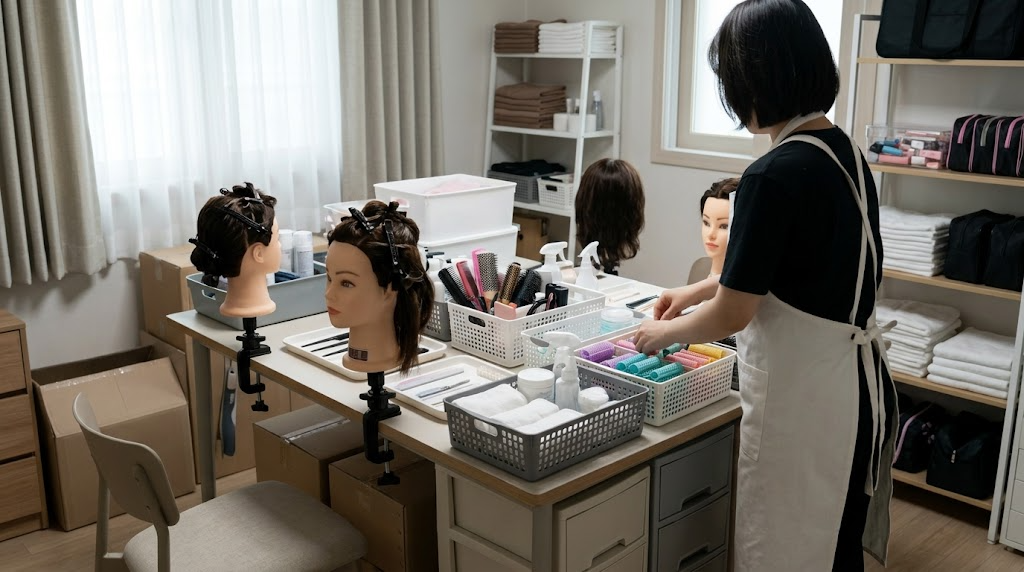
Why You Should Look into Government Support for National Cosmetologist Certifications
If your goal is employment or starting a business in the beauty industry, the very first hurdle to overcome is acquiring a national technical qualification as a cosmetologist (general hair, skin care, nail, makeup). In the past, many hesitated to get started due to the burden of private academy tuition fees running into millions of won, but recently, more savvy applicants are preparing for certifications while drastically lowering cost burdens by leveraging the Ministry of Employment and Labor’s Tomorrow Learning Card system.
- Overwhelming Cost Savings Compared to Private Academies
When enrolling in a private beauty academy to acquire a cosmetology certification, tuition fees for a 3- to 6-month regular curriculum alone cost at least 1.5 million to over 3 million KRW depending on the subject. If practical material fees, special lecture fees, and textbook costs are added on top of this, total costs often easily exceed several million won.
- Private academies: 100% out-of-pocket payment for regular tuition, high likelihood of additional incidental costs (special lecture fees, etc.) beyond registration fees
- Government-funded vocational training: According to national policies, 45% to over 85%, or the entire amount (0 KRW), of tuition is subsidized, significantly reducing tuition burdens down to hundreds of thousands of won
Budgets saved on tuition can be intensively invested in practical items directly tied to passing, such as purchasing additional practical consumables for exam preparation or recruitment fees for mock practice models.
- Systematic Practical Curriculum Tailored to National Standard Specifications
Cosmetology courses established under government funding are approved through rigorous evaluations by the Ministry of Employment and Labor and the Human Resources Development Service of Korea. Because the educational curriculum is designed based on the National Competency Standards (NCS), training is fully aligned with the practical exam grading rubrics instead of unnecessary techniques that do not appear on the test.
- Training to prevent sanitation and basic point deductions: Training in sanitation management, tool sterilization, posture, and basic setup—the largest factors in point deductions during the practical exam—is thoroughly conducted from the very beginning.
- Time management training: Mock tests are systematically repeated to match the characteristics of the practical exam, where completion levels must be maximized within the time limit for each task.
- Customized Choices Across 4 Detailed Sub-Fields
Cosmetologist certifications operate under detailed sub-field national qualification systems rather than a comprehensive general license, and government-funded courses are likewise established in specialized formats according to individual career paths.
| Detailed Certification | Main Practical Tasks | Career Paths and Business Startup Fields |
|---|---|---|
| Hair (General) | Haircut, blow-drying/roller setting, perm (winding), coloring, shampooing | Hair designer, barbershop, hair spa salon |
| Skin (Skin Care) | Cleansing, deep cleansing, manual techniques, pack/mask, hair removal (waxing) | Dermatology aesthetic clinic, hotel spa, waxing shop |
| Nail | Manicure/pedicure, gel nails, acrylic/tip extensions, soak-off | Nail art salon, eyelash beauty shop, beauty distribution |
| Makeup | Wedding/natural makeup, era-specific makeup, character/special effects makeup, eyelashes | Broadcast/wedding makeup studio, cosmetic brand, freelancer |
Once you acquire a certification, you qualify for the issuance of a cosmetologist license and legal business startup (cosmetology business registration) through the local municipal/district office; thus, government-funded training is the most economical and reliable first step toward advancing as a beauty expert.
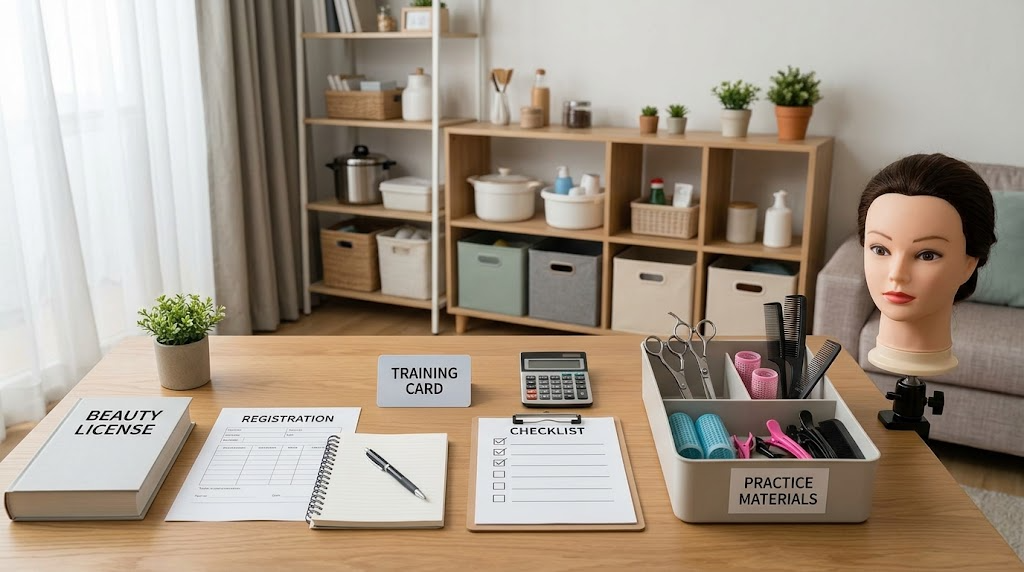
Tuition Benefits and Out-of-Pocket Expense Standards for Government-Funded Cosmetology Courses
When preparing for a government-funded cosmetology course, the most attractive aspect is the ability to drastically reduce high academy tuition costs. However, the same amount of support is not provided to all students, and the actual out-of-pocket payment ratio varies depending on the support type of your Tomorrow Learning Card and the government employment support program you are participating in.
- Tomorrow Learning Card Basic Support System and Limit
To acquire a cosmetologist certification through government funding, you must first have a Tomorrow Learning Card issued via Work24.
- Basic support limit: A basic 3 million KRW is provided for 5 years from the account issuance date, and up to an additional 5 million KRW can be supported depending on income level or employment vulnerability.
- Cosmetology job sector out-of-pocket rate standard: In the cosmetologist field (general, skin, nail, makeup), a basic out-of-pocket payment of approximately 40% to 55% of regular tuition is usually set according to the Ministry of Employment and Labor’s employment rate standards by job category.
For example, in a 3-month course with a total tuition fee of 1.8 million KRW, approximately 900,000 to 1 million KRW is covered by government subsidies, and you only need to pay the remaining balance (out-of-pocket expense).
- Differential Out-of-Pocket Expense Benefits by Participant Type
Depending on which government support program you are linked with, out-of-pocket expenses are reduced even more significantly.
| Participant Classification | Support Benefit and Out-of-Pocket Expense Rate | Notes |
|---|---|---|
| National Employment Support Program Type I | 0% out-of-pocket expense (completely free) or significant reduction | Preferential treatment for low-income and specific vulnerable groups |
| National Employment Support Program Type II (Youth/Middle-Aged) | Additional reduction of approximately 15% to 20%p from basic out-of-pocket rate | Lighter burden compared to general job seekers |
| General Job Seekers / Workers | Basic out-of-pocket rate applied (approx. 40% to 55% of tuition) | Check on Work24 course detail pages |
| Earned Income Tax Credit (EITC) Recipients | Additional 50% reduction in out-of-pocket expenses compared to general applicants | Must submit proof of receipt |
In particular, if you are from a vulnerable group such as Basic Livelihood Security recipients or near-poverty groups, or if you are a participant in Type I of the National Employment Support Program, you can complete the certification course fully funded by the government without paying a single penny in tuition.
- Training Allowance Paid Upon Achieving 80% Attendance Rate
For unemployed individuals taking long-term government-funded cosmetology courses organized for 140 hours or more (typically regular practical classes running daily for 2 to 4 months), a training allowance is provided every month for transportation and meal expenses.
- Payment conditions: You must meet at least 80% of the prescribed attendance days during the unit period (1 month).
- Support amount: Paid in proportion to the number of attendance days up to a maximum of 116,000 KRW per month.
- Additional benefits when linked with the National Employment Support Program: For participants in the National Employment Support Program, the job-seeking promotion allowance (e.g., 500,000 KRW per month) and the training allowance can be received together depending on conditions, allowing you to focus on certification prep with fewer worries about living expenses during the training period.
- Essential Precautions to Check Before Paying Out-of-Pocket Expenses
- Penalties for dropping out midway: If you arbitrarily drop out of a course (giving up training), your out-of-pocket expense ratio will increase as a penalty (20%p to a maximum of 50%p) when applying for subsequent courses, or your card limit will be deducted (200,000 KRW for 1 offense, 500,000 KRW for 2 offenses, etc.).
- Separate verification of material cost inclusion: Amounts supported by government funding are limited strictly to “tuition fees (lecture fees and facility usage fees).” Because material costs such as personal tools, mannequins, and consumables required for the practical exam are generally handled as separate out-of-pocket expenses, you must separate and sum tuition copayments and material costs when calculating your total budget before enrolling.
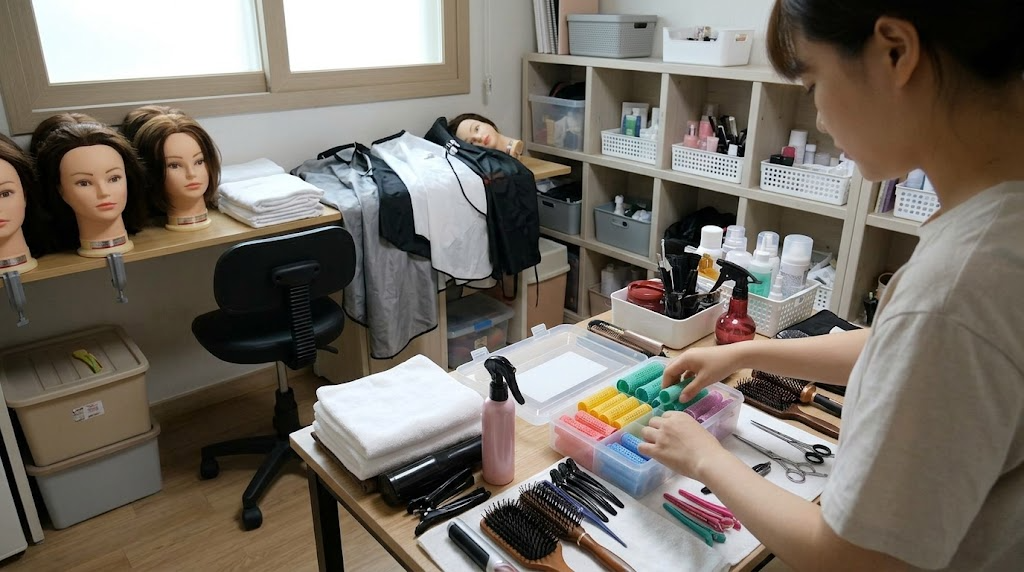
Everything About Practical Material Costs: Government-Funded Items vs. Out-of-Pocket Items
When preparing for a government-funded cosmetologist national qualification course, the aspect that takes students by surprise the most is none other than the “practical material costs.” This is because even if tuition is fully or substantially covered by government support, expenses for tools and consumables needed to practice practical test tasks and bring to the testing site are, in most cases, incurred separately.
To prevent unnecessary spending and establish an accurate budget, you must clearly distinguish between items included under government funding and items that must be paid out of pocket.
- Clear Distinction Between Government-Funded Items vs. Out-of-Pocket Items
In principle, the government funding program is a system that subsidizes “education and training expenses (lecture fees, facility and equipment usage fees).” Consequently, tools that come into contact with an individual’s body or must be owned individually are classified as out-of-pocket expenses.
- Basic Government-Funded Provision (Academy Shared Infrastructure):
- Large equipment inside lecture rooms (styling chairs, shampoo sinks, aesthetic beds, heating equipment, hot towel warmers, etc.)
- Sanitation equipment provided in the academy (UV sterilizers, etc.) and basic shared facilities
- Certain basic theory textbooks and shared chemicals for demonstrations (varies by academy curriculum)
- Student Individual Out-of-Pocket Items:
- Personal dedicated toolsets (shears, perm rods, brushes, nippers, pushers, brush sets, etc.)
- Mannequins for practice and examination (heads, half-wigs, full wigs, hand/foot practice models)
- Consumable materials (perm solutions, hair dyes, cosmetics, nail tips, gel polish, waxing supplies, etc.)
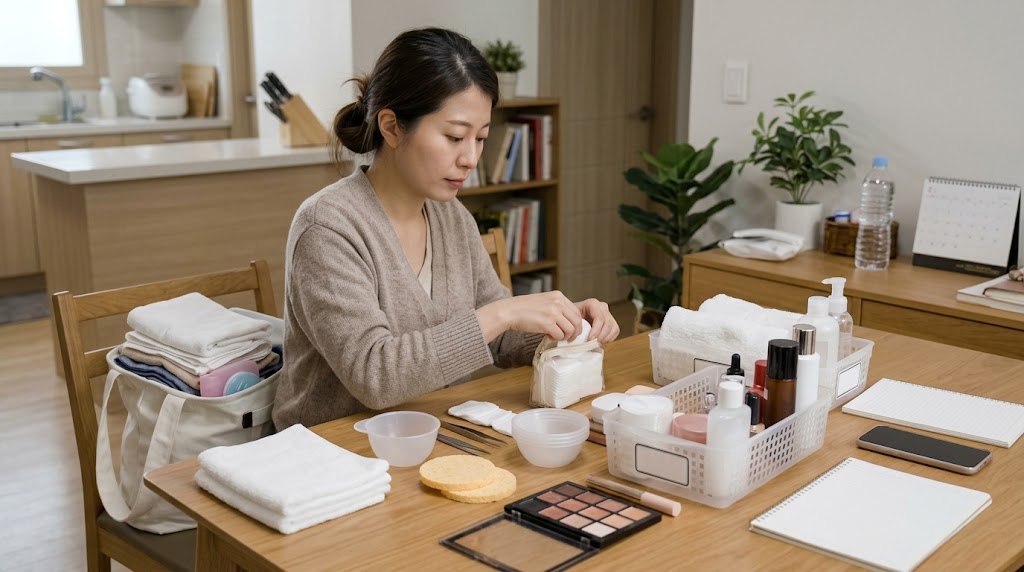
- Sanitation supplies (white lab coats, rubbing alcohol, gauze, absorbent cotton, towels, etc.)
- Realistic Average Budget for Practical Material Costs by Field
Because the types of tools required and the replacement cycles for consumables vary depending on the qualification field, you should understand the average initial set purchase cost in advance.
| Field | Major Mandatory Out-of-Pocket Materials | Average Set Cost (Based on New Items) |
|---|---|---|
| Hair (General) | Cutting shears (straight shears), round brushes, rod sets, spray bottles, clips, holders, multiple mannequins and half-wigs/full wigs | Approximately 400,000 to 700,000 KRW range |
| Skin (Skin Care) | Sponges, turbans, glass bowls, spatulas, pack brushes, wagon towels, dedicated basic skincare set, waxing tools, mannequins | Approximately 300,000 to 500,000 KRW range |
| Nail | Cuticle nippers, pushers, files, acrylic powder/monomer, tips, gel lamps, UV/LED gel colors, extension form papers | Approximately 350,000 to 600,000 KRW range |
| Makeup | Professional brush set, foundation/eyeshadow/lip palettes, false eyelashes, stage makeup beards/latex, sanitation set | Approximately 400,000 to 600,000 KRW range |
※ In the case of the hair course, you must keep in mind that since mannequin hair is consumed during haircut and blow-dry practice, costs for purchasing additional wigs (mannequins) occur continuously up until the exam.
- Pro Tips to Avoid Forced Purchases of Academy Sets and Cut Material Cost Markup
Some academies persuade students to purchase high-priced full sets (new items) configured in-house as if it were a mandatory requirement. Use the following tips to reasonably lower your spending.
- Confirm in advance whether purchasing academy sets is enforced: During the consultation, you should ask first whether you are required to purchase the set specified by the academy, or if individual purchases are allowed provided the products meet the practical exam specifications of the Human Resources Development Service of Korea (Q-Net).
- Differentiate and purchase consumables vs. semi-permanent tools:
- Semi-permanent tools (shears, nippers, etc.): Because these are core pieces of equipment that must fit your hand comfortably and will be used in actual field work even after course completion, it is better to choose solid products that meet standard specifications rather than excessively cheap ones.
- Consumables for practice (wigs, tips, files, etc.): You can lower costs for mannequins and consumables used during early fundamentals practice by purchasing in bulk from online beauty specialty stores or utilizing inexpensive practice products.
- Utilizing secondhand sets from previous graduates: Taking over tool sets that have already passed exam specifications from beauty-related secondhand trading communities or graduates of prior cohorts at 30% to 50% lower prices is also an excellent method. (However, you must thoroughly inspect whether any items fall short of exam-site specifications or are damaged.)
- Verifying the material checklist from Human Resources Development Service of Korea public exam tasks: Print the “Examinee Preparation Materials Checklist” specified in the certification practical exam public tasks on the Q-Net website, and cross-reference it against the items included in the academy’s quotation to see if there are unnecessary excess components.
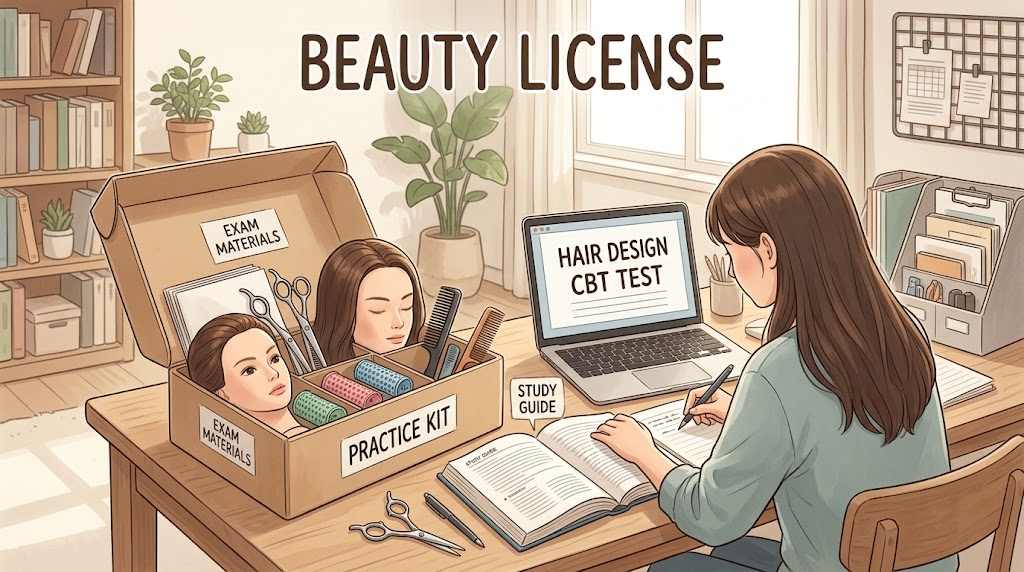
Written and Practical Exam Preparation Strategies for Short-Term Success
For the national cosmetologist license, passing the written exam is a prerequisite to qualify for the practical exam, and the practical portion is evaluated under a strict penalty-point system. To secure the certification in one attempt within the designated government-funded training period (usually 3 to 4 months), a systematic short-term strategy tailored to the characteristics of both the written and practical exams is essential.
- CBT Written Exam: Repetition of Past Questions and Concentrated Study on High-Yield Sections
Across all subjects (hair, skin, nail, makeup), the cosmetologist written exam is an absolute-scored, question-bank CBT (Computer-Based Testing) where scoring 36 out of 60 questions (60 points or higher) results in a pass. Reading thick theory books cover to cover is inefficient.
Securing priorities in key subjects: Commonly tested sections such as public health, sanitation/sterilization, and cosmetology safety/hygiene management have high memorization weight and very consistent question frequencies. Securing high scores in these sections quickly puts you in a safe passing range.
Repeated practice of 5 to 7 years of past CBT questions: The key is to familiarize your eyes with recurring question phrasing and incorrect answer options by solving past exam questions. Briefly organize missed questions with an incorrect-answer note, and actively use mobile CBT mock exam apps during commutes to maintain test-taking intuition.
Clearing the written exam right after the start of government funding: Once practical classes begin in earnest, it becomes difficult to find time for written study while polishing manual techniques. Therefore, taking and passing the written exam within 2 to 4 weeks after course opening is the most reliable roadmap for shortening overall study duration.
- Understanding Practical Exam Scoring Criteria: ‘Hygiene’ and ‘Basic Attitude’ Over Technique
The most common mistake examinees make is obsessing only over flashy hand techniques or final visual forms. However, the Human Resources Development Service of Korea’s practical scoring rubrics allocate massive point weights to ‘hygiene and the operating process.’
Deduction-free hygiene setup:
Strictly observe dress code regulations, including a white lab coat, a white sanitary mask, neat hairstyle, and no accessory wearing.
Thoroughly prepare a setup featuring an ethanol disinfectant spray, disinfectant wipes, and a waste bag with a lid (affixed to the table), and clearly demonstrate to the judges the process of immediately disinfecting or replacing any tool that drops.
Sectioning and balance: In all test categories, if the precision and angles of the most fundamental sectioning (blocking) step—such as in hair winding, haircutting, or skin techniques—are compromised, it is difficult to receive high marks regardless of how clean the subsequent work appears.
- Task-by-Task Timer Practice: The 1-Minute Reduction Strategy
In the practical exam, exceeding time limits results in work being treated as incomplete, leading to fatal score deductions (or disqualification).
Habitual timer training: Right from daily practice, you should aim to finish tasks 1 to 2 minutes faster than the prescribed time for each task. This is because nervousness and trembling hands at the test site inevitably slow down your speed compared to regular practice.
Trimming unnecessary motions: To eliminate time spent hesitating with your hands in midair or searching for materials, memorize and internalize the standard arrangement of supplies on your workstation trolley from Task 1 through Task 4.
- On-Site Practical Exam Passing Tips (Model and Bed Setup)
Advance inspection of skin, makeup, and nail models: For events requiring accompanying models (skin, makeup, etc.), the model’s skin condition, eyebrow shape, and fingernail/toenail conditions must fully conform to HRD Korea standards. You must cross-check the rules to avoid pre-exam point deductions or expulsions due to regulatory violations (tattoos, eyelash extensions, traces of nail extensions, etc.).
Inspection of required material specifications: The specifications (materials, transparency, labeling, etc.) for the examinee-supplied materials checklist published on HRD Korea’s Q-Net—such as baskets, white towels, basket dimensions, and cosmetic labeling—must be packed in complete accordance beforehand to thoroughly eliminate point deduction risks.
Checklist for Choosing a Government-Funded Cosmetology Academy Without Failures
Even if you choose a government-funded course to lighten tuition burdens, poor educational quality and facility infrastructure at an academy can lead to failing the exam, wasting extra re-examination fees and consumable costs. In particular, because cosmetology practicals depend heavily on manual skills, working posture, and on-site awareness, you must meticulously check whether the educational environment genuinely boosts passing rates. Here is a compiled checklist of 5 essential points to verify before enrollment.
- Verify Certified Evaluation Grades and Qualification Acquisition Rates on Work24 (Formerly HRD-Net)
Objective government evaluation data must be reviewed prior to considering an academy’s fancy interior or promotional marketing copy.
Status as a 3-year or 5-year certified excellent training institution: Check whether the institution has passed the rigorous comprehensive screening (trainee satisfaction, employment rates, facility standards, and faculty competency) by the Korea Skills Quality Authority. Institutions that have secured certifications for 3 years or longer offer high operational stability.
Actual certification pass rate for the course: Rather than relying on self-promotions such as “90%+ pass rate,” cross-validate the completion rates and official qualification acquisition metrics of the preceding cohort registered on the Work24 course details page.
- Verify Whether Practice Environments Match Q-Net Practical Exam Room Specifications
During cosmetology practical exams, numerous cases occur where pace is disrupted by unfamiliar workspaces or equipment of different heights, leading to disqualifications or point deductions.
Complete availability of professional equipment: Check whether hot towel warmers and aesthetic beds for the skin track, stand holders and shampoo stations for the hair track, and dust collectors and specialized desks for the nail track are sufficiently prepared to match exam room specifications.
Guaranteed 1-person-per-station practice space: Tour the facility to see if class sizes are overly large—forcing multiple students to take turns using beds or shampoo stations and cutting into practice time—or if an environment is provided where each student can independently set up wagons and mannequins for training.
- Actual Mock Exams and 1:1 Feedback System for Deduction Management
Passing the strict scoring criteria of practical exam sites is difficult with collective lecturing formats that simply teach movements and end there.
Frequency of real mock evaluations: Check whether mock tests applying the same time limits, hygienic attire, and timer setups as the actual test venue are operated regularly 2 to 3 weeks prior to the exam.
Close 1:1 critique: Verify whether dedicated feedback time is secured for instructors to pinpoint and correct subtle deduction factors for each student, such as winding angles, tension control, parting lines, and tool grip techniques.
- Verify Whether Material Purchases Are Enforced and Ensure Transparent Quotes
Some institutions use government funding benefits as bait to demand mandatory purchases of in-house material sets that are overpriced compared to market rates.
Permission to purchase materials separately: You should obtain prior consent on whether bringing items purchased directly online or used tools from previous graduates is acceptable, provided they meet HRD Korea specifications.
Provision of detailed quotes: Check whether a quote transparently listing the product name, quantity, and unit price for every item included in the material set is provided in advance, and examine whether unnecessary superfluous items are included.
- Post-Certification Follow-Up Support (License Issuance and Employment/Startup Connections)
Acquiring a cosmetologist certification is not the end, but the beginning of your professional career. The connection system in place after obtaining your certification is also an important criterion for selection.
Cosmetologist license issuance and administrative guidance: Check whether the academy systematically guides you through procedures such as preparing the health medical certificate required for business registration and license issuance at the city, county, or district office after passing the exam.
Practical employment and startup network: Beyond simple techniques for passing the exam, you must check whether the institution has a practical career infrastructure, such as partnerships for hair salon internships, mentoring for shop-in-shop startups, and recruitment recommendations for beauty enterprises.
Korean version: 한국어로 읽기