Introduction: The Housing Cost Dilemma for Single-Person Youth Households
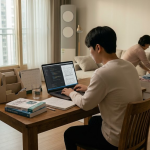
When young adults starting their careers or college students begin living independently, the very first reality they face is housing costs that seem to drain money just by existing.
When trying to find a studio apartment near subway stations close to work or school, the monthly rent of 500,000 to 700,000 KRW alone is overwhelming, but you soon realize that the amount written in the contract is not the whole story.
- An ambush not found in the contract: seasonal “utility bill bombs”
When first starting out living alone in a studio apartment, many people make the mistake of budgeting only for pure “monthly rent.” However, once you actually live there, in addition to the fixed monthly building maintenance fee, you have to shoulder the electricity bill, city gas bill, water bill, and internet bill entirely on your own.
Summer season: Running the air conditioner for just a few extra days during a heatwave can make your heart sink when a progressive-rate electricity bill arrives.
Winter season: Raising the boiler temperature just slightly to block out studio drafts often leads to a gas bill bomb of around 100,000 KRW.
Even if you live alone, the base rate system and seasonal peak rates fall entirely on one person, making the perceived weight of utility bills feel much heavier than that of a 2- to 3-person household.
- Time to calculate “actual total housing maintenance costs” rather than “simple monthly rent”
The housing expenses we actually spend each month should be calculated as follows.
Actual housing costs
Actual housing costs = monthly rent + base maintenance fee + variable utility bills (gas/electricity/water) + telecommunications/living infrastructure costs
On the surface, a studio apartment with a monthly rent of 450,000 KRW may look affordable, but when an 80,000 KRW maintenance fee, 100,000 KRW in utility bills, and 30,000 KRW in internet costs are added, more than 650,000 KRW is actually spent on housing every month. When consumable expenses such as cleaning supplies, detergent, and toilet paper are added to this, the proportion of housing costs relative to young adults’ salaries and allowances reaches a precarious level.
To escape this pressure of fixed costs, the alternative that many young people have recently chosen is the “youth share house.” Let’s examine, step by step, the structural differences of share houses that dramatically ease not only simple rent but also seasonal utility bills and incidental living expenses.

Cost Structure Comparison: Standard Studio Apartments vs. Youth Share Houses
When looking for a place to live, it is a huge mistake to simply compare the “monthly rent” numbers shown on web portals. Looking closely from the initial lump sum down to the detailed monthly out-of-pocket expense items, these two housing types have completely different cost structures.
- Difference in deposit scale: tens of millions of KRW in lump sums vs. small deposits worth 1–2 months of rent
The biggest entry barrier young people encounter when becoming independent is the initial security deposit.
- Standard studio apartment: Near subway stations in the Seoul metropolitan area, standard deposits typically range from 5,000,000 KRW to 10,000,000 KRW, easily exceeding 20,000,000 KRW for newly built units or areas with high public safety. Unless taking out a jeonse/housing deposit loan, it is a lump sum that is burdensome for young career-starters to raise all at once.
- Youth share house: The vast majority of share houses only require a small deposit equivalent to 1 to 2 months of rent, around 1,000,000 to 2,000,000 KRW. Because a large lump sum is not tied up, it dramatically lowers the burden on young people to prepare initial funds.
- Basic rent comparison: paying everything alone in a studio vs. sharing space efficiency in a share house
There is also a clear difference in how rent is structured depending on room size and location.
- Standard studio apartment (approx. 5–7 pyeong): It has the advantage of having the private room, kitchen, and bathroom entirely to oneself, but one must bear the high pure monthly rent alone, around 550,000 to 750,000 KRW per month for subway-accessible locations.
- Youth share house:
- Single room: You have a fully private room while sharing only the living room and kitchen, priced around 400,000 to 550,000 KRW, which is about 10–20% cheaper than studios in the same neighborhood.
- Double/shared room: By sharing a room with a roommate, rent can be dramatically reduced to the 300,000 to low-400,000 KRW range, making extreme housing cost savings possible.
- Seasonal utility bill differences: peak rate bombs vs. 1/N split defense
The point where the difference between the two housing types is most clearly revealed is the utility bill payment method.
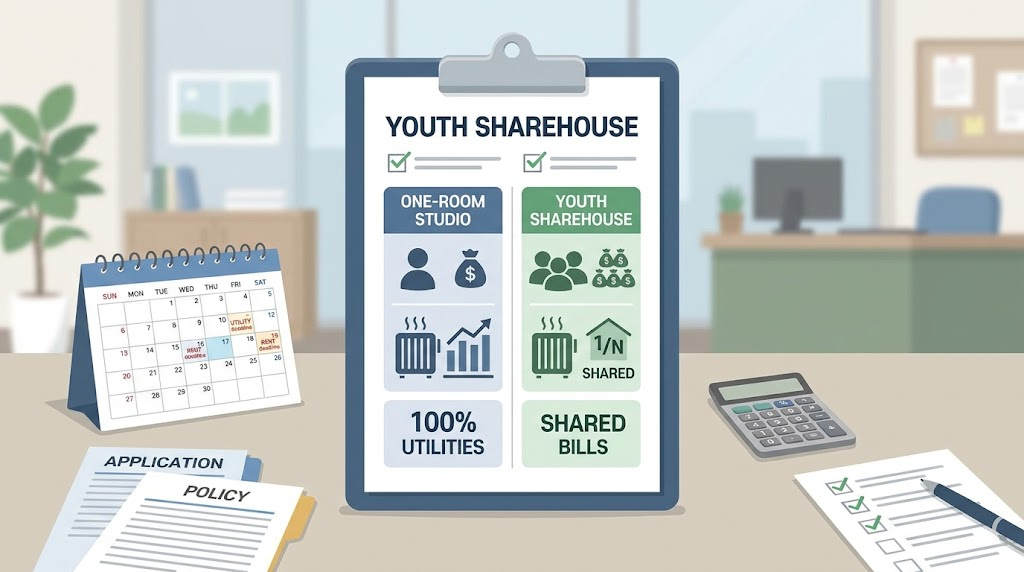
| Comparison item | Standard studio apartment | Youth share house |
|---|---|---|
| Gas/heating bill (winter) | Paying around 100,000 KRW alone when running it to defend against drafts | Even when running the boiler for a larger area, it is split 1/N among all tenants |
| Electricity bill (summer) | Shouldering the rate bomb alone when entering progressive tax brackets | Progressive rates for common areas and individual usage are shared by the number of household members |
| Water/internet/water purifier | Entire base fee and rental costs paid by one person (40,000–60,000 KRW monthly) | Individual burden minimized through management company base provision or inclusion in maintenance fees |
While studios have a structure where usage and progressive tax rates are passed on entirely to one person, share houses split the total utility bills generated in larger houses (apartments/villas) where 3 to 5 people live together by the number of people or offset them with a fixed maintenance fee around 30,000 to 50,000 KRW per month.
Thanks to this, the fluctuation range of utility bills is not large even in seasons when heatwaves or cold snaps hit, allowing you to set a stable monthly living expense plan.
Principles of How Share Houses Reduce Utility Bills and Incidental Expenses
The secret behind share houses dramatically lowering housing maintenance costs compared to studios is not just about sharing rooms. It is because various fixed costs and infrastructure expenses that an individual would have to bear are absorbed through “economies of scale” and a “shared cost division system.”
- 1/N equal division system and fixed maintenance fee (flat-rate) operation
In standard studios, you must bear the base rate and progressive rate bracket fees entirely alone. In contrast, share house utility bills are billed on an apartment or single-family house basis where 4 to 6 people live.
1/N post-settlement method: The total billed electricity, gas, and water fees are divided and settled by the number of tenants. Even in months with high usage, the burden is diluted by the number of people, so the perceived rate per person drops to 30–50% compared to a studio.
Monthly flat-rate maintenance fee method: Recently, many operators have adopted a fixed maintenance fee method (including utilities) around 30,000 to 50,000 KRW per month. A major advantage is that you can maintain predictable monthly fixed expenses without worrying about air conditioning in the summer or heating bill bombs in the winter.
- Basic support for telecommunications and essential home appliance rental costs
When moving into a studio apartment, the small amounts leaking out each month for telecommunications and infrastructure costs—from internet installation to router purchases and water purifier rentals—are by no means trivial.
High-speed gigabit internet & Wi-Fi provided for free: You can use it for free immediately upon moving in, without a separate 3-year contract or internet fees in the 20,000 to 30,000 KRW monthly range.
Equipped with water purifiers and major appliances: You don’t have to pay hot and cold water purifier rental fees and filter replacement costs of 20,000 to 30,000 KRW each month, and essential appliances such as washing machines, dryers, and microwave ovens are already set up as standard, so you don’t need to spend any initial costs on purchasing appliances.
- Living expense reductions through free provision of shared daily necessities and consumables
When you start living alone, the cost of consumables that you have to buy at the supermarket every month—such as toilet paper, detergent, and standard garbage bags—is unexpectedly large. In share houses, operators regularly restock these essential consumables to manage common areas.
Examples of provided items: Laundry detergent and fabric softener, dishwashing soap, toilet paper rolls, standard garbage bags, cleaning supplies, etc.
Living expense defense effect: You can fully save the 20,000 to 30,000 KRW minimum spent each month on supermarket daily necessities for a single-person household, allowing you to experience substantial savings over long-term stays.

Monthly Housing Cost Simulation at a Glance (Studio Apartment vs. Share House)
How much difference is there in the amount leaving your bank account each month when actually living there?
Based on major university areas and subway station areas with good public transportation access in the Seoul metropolitan area (studio apartments around 6 pyeong of actual area vs. share house single rooms), we compared the fixed housing costs and variable expenses incurred over one month under identical conditions.
- Monthly actual expense comparison table based on Seoul metropolitan subway station areas
| Expense item | Standard studio apartment (Single individual) | Youth share house (Based on single room) | Notes and savings factors |
|---|---|---|---|
| Pure monthly rent | 600,000 KRW | 480,000 KRW | Reflecting single room market rate for identical subway station location |
| Basic building maintenance fee | 80,000 KRW | 0 KRW | Share house integrates this into the common maintenance fee policy |
| Seasonal utilities (Electricity/Gas/Water) | 90,000 KRW | 35,000 KRW | Effect of 4-person split (1/N) or flat-rate application |
| Internet / Wi-Fi | 25,000 KRW | 0 KRW | Provided free by the operator (no contract or fee) |
| Water purifier rental / Bottled water purchase | 15,000 KRW | 0 KRW | Hot and cold water purifier provided as standard |
| Daily consumables (Detergent, toilet paper, bags, etc.) | 20,000 KRW | 0 KRW | Regular free provision of shared consumables |
| Total (Monthly actual expenditure) | 830,000 KRW | 515,000 KRW | 315,000 KRW saved every month |
Difference in initial deposits:
- Standard studio apartment: 10,000,000 KRW deposit (additional monthly interest expenses may occur if taking out a jeonse/credit loan)
- Youth share house: 1,000,000 KRW deposit (equivalent to 1–2 months of rent, preventing large sums of money from being tied up)
- Net monthly expenditure savings and annualized savings effect
Dissecting the numbers, the difference generated from incidental expenses such as maintenance fees, utility bills, telecommunications, and daily consumables (195,000 KRW) is far greater than the simple difference in monthly rent (120,000 KRW).
- Monthly savings: approx. 315,000 KRW (approx. 38% housing cost reduction compared to previous studio expenditures)
- Cumulative savings for 1 year (12 months) of residence: 3,780,000 KRW
- Cumulative savings for 2 years (24 months) of residence: 7,560,000 KRW
For young adults entering the workforce or single-person youth households, a cash flow of over 3,700,000 KRW per year becomes a very meaningful seed money pool that can cover a significant portion of Youth Leap Account payments or immediately secure a one-year emergency cash pool.
Must-Read Before Signing! Share House Utility Bill Checklist
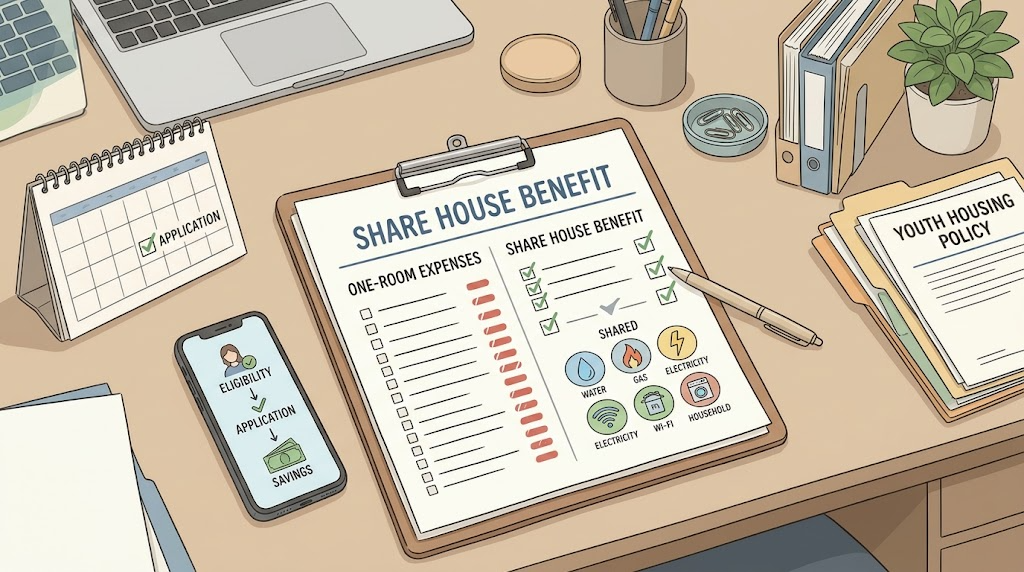
While share houses clearly have a favorable structure for saving on incidental expenses compared to studio apartments, the utility billing criteria and settlement rules vary greatly by management company.
Before signing the contract, you must carefully check the following 3 core checklist items, or you may be flustered by unexpected additional charges billed upon moving out.
- Check the ‘excess billing criteria’ for flat-rate maintenance fees (post-settlement verification)
You should not rashly sign a contract trusting only the phrase ‘50,000 KRW monthly maintenance fee with utilities included.’ Most operators set an upper limit (baseline) to prevent excessive waste.
Check clauses on exceeding the baseline amount: You need to review the special contract conditions to see whether excess amounts are divided and settled 1/N per person if the entire household’s monthly utilities exceed a certain threshold (e.g., 50,000 KRW per person, 200,000 KRW household total).
Check for unused balance refunds: Conversely, it is wise to know whether lower utility charges during certain seasons carry over and accumulate to buffer peak seasons (summer/winter), or if they simply expire as a fixed consumable expense.
- Seasonal operation regulations (cooling/heating temperature limits and operating hours)
Since it is a communal living space, internal house rules exist to conserve energy. If these do not align with your daily lifestyle patterns, they can become a significant source of stress throughout your stay.
Temperature limits and central control status: You need to confirm whether central control prevents adjusting temperatures below or above certain levels, or if autonomous control by tenants is permitted. (e.g., summer target temperature capped at 24–26°C, winter indoor temperature fixed at 22°C, etc.)
Permissibility of bringing individual AC/heating appliances: For single rooms, check whether wall-mounted air conditioners are individually installed in each room, and verify whether extra electricity fees are charged when bringing personal electric blankets, fan heaters, or other heating appliances.
- Check move-out cleaning fees and restoration deduction items
Since deposits are small, around 1,000,000 to 2,000,000 KRW, the proportion of the returned amount can vary significantly depending on the settlement items upon moving out.
Move-out cleaning fee deduction regulations: You need to confirm in advance whether a mandatory professional cleaning fee (usually around 50,000 to 100,000 KRW) deducted upon moving in or moving out is automatically deducted from the security deposit.
Scope of liability for shared fixture damage: You should review the terms and conditions to see whether breakdowns or damage to living room or kitchen fixtures or appliances that an individual did not use are shifted to the collective responsibility of all household members, or if they are billed only when individual fault is clear.
Prorated utility calculation method: Make sure to check whether utilities for that month are cleanly settled using a prorated daily calculation based on the number of days stayed when moving out mid-month.
Conclusion: Recommended for These Types of Young Adults
The most important factor when choosing a living space is “how well it aligns with my current financial situation and lifestyle.”
If a completely independent lifestyle is your top priority, a standard studio apartment may be more comfortable, but for young adults who want to streamline their expense structure and reduce unnecessary fixed costs, a share house serves as a very realistic and sensible alternative.
- Types of young adults particularly suited for share houses
Career starters & job seekers in urgent need of building seed money: Those who want to move into a clean living environment near subway stations with a small deposit of around 1,000,000 to 2,000,000 KRW without the burden of tens of millions in deposits or loan interest.
Novices living alone who fear seasonal variable expenses (utility bombs): Those who want to live on a predictable fixed budget without worrying each month about summer air conditioning electricity bills and winter boiler gas bills.
College students and interns in need of short-term housing: Those who prefer flexible lease terms such as 3 months or 6 months without being tied down by a 2-year long-term lease contract.
Those looking to save on appliance and furniture purchase costs: Those who want immediate access to full-option infrastructure—including beds, mattresses, washing machines, dryers, hot and cold water purifiers, and high-speed internet—with 0 KRW in initial investment.
- Sensible criteria for choosing housing that fits you
Housing expenses are not merely consumption passing through your bank account each month; they are the single most critical variable determining the pace of asset building during your youth.
Carefully compare the “actual total housing maintenance costs,” which combine not only monthly rent, but also building maintenance fees, utility bills, and infrastructure rental fees. The roughly 300,000 KRW saved each month through a share house will become precious seed money of about 3,700,000 KRW in 1 year, and over 7,000,000 KRW in 2 years.
We root for you to make a wise housing choice tailored to your daily radius and spending plan!
Drafting has been completed. Shall we proceed directly with the next steps for blog publishing?
Create 16:9 image generation prompts for the blog
Extract metadata and tags for Naver search optimization
Korean version: 한국어로 읽기