
Introduction: Waste Disposal for Moves and Major Cleanups—Why Do People Get Hit with “Unexpected Extra Fee Bombs”?
This is the first subheading and body draft for the Naver blog post titled “Waste Disposal Company: Check Extra Fee Conditions When Receiving On-Site Estimates.” It is written in an engaging and readable style to help blog readers relate and read through to the end.
- Introduction: Waste Disposal for Moves and Major Cleanups—Why Do People Get Hit with “Unexpected Extra Fee Bombs”?
When moving into a new home or doing a major cleanup to clear out long-accumulated clutter, one of the biggest headaches is undoubtedly “waste disposal.”
From large furniture pieces like sofas, wardrobes, and beds to various household items… when you actually try to throw them away, you are often surprised by the sheer volume and weight. Ultimately, because it is difficult for individuals to handle directly, people turn to professional waste disposal companies.
However, you have likely seen or experienced the absurd situation where you were initially told during consultation, “This amount will cost around 300,000 KRW,” but right after the work is finished on-site, you are hit with demands for hundreds of thousands of won in extra fees under excuses like “The ladder truck fee was omitted,” “There was more volume than expected so more labor was required,” or “It’s special waste so an extra fee applies.”
Why do these “extra fee bombs” always differ from the time of the contract?
The reasons broadly fall into two categories.
Opaque non-face-to-face estimates: When an estimate is given roughly through photos or phone calls without directly inspecting the site.
Vague contract conditions: When the criteria for incurring additional costs are not clearly agreed upon in writing in advance.
Because waste disposal is by no means an inexpensive task, a small moment of carelessness can lead to major expenses. Therefore, what points should you check in advance to permanently prevent extra fees on-site?
From now on, let’s look closely at the key conditions you must check when receiving on-site estimates one by one.
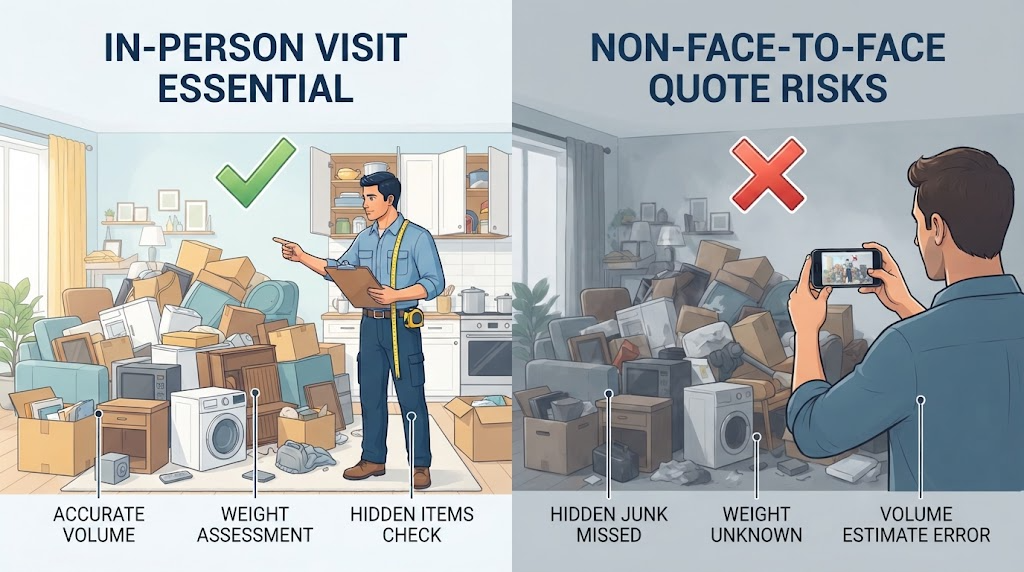
Core Checkpoint ①: Why an “On-Site Estimate” Is Absolutely Essential
Many people, wanting to save on waste disposal costs, take a few pictures of their home with a smartphone and send them, or casually ask over the phone, “It’s a 3-room house, how much will it be?” However, this is the most dangerous shortcut that invites extra fee bombs.
The reasons why an on-site estimate must unconditionally precede are as follows.
① The decisive gap between photos and the actual site (the trap of volume and weight)
Through photos or videos, it is difficult to accurately gauge the “real volume” and “weight” of waste.
The amount of clutter packed inside wardrobes
Old items hidden under kitchen sink cabinets or in the corners of verandas
Marble tabletops or tile materials that look light to the eye but are extremely heavy when actually lifted, etc.
Accurate estimates for these elements can only be made when an expert directly inspects them with their own eyes and calculates the volume that will be loaded onto the truck. Non-face-to-face estimates easily degenerate into a means to lure customers with the “lowest price” and then pile on extra money at the site under the excuse that there is a lot of volume.
② Site variables (ladder trucks, elevators, alleyway parking, etc.)
Even if the amount of waste is small, the difficulty of the work varies wildly depending on the environment around the house.
Presence of elevators and usage restrictions: In cases where there is no elevator or the management office strictly requires the use of a ladder truck in an apartment complex.
Access road conditions: When trucks cannot enter right in front of the house, requiring goods to be moved dozens of meters by handcart or wheelbarrow, or when there is no space to set up a ladder truck, requiring manual work (stair work) to carry items down.
These physical constraints can never be grasped through a phone call alone. If a company employee does not visit in advance to check the moving routes, parking space, and working equipment, you are bound to be demanded extra fees on the day of the site under the pretext that “the working environment is so poor that more labor must be used.”
💡 Core Summary
“An on-site estimate is not a tedious and troublesome procedure, but rather the most certain safety device to finalize the exact cost that fits our home and completely block additional fees.” We strongly recommend getting your site transparently diagnosed in advance through a legitimate company that offers free on-site estimates.

Core Checkpoint ②: ‘Extra Fee Conditions’ That Must Be Clearly Stated in Contracts and Estimates
Just because you have safely finished the on-site estimate doesn’t mean you can rest easy yet. If you only trust verbal statements like “For this much, the total amount is X,” you will have no proper way to respond when words change on-site later.
To perfectly defend against ‘extra fee bombs’ on-site, we highlight 3 core conditions that must be specified in contracts and estimates.
① Confirmation of working personnel and truck tonnage
You must check whether the number of professional workers deployed and the tonnage of dispatched trucks (e.g., 1 ton, 2.5 tons, etc.) are accurately recorded in the estimate.
Instead of leaving it vague like “We’ll call an appropriate number of people ourselves,” you must nail it down clearly in the format of “Deployment of O workers and O vehicles” to prevent unreasonable claims on the day of the work such as “Labor is insufficient so more people need to come, which incurs an extra fee.”
② Clarification of reasons for additional costs and unit prices
The criteria for exceptional situations where costs may inevitably be added besides the estimate must be confirmed in advance, even via text message.
When waste volume is exceeded: You must be notified in advance and put into writing the unit price stating, “If the expected volume (tonnage) is exceeded, an extra fee of X per 1 ton (or per gunny sack unit) will occur.”
Scope of dismantling and demolition work: When additional work is needed, such as dismantling built-in wardrobes, demolishing veranda structures, or dismantling large home appliances, it must be divided and written item by item whether this is included in the basic estimate or incurs a separate fee.
③ Separation of disposal costs by waste type (Household waste vs. Special waste)
Unlike general furniture items, there are items that incur separate costs (disposal marks, report certificates, etc.) at waste disposal facilities.
You must consult in advance whether additional charges are levied when items such as pianos, stone beds, large safes, waste tires, or industrial waste are mixed in.
Sometimes, vicious companies quote cheaply during the estimate stage and then demand several times the extra fee on the day of the site under the pretext that it is a special item, so you must draw a clear line regarding disposal costs for these items as well.
💡 Core Summary
Verbal promises serve as no evidence when a dispute arises. It is safest to request that a phrase stating “No additional charges whatsoever will occur on-site other than this” or specific criteria for calculating extra fees be written as a special agreement at the bottom of the estimate.
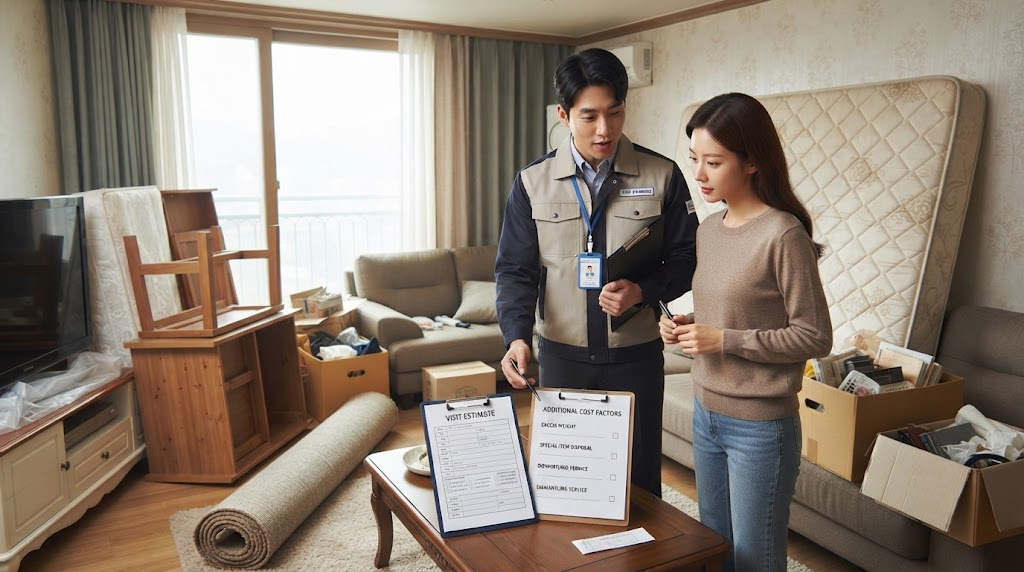
Practical Tips to Know: How to Choose a Reliable Waste Disposal Company
No matter how thoroughly you have checked the estimate conditions and extra fee prevention clauses, if you encounter an unreliable unlicensed company or a vicious company in the first place, it is bound to give you a headache. With what criteria should you choose a reliable waste disposal company that handles work neatly at a reasonable price?
① Check if they are a officially licensed company
The waste collection and transportation business is an industry that can only be operated after obtaining official permission from the jurisdiction local government.
In the case of unlicensed companies, the cost may be ridiculously cheap, but the worst-case scenario (legal responsibility may fall on the client) can occur where they illegally dump in a place that is not an official disposal site or cut off contact halfway.
You must choose a company that can proudly demand and check whether they hold a ‘Waste Collection and Transportation License’ as well as a business registration certificate.
② Availability of issuing a waste disposal confirmation (transfer note)
Large-scale waste or business waste must go through the final disposal process in accordance with lawful procedures.
A trustworthy professional company transparently issues a waste disposal confirmation or related proof proving that the collected waste has been safely disposed of.
Especially in the case of commercial store and office demolitions and large-scale moving waste, this document serves as an important shield to prevent legal issues later on.
③ Transparent disclosure of price lists and avoiding requests for post-completion extra charges
Places that transparently disclose basic price lists by truck tonnage and item on their homepage, blog, or during the consultation process have high reliability.
Rather than making unreasonable demands for extra fees after work completion saying “It cost more because of this and that,” choosing a company that adheres to a ‘fixed-rate system’ principle of not accepting any additional charges whatsoever other than the amount confirmed during the on-site estimate is the shortcut to protecting your wallet.

Conclusion: Thorough Advance Verification is the Shortcut to Cost Reduction
As waste disposal during a move or major cleanup involves greater expenses than expected, approaching it with the mindset of “I can just leave it anywhere roughly” easily leads to regret. In particular, the ‘extra fee bombs’ that snowball on-site not only hurt your feelings but also completely disrupt your budget planning.
We summarize the key points we looked at today once again.
Making on-site visit estimates mandatory: Do not rely solely on photos or phone consultations; make sure to get the volume and weight accurately diagnosed through an on-site visit by the company.
Specifying extra fee conditions within the contract: Clearly leave in writing the deployed personnel, truck tonnage, additional unit prices according to exceptional situations, and special agreement terms.
Selecting an officially licensed company: To prevent the risk of illegal dumping by unlicensed companies and handle it safely, be sure to check whether they hold a ‘Waste Collection and Transportation License’.
Waste disposal is the easiest area where trying to save money ends up leading to greater expenses instead. Even if it is a bit cumbersome and bothersome, if you go through thorough advance verification and written agreement before signing the contract, you will be able to safely and reasonably empty your home cleanly without panicking on the day of the site.
We wish you a successful move and a pleasant fresh start!
Korean version: 한국어로 읽기