
What is the Youth Leap Account? (Core Summary)
Launched by the government to help young people build mid- to long-term assets, the Youth Leap Account is a representative policy-type financial product where making regular monthly deposits allows the government to provide generous matching contributions and tax-free benefits on the final payout.
Widely regarded as an essential course for young adults and beginners in society to build lump-sum funds, the core structure of this product is clearly summarized below.
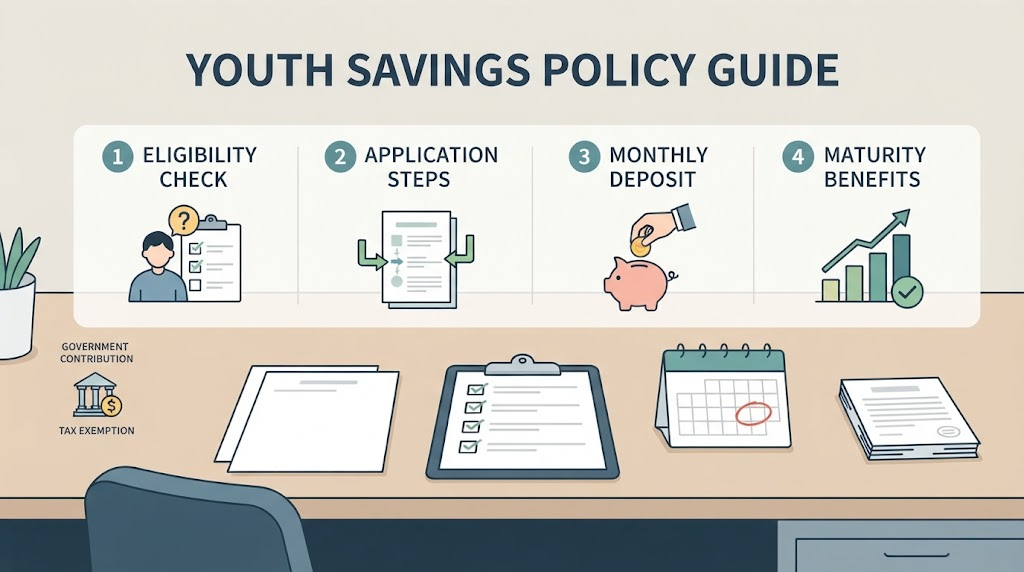
- Eligibility and Basic Requirements
To join the Youth Leap Account, applicants must meet all age, personal income, and household income criteria.
Age criteria: Ages 19 to 34 inclusive as of the subscription date (military service performance period can be additionally counted up to 6 years)
Personal income criteria: Total annual salary of 75 million won or less in the previous tax period (or subscription year)
However, for those with a total annual salary exceeding 60 million won up to 75 million won, only tax-free benefits apply without government contributions.
Household income criteria: Youths whose combined household income meets 180% or less of the median income.
- Support Structure and Matching Ratio (Government Contribution)
The “government contribution” added by the government varies depending on the monthly deposit amount, and matching ratios are applied differentially by income bracket.
Deposit limit: Freely deposit up to 700,000 won per month (can be set in units of 1,000 won)
Government contribution support: Contribution matching ranging from a maximum of 21,000 won to 40,000 won per month depending on personal income level
Operation method: A structure where the principal deposited by the subscriber, the government contribution, and the bank interest thereon are combined with compound interest.
- Expected Benefits at Maturity (Why Should You Subscribe?)
The benefits you can enjoy when faithfully completing the 5-year (60-month) maturity have clear differentiating points from general installment savings products.
Tax-free benefits: Full exemption from interest income tax and rural special tax (15.4% tax exemption)
Preferential support for low-income groups: Provides higher matching ratios for young people with relatively lower incomes, along with the possibility of linking with welfare products.
Principal guarantee and preferential commercial interest rates: Basically, commercial bank preferential rates (base rate + preferential rate) are applied, making it possible to expect stable yet high final returns.
Youth Leap Account Refund (Upon Maturity Termination) Calculation Structure
Please write the calculation structure of the Youth Leap Account refund (upon maturity termination)
What is the structure used to calculate the final refund (lump sum) you receive when you faithfully maintain the Youth Leap Account until the 5-year (60-month) maturity?
It is paid as a complex combination of not just the principal you put in, but the deposited principal + bank interest + government contribution + contribution interest + tax-free benefits. Let’s easily understand the specific calculation structure item by item.
- 4 Components of the Final Refund
The total amount received deposited into your account at maturity consists largely of four financial sources.
- Subscriber Deposited Principal
This is the sum of the amounts set and deposited by the individual each month (up to 700,000 won per month).
Example: When depositing 500,000 won per month for 60 months (5 years)
→ Principal of 30 million won
- Bank Interest (Base Rate + Preferential Rate)
This is the interest added to the monthly deposit according to the contracted interest rate of the subscribed bank (depending on simple or compound interest conditions).
Recently, Youth Leap Account interest rates are applied at the level of annual 4~5% when commercial bank preferential rates are met.
- Government Contribution
This is the total amount supported monthly by the state according to the matching ratio for each income bracket of the subscriber.
Depending on your personal deposit amount and income level, a maximum of 21,000 won to 40,000 won per month is accumulated and steadily piled up over 5 years.
- Government Contribution Interest
The contribution added by the government every month does not just sit there either; interest grows along with it according to the interest rate of the corresponding bank product.
- Tax Benefit Structure (Magic of Tax Exemption)
The core element that maximizes the difference from general installment savings as the maturity refund grows is tax exemption.
In the case of general installment savings: Tax of 15.4% (income tax 14% + rural special tax 1.4%) on interest income is withheld at source, reducing the actual receipt amount.
Upon maturity termination of the Youth Leap Account: Pursuant to the Restriction of Special Taxation Act, the 15.4% tax on interest income is fully exempted.
Therefore, you can receive the amount grown through bank interest and government contribution interest intact into your account, enjoying the effect of drastically increasing the final return.
- Easy-to-Understand Simulation Example (For Reference)
[Assumption Example]
Monthly deposit amount: 500,000 won (5 years / 60 months)
Applied interest rate: Annual 5.0% (assumed)
Government contribution: Assuming maximum monthly support per income bracket
Total deposited principal: Approx. 30 million won
Total government contribution support: Approx. 1.44 million won ~ 2.4 million won range (varies by income)
Interest and tax exemption effect: Bank interest and contribution interest are combined, and a 15.4% tax exemption is applied thereto, completing a structure where a lump sum of approximately 35 million won or more can be received at maturity.
💡 Tip: For accurate refund calculations, you can run real-time simulations tailored to your income and deposit style through the Korea Inclusive Finance Agency ‘Youth Leap Account’ official portal or the estimated inquiry service of the commercial bank app you joined.

Complete Summary of Penalties Incurred Upon Early Termination
Since the Youth Leap Account is a policy-type product for building assets with a long horizon of 5 years, terminating it midway without fulfilling the maturity will result in a much larger loss than expected.
Before debating “Should I terminate it to use a little money?”, you must check the 3 major penalties you will inevitably shoulder upon early termination.
- Full Recovery of Government Contributions (Restriction of Payment)
The subsidies that the government reliably added every month are benefits premised on maintaining maturity.
If you terminate early, the government contributions accumulated up to the time of termination are fully recovered (payment canceled).
You will only receive the principal you paid and the bank interest, and you won’t be able to get a single penny of the contribution supported by the state in your hands, drastically reducing the final lump sum scale.
- Disappearance of Tax-Free Benefits and Conversion to General Taxation
The “interest income tax exemption” benefit, which is one of the biggest weapons of the Youth Leap Account, disappears.
Just like general installment savings, 15.4% interest income tax (14% income tax + 1.4% rural special tax) is withheld at source on early termination interest.
Because taxes are deducted from the interest accumulated over a long time, this becomes the cause of the expected actual receipt amount being significantly lower than expected.
- Application of ‘Early Termination Interest Rate’ Instead of Contracted Interest Rate
The high interest rate (base rate + preferential rate) promised with the bank at the time of subscription is not applied.
A low early termination interest rate applied differentially by period is retroactively applied.
In particular, if you terminate early within 1 to 2 years after joining, you will receive extremely poor interest inferior to the general commercial bank ordinary savings level, resulting in losses relative to the inflation rate in effect.
💡 Wait! The ‘Special Early Termination’ System You Must Check Before Termination
If you fall under ‘special early termination reasons’ stipulated by law, such as death/retirement, workplace closure, natural disaster, first-time home purchase, or marriage, rather than a simple change of mind or personal capital need, you can avoid penalties.
In this case, since government contributions can be maintained and tax-free benefits can also be applied, we strongly recommend preparing relevant evidentiary documents before termination and checking with the bank customer center or the Korea Inclusive Finance Agency.

Special Early Termination Reasons (Penalty Exemption Conditions)
In principle, terminating the Youth Leap Account early results in major penalties, such as the recovery of government contributions and the disappearance of tax-free benefits. However, if it falls under unavoidable life-cycle events or economic crisis situations that are not attributable to the subscriber, the government operates a ‘Special Early Termination System’ that recognizes exceptions and preserves benefits without penalties.
We have summarized the specific conditions under which you can be exempt from penalties.
- 5 Core Reasons Recognized for Special Early Termination
If you terminate due to one of the following statutory reasons, you become eligible for special early termination.
- Death or Overseas Migration of the Subscriber
When it becomes difficult to maintain a domestic residence due to an unexpected accident, death, or immigration, etc.
- Retirement or Business Closure
In the event of involuntary retirement due to business closure or restructuring of a workplace, or closure of a sole proprietorship
- Natural Disaster
When economic damage is suffered or fund liquidity severely deteriorates due to unexpected natural disasters
- First-Time Home Purchase
When purchasing a home under your name for the very first time in a state where there is no history of owning a home during the subscription period
- Marriage (Matrimony)
When filing a marriage report within the subscription period (aimed at supporting the life cycle transition of the youth class)
- Benefits Applied Upon Special Early Termination (What’s Different?)
Unlike general early termination, when special early termination requirements are met, the following powerful protective measures operate.
Full receipt of government contributions: Government contributions accumulated up to the point of termination and interest thereon are not recovered and are paid in full.
Maintenance of tax-free benefits: The interest income tax (15.4%) exemption benefit is applied as is, allowing you to pocket the grown amount entirely as a lump sum without tax deductions.
Need to check whether contracted interest rate applies: Depending on each bank’s terms and conditions, more favorable conditions than general early termination interest rates may apply or it may follow product-specific detailed standards, making exact interest rate verification through the financial institution prior to termination essential.
- Essential Evidentiary Documents to Prepare When Applying
Special early termination is not processed automatically, and public documents proving the reason must be submitted.
First-time home purchase: Housing completion register/certified copy of the registry, local tax item-by-item taxation certificate (for checking national home ownership status), etc.
Marriage (Matrimony): Certificate of family relations (wedding invitations or wedding hall contracts are not recognized; based on the completion of official marriage registration)
Retirement and closure: Employment insurance benefit qualification certificate, business closure fact certificate, etc.
Death and migration: Basic certificate (death certificate), migration-related evidentiary documents, etc.
💡 Tip: If you fall under the timing for special early termination, we recommend that you do not proceed with general termination blindly, but first contact the commercial bank customer center where you subscribed or the Korea Inclusive Finance Agency to receive a prior review on whether your reason accurately meets the special early termination requirements and what documents are needed.

Maturity Maintenance vs Early Termination Comparison Guide (Conclusion and Suggestions)
Since the Youth Leap Account requires steady monthly deposits throughout the 5-year (60-month) subscription period, you will face economic temptations or financial pressures several times along the way.
For those debating, “Should I terminate it because I need a lump sum right now?”, we clearly compare the differences between maintaining until maturity and early termination, and deliver suggestions for a wise choice.
- At-a-Glance Comparison: Maturity Maintenance vs Early Termination
| Category | When Maintaining 5-Year Maturity | When Terminating Early (General) |
|---|---|---|
| Government Contribution | Paid in full (Receive both matching amount + contribution interest) | Fully recovered (Full recovery of paid contributions) |
| Tax Benefits | Tax-free application (15.4% interest income tax fully exempted) | Converted to taxation (15.4% interest income tax withheld at source) |
| Applied Interest Rate | Contracted rate (Base rate + commercial bank preferential rate applied) | Early termination interest rate (Applied differentially by subscription period, low interest) |
| Final Achievement | Maximized lump-sum accumulation + maximum benefit from government support | Receive principal and very partial interest only (Real loss incurred) |
- Felt Losses Upon Early Termination by Period (Simulation Perspective)
- Termination within 1 to 2 years after subscription: In effect, you only get your hands on interest at the level of an ordinary deposit at a general commercial bank, and all accumulated government contributions disappear, effectively fading the meaning of joining an installment savings account.
- Termination in the 3rd to 4th year after subscription: Since this is the point where a lump-sum amount starts becoming visible, it is the section with the most severe conflict—either trying to hold on until the end out of reluctance or needing urgent funds instead. If you terminate at this time, the opportunity cost is very large because you blow away the tax-free and contribution benefits intact.
- Final Suggestions for Wise Asset Management
- Prioritize reviewing ‘temporary suspension of deposits’ or ‘utilizing loans’ over ‘termination’
- If you immediately lack living expenses or face a temporary cash crunch, it is advantageous to look for other ways to preserve the account maintenance state rather than terminating right away. (Consider product-specific deposit deferral features or using installment/savings-collateralized loans backed by the Youth Leap Account, etc.)
- Carefully check whether you fall under special early termination reasons
- If reasons such as marriage, first-time home purchase, or retirement have occurred, applying for special early termination rather than general termination to fully secure your government contributions and tax-free benefits is unconditionally advantageous.
- 5 years is long, but the policy benefits are certain
- The Youth Leap Account is one of the most powerful institutional devices enabling South Korean youth to build assets. Rather than a short-term perspective, we sincerely cheer for you to complete the journey to the end, remembering the value of the ‘tax-free lump sum + government subsidy’ you will hold in your hands 5 years later.
Korean version: 한국어로 읽기