Introduction: The Financial Manager Certification, the Surest Path to Becoming a Corporate Finance Expert
Regardless of a company’s size or industry, the success of any business begins with thorough, transparent fund management and strategic financial planning. Amidst a rapidly changing economic environment, for a company to grow steadily and defend against risks, the role of professional personnel encompassing the entire process—ranging from budget formulation, fundraising, and investment analysis to tax accounting—is absolutely crucial.
“How can I enhance corporate core fund management capabilities and be recognized as an irreplaceable expert in the finance field?”
“What is the surest certification that can prove both resume and practical competencies at the same time?”
If you are a job seeker preparing for employment in finance and accounting departments or an office worker looking to build new job competencies, you have likely pondered these concerns at least once. There is nothing quite like acquiring a professional certification to prove practical financial competencies that can be immediately utilized in the field without leaning solely toward theory.
Then, what kind of certification is the ‘Financial Manager’ that you must definitely pay attention to in order to be reborn as a core finance expert coveted by companies, and how should you start preparing for the exam? Let’s take a closer look one by one from now on!

STEP 1. Financial Manager Certification Overview and Analysis of Exam Eligibility and Subjects
[Subheading Body] STEP 1. Financial Manager Certification Overview and Analysis of Exam Eligibility and Subjects
Reading corporate fund flows and establishing optimal financial strategies are core competencies that determine a company’s survival and growth. Among them, the ‘Financial Manager’ certification stands out as a representative professional qualification capable of proving practical competitiveness in the corporate finance and accounting fields.
“Who can take the Financial Manager exam, and what subjects specifically need to be studied?”
If you have officially decided to acquire a certification, your first priority is to accurately grasp the basic overview of the exam, eligibility requirements, and the framework of the tested subjects.
- Financial Manager Certification Overview and Eligibility
The Financial Manager is a qualification exam that verifies practical expertise regarding overall finance, such as corporate fundraising and operation, investment analysis, budget management, and financial risk management.
Eligibility: Despite being an exam that verifies professional financial knowledge and practical skills, there are often no separate restrictions based on major, education level, age, or career experience.
Anyone Can Challenge: From job seekers hoping to enter the finance and accounting fields to practical finance personnel at general companies wanting to strengthen job competencies, and office workers preparing for job changes, anyone interested can take the exam.
- Analysis of Major Exam Subjects and Tested Areas
The Financial Manager exam is composed of practical-oriented subjects that can be applied immediately in the field, as well as theoretical knowledge.
Corporate Finance and Fund Management: Covers corporate fund demand forecasting, short- and long-term fundraising methods, capital structure determination, and liquidity management strategies.
Investment Analysis and Valuation: Evaluates valuation methods for financial assets such as stocks and bonds, and investment decision-making techniques such as mergers and acquisitions (M&A) and capital budgeting.
Financial Statement Analysis and Accounting Practice: Diagnoses a company’s financial soundness and profitability based on financial statements, and checks basic practical knowledge of cost and tax accounting.
As it encompasses such a wide financial domain, understanding the characteristics of each exam subject and approaching them strategically determines whether or not you pass.
Then, what are the core study methods and textbook selection tips by subject that allow even non-majors or beginners to efficiently raise their scores? We will find out in detail in the next step!
STEP 2. Core Study Methods by Subject and Textbook Selection Tips to Increase the Passing Rate
[Subheading Body] STEP 2. Core Study Methods by Subject and Textbook Selection Tips to Increase the Passing Rate
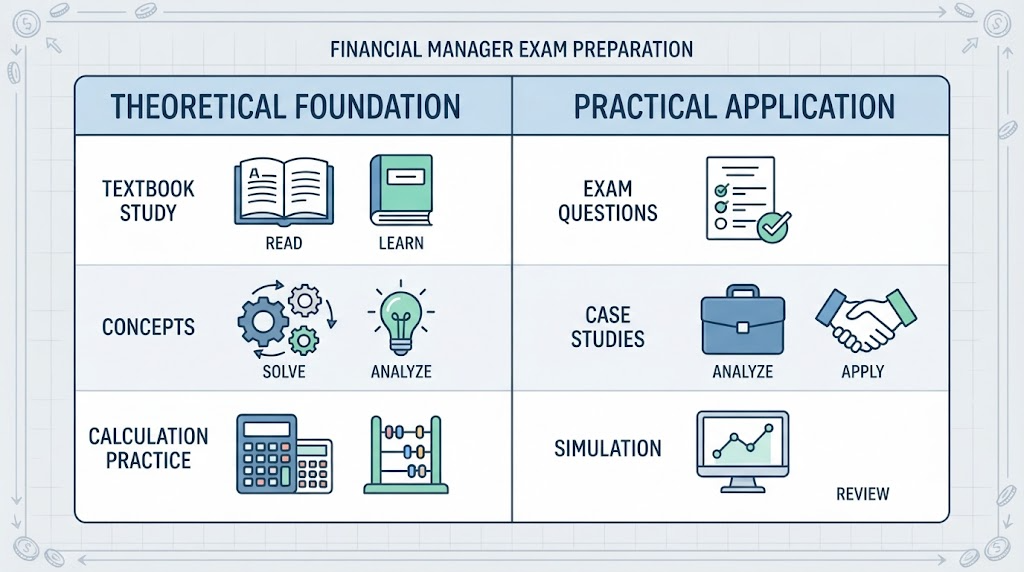
Because the Financial Manager exam requires digesting extensive theory and practical calculation problems at the same time, it is difficult to reach the passing range by blindly reading a thick book from cover to cover. To efficiently raise your scores within a limited time, you must establish strategic study methods centered on core subjects with high examination weights.
We examine efficient learning strategies tailored to the characteristics of each subject and foolproof textbook selection guidelines.
- Core Study Strategy by Subject
Corporate Finance and Fund Management: The sense of grasping the flow of funds is important. Rather than simple memorization, focus on understanding the mechanism by which a company raises and operates funds. In particular, frequently appearing formulas such as financial ratio analysis or cost of capital calculation must be organized in your own notes and repeatedly mastered.
Investment Analysis and Valuation: This is an area where calculation problems are heavily weighted. Formulas for the time value of money, stock and bond evaluation models, etc., should not just be read over with your eyes, but solved directly by hand to increase your familiarity with using a calculator so you can reduce mistakes in actual practice.
Financial Statement Analysis and Accounting Practice: This is a subject where your score can be protected only when the basics of accounting principles are solid. Organically understanding the structures of the statement of financial position and income statement, and accurately mastering accounting treatment standards by account item are the shortcuts to high scores.
- Textbook Selection Tips to Call in a Pass
Check for the Reflection of Recently Revised Laws and Standards: Since tax laws or accounting standards frequently change in the finance and accounting fields, you must select the latest revised edition test-prep book of the most recent year.
Inclusion of Practice-Type Examples and Past Exams: Rather than textbooks where only theoretical explanations are listed long, you should choose a textbook abundantly featuring chapter-by-chapter review questions, practical mock exams, and detailed explanations so you can grasp exam trends quickly.
If thorough analysis by subject and proper textbook selection are backed up, even non-majors can cross the gate of passing within a short period.
Then, how should office workers living busy daily lives or non-majors lacking a base set up a study plan and continue self-study? We reveal specific know-how in the next step!

STEP 3. Efficient Study Plan and Self-Study Know-How for Non-Majors and Office Workers
[Subheading Body] STEP 3. Efficient Study Plan and Self-Study Know-How for Non-Majors and Office Workers
Because the Financial Manager exam handles professional knowledge, it may feel unfamiliar and burdensome to those who are not finance/accounting majors or office workers busy with work. However, if you grasp the examination trends and establish a realistic study plan tailored to your lifestyle, you can enjoy the joy of passing in a short period through self-study alone without the help of an academy.
We organize the efficient learning time distribution and self-study know-how that successful examinees who are non-majors and office workers unanimously talk about.
- Establishing a Weekday/Weekend Two-Track Study Plan
Utilizing ‘Commute and Niche Times’ During Busy Weekdays: On weekdays exhausted from overtime and work, rather than sitting at a desk for several hours unreasonably, maintain your touch by utilizing 30-minute to 1-hour niche times such as the subway commute or lunchtime to take theoretical lectures or lightly read core concept notes.
Immersing in ‘Focused Problem Solving’ During Relaxed Weekends: Devote about 3 to 4 hours entirely during weekend mornings or daytime to run a focused session where you solve financial management formulas and calculation problems by hand—which you familiarized your eyes with during the weekdays—and organize wrong answers.
- Self-Study Passing Know-How for Non-Majors and Beginners
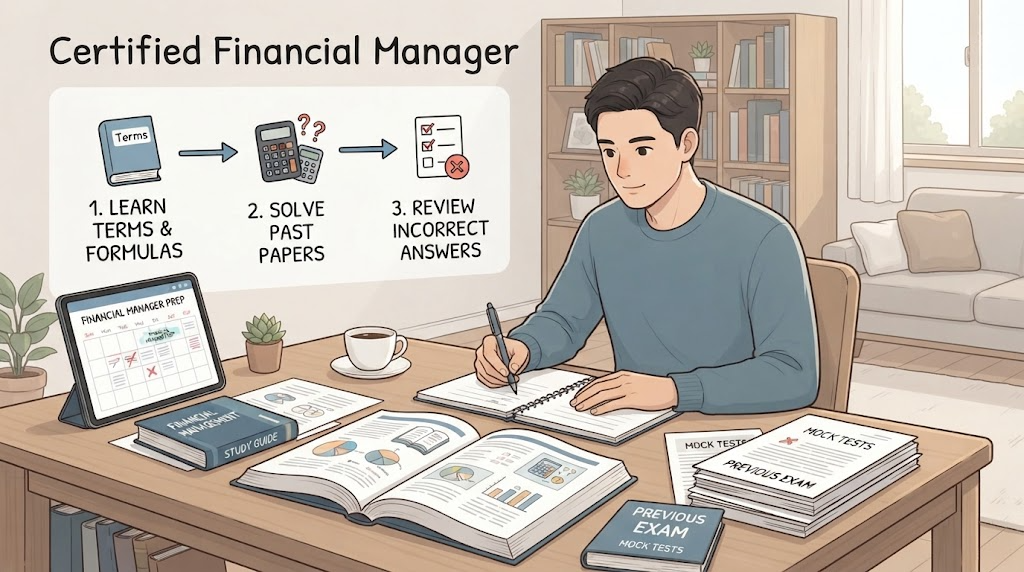
Conquering Terms and Basic Formulas First: Rather than stopping your progress to understand everything perfectly from the start, it is much faster to memorize frequently appearing financial accounting terms and basic formulas first, and then learn application methods while solving past exams.
Increasing the Number of Readings Centered on Wrong Answer Notes: Rather than thoroughly reading a thick basic book 3 to 4 times, reading a single textbook quickly about 2 times and then gathering only the pages you got wrong in past exams and mock tests for repeated review is the secret to raising your score most reliably.
If you make thorough time management and efficient study methods your weapons, non-majors can also proudly grasp the certification.
Then, let’s check in the final step how the hard-earned Financial Manager certification can be utilized 200% in actual employment, job changes, and field practice!
TIP. Employment, Job Change, and Practical Application Guide After Acquiring Certification
[Subheading Body] TIP. Employment, Job Change, and Practical Application Guide After Acquiring Certification
If you leave the Financial Manager certification, which you acquired with long effort, merely as a decorative item in a corner of your resume, or if you simply end up as a ‘certification collector’, you will not display even half of its true value. The true value of this certification shines only when it is used as a powerful weapon to prove your practical competence to corporate recruiters and appeal that you are an immediate force who can be deployed directly into the field.
We organize the core know-how to utilize it 200% in successful employment, job changes, and actual work sites after acquiring the certification.
- Strategy to Maximize Job Competencies in Resumes and Cover Letters
Appealing the Practical Relevance of the Certification: Rather than simply writing ‘Acquired Financial Manager’ in the resume certification section, you must specifically melt down how core competencies such as corporate finance, fundraising, investment analysis, and budget management learned while preparing for the certification can contribute to the applied job role (finance team, accounting team, planning and coordination office, etc.).
Emphasizing Project and Practical Understanding: If you mention financial statement analysis cases or fund operation simulation experiences covered during the certification study process in the ‘job performance plan’ or ‘growth process’ of your cover letter, you can leave a strong impression that you are talent equipped with practical sense rather than an applicant who only knows theory.
- Utilizing Certification Knowledge 200% in the Practical Field
Multi-dimensional Diagnosis of Financial Soundness and Fund Flows: When grasping the status of a company’s fund receipts and disbursements or managing short-term liquidity after joining a company or in a field department, you can propose rational alternatives based on the fundraising and capital structure optimization theories acquired during the certification acquisition process.
Smooth Communication and Collaboration with Other Departments: Finance and accounting knowledge is closely connected to all departments of a company, such as sales, planning, and marketing. Since you acquire the perspective to analyze profit and loss from a financial standpoint and examine cost efficiency, you can rapidly establish yourself as a core talent leading company growth from a company-wide perspective.
Acquiring a certification is not the end, but a solid starting line to newly begin your career as an expert.
I sincerely cheer that today’s post has become a precious stepping stone for you to leap your career to the next stage and achieve your desired goals through the Financial Manager certification.
If today’s content was helpful, please add as a neighbor and widely share it with friends preparing for employment or job changes around you! I always cheer for your shining career.
Additionally, if you need an integrated summary of the entire post or SEO metadata drafting, please feel free to let me know at any time!

Conclusion: Leaping into Corporate Core Talent Through Systematic Preparation
[Subheading Body] Conclusion: Leaping into Corporate Core Talent Through Systematic Preparation
So far, we have taken a step-by-step look at the basic overview of the Financial Manager certification, exam subjects and eligibility requirements, core study methods by subject to increase the passing rate, efficient study plans for non-majors and office workers, and employment, job change, and practical application guides.
Amidst a rapidly changing business environment, the value of professional financial personnel who soundly protect corporate funds and present strategic investment directions is increasing day by day. Rather than hesitating to take on the challenge with vague fear, if you establish a systematic plan starting today and prepare one by one, anyone can jump over the wall of being a non-major and be reborn as an expert in the finance field.
For successful certification acquisition and career leap, engrave the core points in your heart once again lastly!
📌 Strategic Approach by Subject: Raising practical sense by concurrently handling theory and calculation problems centering on core areas with high examination weights, such as corporate finance, investment analysis, and financial statement accounting
📌 Utilizing Niche Time and Self-Study: Consolidating concepts on weekdays by utilizing commute niche times, and achieving the goal of short-term passing without difficulty even as a non-majors through focused problem solving on weekends
📌 Appealing Practical-Linked Competencies: Not stopping at acquiring the certification, but specifically melting down field job relevance into resumes and cover letters to be reborn as core talent coveted by companies
The Financial Manager certification is not a mere piece of paper, but the surest weapon and solid stepping stone that will allow you to be recognized as a financial expert taking on a pivotal role in a company.
I sincerely cheer that today’s post has added conviction to your wavering challenge and served as a precious compass to achieve shining career growth.
If today’s content was helpful, please add as a neighbor and widely share it with colleagues or friends preparing for employment or job changes around you! I always sincerely cheer for your dazzling tomorrow.
Additionally, if you need an integrated summary of the entire post or SEO metadata drafting, please feel free to let me know at any time!
Korean version: 한국어로 읽기