Introduction: The Start of Moving Preparation, Why Does ‘Luggage Sorting’ Come First?
[Subtitle Body] Introduction: The Start of Moving Preparation, Why Does ‘Luggage Sorting’ Come First?
Moving to a new home begins with excitement, but once you actually open the box, a sense of overwhelm and fatigue is often what hits you first. It is easy to think that leaving everything to a packing moving company will make things convenient, but if you do not properly ‘sort your luggage’ before the move, you will encounter unexpected problems.
The very first issue you will experience is ‘cost.’ Moving costs are basically determined by the volume and weight of the moving items—in other words, the truck tonnage. If you end up taking items that should be discarded or useless clutter all the way to your new home, you will end up calling an unnecessarily large truck, causing your estimate to skyrocket.
In addition, the process of sorting luggage holds a meaning far beyond simply saving money.
Time and labor savings: On the day of the packed move, if items to discard and items to keep are mixed together, people run around in confusion on-site, which delays the moving time itself.
Interior efficiency in the new home: You must weed out unused items in advance so that you can make the most efficient use of storage space in your new home and begin a comfortable, minimalist interior design.
Mental management: It drastically reduces in advance the stress experienced from repeatedly packing and unpacking luggage.
Ultimately, the core of a successful and economical move is not packing skills, but the sorting work of wisely deciding ‘what to keep and what to throw away’ before the move.
Then, how should we weed out our luggage without regret and handle the large and small waste items that need to be discarded? From now on, let’s take a look one by one at smart luggage sorting and waste disposal tips for moving.
If there are any additional subheadings that need writing or revision, please feel free to let us know!

STEP 1. Basic Principles for Sorting Items to Keep and Items to Discard (Establishing Criteria)
[Subtitle Body] STEP 1. Basic Principles for Sorting Items to Keep and Items to Discard (Establishing Criteria)
The very first step and most difficult gateway of packing for a move is the moment of agonizing debate: ‘Should I throw this away, or should I keep it?’ If you hold it in your hand and hesitate for a long time, time flies by and the boxes just keep multiplying. For successful moving waste disposal, it is important to establish clear criteria rather than relying on emotions and to categorize them strictly.
Check out the 3 basic classification principles that help you make decisions without regret.
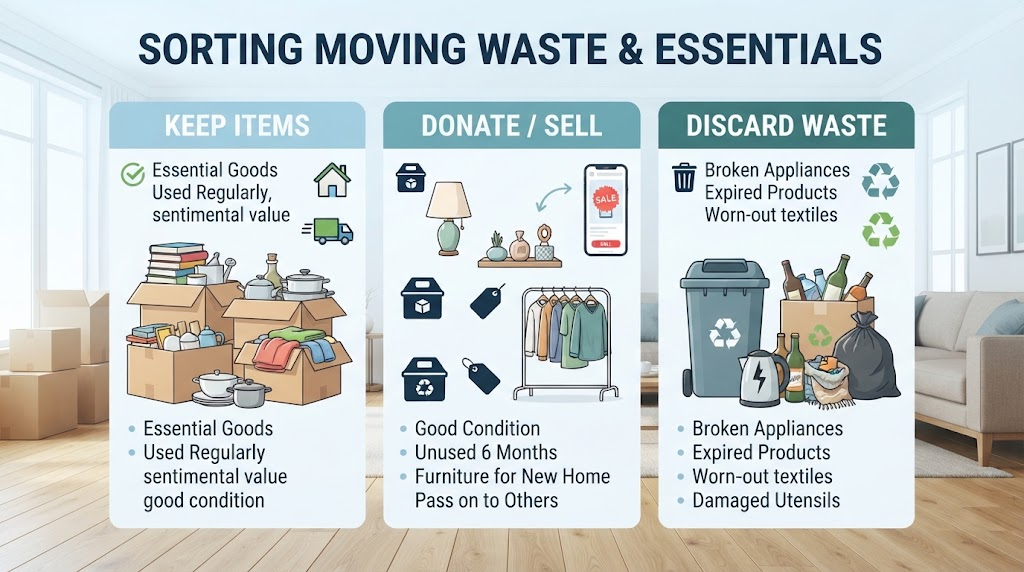
- Criterion A (Essential Retention): Items used within the past year or items with practical value
Judgment criteria: Have you used it directly with your own hands at least once per season over the past year?
Applicable items: Frequently worn clothing, daily-use home appliances and kitchenware, actually used furniture, etc.
Know-how: Even if you bought it expensively, if you haven’t looked for it at all over the past year, the probability that you won’t use it in the future is high. It is best to boldly move it to the exclusion list.
- Criterion B (Bold Discarding): Broken items, daily necessities past their expiration date, items neglected for years
Judgment criteria: Are these items that you tucked away in the corner of a box thinking ‘I’ll fix and use them someday’ or ‘I’ll find a use for them later’?
Applicable items: Broken small home appliances, old pots and tableware, cosmetics and detergents past their expiration date, torn or frayed bedding
Know-how: These items will only take up space even if you take them to your new home. They are the top priority targets to discard unconditionally before moving in order to save moving costs and storage space.
- Criterion C (Ambiguous Items): Clear judgment criteria for ‘troublesome items’
Judgment criteria: Troublesome items that feel too wasteful to throw away and too ambiguous to use
Application tips:
6-month rule: If you have no concrete plan to use them within the next half year, boldly dispose of them (sell on Danggeun Market or discard).
Substitutability: Dispose of furniture in advance that you think you won’t use when you go to the new home, and purchasing necessary furniture anew after the move will greatly increase your interior design satisfaction.
When sorting your luggage, if you create 3 boxes or zones ahead of time in one corner of the living room—[To Take / To Discard / Danggeun (Sharing/Selling)]—and sort into them, the work speed becomes much faster.
Now that your criteria are clear, next let’s look at specifically which items to weed out and how for each space!
STEP 2. Efficient Sorting and Processing Know-how by Space
[Subtitle Body] STEP 2. Efficient Sorting and Processing Know-how by Space
Once you have established overall classification criteria, it is now time to dive into full-scale luggage weeding for every nook and cranny of the house space by space. Since it is daunting to try to organize by looking at the whole thing vaguely, approaching it by breaking down the spaces in the order of kitchen, closet/bedroom, and living room/balcony is much more efficient.
Here are sorting and disposal know-hows by space that are easy to miss.
- Kitchen and Bathroom: Realistic Compromises for Tableware and Consumables
Dishes and pots: Boldly empty out cracked dishes, mismatched cups, and scratched coated pots that you collected thinking ‘I’ll use these when guests come someday.’ Narrow them down to mainly the main tableware that you frequently reach for in daily life.
Seasonings and ingredients: Condiments past their expiration date and ingredients frozen in mysterious conditions in the corner of the freezer are the shortcut to reducing the weight and volume of your luggage if you clear them all out before moving.
Bathroom supplies: Cosmetics received as samples that you don’t use, old towels, etc., become awkward luggage during a move, so categorize them in advance to use up for cleaning purposes or discard them.
- Closet and Bedroom: How to Organize Unworn Clothes and Frayed Bedding
3 principles of clothing classification: Clothes that you haven’t worn even once over the past 1 to 2 years have a 99% probability of not being worn even after going to the new home. Outdated clothes and clothes that do not fit your size should be placed in clothing collection bins or disposed of secondhand.
Bedding and curtains: Quilts with flattened cotton, contaminated pillow fillings, and curtains that fit only the window dimensions of your old home do not match the interior of your new home after moving, so boldly put them on the target list for disposal.
- Living Room and Balcony: Handling Books, Small Home Appliances, and Seasonal Items
Books and reference books: Complete book sets that children have finished reading, and test preparation books or major textbooks that haven’t been opened for years are huge culprits that increase moving costs due to their massive weight. Scan only the necessary pages, sell them to a secondhand bookstore, or discard them into a waste paper collection bin.
Small appliances and miscellaneous items: Broken multi-taps, old electric fans, and unused electronic devices that were sleeping inside boxes should be sorted out in advance according to large/small waste disposal standards.
Once you have finished sorting by space, the practical disposal method of how to discard these items legally and neatly becomes important. In the following content, we will look into proper waste disposal methods by category in detail!

STEP 3. Proper Disposal and Processing Methods for Items to Discard by Category
[Subtitle Body] STEP 3. Proper Disposal and Processing Methods for Items to Discard by Category
Now that you have finished sorting by space, it is time to properly dispose of the mountains of items to discard. If you illegally dump them thinking “I can just throw them away anywhere” or fail to sort them correctly, you might get hit with a hefty fine, so you must make sure to check the exact processing methods for each item category.
Here is a summary of legal and neat disposal know-hows by category.
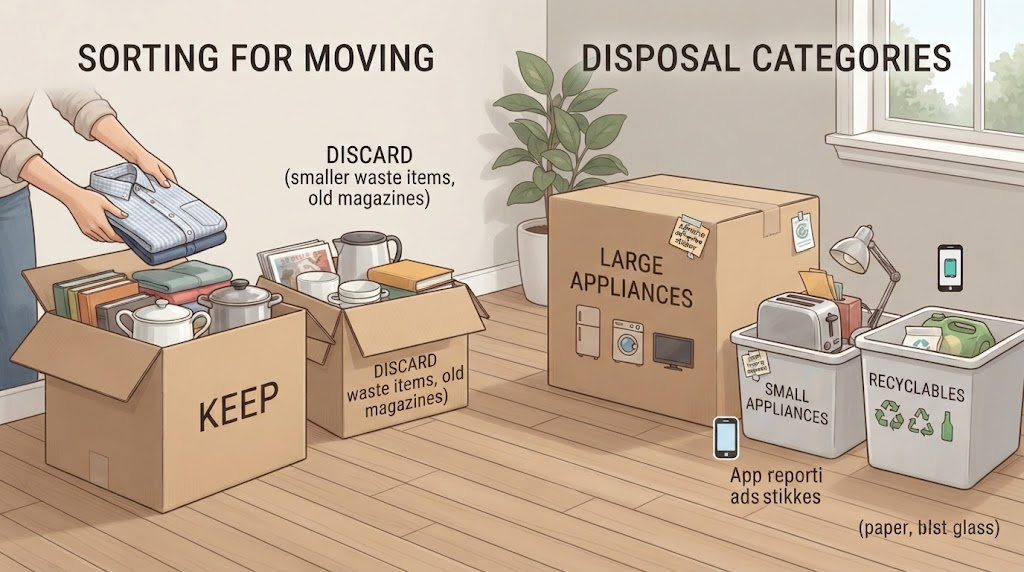
- Large Waste (Furniture such as wardrobes, mattresses, desks, etc.)
Reporting method: You must visit a community service center (administrative welfare center) or report the internet fee on the relevant local government district office website, then print and attach the payment certificate (sticker). Recently, convenient reporting services through smartphone apps are also widely utilized.
Precautions: If you fail to attach a sticker or illegally dump items, it may be regarded as illegal dumping and fines may be imposed, so make sure to observe the designated collection date and location when disposing.
- Small Home Appliances and Waste Appliances (Microwaves, electric fans, vacuum cleaners, etc.)
Utilizing free visit-for-collection: In the case of small home appliances, free visit-for-collection is available only if you gather 5 or more on your own, but when disposing of large home appliances like refrigerators and washing machines, they are collected free of charge together.
Community center small waste appliance collection bin: If you have 1 or 2 small home appliances, you can put them for free into the dedicated collection box set up in front of your residential administrative welfare center.
Large waste appliances: For refrigerators, TVs, washing machines, etc., using the ‘Waste Appliance Free Visiting Collection (E-Cycle)’ website or call center is most useful when moving because technicians will visit your home directly to collect them.
- Recyclables and General Waste (Small Miscellaneous Items, Clothing, Tableware)
Clothing and bedding: For clothes you do not wear, you can use the ‘clothing collection bin’ inside the apartment complex, or if you have a large amount, you can call a clothing collection company. However, since cotton quilts or heavily contaminated bedding often need to be put into general volume-based garbage bags to be discarded, check your local government standards.
Broken dishes and glass bottles: Wrap them in multiple layers of newspaper and place them safely into a general volume-based garbage bag, or if special gunny sacks (special standard-specification bags) for broken glass and ceramic products are sold, dispose of them according to the district office standards.
On a day already hectic with moving preparations, having waste disposal pile on top of it is bound to give you a headache. You must finish your disposal reservations and sticker printouts a few days before the move to prevent chaos on the moving day.
Next, let’s look into practical tips to save as much as possible on these heavy waste and moving costs!
TIP. Practical Tips to Save on Moving Waste Disposal Costs
[Subtitle Body] TIP. Practical Tips to Save on Moving Waste Disposal Costs
While preparing for a move, unexpected expenses such as furniture disposal costs, additional estimates from moving companies, and cleaning fees tend to snowball easily. In particular, costs for large waste stickers or ladder truck calls are points where you can save quite a bit if you pay just a little attention.
Here are 3 practical tips to protect your wallet and save on moving waste disposal costs!
- Comparing Moving Company Waste Collection Service vs. Professional Organizing Company
Additional collection by moving company: On the day of a packed move, people often ask the helpers or drivers to roughly dispose of unused furniture and garbage. While it has the advantage of being convenient on-site, depending on the company, they might demand excessive additional fees or the disposal method could be opaque.
Advantages of prior self-disposal: Attaching district office stickers a few days before the move to dispose of items in advance or using free collection services is much more cost-effective. On the moving day, you should leave only ‘the luggage you are truly taking’ to reduce the moving truck tonnage and save on your estimate.
- Offsetting Disposal Costs Through Danggeun Market and Secondhand Trading
Home appliances or furniture that feel ‘too wasteful to throw away and too ambiguous to use’ should not be discarded right before the move; instead, try listing them on Danggeun Market or Joonggonara for free or at a low price starting 2 to 3 weeks prior to the move.
If you put them up for free sharing or at a low price, transactions are completed much faster than you might think. Since buyers come to pick them up directly, not only do you save on large waste sticker costs, but you also get the dual benefit of earning a small amount of moving funds.
- Utilizing Separate Disposal and Small Appliance Collection Services 200%
For large home appliances that you would otherwise have to pay to discard, unconditionally use the ‘Waste Appliance Free Visiting Collection (E-Cycle)’. Because a technician will come directly into your home on the designated date to collect them, it costs absolutely nothing.
It is wise to thoroughly block unnecessary expenses by gathering small home appliances (electric fans, vacuum cleaners, etc.) and utilizing free collection services or using dedicated collection bins provided by local governments.
With just a little effort and prior preparation, you can save hundreds of thousands of won on moving costs. Check things carefully and wrap up your moving preparations frugally!

Conclusion: Moving Preparation Checklist for a Neat New Beginning
[Subtitle Body] Conclusion: Moving Preparation Checklist for a Neat New Beginning
Up to this point, we have looked together at how to wisely sort items to discard and items to keep, along with tips on how to neatly process them by category.
Moving goes beyond simply transferring physical space; it is an important process of wrapping up past times and preparing for a new start. Moving preparation that once felt daunting—finally, organize it at a glance through the D-Day practical checklist!
📌 Successful Moving Waste & Luggage Sorting Checklist
D-30 ~ D-20 (Prior Sorting and Disposal Period)
[ ] Go through the entire house and figure out luggage by space (kitchen, closet, balcony)
[ ] Upload reusable items among unused home appliances and furniture to Danggeun Market / secondhand trading
[ ] Pre-book ‘Waste Appliance Free Visiting Collection’ for large appliances
D-10 ~ D-5 (Full-scale Emptying and Reporting)
[ ] Boldly weed out items, clothing, and bedding unused for a year
[ ] Print and attach the payment certificate (sticker) after reporting large waste online at the district office
[ ] Complete separate disposal of small appliances and miscellaneous items
D-Day (Day of New Beginning)
[ ] Load only the essential meat-and-potatoes luggage you will truly take to save on moving costs
[ ] Start a comfortable daily life in your new home with a light heart!
Merely practicing ’emptying’ and ‘sorting’ before packing your luggage blindly can reduce moving stress and costs by more than half. Referring to the tips shared today, I hope you completely clear out unnecessary luggage and welcome a pleasant new start with a light heart.
Rooting for your successful move!
Korean version: 한국어로 읽기