Introduction: How Much Should I Deposit Every Month to Maximize My Benefits?
Launched to help young people build a solid asset foundation, the ‘Youth Leap Account’ has established itself as an essential financial tech course thanks to government-matched contributions and tax-exempt interest income benefits for faithful monthly savings. With continuous reviews from people around us who walked away with tens of millions of won in a lump sum upon the 5-year maturity, it continues to receive passionate attention.
“Would it be better to just put in 400,000 won according to my disposable funds every month, or is it more profitable to fill it up to the maximum limit of 700,000 won?”
“How much exactly will the government contribution and final refund differ depending on the amount I pay every month?”
Anyone who is about to sign up for the Youth Leap Account or is already making payments has likely had these thoughts at least once. The core key to maximizing the benefits of the Youth Leap Account is none other than ‘setting the optimal monthly deposit amount according to your income level and circumstances’.
Rather than recklessly forcing the maximum amount, you can reap practical benefits only by carefully examining the government contribution matching ratio and your personal financial situation. So, how will the government contribution change by monthly deposit amount, and how much will the payout and refund at maturity differ? Let’s take a detailed look one by one from now on!

Core Summary of the Youth Leap Account Structure: The Principles of Government Contributions and Tax Exemption Benefits
Before fully comparing refunds and payouts by deposit amount, it is important to accurately understand the framework of how the Youth Leap Account builds assets. The reason why the Youth Leap Account has a decisive difference from general savings products and boasts explosive returns is largely thanks to two core mechanisms.
“Based on what criteria are the contributions subsidized by the government paid, and how big of a benefit will the interest income tax exemption be to me?”
We will easily summarize the core structure of the Youth Leap Account, which can feel complex, down to the essentials.
- The Core of Matching Synergy, The Principle of ‘Government Contributions’
The Youth Leap Account has a structure where the government additionally accumulates a certain percentage of contributions in proportion to the amount deposited by the subscriber every month.
Differential Payment by Income Bracket: Depending on the personal income level (based on total salary), the ratio and limit of contributions matched by the government differ. The lower the income, the higher the matching ratio applied, strongly supporting asset building for low-income youth.
Monthly Deposit Limit and Contribution Limit: You can deposit up to 700,000 won per month, and government contributions are also matched and accumulated within a set maximum limit according to the income bracket (e.g., around a maximum of 21,000 won to 24,000 won per month, etc.). In other words, the total scale of support funds received from the state varies depending on how much you deposit every month.
- ‘Interest Income Tax Exemption’ Benefit Maximizing Returns
If you sign up for a general commercial bank savings product and receive interest, you must pay 15.4% (including resident tax) of the interest income as tax. However, for the Youth Leap Account, if conditions are met, such interest income tax is fully exempted (tax-exempt).
Combination with Compound Interest Effect: Because no tax empathy occurs at all on interest grown at high interest rates during a long accumulation period of 5 years, an overwhelming difference occurs compared to general savings in the actual take-home pay you hold in your hands upon maturity.
Refund and Tax-Saving Effect: Since money that would have practically leaked out as tax remains intact in your account, you can enjoy powerful benefits equivalent to receiving indirect refunds and reductions.
Understanding the matching structure of government contributions and the principle of interest income tax exemption in this way makes you realize how important of a variable the monthly deposit amount is in determining the final asset scale beyond simple savings. Then, how specifically will government contributions and benefits change depending on the deposit amount, such as 400,000 won, 500,000 won, or 700,000 won per month? Let’s compare in detail in the next step!
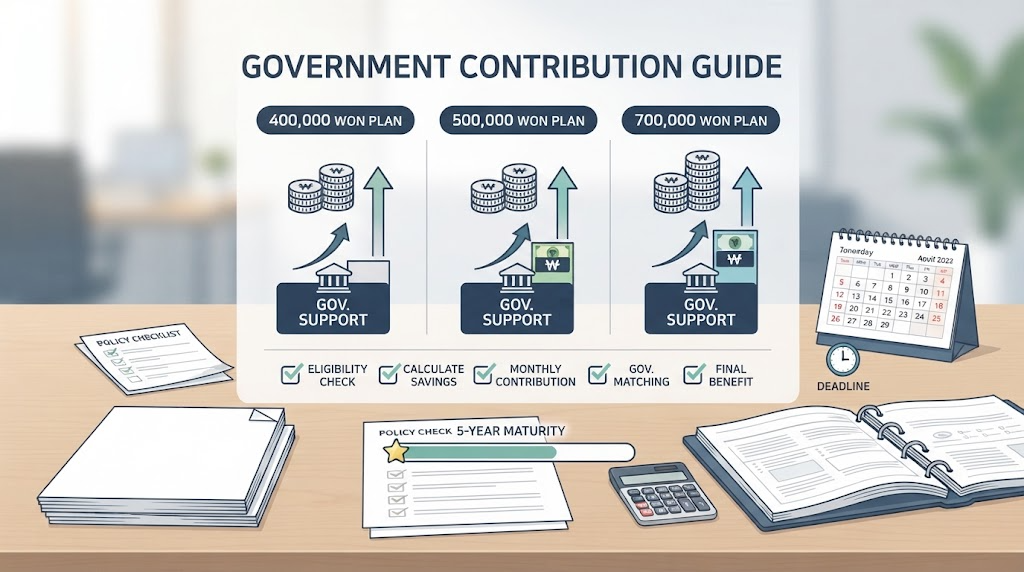
Analysis of Government Contribution Matching Structure by Monthly Deposit Amount (400,000 Won, 500,000 Won, 700,000 Won)
To maximize the benefits of the Youth Leap Account, it is essential to understand the structure of how the contributions supported by the government are precisely matched according to your income bracket and monthly deposit amount.
“When putting in 400,000 won per month versus putting in 700,000 won which is the maximum limit, what specific differences occur in the government contribution and total accumulated amount?”
To help you weigh your wallet circumstances and future asset formation goals, we will analyze in detail the government contribution matching structure and characteristics by major monthly deposit amount bracket (400,000 won, 500,000 won, and 700,000 won).
- When Depositing 400,000 Won Per Month: Practical Type for Lowering Burden and Securing Substance
This is a bracket frequently chosen as an alternative by early-career workers or those who have many fixed expenses every month and find it burdensome to deposit the full 700,000 won.
Government Contribution Matching Characteristics: A certain percentage of contributions is matched according to the income bracket, but since the deposit amount itself is 400,000 won, the scale of contribution receipt compared to the maximum limit is somewhat reduced.
Pros and Cons Analysis: While there is little burden in taking a breather every month and steadily building savings habits, a sense of regret may remain in terms of final payouts and government support benefits upon 5-year maturity compared to maximum depositors.
- When Depositing 500,000 Won Per Month: Compromise Type Balancing Efficiency and Balance
This is a bracket chosen by many young subscribers as a realistic compromise considering the balance between budget and benefits.
Government Contribution Matching Characteristics: It serves as a baseline where the government contribution payment limit or matching efficiency is flexibly applied across a significant number of income brackets.
Pros and Cons Analysis: While escaping the pressure of the maximum amount of 700,000 won, you can secure government contributions and interest benefits above a certain level, making high long-term sustainability its greatest advantage.
- When Depositing 700,000 Won Per Month: Maximum Limit Type Maximizing Benefits
This is the maximum monthly deposit limit allowed by the Youth Leap Account, representing the bracket that can boost benefits most powerfully.
Government Contribution Matching Characteristics: You can fully receive the government contributions supported by the state up to the statutory maximum limit every month, and as the scale of principal and contributions grows, the size of compound interest is also maximized.
Pros and Cons Analysis: Since you must fixedly inject 700,000 won every month for 5 years, high savings capacity is required, but the scale of the lump sum received at maturity and the economic effect of refunds (combining tax exemption and contributions) are overwhelming.
In this way, the size of the support funds received from the state and the asset scale of the lump sum held in your hands 5 years later completely change depending on the monthly deposit amount. Then, when these differences in deposit amounts and interest rate conditions interlock, how much will the actual payout and refund at maturity specifically differ? Let’s check through simulation comparison in the next step!

Simulation Comparison of Maturity Payouts and Refunds Based on Interest Rates and Deposit Amounts
As examined earlier, the monthly deposit amount (400,000 won, 500,000 won, 700,000 won) and whether or not preferential interest rates by bank are applied are decisive factors that completely change the digits in your bank account balance 5 years later.
“Then, how much of a difference will there actually be in the total payout you hold in your hands upon the 5-year maturity depending on how much you deposit every month and what interest rate is applied?”
For those who do not get a good feel from theoretical explanations alone, let’s clearly check the difference through simulation comparisons based on deposit amounts and interest rate conditions.
- Comparison of Estimated 5-Year Principal, Interest, and Contribution Scale by Monthly Deposit Amount
When Depositing 400,000 Won Per Month: If you faithfully accumulate principal for 5 years (60 months), a total of 24 million won in principal alone accumulates, and when combined with government contributions by income bracket and bank interest (base to preferential interest rates), it forms a lump sum of around 26 million won to 27 million won.
When Depositing 500,000 Won Per Month: The total deposited principal increases to 30 million won, and with the proportionally increased government contributions and compound interest effect added, you can expect a payout of around 33 million won to over 34 million won at maturity.
When Depositing 700,000 Won Per Month (Maximum Limit): You save a total of 42 million won in principal for 5 years, and the maximum-limit government contributions supported by the state and the maximum interest rate compound effect combine explosively, returning as a huge lump sum with a final payout reaching around 50 million won (including interest and contributions).
- Perceived Effect According to Interest Rate Fluctuations (Base Interest Rate vs. Maximum Preferential Interest Rate)
When Only the Base Interest Rate is Applied: Even if you faithfully deposit the full 700,000 won every month, if you miss preferential conditions such as card performance or salary transfer and are only applied the base interest rate, a loss of hundreds of thousands of won or more occurs in the 5-year cumulative interest income, reducing satisfaction with the final payout.
When the Maximum Interest Rate (100% Fulfillment of Preferential Conditions) is Applied: When a difference of around 1.0% per annum in preferential interest rates interlocks with compounding during the 5-year accumulation period, not only does simple interest increase, but tax reduction effects according to tax-exempt benefits are also added, maximizing the actual refund and payout value.
Increasing the deposit amount and meticulously taking care of preferential interest rate conditions in this way is the most powerful weapon that goes beyond simple savings to determine the speed of asset growth 5 years later. Then, what specific deposit strategy should you establish to maximize the effectiveness of refunds and benefits according to your income bracket and economic circumstances? Let’s find out in detail in the next step!
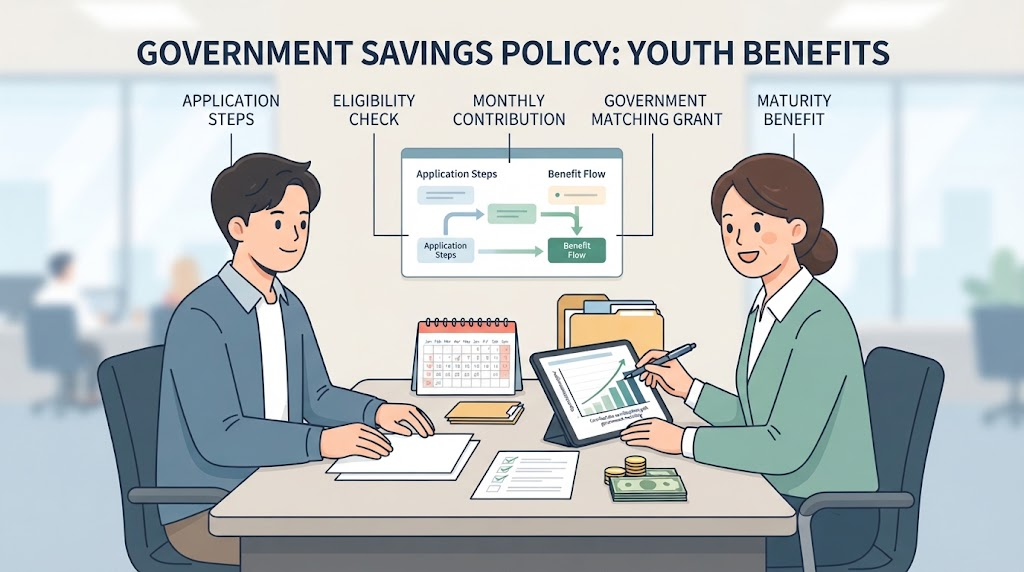
Optimal Deposit Strategy to Enhance the Effectiveness of Refunds by Income Bracket
To make the benefits of the Youth Leap Account fully your own, rather than blindly insisting on the maximum amount of 700,000 won, it is most important to coolly analyze your income bracket and monthly cash flow, and then establish a customized deposit strategy.
“At my income level, how much should I deposit every month as the wisest way to maximize the efficiency of government contributions and tax-exempt benefits?”
To ensure you do not experience the risk of early termination due to excessive deposits or, conversely, miss out on support funds by depositing too little, we will organize effective and optimal deposit strategies by income bracket.
- Low-Income Bracket (Eligible for Preferential Government Contribution Matching Ratio): ‘Maximum Limit All-In Strategy’
This is an income bracket where your total salary is relatively low, allowing you to receive the highest matching ratio and contribution benefits from the government.
Strategy Point: If circumstances permit, it is absolutely advantageous to actively fill the maximum monthly deposit limit of 700,000 won. Because this is the bracket where the government’s matching support funds come in most thickly, the higher you raise the deposit amount, the more the scale of support funds subsidized by the state and the tax-exempt compound interest effect will multiply.
Practical Tip: By checking fixed expenses, creating leeway in housing or living costs, and setting up an automatic transfer before the monthly deposit date, you should aim to 100% receive the benefits given by the state without missing a single penny.
- General Income Bracket (Targeting Median Income and Above Standard Median Income): ‘Flexibility and Budget Balance Strategy’
This is a general income bracket where the amount of 700,000 won per month places no small burden on living expenses, which can easily leave you feeling breathless.
Strategy Point: You must guard against the worst-case scenario where, if you stubbornly insist on 700,000 won and terminate the account midway, you lose both tax-exempt benefits and government contributions. It is wise to set the 500,000 won mark, which is a realistically sustainable amount, as a baseline, or to adjust it flexibly according to your monthly fixed income.
Practical Tip: Since the Youth Leap Account operates on a flexible contribution method, you should make completing the 5-year maturity your top priority while managing it flexibly, such as utilizing additional deposits in months with spare cash and maintaining the basic deposit amount in months with heavy spending.
- Core Know-Hows Common to All Income Brackets
Actively Utilizing the Deposit Amount Change System: When the year changes after joining or income fluctuations occur, you can greatly alleviate the burden by utilizing the system that allows you to flexibly readjust your monthly deposit limit according to your financial situation.
Maximizing Tax-Exempt Refund Effects: Interest income tax exemption has a greater perceived tax-saving (refund) effect when income is higher and the total interest amount is larger. Therefore, the core is to grow the interest pie by faithfully filling the deposit period as much as possible within the limits allowed by your income bracket.
If you establish an optimal deposit strategy suited to your income level and continue saving steadily like this, you can catch two birds with one stone: a lump sum and a refund 5 years later. Then, what maintenance know-hows must you know to safely protect the Youth Leap Account you started with such effort for 5 years without giving up midway? Let’s find out in detail in the next step!

Practical Maintenance Know-Hows to Prevent Early Termination or Non-Payment During Deposits
No matter how favorably you figure out your income bracket and establish a large-scale deposit plan every month, if you terminate early or fail to make payments due to unexpected expenditures or cash crunches during the long span of 5 years, the government contributions and tax-exempt benefits accumulated up to that point will all come to nothing.
“What things must we watch out for so that we can complete the race to the end without running out of breath during a long 5-year marathon?”
We will organize practical maintenance know-hows that thoroughly block the risk of quitting midway and allow you to safely protect your Youth Leap Account without hassle in daily life.
- Strategic Matching of Automatic Transfer Date and Payday
Prevention of Non-Payment Due to Insufficient Balance: If you deposit manually every month or if an automatic transfer fails due to an insufficient balance, the deposit performance for that month is not recognized, which creates a hitch in calculating contributions.
Setup Tip: Fix your automatic transfer date to the exact day right after your salary comes in. You must set it up so that money is transferred directly to the Youth Leap Account without any time to linger in your account, which can fundamentally block the temptation to spend and prevent non-payment accidents.
- Flexible Fund Management Utilizing the Flexible Deposit Method
Unlike general savings accounts where you must forcibly fill a certain amount every month, the Youth Leap Account operates by partially complementing the characteristics of a flexible deposit method.
Coexistence with Emergency Funds: If your living expenses for the month fall drastically short due to sudden hospital bills, family events, moving, etc., you need the wisdom to flexibly adjust your deposit conditions for that month rather than recklessly putting in the maximum amount.
Completion is Top Priority: Even if you cannot perfectly fill 700,000 won, continuing to make deposits flexibly rather than terminating the account and keeping the completion title of 5-year maturity is unconditionally advantageous from an asset formation perspective.
- Understanding Special Early Termination Conditions in Advance
Inevitable major events are bound to occur as you live life. When unavoidable situations arise for subscribers, the Youth Leap Account has safety devices in place that apply special early termination conditions, allowing you to be partially recognized for government contributions and tax-exempt benefits even upon early termination.
Applicable Reasons: Subscriber’s death, overseas migration, marriage, childbirth, retirement, business closure, housing purchase after 3 years or more have elapsed since initial subscription, etc.
Pre-awareness Effect: If you are already well-versed in these special early termination conditions, you can prevent the mistake of breaking the account early out of vague anxiety and defend your benefits even in crisis situations.
If you quietly endure 5 years based on such automatic transfer routines, flexible fund management, and an understanding of safety devices, a huge lump sum you never expected and a solid refund bonus will accumulate intact in your bank account balance. Let’s look at how we should put a period to the utilization of the Youth Leap Account for successful asset formation in the final step!
Conclusion: Suggestions for Utilizing the Youth Leap Account for Successful Asset Formation
So far, we have carefully examined everything about the Youth Leap Account, from the government contribution matching structure by monthly deposit amount to simulations based on interest rate conditions, and practical maintenance know-how to complete the 5-year marathon.
“The time of 5 years is long if long and short if short, but the savings habits faithfully built up every month become a powerful asset that will completely change your future life.”
Rather than being overwhelmed by rumors around you or unreasonable maximum deposit amounts, it is most important to set a monthly deposit amount appropriate to your income level and realistic cash flow, and to meticulously take care of preferential interest rate conditions. Although money leaving your bank account every month may feel like no small burden, the huge lump sum and refund returning with heavy government contributions and interest income tax-exempt benefits added 5 years later will pleasantly reward your efforts so far.
Going beyond a simple bank account that just saves money, the Youth Leap Account is the surest stepping stone for early-career workers and youth to achieve their first economic independence with their own strength. Based on the core strategies and know-hows we checked today, we sincerely cheer you on to proudly take your first step toward your precious asset formation right now!
Korean version: 한국어로 읽기