
Introduction: EITC Regular Application, What Should Single-Household Persons Check First?
This is the draft body for the first section of the Naver blog post: [Introduction: EITC Regular Application, What Should Single-Household Persons Check First?]. It is written in a friendly yet informative tone suited for a blog sensibility.
- Introduction: EITC Regular Application, What Should Single-Household Persons Check First?
Whenever May comes around, there is a keyword that heats up among office workers and small business owners. It is none other than the “Earned Income Tax Credit Regular Application,” a government subsidy that supports the livelihood stability of hardworking low-income earners.
Especially for single-person households living alone and making a living—that is, “single-household” youth and office workers—the Earned Income Tax Credit can be a precious lump sum like rain in a drought.
However, every application period, there are truly many people who have these worries.
“Will I, living alone, be included as a target?”
“Is my annual salary a bit higher than the standard?”
“Can part-timers or freelancers also apply?”
The Earned Income Tax Credit sets income criteria and payment amounts completely differently depending on household member composition (single, single-earner, dual-income). Therefore, for a single-person household, accurately grasping the “single-household criteria” without getting confused with other household types is the very first gateway that separates approval from rejection.
In this post, we will easily point out the annual total income criteria and core eligibility requirements that single-household applicants find most confusing. We hope you check carefully and do not miss out on this year’s precious grant benefits!
2026 Earned Income Tax Credit Single-Household Basic Concepts and Definition
This is the draft body for the second section of the Naver blog post: [2026 Earned Income Tax Credit Single-Household Basic Concepts and Definition]. We have easily organized the accurate definition and concept of a single household in accordance with the latest 2026 criteria.
- 2026 Earned Income Tax Credit Single-Household Basic Concepts and Definition
The very first thing you must check when applying for the Earned Income Tax Credit is “which household type does our home belong to?” The National Tax Service applies criteria by dividing households into single households, single-earner households, and dual-income households depending on the composition of household members.
Then, as of 2026, what are the accurate criteria and definition of a “single household”?
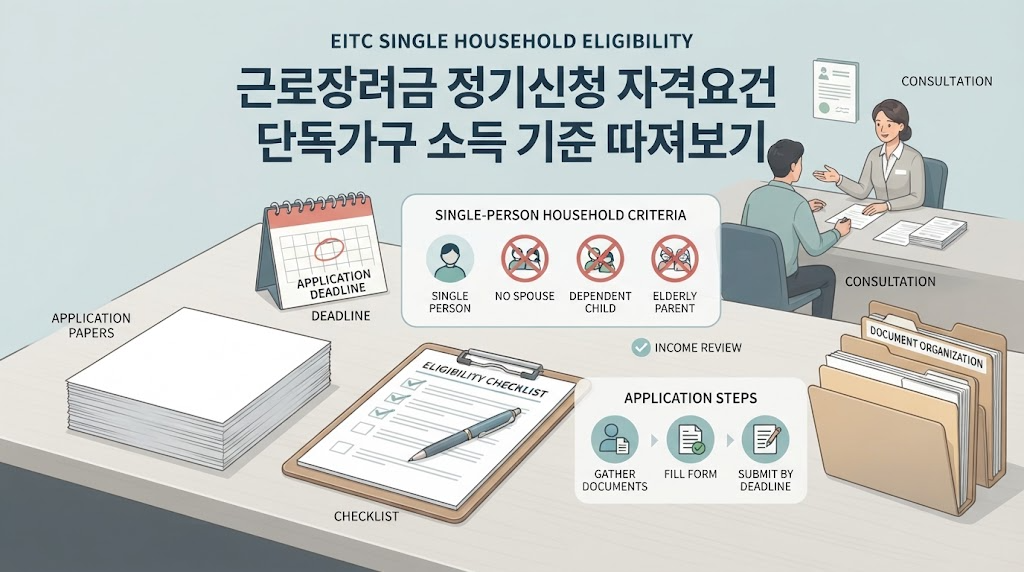
👤 Accurate Criteria for a Single Household
Core Definition: It means a single-person household with no spouse, no dependent children, and no lineal ascendants aged 70 or older.
In other words, those who make a living alone and constitute an independent household on the resident registration certificate correspond to representative single households.
🏠 Even If There Is a Co-resident on the Resident Registration Certificate, Is It a Single Household?
Questions may arise if you live in a sharehouse with a friend or acquaintance to save on monthly rent, or if there is a co-resident whose resident registration is together in a studio apartment building.
To tell you the conclusion first, even if there is someone living together on the resident registration, if that person is not your legal spouse, dependent child, or lineal ascendant aged 70 or older, they are often recognized as an independent household (single household) in many cases.
However, since the National Tax Service thoroughly checks during the screening process depending on the relationship between the head of household and household members and whether actual living expenses are separated and used, it is good to accurately check the household composition on the resident registration in advance.
💡 Blog Writing Tip:
Within the overall Earned Income Tax Credit system, income criteria and maximum payment amounts are established for single households in accordance with the characteristics of single-person households. If you have solidly understood the basic concepts, in the next section, we will specifically figure out the annual total income threshold for single households that readers are most curious about!

Core Requirement ①: Single-Household Annual Total Income Criteria and Calculation Method
This is the draft body for the third section of the Naver blog post: [Core Requirement ①: Single-Household Annual Total Income Criteria and Calculation Method]. We have clearly organized the income threshold amount and calculation scope that readers are most curious about.
- Core Requirement ①: Single-Household Annual Total Income Criteria and Calculation Method
The gateway that single-household applicants must check with the most nervous heart is none other than the “annual total income criteria.” This is because even if you are working hard to earn money, if you exceed a certain income threshold set by the state, you are regrettably excluded from eligibility.
Based on 2026, let’s carefully dissect the income requirements and calculation methods for single households.
📊 Single-Household Annual Total Income Threshold Amount
Income Upper Limit: In the case of a single household, application is possible only if the total income is less than the total income threshold amount based on 1 person, not combined for a couple.
In accordance with recent tax law revisions and policy standards, single-household income criteria have been gradually raised upward, and you must satisfy an income bracket of roughly less than 22 million KRW per year (※ Essential to check Hometax announcements as it may change according to accurate official notice criteria).
This criterion is based on the sum of all income earned over the course of a year (total income), not “monthly income.”
🔍 Income Scope Included When Calculating Total Income
During Earned Income Tax Credit screenings, not only the monthly salary received from the company but also various forms of income are all summed up.
- Earned Income: Salaries, bonuses, etc. received from the workplace (based on total salary amount)
- Business Income: Income reflecting the industry-specific adjustment rates for freelancers, 3.3% business income earners, and individual business operators
- Religious Person Income: Income received by religious-related workers
- Other Income and Interest, Dividend, and Pension Income: If there is financial income or pensions above a certain standard, they may be summed up together.
💡 Practical Tip (Attention Freelancers and Part-Timers!):
Not only office workers but also those who have income in the form of 3.3% withholding tax, such as delivery agency workers, tutors, freelancers, and short-term part-timers, can apply for the Earned Income Tax Credit matching single-household criteria if their income is properly reported to the National Tax Service.
💡 Core Summary Point:
Checking in advance on the National Tax Service Hometax whether the total income you earned this year (or based on the immediately preceding year’s attribution) exceeds the single-household threshold amount is the most accurate.
In the next section, we will examine in detail another important condition that can hold you back even if you pass the income criteria: the “household member property criteria”!
Core Requirement ②: Household Member Total Property and Housing/Vehicle Criteria
This is the draft body for the fourth section of the Naver blog post: [Core Requirement ②: Household Member Total Property and Housing/Vehicle Criteria]. We have neatly organized the core content so that you won’t get eliminated based on property criteria even if you pass the income criteria.
- Core Requirement ②: Household Member Total Property and Housing/Vehicle Criteria
“Your annual salary fits the criteria perfectly, but you got disqualified because of the money saved in your bank account or a small house (or jeonse deposit)?”
What is viewed as importantly as income in the Earned Income Tax Credit screening is none other than the “property criteria.” Even if you worked hard and satisfied the income requirements, if the total property held by household members exceeds the standard, unfortunately, you cannot receive the grant.
Shall we carefully dissect the property criteria for all household members, including single households?
💰 Household Member Total Property Threshold and Differential Payment
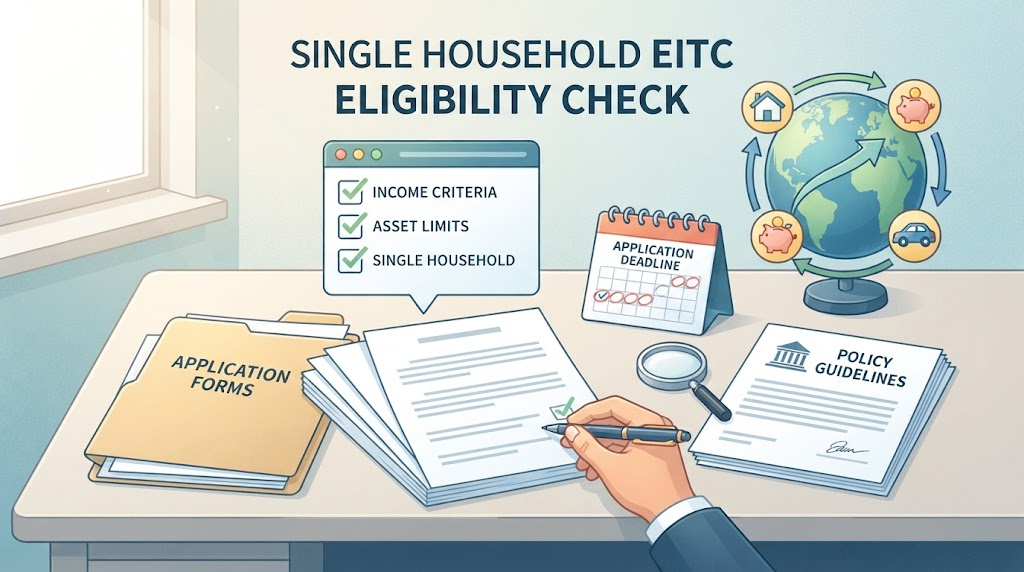
Threshold Amount: The total property sum held by all household members must be less than 200 million KRW.
Payment Reduction Criteria (140 million KRW to less than 200 million KRW):
If the total property sum falls in the bracket of 140 million KRW or more and less than 200 million KRW, application is possible, but 50% of the calculated Earned Income Tax Credit payment amount is reduced (deducted) and paid.
In other words, you must definitely remember that if your property exceeds 140 million KRW, the grant amount you can receive is cut in half.
Elimination Criteria (200 million KRW or more): If the total property sum is 200 million KRW or more, no matter how perfectly you satisfy the income criteria, you are finally excluded from the Earned Income Tax Credit payment targets.
🏠 Items Included in Property Calculation and Evaluation Method
The National Tax Service screens by summing up not only simply cash but also various properties such as real estate, vehicles, and financial assets.
- Housing, Land, and Buildings: The value of real estate is evaluated based on the standard market price (officially assessed land price, etc.). (In the case of a jeonse deposit, the simplified lease deposit evaluation method is applied)
- Passenger Cars (Automobiles): Passenger cars are reflected based on the standard market price (vehicle value), and even if it is a vehicle for business or livelihood, it is included in the criteria, so caution is required if you own an expensive vehicle.
- Financial Assets and Debts: They are summed up based on net property, which is financial assets such as deposits, installment savings, stocks, and bonds minus debts such as loan amounts.
💡 Core Checkpoint:
The net property—obtained by subtracting debts from the total amount of deposits, key money, and installment savings/deposits of the house you live in—must be less than 140 million KRW for you to secure 100% of your grant without reduction!
Since all names of the entire household members are summed up when calculating property criteria, please check the property status under family names in advance before applying.
In the upcoming final section, we will summarize the practical action plan and concluding guide for successful application based on today’s content!

Conclusion: Practical Action Plan for Successful Earned Income Tax Credit Regular Application
This is the draft body for the fifth and final section of the Naver blog post: [Conclusion: Practical Action Plan for Successful Earned Income Tax Credit Regular Application]. It has been written to cleanly conclude the posting while encouraging practical actions from readers.
- Conclusion: Practical Action Plan for Successful Earned Income Tax Credit Regular Application
So far, we have meticulously examined everything single-household individuals preparing for the 2026 Earned Income Tax Credit regular application need to know—from the essential basic concepts to the annual total income criteria and the easily missed property criteria.
For single-person household youth and office workers who diligently fill their days by working hard, the Earned Income Tax Credit is a truly welcome government subsidy. Finally, we will summarize a practical action plan for a successful application!
📌 3-Step Action Plan for Successful Application
- Pre-qualification Inquiry:
Log in to the National Tax Service Hometax official website or mobile app ‘Sontax’ and perform a preliminary calculation through the [Earned/Child Tax Credit Simple Application / Pre-inquiry] menu to see if your income and property requirements are met.
- Check Application Notice (Notice Recipient):
If you have received a notice from the National Tax Service via KakaoTalkalimtalk or mail, you can easily and quickly complete your application by utilizing the individual verification number written inside.
- Strictly Observe the Regular Application Period:
If you miss the regular application period every May, you have to move on to ‘late application’ where benefits are reduced, so completing your submission within the period is definitely the safest.
💡 Closing Remarks
Did the Earned Income Tax Credit conditions, which felt only complicated, become a bit clearer regarding whether you are a target after carefully examining them together with today’s post? We sincerely encourage you not to miss out on precious lump sum benefits through small interest and checking, and to make sure to claim them!
If today’s posting was helpful, please [Add Neighbor] and leave [Sympathy & Comments], and we will come back next time with more useful and substantive living policy information. Thank you!
Korean version: 한국어로 읽기