Introduction: Why Beotimmok Jeonse Loan ‘Refinancing’ Is Gaining Attention in the Era of High Interest Rates
Along with soaring prices and stubbornly high interest rates, the burden of housing costs fixedly leaving every month is coming as the biggest financial pressure to office workers, youth, and newlyweds. Especially among tenants using jeonse loans, the amount of interest paid every month has reached a level that is hard to bear, to the point where people say “interest is scarier than monthly rent.”
Among tenants hit by this interest bomb, the breakthrough that has recently been receiving the most passionate attention is ‘Beotimmok Jeonse Loan Refinancing (Switching).’
While jeonse loan interest rates at regular commercial banks fluctuate around 4% to 6% per annum and crush household economies, the ‘Beotimmok Jeonse Loan,’ a government-supported jeonse loan supported by the Housing and Urban Fund, provides an unprecedentedly low interest rate of around the 2% range.
“Are you exhausted by the high interest of commercial banks?”
“Do you want to lower your interest even a little if you meet the conditions?”
‘Refinancing,’ which switches an existing jeonse loan received from a regular bank to a low-interest Beotimmok product, is considered the most realistic and powerful financial management tool and housing cost reduction method that dramatically slashes tens of thousands of won in monthly interest costs.
However, if you rush to apply for refinancing without thinking, you are likely to face failure due to strict income and asset requirements and housing price limitations. Let’s now examine in detail one by one whether I am qualified to switch to the Beotimmok Jeonse Loan and what criteria must be carefully checked to fully enjoy the interest rate reduction benefits.

What Is Beotimmok Jeonse Loan Refinancing? (Basic Concept Organization)
You often hear the term “jeonse loan refinancing” in media or around you, but the concept of how it is actually executed can feel unfamiliar.
Simply defined, ‘Refinancing (Replacement Loan)’ means liquidating (repaying) an existing jeonse loan received at a regular interest rate from a commercial bank and newly switching to a more advantageous low-interest loan product that fits your conditions.
The ‘Beotimmok Jeonse Loan’ referred to here is a representative government-supported jeonse loan product supported by the Housing and Urban Fund for the housing stability of homeless commoners. Because it receives an interest rate vastly lower than that of commercial banks, if you utilize this to refinance (convert) an existing loan, your housing cost burden will be reduced in the following structure.
- Existing Loan Repayment and Conversion Structure
When a tenant who satisfies the Beotimmok refinancing requirements applies for refinancing to a bank, the existing jeonse loan balance in use is repaid in a lump sum using the fund loan. Thereafter, a new Beotimmok jeonse loan agreement with the Housing and Urban Fund is newly executed using the remaining jeonse deposit return claim as collateral.
- Dramatic reduction in monthly interest costs
When regular commercial bank jeonse loan interest rates are around 4% to 5% per annum, the Beotimmok Jeonse Loan allows you to apply interest rates in the 2% range (from the late 1% to mid-2% at the lowest) depending on your income level and household type. For example, if you are utilizing a 200 million won jeonse loan and the interest rate drops from 4.5% to 2.5%, your monthly interest payment will decrease by hundreds of thousands of won, allowing you to save millions of won in cash annually.
💡 Differences Between General Jeonse Loan Switching and Government-Supported Refinancing
Recently, ‘jeonse loan refinancing infrastructure (switching service)’ to lower interest rates among commercial banks has become active, but this usually involves switching to another product from a regular commercial bank. On the other hand, since ‘Beotimmok Jeonse Loan Refinancing’ switches to the Housing and Urban Fund resources operated by the state, you can enjoy unprecedentedly radical interest rate reduction benefits that cannot be compared to commercial bank products.
However, as the benefits are large, the threshold for target qualifications (homeless householder, income and asset criteria, target housing scale, etc.) is set much stricter than commercial bank loans.
Then, what conditions must be perfectly satisfied to become the protagonist of this amazing interest rate reduction benefit? Let’s carefully examine the core requirements one by one in the next section.
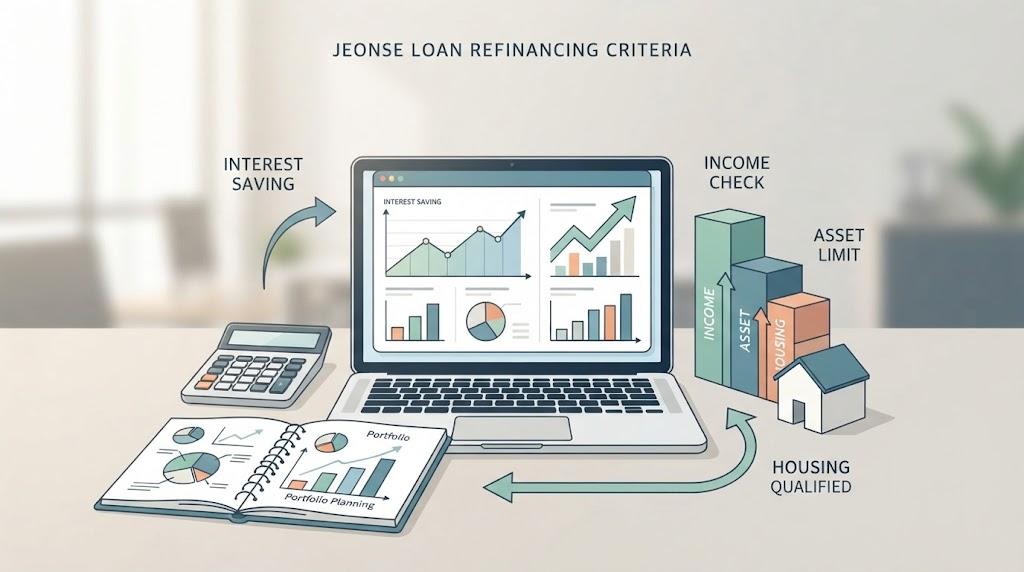
Complete Summary of Main Conditions and Eligibility Requirements for Beotimmok Jeonse Loan Refinancing
While the point that switching to the Beotimmok Jeonse Loan can drastically reduce interest is attractive, because it is a government-supported product operated with national funds, the threshold of qualification requirements to be fulfilled is quite specific and strict.
Before applying, you must carefully compare whether your household perfectly conforms to the following 4 core requirements (housing, income, assets, lease deposit).
- Housing Requirements (Target Housing Area and Scale)
Housing area: The dedicated area of the housing to be leased must be 85 square meters (㎡) or less. (However, up to 100 square meters or less is allowed in eup and myeon regions)
Residential officetels: Residential officetels are also included in the target if they satisfy the requirement of an exclusive area of 85 square meters or less.
- Income Requirements (Annual Total Income Criteria)
Since Beotimmok refinancing is basically a system for commoner and homeless households, there is an upper limit on the combined annual income of the household.
General households: Annual total income of 50 million won or less
Preferred households (newlywed couples, first-time homebuyers, workers at public institutions relocated to innovative cities, migrants from other regions, etc.): Criteria are relaxed and applied to an annual total income of 60 million won to 70 million won or less.
- Asset Requirements (Latest 2026 Criteria)
The item evaluated as strictly as income is the total asset scale of all household members.
Asset criteria: Total assets combined among household members must be 345 million won or less.
Included assets: Real estate, automobiles, financial assets, general assets, etc., are all aggregated, and debts are not deducted from this property sum and are evaluated based on the total asset value, so you must thoroughly check your asset details in advance before applying.
- Target Housing Lease Deposit Limit
The deposit amount itself for the housing where Beotimmok refinancing will be processed is also limited to a certain level or below.
Metropolitan area (Seoul, Gyeonggi, Incheon): 300 million won or less
Local regions (non-metropolitan areas): 200 million won or less
(However, for newlywed couples or households with 2 or more children, the limit is raised and applied to 400 million won or less in the metropolitan area / 300 million won or less in local regions.)
⚠️ Prerequisite Condition for Refinancing Application: “Existing Loan Status”
In addition to eligibility requirements, technical prerequisite conditions must be met to proceed with refinancing.
Usually, it is smoothest to attempt switching when a certain period has passed since receiving the existing jeonse loan (usually the contract renewal timing or the timing when early repayment fees occur), or in accordance with the timing of renewing (re-signing) the lease agreement.
If even a single one of the above requirements exceeds the criteria, the fund loan approval will be rejected, so before full-scale document preparation, please be sure to first check your income certificate and asset details.

Additional Preferential Interest Rate Application Conditions to Maximize Interest Rate Reduction Benefits
Even with just the base interest rate of the Beotimmok Jeonse Loan itself, it is tearfully cheap compared to commercial bank loans, but if you overlap this with ‘additional preferential interest rate’ benefits, you can lower the interest rate down to the bottom.
National fund products generously open up additional interest rate reduction benefits for diligently living youth, newlywed couples, and socially vulnerable groups. Carefully check what preferential conditions your household can additionally secure.
- Preferential Interest Rate for First-Time Homebuyers, Youth, and Newlywed Couples
Youth and newlywed couples: If you are a youth household, a newlywed couple within 7 years of marriage, or an expecting newlywed couple, you can receive additional interest rate reduction benefits through exclusive products in addition to the basic Beotimmok product.
First-time homebuyer households: If all household members are ‘first-time’ households with no history of owning a home in the past, the scope of preferential interest rate benefits becomes even wider.
- Preferences for Housing Stability Monthly Rent and Electronic Contract Execution
Execution of real estate electronic contracts: When executing a real estate electronic contract through the Ministry of Land, Infrastructure and Transport’s systems or actual transaction price systems and entering into a lease agreement, an additional interest rate reduction benefit of 0.1%p per annum is given. Although small, it is worth utilizing effectively for interest savings on a total loan amount exceeding 100 million won.
Multi-child households and housing-vulnerable groups:
Households with 2 children: 0.3%p preference per annum
Multi-child households with 3 or more children: Radical preference of 0.5%p per annum
Disabled persons, single-parent households, multicultural households: Preferential interest rates for socially vulnerable groups are applied overlapping or independently to significantly ease the interest burden.
💡 Points to Note When Applying Preferential Interest Rates (Lowest Interest Rate Baseline)
As preferential interest rates are repeatedly stacked overlappingly, people sometimes joke, “Won’t the interest become 0 or even negative?”
However, no matter how many preferential conditions are satisfied for Housing and Urban Fund loans, a final lowest interest rate baseline (usually around 1.0% to 1.5% per annum) that can be applied is fixed. Therefore, even if the interest rate calculated based on your conditions drops below this baseline, the statutory lowest interest rate will ultimately be applied and executed.
If you were suffering from the high interest of existing commercial bank loans, we hope you carefully check what preferential interest rate conditions you are missing and maximize your interest rate benefits!

Refinancing Application Procedure and Essential Documents Complete Guide
If you have carefully checked the Beotimmok jeonse loan refinancing requirements and preferential interest rate benefits, it is now time to move on to the most important practical stage: preparing the application procedure and essential documents.
Unlike regular commercial bank products, government-supported fund loans have a few more steps to go through, so you must prepare step by step in order not to waste your effort. We have organized the complete guide for successful refinancing.
[Step 1] Prior Consultation with Existing Loan Bank and Beotimmok Handling Bank
- Check existing loan: First inquire whether an early repayment fee occurs on the commercial bank jeonse loan you are currently using, and when it is most advantageous to repay upon refinancing.
- Visit handling bank: Beotimmok jeonse loans are handled by major commercial banks such as Woori, Kookmin, NH Nonghyup, Shinhan, Hana, Busan, and Daegu Bank. Before visiting, contact your main transaction bank or a branch that mainly deals with fund loans to test in advance whether refinancing is smoothly possible under your conditions.
[Step 2] Fund e-Ddeun Preliminary Application (Online Reception)
- Access the Housing and Urban Fund portal ‘Fund e-Ddeun (enuri.hug.or.kr)’ website or mobile application.
- After logging in with a joint certificate or similar, proceed with the Beotimmok jeonse loan (refinancing) preliminary application under the [Loan Application] ➡️ [Housing Jeonse Fund Loan] menu.
- This is the gateway you must pass through first because you must receive an ‘eligible’ judgment in the online screening before you can submit documents to the bank and move on to the full-scale screening stage.
[Step 3] Complete Preparation of Essential Documents and Bank Visit Reception
After the Fund e-Ddeun preliminary application, visit a bank branch to submit the final documents. Since documents must usually be issued within the last 1 month, you need to prepare them matching the timing well.
ID card and resident registration copy/extract: Extract including address change history for the past 5 years, family relationship certificate, etc.
Lease-related documents:
Original actual lease (jeonse) contract with a confirmed date stamp
Down payment receipt (proof of paying 5% or more of the deposit)
Certified copy of the leased property building register (including deleted items)
Income and asset proof documents:
Earned income earner: Income amount certificate, withholding receipt, etc.
Business income earner: Income amount certificate, copy of business registration certificate, etc.
If jobless: Non-income fact certificate, etc.
Existing loan-related documents: Liability certificate for the general jeonse loan currently in use or virtual account confirmation for loan repayment, etc.
💡 Practical Tips to Remember Before Visiting the Bank
Refinancing loans have more complex documents and processes to review from the bank practitioner’s standpoint than general new loans. Therefore, when visiting the trustee bank branch guided by text message after completing the Fund e-Ddeun application, the safest and fastest shortcut is to precisely notify the person in charge that it is for the “purpose of refinancing switching from a general jeonse loan to Beotimmok” and check once more by phone whether there are any additional documents needed before visiting.

Conclusion: Precautions to Check Before Applying for Refinancing
So far, we have examined in detail the ‘Beotimmok Jeonse Loan refinancing conditions and interest rate reduction benefit criteria’ that can dramatically lower the interest burden in the era of high interest rates.
For tenants struggling with the high interest rates of commercial banks, the Housing and Urban Fund’s Beotimmok refinancing is undoubtedly a truly precious relief pitcher that reduces fixed costs leaving every month and gives breathing room to household finances. However, if you rush blindly thinking, “The interest rate is low, so I must switch unconditionally!”, you may end up in trouble due to unexpected costs or administrative errors.
Before making a final decision to apply for refinancing, we have summarized the precautions that must be checked last.
- Calculate the ‘net profit (profit and loss)’ between the early repayment fee and interest savings
When terminating and repaying an existing commercial bank jeonse loan mid-way, an early repayment fee (typically around 0.5% to 1.5%) may occur depending on the remaining loan period and agreement.
If the one-off cost incurred by this fee is greater than the annual interest cost that can be saved through Beotimmok refinancing, there may actually be no immediate net profit. Therefore, it is wise to proceed after carefully comparing the fee cost and the interest to be saved through interest rate reduction.
- Coordinate the lease contract renewal schedule and loan execution timing
Refinancing loans are not executed anytime you want, but usually proceed smoothly in accordance with the timing of renewing (re-signing) the lease agreement or the loan handling deadline.
Since some cooperation from the landlord (such as checking the deposit return account) is also necessary, if the contract renewal schedule is left too tight or communication with the landlord is not smooth, you must adjust the schedule with plenty of time in advance.
- Check the base date for income and asset requirements once more
As emphasized earlier, the household combined annual income (50 million won or less for general, 60 million won to 70 million won or less when preferential treatment is applied) and total asset criteria (345 million won or less) are absolute yardstones dividing the qualifications of the screening party.
If you narrowly crossed the income threshold due to a recent promotion or salary increase, you may fail the screening, so you must gauge your accurate standard income in advance through the recent income amount certificate.
💡 Thorough Preparation Makes Successful Refinancing!
Because government-supported loans offer radical benefits, the screening process is strict and there are quite a few documents to prepare. However, if you run around carefully and prepare accordingly, it becomes the surest weapon to escape from the snowballing monthly interest burden and reliably protect your housing stability.
If you prepare step by step using the refinancing conditions, application tips, and precautions provided today as your compass, your household economy will gain significant breathing room along with a successful interest rate reduction. We sincerely cheer for the stable housing life and financial security of all of you who always live diligently!
Korean version: 한국어로 읽기